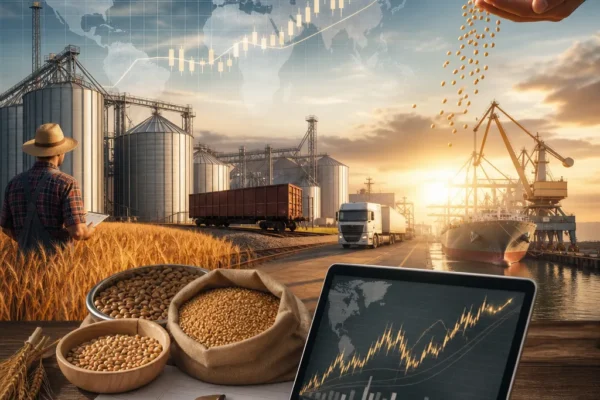
Grain Price Trends
Grain price trends are never just one number. The price shown on a futures exchange is a benchmark, while the price a farmer, feed mill, exporter, or processor actually pays or receives is usually a local cash price shaped by…
Grain price trends are never just one number. The price shown on a futures exchange is a benchmark, while the price a farmer, feed mill, exporter, or processor actually pays or receives is usually a local cash price shaped by…

“US grain prices today” usually refers to a set of linked markets rather than one single national price. In the United States, corn, soybeans, wheat, sorghum, oats, rice, and other grains are priced through a combination of futures markets, local…

Grain market prices are not a single number. The price a trader sees on a futures screen, the bid posted by a local elevator, and the delivered price paid by a mill or exporter can all differ at the same…
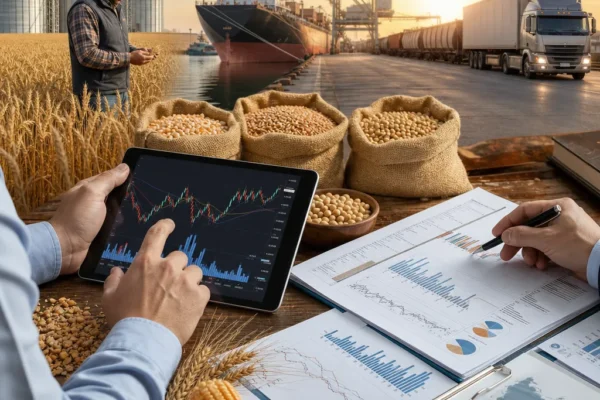
Grain prices today depend on which market you are looking at. A futures quote on an exchange such as CME Group is not the same as the cash price offered by a local elevator, feed mill, crusher, exporter, or rice…

The global grain industry relies on an intricate network of intermediaries who bridge the gap between farmers and end consumers. At the heart of this system, traders facilitate the smooth movement of commodities such as wheat, corn, barley and rice…
The global grain sector stands at a pivotal crossroads, where the demands of a growing population, shifting dietary patterns, and mounting climate pressures intersect. Ensuring reliable access to staple crops such as wheat, maize, rice, and barley hinges on forging…
In the intricate world of global agriculture, traders and analysts continuously seek opportunities to capitalize on price differentials across regions. Grain arbitrage represents a powerful strategy that leverages variations in market conditions, supply dynamics, and logistical factors to generate profit…
As the global economy navigates persistent price increases, the grain sector stands at the forefront of shifting cost structures and changing trade dynamics. From wheat and maize to rice and barley, staple crops underpin food security for billions, yet they…
The global grain market relies heavily on intricate logistics frameworks to move millions of tonnes of wheat, corn, barley, and other cereals across continents. In this article, we explore how cutting-edge strategies and solutions redefine export processes, ensuring seamless delivery…

The integration of blockchain technology into the grain market is transforming traditional contract management by introducing unprecedented levels of transparency, traceability, and efficiency. As global demand for grains like wheat, corn and barley continues to rise, supply chain participants seek…