




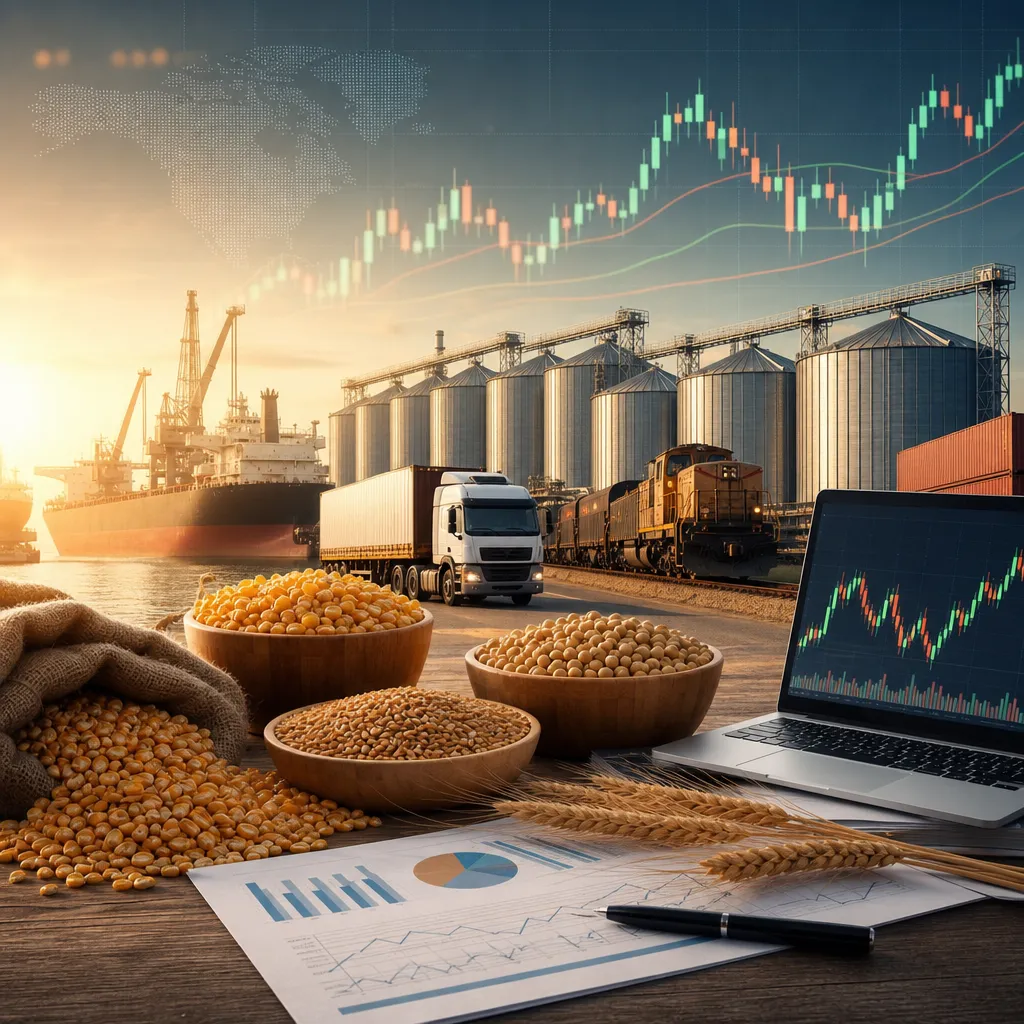
“US grain prices today” usually refers to a set of linked markets rather than one single national price. In the United States, corn, soybeans, wheat, sorghum, oats, rice, and other grains are priced through a combination of futures markets, local cash bids, processor demand, export bids, and transportation costs. That is why two farmers in different states can see very different cash prices on the same day even when the same benchmark futures contract is being watched nationwide. For anyone checking “today’s” price, the first step is to separate benchmark futures from the actual local cash market where grain is bought and sold physically.
The US grain market operates across major crop regions including the Corn Belt, Great Plains, Delta, and Pacific Northwest, with price discovery centered on exchange-traded futures and then translated into local bids. Prices are commonly quoted in US dollars per bushel in domestic farm and futures markets, while export business is often discussed in US dollars per metric ton or as FOB values at export locations. Chicago futures remain the main benchmark for many US grain prices, but local basis, quality, and freight often matter just as much as the board price.
What “US grain prices today” means in practice
In the United States, “grain prices” can mean several different things depending on who is asking. A farmer may mean the nearby cash bid at a local elevator. A merchant may mean a river, rail, or processor bid. An exporter may mean a Gulf or Pacific Northwest export value. A futures trader may mean the latest quote for a CME Group contract such as CBOT corn, soybeans, or wheat.
That distinction is essential because the US does not have one official national spot price for physical grain. Instead, there is a network of bids and offers shaped by geography, logistics, and demand. The same corn crop may be priced one way at a country elevator in Iowa, another way at an ethanol plant in Nebraska, and another way again at an export terminal connected to the Gulf.
| Price type | Where quoted | What it means |
|---|---|---|
| Futures price | CME Group futures market | Benchmark exchange price for a standardized contract, not the exact local farm-gate price |
| Cash bid | Elevator, cooperative, processor, feed mill, ethanol plant | Price a local buyer is willing to pay for physical grain at a specific location and quality |
| Basis | Local market quotation relative to futures | Difference between local cash price and the relevant futures contract |
| Delivered price | Buyer-specific contract | Price including delivery to a named destination such as a mill, feedlot, or processor |
| FOB export price | Export channel, often Gulf or PNW-related market reporting | Value of grain loaded or ready for loading at export point, before ocean freight |
| CIF import price | Overseas destination market | Price including cost, insurance, and freight to the importing market |
Where the US grain market operates
The United States is one of the world’s most important grain and oilseed producers, users, and exporters. Corn and soybeans are heavily concentrated in the Midwest and Corn Belt. Wheat is more geographically dispersed, with important production in the Great Plains, Northern Plains, and Pacific Northwest, while rice is more concentrated in the South and parts of California.
Physical grain markets operate through country elevators, farmer cooperatives, feed mills, flour mills, crushers, ethanol plants, livestock feeders, rail shippers, barge terminals, and export houses. Inland grain often moves by truck to local buyers, then by rail or barge toward processors or export channels. Key export-linked logistics include the Mississippi River system to the Gulf and rail corridors to the Pacific Northwest, although not every crop or region uses the same route.
US domestic prices are usually discussed in US dollars per bushel. Export values are often translated into dollars per metric ton because global buyers compare US grain with supplies from Brazil, Argentina, the Black Sea, Canada, Australia, and the European Union using internationally familiar units.
How US grain prices are formed
US grain prices are formed through an interaction between benchmark futures and local physical market conditions. For corn, soybeans, and several wheat classes, futures listed by CME Group provide a central reference that market participants watch throughout the trading day. But the local cash bid is built by adjusting that benchmark for basis.
Basis is the local cash price minus the relevant futures price, or the local premium/discount relative to futures. A strong basis can reflect tight nearby supplies, active processor demand, export competition, or expensive freight into the buyer’s location. A weak basis can reflect harvest pressure, large local stocks, poor transportation economics, or limited buyer competition.
Actual cash prices also depend on grain quality. Protein levels for wheat, test weight, moisture, damage, foreign material, and mycotoxin risk can affect what a buyer pays. Storage availability matters too. When harvest supplies are abundant and storage is tight, local bids may weaken even if futures are stable.
Currency still matters in the US market, especially for exports. Grain is priced in US dollars, so a stronger dollar can make US exports less competitive for foreign buyers, while a weaker dollar can improve export competitiveness. Freight costs also shape inland and export values, especially barge rates, rail availability, and truck costs.
| Price driver | Typical effect | Why it matters |
|---|---|---|
| Futures market moves | Changes benchmark price quickly | Sets the reference used by many cash buyers and hedgers |
| Local basis | Raises or lowers local cash bid relative to futures | Reflects local supply, demand, logistics, and competition |
| Weather and crop conditions | Can move futures and basis | Affects yield expectations, harvest pace, and quality |
| Export demand | Often supports export-linked regions and futures | Important for corn, soybeans, and wheat balance sheets |
| Domestic processor demand | Can strengthen nearby basis | Ethanol plants, soybean crushers, and mills compete for grain |
| Transportation costs | Widens or narrows local bids | Truck, rail, and barge economics affect net value back to origin |
Where to check US grain prices online
If you need “today’s” US grain price, the most reliable approach is to check the specific market layer you care about.
For benchmark futures, CME Group is the primary reference for CBOT corn, soybeans, soybean meal, soybean oil, wheat-related contracts, and other relevant grain and oilseed futures. These are exchange prices, useful for market direction and hedging, but they are not the same as a local physical bid.
For national market commentary, supply-demand indicators, export information, and selected price reporting, the US Department of Agriculture is essential. USDA publishes widely used reports through agencies such as the Agricultural Marketing Service, the National Agricultural Statistics Service, and the Foreign Agricultural Service. Market participants watch USDA for cash market reports, grain transportation information, export sales, production estimates, and crop progress data.
For local cash prices, farmers and commercial users usually check the websites or bid sheets of nearby elevators, cooperatives, processors, mills, and ethanol plants. Many buyers post current bids online or through mobile apps. Some regions also use state or regional market reporting services, but the most actionable price for a producer is often the bid from the buyer who can actually take delivery.
Brokerage platforms and market data services are also widely used for futures and options access, but they typically serve trading and risk management rather than replacing local physical grain merchandising.
How physical grain is actually bought and sold in the United States
Physical grain trade in the US usually begins with a producer selling to a nearby elevator, cooperative, processor, feed manufacturer, ethanol plant, crusher, or merchandiser. The transaction may be a spot sale for immediate delivery, a forward contract for future delivery, a basis contract, or another commercial arrangement depending on the buyer and region.
The buyer will specify delivery location, delivery window, quality standards, moisture limits, and payment terms. Grain is graded and weighed on receipt. Discounts may apply if the grain does not meet contract standards. Some buyers offer storage arrangements or delayed pricing, but these involve commercial and price risk that should be understood clearly before signing.
Large merchants and exporters assemble grain from many inland origins, hedge the futures exposure, and then move the grain into domestic consumption channels or export positions. A mill or feed company buying physical grain is focused on dependable supply and usable quality. A grain merchant may be focused on margins between origin, freight, hedge position, and destination bid.
Counterparty risk matters. Physical grain sales are not just about price; they also involve contract performance, grading, weights, settlement, and payment timing.
How futures and options are used for trading and hedging
Futures and options trading is different from owning or selling physical grain. In the US grain market, futures are standardized contracts traded on CME Group through a brokerage account. Users must post margin, manage mark-to-market risk, and understand that leverage can magnify both gains and losses.
Farmers, elevators, processors, exporters, and feed manufacturers use futures primarily to hedge price risk. For example, a grain elevator buying corn from farmers may sell corn futures to reduce exposure to a board price decline while it holds physical inventory. A feed buyer may use futures or options to protect against adverse price moves before physical purchases are completed.
Speculators also participate, providing liquidity, but they are not the same as physical grain merchants. Most futures positions are offset before delivery. Watching futures online does not mean someone is buying truckloads of grain, and selling physical grain to a local elevator does not require a producer to trade futures personally.
Options can help manage risk with more flexibility than straight futures, but they involve a cost and still require understanding of volatility, timing, and basis risk. Even a well-hedged futures position may not perfectly match the local cash market because basis can move independently.
US grain exports, imports, and why port markets matter
The United States is a major exporter of corn, soybeans, and wheat, so export channels play a major role in domestic price formation. Export demand can strengthen basis at river terminals, shuttle loaders, and coastal facilities, which then influences inland bids. The Gulf is especially important for grain moving through the Mississippi River system, while the Pacific Northwest is important for certain wheat and soybean flows and for Asian demand access.
Export prices may be discussed as FOB values, meaning the grain’s price at the export point before ocean freight. Importing countries often compare CIF landed values, which include freight and insurance to destination. Inland US farmers usually do not sell directly on an FOB export basis, but export values can still affect what country elevators are willing to bid after accounting for handling and transport.
The US also imports some grain and grain products in selected regions or qualities, but for many major commodities the bigger pricing story is how domestic supplies connect to world demand through export competition. When global buyers shift among origins, US prices can react even if local field conditions have not changed.
What to watch for the near-term price trend
No honest “today” article should pretend to know the next move with certainty. In the US grain market, the most practical way to think about price direction is through scenarios.
If weather threatens yield during the growing season, futures can rise quickly as production risk increases. If harvest turns out large and logistics remain smooth, local basis may weaken even if benchmark futures hold steady. If export demand improves because competing exporters face problems, US export-linked prices may strengthen. If domestic demand from crushers, mills, feeders, or ethanol plants slows, nearby bids can soften.
Key variables to watch include USDA acreage and production reports, weekly export sales, crop progress, seasonal harvest pressure, river conditions, rail service, biofuel demand, livestock feed demand, and the US dollar. For wheat, quality and class differences can be especially important. For soybeans, crush demand and export competitiveness are central. For corn, feed, ethanol, and export channels all matter.
Practical questions readers usually ask
Where can I check US grain prices today?
Check CME Group for benchmark futures prices and check your local elevator, cooperative, processor, or mill for actual cash bids. USDA market reporting is useful for broader price context and market conditions.
Is the CME or CBOT price the same as the price a farmer receives?
No. The exchange price is a benchmark futures quote. A farmer usually receives a local cash price that reflects futures plus or minus basis, as well as quality and delivery terms.
What unit are US grain prices usually quoted in?
Domestic grain and futures prices are commonly quoted in US dollars per bushel. Export markets often discuss values in US dollars per metric ton.
Why do cash prices differ between states or even nearby towns?
Local bids differ because of basis. Basis reflects freight, nearby supply, buyer competition, storage space, processor needs, export access, and regional logistics.
How is grain physically sold in the US?
Most physical grain is sold to elevators, cooperatives, processors, feed mills, ethanol plants, crushers, or merchants under spot or forward contracts with defined delivery and quality terms.
Can someone trade US grain prices online without buying physical grain?
Yes. Futures and options can be traded through a broker on CME Group markets, but that is financial exposure, not the same as owning or delivering physical grain.
What is the most important benchmark for US grain markets?
For many commodities, the main benchmark is CME Group futures, especially CBOT-linked corn, soybeans, and wheat contracts. Local physical prices are then built from that reference.
What are the biggest drivers of US grain prices right now in general?
The main drivers are usually weather, crop size expectations, export demand, domestic processor demand, logistics, currency movement, and USDA reports.
Sources
- US Department of Agriculture
- CME Group
- USDA Agricultural Marketing Service