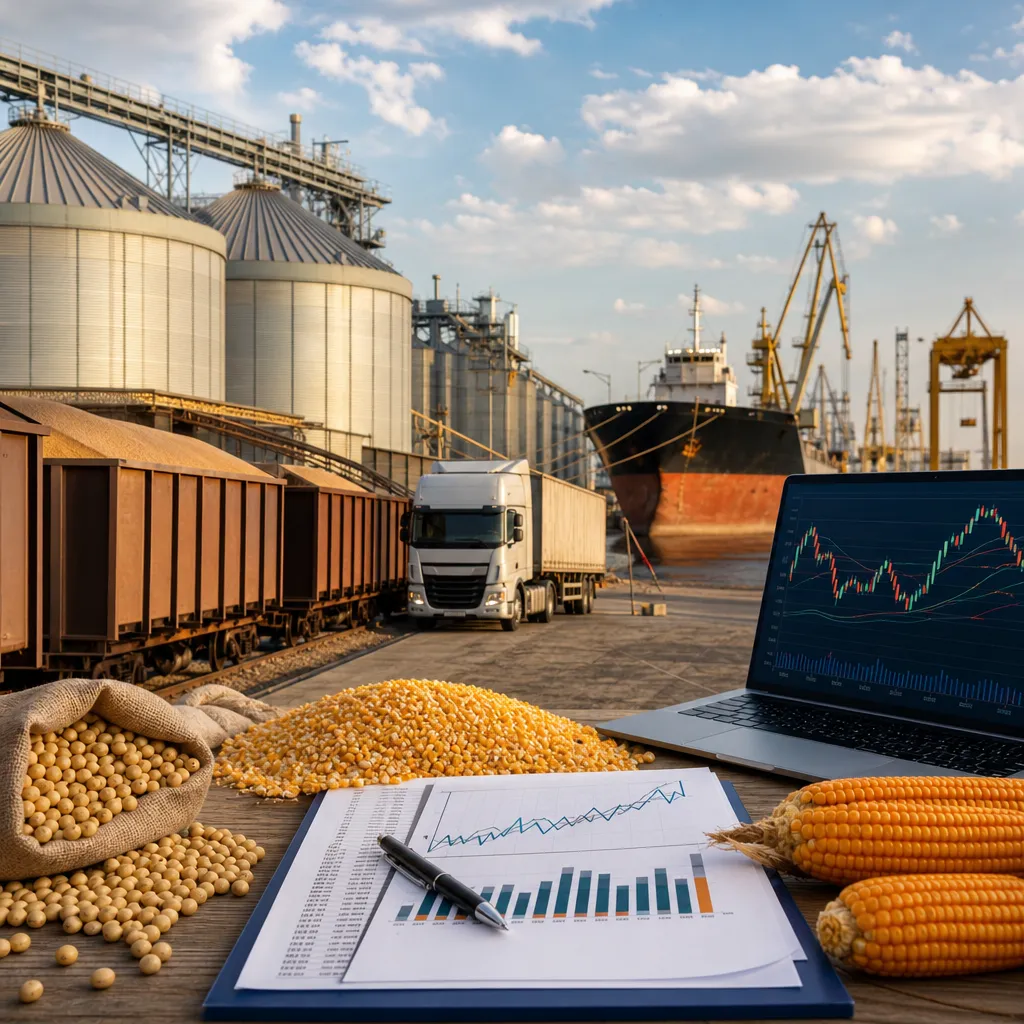








The EU barley import market is the physical and traded market through which barley is bought from non-EU origins and brought into the European Union for feed, malting, or processing use. It operates across the whole EU customs area, but the most practical market points are importing member states, major feed-consuming regions, and seaports that receive grain cargoes. Prices are usually discussed in euros per metric tonne, while international trade may also be quoted as FOB or CIF values depending on where ownership and freight are priced. In practice, the market links inland feed demand in Europe with global barley exporters, shipping routes, currency movements, and grain benchmarks used by merchants and risk managers.
Barley is not imported into the EU through a single exchange or one unified spot market screen. Instead, the market is a network of tenders, trader-to-trader deals, feed compounder purchases, maltster procurement, and merchant hedging activity. Readers looking for “the EU barley import price” should therefore think in terms of price references by location, quality, delivery basis, and timing rather than one universal number.
What the EU barley import market means
The European Union is both a major barley producer and, in some years or regions, an importer. That may seem contradictory, but it is normal in grain markets. Some EU member states produce surplus barley for export, while others may need imported barley because of local crop shortfalls, feed demand, quality needs, regional logistics, or price competitiveness versus other feed grains.
Imported barley into the EU is mainly relevant for:
- Feed use, especially when feed barley is competitive against wheat or corn.
- Malting use, where quality matters more than simple tonnage.
- Regional balancing, when one part of Europe has deficit demand despite adequate EU-wide supply.
- Trade arbitrage, if non-EU barley lands cheaper than alternative domestic or intra-EU supplies.
The market operates within EU import rules, sanitary and phytosanitary controls, customs procedures, and quality requirements set by buyers. Because the EU is a single customs union, imported grain can enter through one member state and move onward within the bloc, subject to commercial and logistical realities.
Where the market operates
Geographically, the EU barley import market is not limited to Brussels or any one port. It functions across importing destinations and entry points where feed mills, grain terminals, livestock regions, and maltsters create demand. Coastal locations matter because imported barley generally arrives by vessel, while inland regions matter because they determine the final delivered value.
In practical terms, the market is most visible in:
- EU seaports, where imported cargoes are offered on a CIF or delivered basis.
- Feed-consuming regions, where compounders compare barley with corn, wheat, and other feed ingredients.
- Malting supply chains, where buyers may seek specific quality from domestic or imported origins.
- Merchant trading desks, where import opportunities are evaluated against freight, currency, and substitute grains.
For barley entering the EU, the key commercial question is not simply the port arrival price. It is the landed and delivered cost into the final consumption zone compared with competing grains already available inside the EU.
| Market layer | Where it operates | What it represents | Typical users |
|---|---|---|---|
| Import market | EU ports and trader networks | Barley bought from non-EU origins for arrival into the EU | Importers, merchants, feed buyers, maltsters |
| Physical cash market | Inland depots, mills, consuming regions | Actual grain bought and sold for nearby or forward delivery | Farmers, cooperatives, merchants, processors |
| Benchmark futures market | Primarily Euronext grain futures for broad EU grain risk management | Reference for price discovery and hedging rather than a direct EU barley import quote | Traders, hedgers, brokers, commercial firms |
| International origin market | Exporting countries and FOB loading ports | The starting point for export offers to EU buyers | Exporters, global merchants, ship charterers |
How prices are formed
EU barley import prices are formed from several layers, not from one single quote. The starting point is usually the origin value in the exporting country. To that are added ocean freight, insurance where relevant, financing, port handling, customs-related costs, and the importer’s margin. Then the buyer compares that landed cost with domestic and intra-EU grain alternatives.
The main price concepts are:
- FOB price: the grain value at the export port, before ocean freight to the EU.
- CIF price: the cost including freight and insurance to the destination port.
- Delivered price: the price into the final user’s location, such as a feed mill or inland warehouse.
- Cash price: the physical market price for actual barley of a stated quality, location, and delivery period.
- Futures price: a standardized exchange-traded contract used for benchmarking and hedging, not the same as a local imported cargo price.
- Basis: the difference between a local physical price and a benchmark futures or reference market.
Barley import values into the EU can move even if a grain futures market is flat. That is because the local import price also reflects:
- export availability in origin countries,
- freight market changes,
- euro exchange-rate moves against other currencies,
- protein and screening quality,
- feed grain substitution with corn or wheat,
- buyer urgency and nearby coverage needs,
- port congestion or inland transport costs.
In most commercial situations, a buyer does not simply ask, “What is barley worth?” The better question is, “What is the cost of barley of this quality, delivered to this place, in this month, relative to competing feed ingredients?”
Which benchmarks matter
There is no dominant pan-European barley futures contract used the same way everywhere in the physical import trade. In Europe, grain professionals often watch broader feed grain benchmarks, especially Euronext wheat futures, because wheat is one of the main reference markets for feed grain valuation and risk management in the region. Corn markets and international Black Sea or global feed grain values may also influence import parity calculations.
That does not mean Euronext wheat futures equal the EU barley import price. It means they can help traders estimate direction, hedge some part of grain exposure, and compare barley against wheat in feed formulations. The physical barley market then trades at a premium or discount depending on local availability, quality, and logistics.
For importers and end users, the practical benchmark chain is often:
- international origin barley offer,
- freight to EU destination,
- landed parity versus local corn and feed wheat,
- delivered price into the consuming region,
- hedging reference, if used, through listed grain futures or OTC risk tools.
| Price type | Usually quoted where | What it tells you | Main limitation |
|---|---|---|---|
| Futures benchmark | Exchange screen | General market direction and hedging reference | Not a direct import cargo price |
| FOB offer | Exporter or merchant quote | Value at origin loading port | Excludes destination freight and inland delivery |
| CIF import offer | Port market or trader communication | Landed cost to destination port | Still may exclude inland haulage and some handling |
| Local delivered cash price | Mill, merchant, cooperative, or feed buyer | Actual buying price for specified delivery and quality | Highly location- and buyer-specific |
How barley is actually bought and sold into the EU
Physical grain trade into the EU is usually handled by commercial firms rather than by exchange delivery. A seller in an exporting country may offer barley to an international merchant, importer, feed manufacturer, or maltster. The deal can be negotiated directly, through brokers, or via trade tenders depending on the buyer and market practice.
A typical physical import chain may look like this:
- An EU buyer identifies demand for a delivery month and quality specification.
- Merchants collect offers from possible origins.
- The buyer compares FOB origins plus freight into a destination port.
- A cargo is booked on agreed contract terms covering quality, shipment period, payment, and discharge conditions.
- After arrival, the grain may move by truck, rail, barge, or short-sea route to the final consumer.
Key commercial details usually include:
- quality parameters such as moisture, screenings, test weight, and for malting barley additional specification requirements,
- shipment or arrival window,
- incoterms or delivery basis,
- weight and inspection method,
- payment timing,
- dispute and arbitration clauses,
- counterparty risk management.
For many EU feed users, imported barley is one option in a wider feed ration. If corn or feed wheat becomes cheaper on a delivered basis, barley demand may weaken. If barley offers better value or local supply is tight, imports become more attractive.
How importers and traders hedge price risk
Physical grain buying and futures trading are related but not identical. An EU importer that buys a barley cargo owns or controls physical grain risk. To manage price exposure, that company may hedge part of the position using exchange-traded grain futures or options through a broker, or use OTC contracts with commercial counterparties.
The two sides should be clearly separated:
Physical grain market
- Occurs between merchants, exporters, importers, feed mills, maltsters, cooperatives, and processors.
- Requires negotiation of quality, shipment, logistics, and payment.
- Results in actual grain movement and transfer of title.
Futures and options market
- Takes place on regulated exchanges through a brokerage account.
- Uses standardized contracts and margin requirements.
- Provides financial hedging or speculative exposure, usually without the trader taking physical barley into an EU warehouse.
An important practical risk is basis risk. A company may hedge using a broader grain futures contract, but the physical value of imported barley can still move differently because freight, quality, and local demand change independently from the hedge benchmark.
Where to check prices and market information online
Because there is no single live “EU barley import screen” for all users, market checking is a matter of combining official and commercial sources. For benchmark direction, many market participants monitor exchange prices and official grain reporting. For physical values, they rely on merchants, buyers, brokers, and specialized reporting services.
Useful places to check include:
- European Commission for EU agriculture and trade context, including market information and policy-relevant data.
- Eurostat for official EU trade and agricultural statistics, useful for understanding import patterns by member state and period.
- USDA Foreign Agricultural Service for global grain balance sheets and country or regional trade analysis, including EU market context.
- Euronext for exchange-traded grain benchmark prices and contract information relevant to hedging and broader price discovery.
- Local merchants, feed companies, cooperatives, and brokers for actual cash or delivered indications in specific EU destinations.
- Import tenders or buyer inquiries where applicable, particularly for larger commercial volumes.
Readers should remember that an exchange price seen online is not automatically the price an EU feed mill will pay for imported barley. The local delivered value may differ because of basis, freight, handling, timing, quality premiums or discounts, and currency effects.
Main drivers of the EU barley import market
The EU barley import market tends to react to a mix of agricultural, logistical, and macroeconomic drivers. Some matter at harvest, others matter year-round.
- EU crop size and quality: a larger domestic barley crop can reduce import need, while poor quality or regional shortfalls can increase it.
- Feed demand: livestock numbers and feed formulation economics directly affect barley consumption.
- Competition from corn and feed wheat: these grains often set the comparative value ceiling or floor for feed barley demand.
- Export availability from non-EU suppliers: when origin sellers are aggressive, import parity into the EU can improve.
- Freight costs: ocean and inland logistics can change landed competitiveness even if origin grain values stay stable.
- Euro exchange rate: because international grain trade often references non-euro values as well, currency moves matter to import costs.
- Port and inland logistics: terminal capacity, river conditions, trucking availability, and rail efficiency affect final delivered prices.
- Policy and trade rules: import measures, phytosanitary standards, and customs administration can alter trade flows.
Forecasting this market is best done through scenarios rather than certainty. If EU barley production is comfortable and corn remains cheap, imports may stay limited. If regional feed demand strengthens, weather reduces local barley quality, or imported offers become relatively cheaper, buyers may step in more actively. If freight or currency turns against imports, trade can slow quickly even when barley itself looks affordable at origin.
Practical guidance for market users
For buyers, the most useful discipline is to compare barley not only against its own recent history but also against all substitute feed grains on the same delivered basis. A CIF port price can look attractive and still be uncompetitive once inland transport is added.
For sellers and traders, it is important to separate market visibility from executable business. Public market commentary may describe the direction of EU feed grains, but real import opportunities depend on a specific destination, shipment slot, vessel economics, and buyer specification.
For firms considering hedging, the first question is whether they are managing physical margin risk or simply speculating on grain prices. A feed manufacturer with barley purchase exposure may use futures or options defensively. A financial trader may use the same instruments without participating in the physical barley trade at all.
Good commercial practice in the EU barley import market usually includes:
- checking multiple origins and substitute grains,
- using written contract terms with clear quality rules,
- evaluating counterparty strength,
- tracking freight and currency daily,
- monitoring benchmark futures separately from local cash values,
- confirming discharge and inland logistics before fixing a cargo.
Frequently asked questions
Where can I check the current EU barley import price?
There is usually no single official live price for all EU barley imports. Check Euronext for benchmark grain futures, then contact merchants, brokers, feed buyers, or market reporting services for destination-specific CIF or delivered barley indications.
Is there an EU barley futures contract that equals the import market price?
No. Broader grain futures, especially in Europe, may be used as a hedge or reference point, but they do not equal the exact imported barley price into a particular EU port or inland market.
What currency and unit are normally used?
Within the EU, prices are commonly discussed in euros per metric tonne. International trade can also reference FOB or CIF values that traders then convert into the buyer’s landed and delivered cost.
Why can imported barley be cheaper or more expensive than domestic EU barley?
Because the comparison depends on origin supply, freight, exchange rates, quality, and the cost to move grain to the final buyer. Imported grain may look cheap at the port but expensive inland, or the reverse.
Who buys imported barley in the EU?
The main buyers are feed manufacturers, grain merchants, maltsters, processors, and sometimes other commercial users who need either feed grain coverage or specific quality.
How is barley physically imported into the EU?
Usually through commercial contracts between exporters and importers or merchants, with shipment by vessel into EU ports and onward movement by truck, rail, barge, or short-sea logistics to the end user.
Can a trader hedge EU barley import exposure online?
Yes, but hedging normally takes place through exchange-traded futures or options accessed via a broker, not by buying physical barley online. The hedge manages financial price risk, while the physical cargo still requires separate commercial execution.
What most often moves the EU barley import market?
EU crop conditions, feed demand, competition from corn and wheat, export offers from non-EU origins, freight costs, and euro currency movements are among the most important drivers.
Sources
- European Commission
- Eurostat
- USDA Foreign Agricultural Service