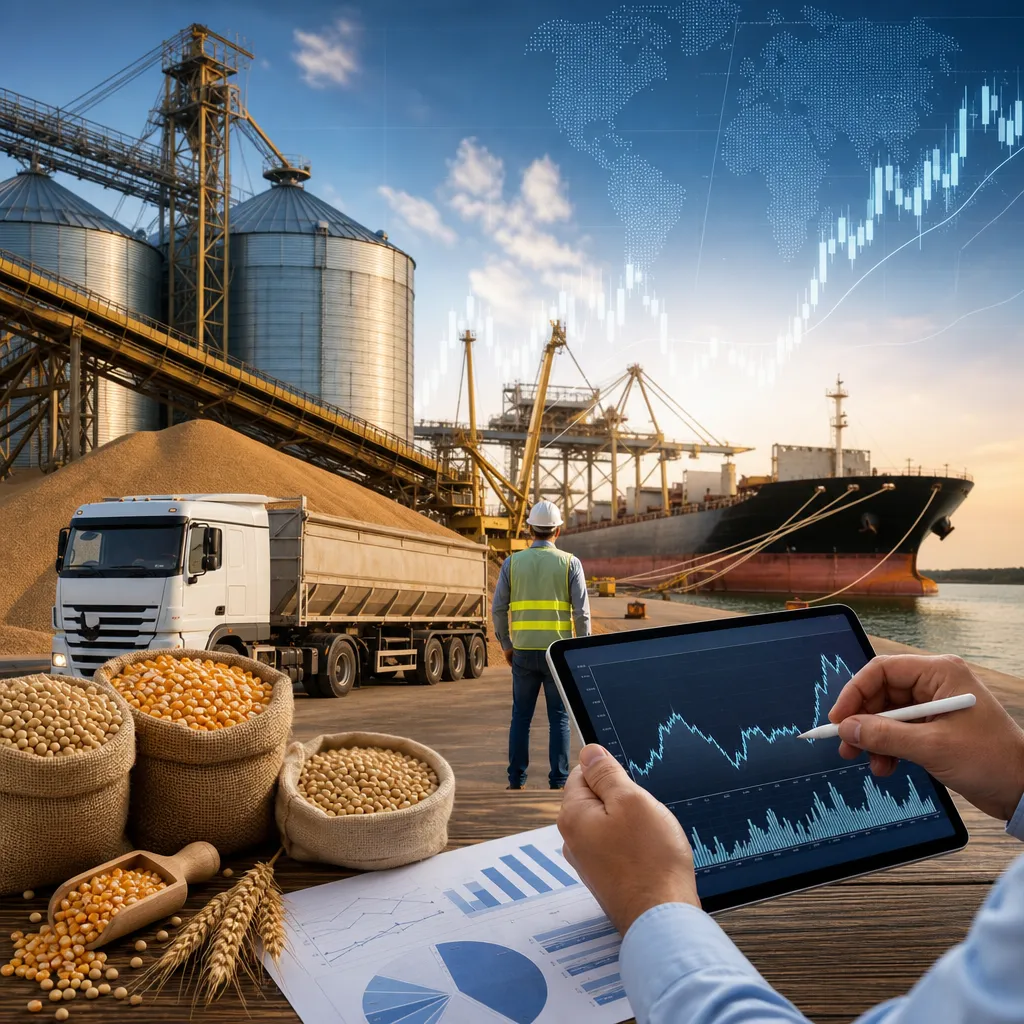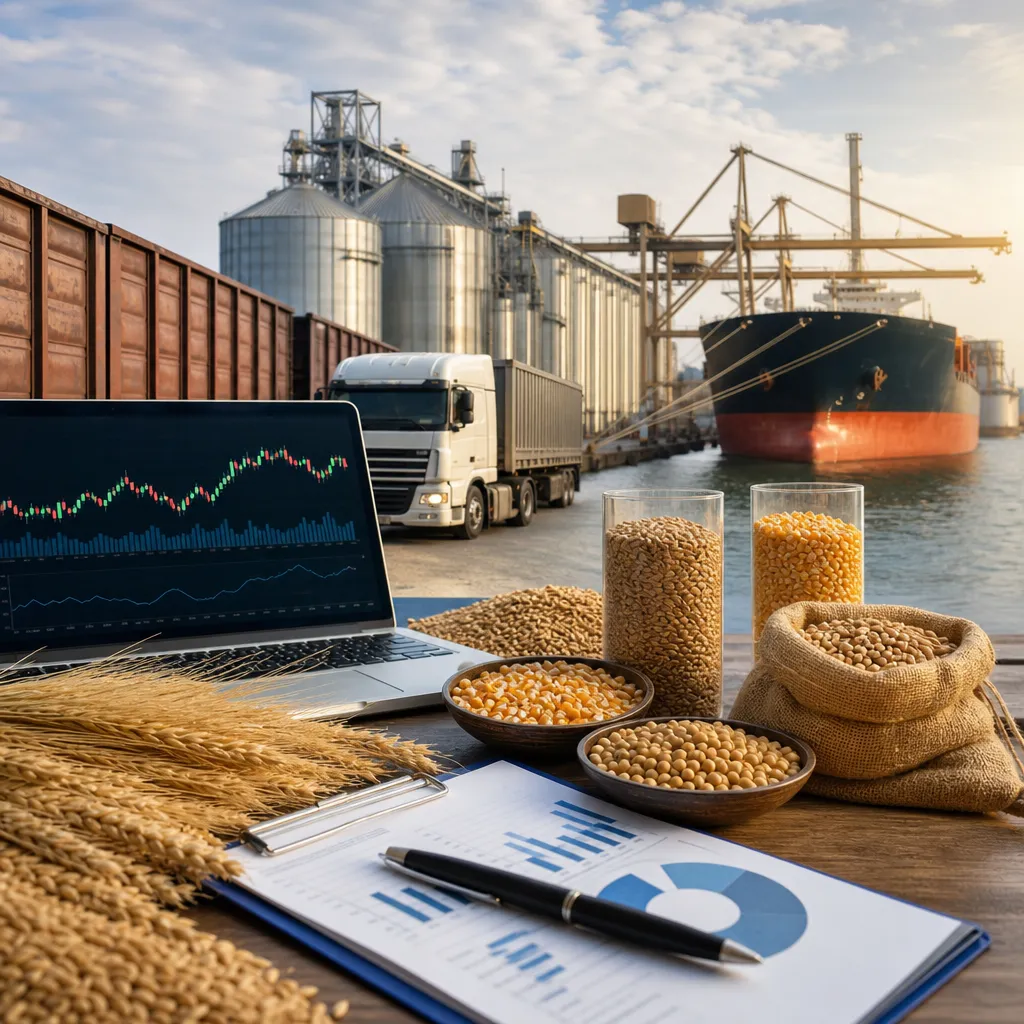
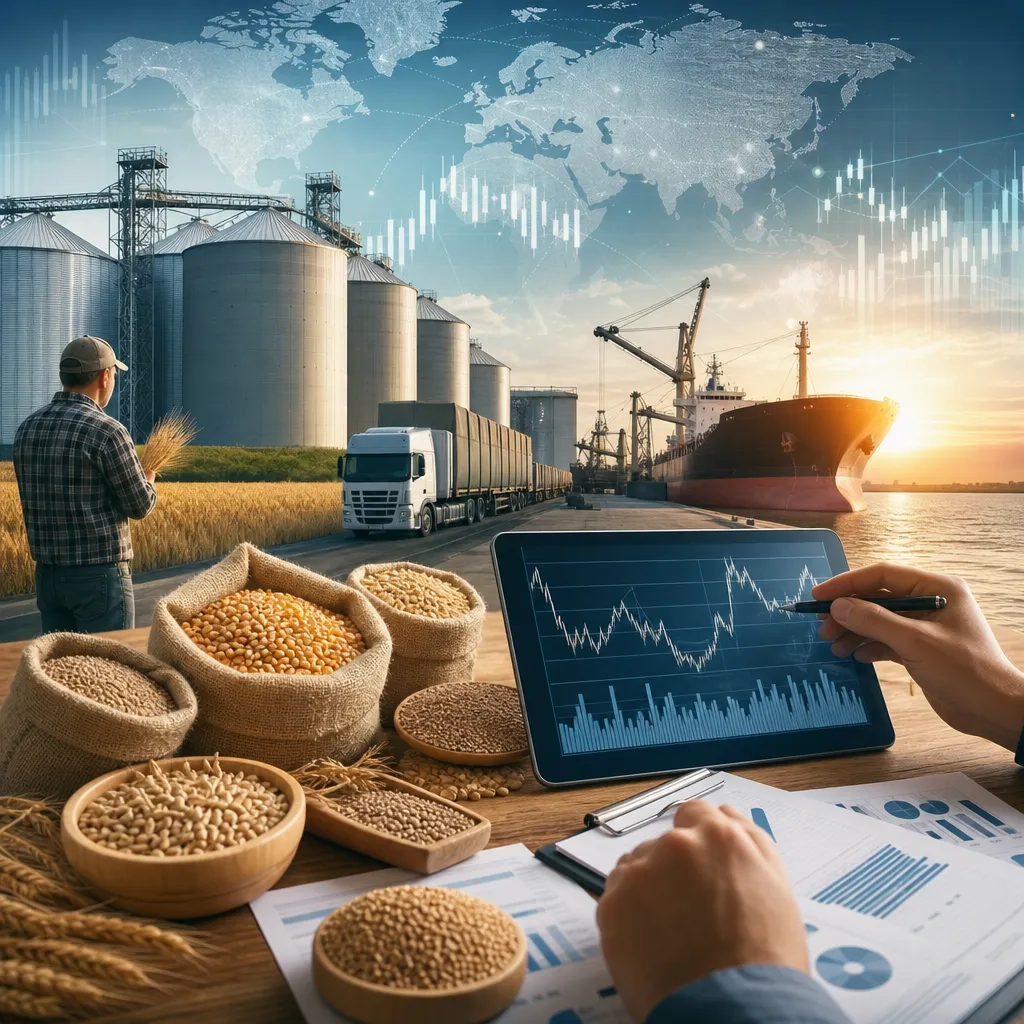
The global grain market is the network through which wheat, corn, soybeans, rice, barley, oats, rye, sorghum, canola, rapeseed, and sunflower seed are priced, traded, moved, stored, processed, imported, and exported. It operates in two connected but different arenas: the financial market, where futures and options are traded on regulated exchanges, and the physical market, where actual grain changes hands through elevators, cooperatives, merchants, processors, exporters, and importers. To understand how the market works in practice, a reader needs to know where benchmark prices are formed, where local cash bids are negotiated, which reports drive price moves, and how logistics, quality, and basis turn a global headline into a real farmgate or delivered price. The most useful approach is to treat the grain market as a chain: production, storage, transport, pricing, risk management, and final use are all linked.
What the global grain market includes
At the broadest level, the grain market covers both food grains and feed or oilseed crops that compete for acreage, freight, and end-user demand. Wheat, corn, rice, barley, oats, rye, and sorghum are core grains. Soybeans, canola, rapeseed, and sunflower seed are oilseeds, but they are often analyzed alongside grains because they share many of the same market drivers: weather, stocks, exports, crushing demand, biofuels, and farm input costs.
The market exists physically in producing regions, storage networks, rail and truck corridors, inland terminals, river systems, and export ports. It exists online through exchange screens, broker platforms, official reports, customs databases, and commercial data terminals. A global price move often starts with a weather event, crop report, export tender, policy change, or freight disruption, but the price a farmer or end user actually pays still depends on local supply, quality, transport, and basis.
How prices are formed: futures, cash, and basis
Benchmark grain prices are usually discovered first in futures markets. For example, globally watched contracts include corn, wheat, and soybeans traded on CME Group exchanges. These futures contracts are standardized, centrally cleared, and quoted by delivery month, unit, and exchange rules. They are not the same as a local physical offer for immediate delivery.
Local cash prices are the bids and offers available in the physical market. A farmer may sell to a country elevator, cooperative, feed mill, crusher, ethanol plant, flour mill, exporter, or grain merchant. Those buyers post or negotiate a cash bid that usually reflects:
- the relevant futures price or import benchmark,
- basis, meaning the local premium or discount versus that benchmark,
- quality and grade,
- delivery location,
- freight and handling,
- timing of delivery and payment terms.
Basis is critical. A strong export corridor, tight nearby local supply, or heavy processor demand can make basis firmer even if futures are unchanged. Weak logistics, harvest pressure, or distance from end users can weaken basis. This is why a futures quote on an exchange website should never be assumed to equal the local price available to a seller.
| Market type | What is traded | Where it is accessed | Main users |
|---|---|---|---|
| Futures market | Standardized contracts tied to a future delivery month | Regulated exchanges through futures brokers and trading platforms | Hedgers, merchants, funds, traders, processors |
| Options market | Rights to buy or sell futures at a strike price | Regulated exchanges through brokers | Producers, end users, traders managing price risk |
| Cash market | Physical grain for nearby or forward delivery | Elevators, cooperatives, merchants, processors, exporters | Farmers, buyers, feed companies, mills, crushers |
| OTC forward contract | Privately negotiated physical or financial agreement | Merchant, processor, broker, or direct counterparty | Commercial participants |
Where to check grain prices and market information
For futures prices, readers normally check exchange data distributed by CME Group, broker platforms, market terminals, financial data sites, or agricultural market services. The key is to confirm the contract month, exchange, unit, and currency. A corn futures price in cents per bushel is a benchmark, not a freight-adjusted cash bid at a local elevator.
For local cash prices, farmers and physical buyers normally check:
- country elevator and cooperative bid sheets,
- merchant and processor bid portals,
- local agricultural market reporting services,
- regional cash price bulletins from government or industry bodies,
- direct phone or electronic bids from nearby buyers.
In export markets, participants also watch port offers, tender results, and shipment lineups where available. Importing countries often buy through state agencies, private tenders, or negotiated contracts. Those transactions can affect world prices even before the grain moves physically.
For market fundamentals and official reports, the most widely used public sources include USDA for global and US supply-demand reports, crop progress, export sales, and production data; CFTC for positioning data in US futures; and FAO for international food and agricultural market context. In Europe and other regions, analysts also use national ministries, statistical agencies, customs data, and exchange market notices where relevant.
How physical grain buying and selling works
A physical grain transaction starts with a seller and a buyer, but in practice there are often intermediaries. A farmer may deliver to an elevator or cooperative, which then resells to a merchant, processor, feed manufacturer, crusher, or exporter. Larger commercial flows may move directly from merchant to vessel loader, mill, or industrial user.
A typical physical sale involves these steps:
- Price discovery: the seller checks local bids or negotiates with one or more buyers.
- Contracting: the parties agree on quantity, quality, delivery window, pricing method, and payment terms.
- Delivery: grain is delivered by truck, rail, barge, or vessel to the agreed point.
- Inspection and grading: moisture, protein, test weight, foreign material, damage, and other quality factors are checked.
- Settlement: final price is adjusted for quality, basis, freight, storage, or drying if applicable, then payment is made according to contract terms.
Where this happens depends on the scale. Local farm sales are often handled through country elevators, cooperatives, or processors. Export-grade business may be arranged by multinational merchants, exporters, trading houses, or specialized brokers. In importing regions, buyers may be flour mills, feed mills, poultry integrators, crushers, or state purchasing agencies.
Important practical points include delivery point, Incoterms in international trade, inspection standards, receival limits, counterparty risk, and transport availability. Grain that looks well priced on paper may become uneconomic after truck queues, rail shortages, demurrage risk, or quality discounts are considered.
How futures and options are used for hedging
Futures and options are tools for managing price risk, not just for speculation. A futures contract represents a standardized quantity and quality under exchange rules. It is traded through a regulated broker account and requires margin, which means cash must be posted and maintained as prices move. Because leverage is involved, losses can build quickly if positions are not aligned with the underlying physical exposure or risk tolerance.
A producer may sell futures to protect against falling prices before harvest. A feed mill or processor may buy futures to protect against rising input costs. An exporter may hedge inventory or export commitments. These hedges reduce exposure to benchmark price moves, but they do not remove basis risk. If local cash differentials weaken unexpectedly, the hedge may not fully protect the net price.
Options add flexibility because they provide the right, but not the obligation, to buy or sell futures at a strike price. A farmer may use a put option to establish a floor while keeping some upside if the market rallies. The trade-off is the premium cost. Commercial users choose between futures, options, or fixed-price forward contracts depending on cash flow, basis views, margin capacity, and marketing objectives.
| Tool | Primary use | How it is accessed | Main limitation |
|---|---|---|---|
| Cash contract | Sell or buy physical grain | Elevator, cooperative, merchant, processor | Locks in local terms with limited flexibility |
| Futures | Hedge benchmark price risk | Regulated exchange via futures broker | Margin calls and basis risk |
| Options | Price floor or ceiling with flexibility | Regulated exchange via futures broker | Premium cost and time decay |
| Forward contract | Fix future physical terms directly with buyer | Merchant, elevator, processor, broker | Counterparty and delivery performance risk |
Main drivers of global grain markets
Supply and demand still dominate long-run grain pricing, but they work through several channels at once. Acreage, yield, and harvested area matter on the supply side. Weather is often the fastest-moving driver because drought, excessive rain, heat stress, freeze risk, and harvest delays can alter production expectations before official statistics catch up.
Demand is split across food, feed, industrial use, and biofuels. For soybeans and canola, crushing demand for meal and oil is central. For corn, feed demand, ethanol policy, and export competitiveness can all matter. Wheat markets are influenced by milling quality, feed substitution, and exportable surplus from major origins.
Other important drivers include:
- Stocks and stocks-to-use: tight carryout generally increases market sensitivity to weather and logistics shocks.
- Currencies: export competitiveness shifts when major exporting countries’ currencies strengthen or weaken.
- Energy and fertilizer: they affect farm economics, planting decisions, drying costs, and biofuel margins.
- Freight and logistics: rail congestion, low river levels, port delays, or vessel shortages can widen basis and disrupt trade flows.
- Government policy: export restrictions, tariffs, biofuel mandates, sanctions, and import quotas can move markets quickly.
Storage, quality, and logistics in the real market
Storage is where many grain market decisions become economic rather than theoretical. Holding grain after harvest may improve sales timing, but only if the expected carry, basis improvement, or quality premium exceeds the costs and risks. Those costs may include interest, shrink, aeration, drying, handling, insurance, and potential spoilage.
Physical storage options usually include on-farm bins, commercial elevators, warehouses, inland terminals, and port storage. The right choice depends on volume, crop type, cash flow needs, transport access, and the level of quality control required.
Quality matters because grain is not a uniform commodity once it leaves the exchange specification. Moisture, protein, oil content, falling number, mycotoxins, foreign material, damage, admixture, and test weight can all change commercial value. Export cargoes may require independent inspection and phytosanitary certification. Processors and mills may use tighter commercial specs than a benchmark futures contract implies.
Logistics connects local and global prices. A farm close to a crusher or export route may enjoy stronger basis than an equally productive region with poor rail or road access. In international trade, vessel timing, port elevation capacity, inspection delays, and destination discharge rules can materially affect net price and risk.
Reports, data services, websites, and software that matter
Useful grain market analysis depends on matching the source to the question. For global supply-demand balance, USDA reports are among the most widely used references. For market positioning, CFTC data shows how different trader categories are positioned in regulated US futures markets. For exchange rules, contract specifications, and official settlement data, exchange publications are essential.
In practice, market participants often use four types of tools:
- Exchange and broker platforms: for futures and options prices, contract details, and order execution.
- Physical bid and merchandising systems: used by elevators, cooperatives, merchants, and processors to post local bids and manage contracts.
- Farm and grain management software: used to track inventory, storage, contracts, freight, and hedge positions.
- Data and analytics services: used by analysts and traders for charts, cash pricing, weather, vessel tracking, and trade flow analysis.
Public information is commonly available from government agencies and exchanges. More granular regional bids, freight intelligence, or proprietary analytics are often commercial products. Readers should distinguish between a website showing delayed futures data, a broker platform enabling live trading, and a merchant portal used to contract actual physical grain.
How to use the global grain market practically
For a farmer, the practical workflow is usually: monitor local crop conditions and benchmark futures, check nearby and forward bids from several buyers, compare basis and freight, decide whether to store or sell, and use hedging tools only if the mechanics and cash-flow implications are understood. A basis contract or hedge-to-arrive structure may suit some operations, but contract details must be reviewed carefully with the buyer.
For a feed mill, crusher, or miller, the process is reversed: assess physical requirements by quality and timing, compare local supply with imported alternatives, manage freight exposure, and hedge benchmark risk where appropriate. For a trader or analyst, the key is to integrate exchange pricing, crop reports, weather maps, export data, and logistics signals instead of relying on a single headline indicator.
The biggest mistakes are confusing futures with cash prices, ignoring basis, underestimating quality discounts, assuming storage always adds value, and using leveraged instruments without a clear hedge or risk plan. In grain markets, practical execution matters as much as market direction.
FAQ
Where can I check grain prices?
Benchmark futures prices are commonly checked through exchange data, broker platforms, and agricultural market services. Local cash bids are usually checked through elevators, cooperatives, processors, merchants, or regional market reporting systems. The two are not the same price.
What is the difference between a futures price and a cash grain price?
A futures price is an exchange-traded benchmark for a standardized contract month and specification. A cash grain price is the real-world bid or offer for physical grain at a specific location, quality, and delivery period. Cash price equals benchmark plus or minus basis and any quality or freight adjustment.
Where does physical grain actually get bought and sold?
Most physical grain is traded through country elevators, cooperatives, grain merchants, processors, mills, feed manufacturers, crushers, exporters, and importers. Large international cargoes are often negotiated by trading houses or brokers and delivered through ports under agreed commercial terms.
How do farmers usually hedge grain prices?
They may use forward contracts with elevators or processors, sell futures through a regulated broker, or buy put options to establish a price floor. The right method depends on basis exposure, margin capacity, crop uncertainty, and the producer’s marketing plan.
Which reports move the grain market most often?
Widely followed reports include USDA WASDE, USDA Crop Progress, USDA Export Sales, and CFTC Commitments of Traders. Traders also watch national crop reports, weather forecasts, export tenders, customs data, and exchange notices.
Can I buy physical grain through a futures exchange?
Not in the way most commercial users mean. Futures exchanges list standardized contracts and may allow delivery under strict rules, but most participants offset positions financially before delivery. Physical grain buying for feed, milling, export, or farm sales is usually done through commercial counterparties in the cash market.
What are the main risks in the grain market?
Price volatility, basis risk, margin calls on futures, counterparty risk, quality discounts, storage losses, freight disruption, policy changes, and currency moves are all relevant. The mix of risks differs between a farmer, processor, exporter, and financial trader.
Why do grain prices differ so much by region?
Regional prices reflect local supply, nearby demand, quality, storage capacity, freight to end users or ports, and access to export routes. Two areas can face the same global futures market but very different local cash values.
Sources
- USDA World Agricultural Supply and Demand Estimates
- CME Group agricultural contract specifications and market data
- CFTC Commitments of Traders