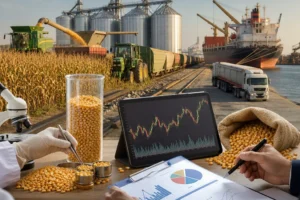

“EU grain prices today” usually refers to a set of related markets rather than one single price. In the European Union, grain values are shaped by exchange-traded futures, export and import offers, inland cash bids from merchants and cooperatives, and delivered prices paid by mills, feed compounders, and processors. The most watched benchmark for many EU grain discussions is Euronext wheat, but that is not the same thing as the exact price a farmer, trader, or buyer pays in a local physical market. To understand today’s EU grain prices, readers need to know where the benchmark is formed, how local basis works, and where official market information can be checked online.
The EU grain market covers a large geographic area with different crop balances and logistics patterns. France is central for wheat futures and export pricing, Germany is a major wheat and feed grain market, Romania and Bulgaria are important Black Sea origins, Spain is a major grain importer, and Italy is a significant consumer of milling wheat, corn, and feed materials. Prices are usually discussed in euros per metric tonne in the EU physical market, while international comparisons often reference Black Sea export values or U.S. futures benchmarks.
What “EU grain prices today” means in practice
In the EU, “grain prices” can refer to several different things at the same time:
- Futures prices on Euronext, especially milling wheat and other agricultural contracts used as benchmarks.
- Cash prices at inland collection points, cooperatives, elevators, merchants, or processors.
- Delivered prices paid by end users such as mills, feed mills, starch plants, or biofuel plants.
- Export prices quoted on an FOB basis at ports.
- Import prices quoted on a CIF or delivered basis for buyers in deficit regions.
Because the EU is both a major producer and a large internal consumer, there is no single physical spot price for all member states. A wheat price in Rouen, Hamburg, Constanta, Zaragoza, or northern Italy can differ materially on the same day because of freight, crop quality, local demand, and the relationship to export channels.
| Price type | Where quoted | What it means |
|---|---|---|
| Futures price | Exchange screen, mainly Euronext | A financial benchmark for a standardized contract, not a local farm-gate bid |
| Local cash bid | Cooperative, merchant, elevator, processor | Price offered for physical grain at a specific location and quality |
| Delivered price | Mill, feed buyer, industrial processor | Physical grain price including delivery to the buyer |
| FOB export price | Port/export trade | Price for grain loaded free on board at an export port |
| CIF import price | Import trade | Price including cost, insurance, and freight to the destination |
Where the EU grain market operates
The EU grain market is not concentrated in one city alone. It operates across inland production zones, river systems, rail corridors, feed and milling centers, and seaports connected to export and import trade.
Western Europe is heavily tied to Euronext benchmark pricing, especially in France and nearby trade flows. France is particularly important because of its role in wheat production and exporting through Atlantic and Channel ports. Germany is a major producer and consumer with strong inland demand from feed, milling, and industrial users.
Central and Eastern Europe have become increasingly important for corn, feed wheat, and Black Sea-connected export flows. Romania and Bulgaria matter because grain from those origins can compete directly in export markets. Hungary also plays an important regional role in feed grain and corn trade.
Southern Europe, especially Spain and Italy, is notable for large livestock and processing demand. In many years, these areas depend on imported grain or inter-EU trade from surplus regions.
As a result, EU grain prices are formed through a combination of internal movement and international competition. A surplus crop in one member state can pressure prices elsewhere if freight and quality allow trade to flow, while an import need in another region can support local values independently of futures.
How prices are formed in the EU
The core idea is simple: the benchmark futures market gives a reference value, but the final physical price depends on basis. Basis is the difference between the local cash price and the relevant futures price or trade benchmark.
EU grain prices are usually influenced by these main factors:
- Benchmark futures, especially Euronext milling wheat for much of the wheat trade.
- Quality, including protein, test weight, moisture, falling number, and mycotoxin risk where relevant.
- Location, because grain near an export port, major mill, or deficit region may command a premium.
- Transport costs, including truck, rail, barge, and port handling.
- Storage and timing, since harvest pressure can weaken spot cash prices while later shipment positions can trade differently.
- Currency effects, as the euro’s relationship with the U.S. dollar affects export competitiveness against non-EU origins.
- Local supply and demand, including feed demand, milling demand, industrial use, and farmer selling pace.
- Global competition, especially from Black Sea origins, North America, and South America depending on the crop.
For example, a trader may watch Euronext wheat futures online, then adjust that benchmark for local basis, quality premium or discount, and transport to derive a bid in a French inland silo, a German mill, or a Romanian export corridor. That is why using a futures quote alone to represent “today’s EU cash wheat price” is incorrect.
Which benchmarks matter most
For much of the EU wheat market, Euronext is the main exchange benchmark. It is often still called MATIF in market language, even though the exchange brand is Euronext. This benchmark is especially relevant for milling wheat hedging and price discovery in Western Europe.
Other benchmarks also influence EU grain pricing:
- CBOT can affect sentiment, especially for corn and global grain macro direction.
- Black Sea export pricing matters because EU wheat and corn must compete in nearby destination markets.
- Domestic processor bids matter where there is strong local consumption and less export orientation.
Importantly, not every EU grain market uses one benchmark equally. French export wheat may track Euronext very closely. Spanish imported corn may be influenced more directly by international maritime values and destination demand. Feed grain markets may also respond differently from milling wheat markets because quality and end-use requirements are not the same.
| Market reference | Main role | Typical users |
|---|---|---|
| Euronext grain futures | Price discovery and hedging benchmark in Europe | Merchants, cooperatives, exporters, mills, funds, brokers |
| Local cash market | Actual physical buying and selling | Farmers, collectors, processors, feed mills, merchants |
| Port export market | Connects inland grain to international buyers | Exporters, trading houses, shipping participants |
| Import destination market | Sets demand-driven delivered prices in deficit regions | Feed manufacturers, mills, importers |
Where to check EU grain prices online
For readers looking for today’s EU grain prices, the practical approach is to check both benchmark markets and physical market sources.
Euronext is the first place to monitor exchange-traded grain futures in Europe. This is the proper source for benchmark futures information, contract months, and official exchange market data.
The European Commission publishes agricultural market information, including cereals-related reporting and market context that helps explain internal EU supply, trade, and price developments.
USDA, especially through its world supply and trade reporting and Foreign Agricultural Service material, is widely used for international balance-sheet context and trade analysis affecting EU grain values.
For actual local cash prices, readers usually need to check:
- cooperatives and grain merchants in the relevant member state,
- domestic processors such as mills or feed manufacturers,
- regional agricultural market bulletins where available,
- broker or market information services used by professional grain trade participants.
These local sources matter because the same futures market can translate into very different cash bids depending on distance to port, protein specification, whether delivery is immediate or forward, and whether the buyer is purchasing ex-farm, silo, or delivered.
How grain is actually bought, sold, exported, and imported in the EU
The physical EU grain trade starts with farmers, cooperatives, local collectors, and merchants. Grain is commonly sold under specifications covering moisture, impurities, specific quality criteria, and delivery terms. The buyer may be a domestic processor, a feed compounder, an exporter, or another merchant assembling cargoes.
Inland physical transactions are often done on one of these bases:
- Ex-farm, where the grain is bought at the farm and the buyer arranges transport.
- Delivered silo or collection point, where the seller delivers to a named warehouse or cooperative.
- Delivered processor, where the price includes movement to the end user.
- Forward contract, where price or basis is agreed for future delivery.
Export trade usually involves merchants or trading houses buying inland grain, moving it to port terminals, and then selling it on an FOB basis. Import trade works the other way: an importer or end user buys grain on a CIF or delivered basis, with maritime freight and destination handling becoming part of the final landed cost.
Because the EU contains both surplus and deficit zones, a large amount of trade is internal rather than extra-EU. Grain may move across borders by truck, rail, barge, or vessel depending on origin and destination. That means “EU grain prices today” can reflect both international competition and internal arbitrage.
How hedging works: futures and options versus physical grain
Physical trade and futures trading are related but not the same thing.
Physical grain involves actual ownership, quality testing, transport, storage, and settlement between commercial counterparties. Farmers and commercial firms usually transact with cooperatives, merchants, processors, feed mills, or exporters.
Futures and options are financial tools used to manage price risk or gain market exposure. In the EU grain market, Euronext plays a central role in hedging for many commercial participants. A merchant who buys wheat physically may sell futures to reduce flat-price risk. A mill may buy futures or options to help manage the risk of rising prices while sourcing physical wheat separately.
Access to the futures market normally comes through a broker or trading platform that provides exchange access. This requires understanding margin, contract expiry, and basis risk. A futures hedge does not remove all risk, because the physical cash basis can still change even if the futures position offsets broad market movement.
This distinction is critical: watching prices online on an exchange does not mean a user is buying physical grain, and selling physical grain to a local merchant does not necessarily require trading futures directly.
What drives the near-term trend in EU grain prices
Without inventing a forecast, it is possible to outline the main scenarios that usually drive short-term and medium-term EU grain price direction.
| Driver | Potential effect | Why it matters in the EU |
|---|---|---|
| Weather and yield risk | Can support or pressure prices | EU production is spread across many climates, but major crop issues still affect supply and quality |
| Harvest pressure | Often weakens nearby cash markets | Large seasonal selling can widen basis and strain storage capacity |
| Export competitiveness | Supports prices if EU origin is competitive, pressures them if not | The EU competes with other major exporters for destination business |
| Euro exchange rate | A stronger euro can reduce competitiveness; a weaker euro can help exports | Many global grain comparisons are effectively made in dollar-linked trade terms |
| Feed and processing demand | Can strengthen local premiums | Deficit livestock and industrial regions can stay firm even if futures soften |
| Freight and logistics | Changes local basis and delivered cost | Distance to ports and consumers strongly affects regional EU pricing |
In practical terms, readers following today’s market should not focus only on the futures screen. They should also ask whether local buyers are active, whether export demand is present, whether weather is affecting crop quality, and whether logistics are smooth enough to move grain to the best-paying outlet.
How to read an EU grain market quote correctly
When you see a grain quote, always identify five things before drawing any conclusion:
- Commodity — wheat, corn, barley, durum, rapeseed, or another product.
- Market location — exchange, inland region, processor, or port.
- Price basis — futures, ex-farm, delivered, FOB, or CIF.
- Currency and unit — usually euros per metric tonne in EU physical trade.
- Date or contract month — especially important for futures and forward offers.
A quote that lacks those details may still have value as a market signal, but it is not enough to compare directly with a local buying opportunity or a farm selling decision.
Frequently asked questions
Where can I check EU grain prices today?
For benchmark futures, check Euronext. For market context, use the European Commission and USDA. For real local cash bids, check cooperatives, merchants, processors, and regional market bulletins in the specific EU country or region you are trading.
Is the Euronext wheat price the same as the farm-gate price in the EU?
No. Euronext is a futures benchmark. A farm-gate or local cash price will differ because of basis, quality, transport, storage, timing, and buyer competition.
What currency and unit are normally used in EU grain markets?
Most EU physical grain prices are discussed in euros per metric tonne. Some international comparisons may also reference dollar-denominated export values, but local trade within the EU is usually framed in euros.
How is grain physically sold in the EU?
It is usually sold through cooperatives, merchants, collectors, processors, feed companies, or exporters under contracts that specify quality, volume, delivery point, delivery period, and payment terms.
How do exporters and importers use EU grain prices?
Exporters assemble inland grain and price it toward ports, often using FOB terms. Importers and destination buyers look at CIF or delivered values. Both compare EU origin with competing world suppliers and freight-adjusted alternatives.
Can I trade EU grain futures online?
Yes, but that is financial market access rather than physical grain buying. Futures and options are normally accessed through a broker connected to the exchange. Users need to understand margin, leverage, expiry, and basis risk.
Why do grain prices differ across EU countries on the same day?
Because the EU is a large, diverse market. Differences in quality, freight, local deficits or surpluses, processor demand, export access, and logistics can all create regional price gaps.
What usually matters most for the short-term EU grain trend?
Weather, harvest progress, export competitiveness, euro exchange rate, feed demand, and transport conditions are usually the key short-term drivers alongside futures market sentiment.
Sources
- Euronext
- European Commission
- USDA Foreign Agricultural Service