






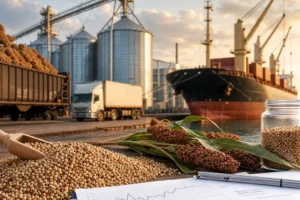



CBOT soybean prices refer to soybean futures traded in the United States on the Chicago Board of Trade, now part of CME Group. This market is one of the main global benchmarks for soybean pricing, so farmers, crushers, exporters, importers, feed companies, and financial traders around the world watch it closely. When people ask for “CBOT soybean prices today,” they usually mean the latest futures quote for a specific contract month, not the exact cash price at a farm, elevator, or export terminal. That distinction matters, because physical soybean prices are built from futures plus or minus a local basis that reflects location, quality, transport, storage, and nearby supply and demand.
The CBOT market operates in Chicago, Illinois, but its influence is global. Soybeans traded there are quoted in U.S. cents per bushel, while many international physical trades are negotiated in U.S. dollars per metric tonne or in local currency equivalents. Even outside the United States, CBOT often serves as the benchmark from which local cash bids, crusher bids, and export offers are derived.
What CBOT Soybean Prices Mean
CBOT soybean prices are futures prices. A futures contract is a standardized exchange-traded agreement linked to a future delivery period. In practice, most users do not intend to make or take delivery through the exchange; they use the contract to manage price risk or to take a market view.
For soybeans, the CBOT benchmark is widely used because the United States is a major soybean producer, processor, and exporter, and because Chicago futures have long been a central pricing reference in global oilseed trade. A soy processor in the Midwest, an exporter at the Gulf, or an importer in Asia may all monitor the same futures market, even though their physical prices differ.
| Price type | Where quoted | What it means |
|---|---|---|
| CBOT soybean futures | CME Group / broker platforms | Exchange-traded benchmark price for a specific contract month |
| Local cash bid | Elevator, cooperative, merchant, processor | Price paid for physical soybeans at a specific location and delivery period |
| Delivered plant bid | Crusher or processor | Cash price including delivery to a processing point |
| FOB export offer | Export market reports / merchants | Price for soybeans loaded at an export point, before ocean freight |
| CIF import price | Importer tenders / trade reports | Price delivered to the destination port including freight and insurance terms as agreed |
Where the Market Operates
The exchange market itself is based in Chicago and administered by CME Group. Trading takes place electronically, and market participants around the world access soybean futures through licensed brokers and trading platforms. The contract is therefore a U.S. exchange product, but it functions as an international benchmark.
The linked physical market is much broader. In the United States, soybeans move from farms to country elevators, river terminals, crushers, rail origins, feed users, and export terminals. Internationally, importers and exporters may quote soybean values relative to CBOT, then adjust for freight, local premiums, currency, and quality. That is why a Brazilian port offer, an Argentine crushing value, and a Midwest cash bid may all reference Chicago futures while still trading at different outright prices.
How CBOT Soybean Prices Are Formed
Futures prices are formed through continuous buying and selling on the exchange. Participants include commercial hedgers and non-commercial traders. Commercial users include farmers, grain elevators, processors, exporters, and importers trying to manage price risk. Financial traders provide liquidity and also express bullish or bearish views on crop conditions, demand, macroeconomic risk, and spreads between contracts.
The futures price reflects expectations about supply and demand over time. Key influences commonly include U.S. acreage, planting progress, weather, yield potential, harvest pace, domestic crushing demand, export sales, competing South American supplies, vegetable oil markets, biofuel policy, and broader currency and macro trends.
However, the futures market does not directly tell a producer what they will receive at a local delivery point. Physical prices are usually calculated as:
Cash price = Futures price + or – basis
Basis is the adjustment between the exchange benchmark and the local physical market. Basis can strengthen or weaken depending on freight costs, nearby stocks, local processor demand, export congestion, storage availability, and buyer competition. A tight local supply area may post a stronger basis than a surplus area far from end users.
Where to Check CBOT Soybean Prices Today
If you need the current benchmark futures price, the most direct reference point is CME Group, which publishes market information for CBOT soybean futures. Many brokers, futures platforms, market terminals, and financial data services also display live or delayed quotes, depending on the service level.
For people involved in the physical soybean trade, the exchange quote alone is not enough. You should also check cash bids and market reports from the specific buyer or region involved. In the United States, farmers commonly monitor bids from local elevators, cooperatives, processors, or river terminals. Export-oriented users also follow U.S. Department of Agriculture reporting and recognized market commentary on export demand and basis trends.
Useful places to check include:
- CME Group for soybean futures contract months and official contract-related market information.
- USDA Agricultural Marketing Service for regional and terminal market reporting where available.
- USDA Foreign Agricultural Service and USDA WASDE reporting for export demand and global balance-sheet context.
- Local elevators, cooperatives, processors, and merchants for actual cash bids and delivery terms.
- Broker platforms for futures and options quotes, spreads, and account execution.
If a reader wants “today’s price,” the practical first step is to identify the exact reference: nearby CBOT futures, a specific deferred month, a local cash bid, a crush plant delivered bid, or an export basis quote. These are related prices, but they are not interchangeable.
| Source | What you can check | Best use |
|---|---|---|
| CME Group | CBOT soybean futures prices by contract month | Benchmark futures reference |
| USDA Agricultural Marketing Service | Cash market and terminal reporting where available | Regional physical market context |
| USDA WASDE / FAS | Supply, demand, trade, exports, imports | Fundamental market outlook |
| Local buyer bids | Actual cash and delivered offers | Selling physical soybeans |
| Broker or trading platform | Tradable futures and options quotes | Hedging or speculative execution |
Futures Versus the Physical Soybean Market
A common mistake is to treat the CBOT quote as if it were the farm-gate soybean price everywhere. It is not. The futures market is standardized and financial in form, while the physical market depends on very specific commercial terms.
In the physical market, soybeans are bought and sold based on quality specifications, moisture, foreign material, protein or oil considerations when relevant, delivery window, weighing and grading rules, storage position, and payment terms. The buyer may be a country elevator, cooperative, processor, feed manufacturer, export house, or merchant. The price offered can be spot, forward, basis-only, or tied to a later futures fixation.
In the futures market, a trader buys or sells a contract through a broker and posts margin. That position gains or loses value as futures move. The trader does not need to own soybeans physically. This is useful for hedging but it is not the same as buying grain in a warehouse or selling a truckload to a crusher.
How Soybeans Are Actually Bought, Sold, Exported, and Hedged
Physical grain trade
Physical soybean trade usually begins with a direct commercial transaction. A farmer may sell to a local elevator or processor. A merchant may assemble soybeans from multiple origins and move them by truck, rail, or barge. At the export level, companies may purchase inland, move beans to a terminal, and price export sales on an FOB basis.
Common physical deal structures include:
- Spot cash sale for immediate delivery
- Forward contract for delivery in a future month
- Basis contract, where the basis is fixed but the futures component is priced later
- Hedge-to-arrive style structures, depending on local commercial practice
Each transaction needs clear terms on quality, quantity, place of delivery, delivery period, weighing, grading, and payment. Counterparty risk also matters, especially when prices move sharply.
Futures and options use
CBOT soybean futures and options are mainly used for hedging and price discovery. A farmer, cooperative, merchant, or processor may sell futures to protect against lower prices on unsold inventory or expected purchases. A crusher or feed user may buy futures to reduce the risk of rising input costs. Options can be used to define risk while keeping some upside or downside flexibility, but they involve premiums and strategy complexity.
Access normally requires a futures broker and a properly approved trading account. Market participants should understand margin calls, contract expiry, liquidity differences between months, and basis risk. Hedging with futures can reduce benchmark price exposure, but it does not eliminate basis risk in the local cash market.
Main Factors That Move CBOT Soybean Prices
Because CBOT is a global benchmark, it reacts not only to U.S. conditions but also to developments in competing origins and consuming countries. In practice, these are the drivers most market participants watch first:
- U.S. planting conditions, summer weather, and yield expectations
- Harvest progress and farmer selling pace
- Domestic crushing demand for meal and oil
- U.S. export sales and shipment pace
- South American crop prospects, especially in major exporting countries
- Currency moves, particularly the U.S. dollar and competitor currencies
- Freight and logistics disruptions affecting export competitiveness
- Vegetable oil markets and biofuel-related demand
- Government reports that alter expectations for supply, stocks, or trade
No single factor determines the market every day. At times weather dominates; at other times export demand, policy, or macro risk takes over.
Practical Reading of the Market Today
For day-to-day commercial use, readers should avoid focusing only on an isolated futures number. A more practical reading of “CBOT soybean prices today” includes four checks: the contract month being quoted, whether the market is up or down versus the prior close, what local basis is doing, and whether export or crusher demand is strengthening or weakening.
If nearby futures are stable but your local cash bid falls, the basis may have weakened because of harvest pressure, transport bottlenecks, or weaker buyer demand. If futures fall but the local cash bid holds relatively firm, basis may be strengthening due to tight supply or active processor competition. For exporters, FOB values can also change differently from inland bids if vessel lineups, freight, or port demand shift.
For market outlook, scenario thinking is more reliable than false precision. Bullish conditions may develop if weather damages yield potential, stocks tighten, or export demand strengthens. Bearish pressure may develop if crops are large, demand disappoints, or competing exporters gain price advantage. Neutral conditions can still produce sharp basis moves in local markets even if futures remain range-bound.
FAQ
Where can I check CBOT soybean prices today?
The standard reference is CME Group. Futures brokers and market data platforms also display soybean quotes, often with varying delay or subscription levels.
Are CBOT soybean prices the same as the cash price farmers receive?
No. CBOT is a futures benchmark quoted in U.S. cents per bushel. Farm or elevator cash prices are futures adjusted by basis, quality, location, and delivery terms.
What unit are CBOT soybean prices quoted in?
They are commonly quoted in U.S. cents per bushel. Many physical export trades, however, are discussed in U.S. dollars per metric tonne or local currency equivalents.
How do I buy or sell actual soybeans instead of trading futures?
Physical soybeans are normally sold through elevators, cooperatives, processors, merchants, or exporters under commercial contracts. Futures trading through a broker gives price exposure, not necessarily physical ownership.
Who uses CBOT soybean futures?
Farmers, grain companies, processors, exporters, importers, feed users, hedge funds, and other market participants use them for hedging, price discovery, and speculation.
Why can local soybean prices rise even if CBOT falls?
Because basis can strengthen. Strong processor demand, tight nearby supply, or logistics constraints can support local cash bids even when the futures benchmark weakens.
Do most futures traders take delivery of soybeans?
No. Most positions are offset before delivery. The contract is mainly used to transfer price risk rather than to arrange routine physical movement of soybeans.
What reports matter most for soybean price direction?
Market participants commonly monitor CME Group prices, USDA WASDE reports, USDA export reporting, crop progress updates, and regional cash market information from buyers and official market reporting services.
Sources
- CME Group
- USDA Agricultural Marketing Service
- USDA World Agricultural Supply and Demand Estimates