






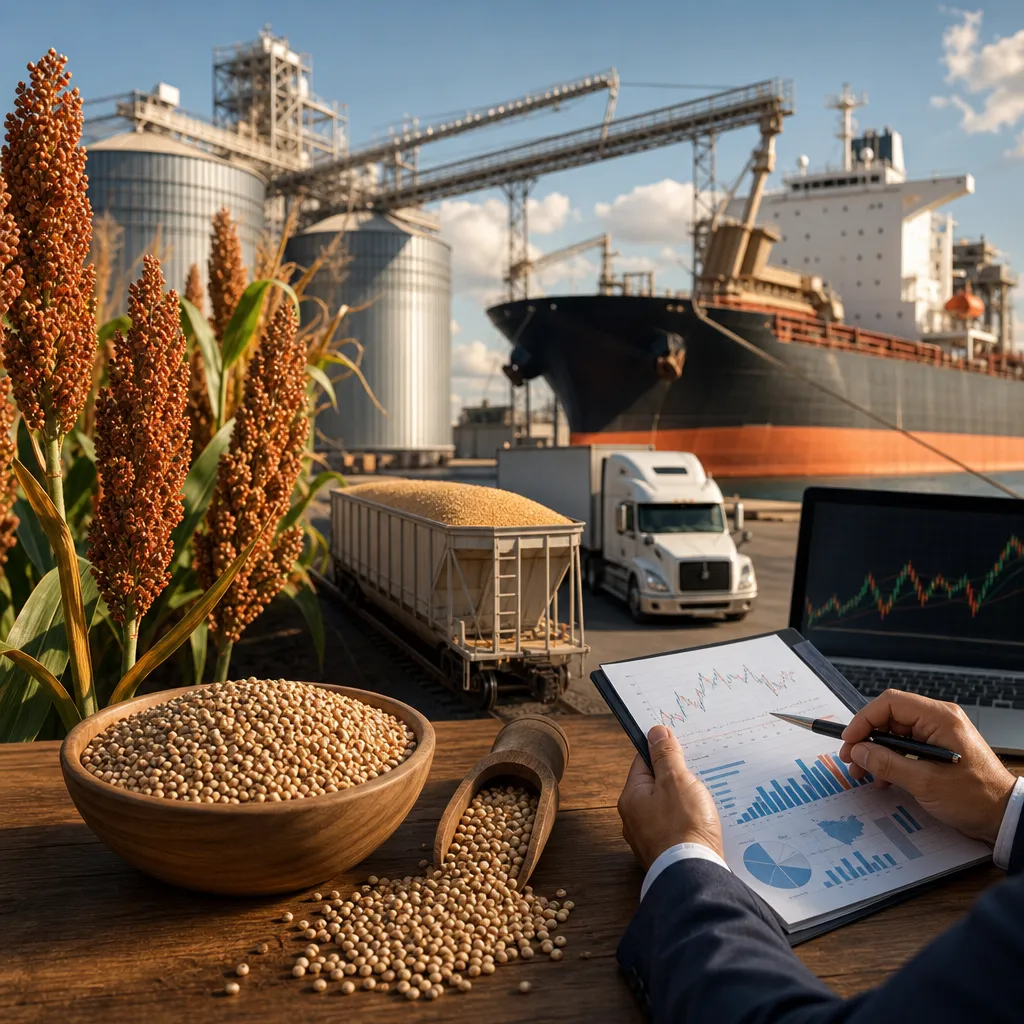
The US sorghum export market is the trade in American sorghum sold from inland growing areas to domestic merchants, rail and river terminals, export elevators, and ultimately overseas buyers. It is centered in the United States, especially the Plains sorghum belt, but its export prices are formed through a chain that links farm cash bids, interior logistics, Gulf export values, and global competition from other feed grains. Sorghum is a grain used mainly for feed, but also for food and industrial uses in some destinations, so export demand can shift with livestock economics, policy, and substitution against corn, barley, and wheat. For anyone following this market, it is essential to separate futures-based price signals from actual physical export bids.
What the US sorghum export market is
The United States is one of the world’s established sorghum exporters. The crop is produced mainly in states such as Kansas and Texas, with additional output in other Plains and Southern regions depending on the season. The export market refers not simply to production, but to the commercial system through which US sorghum is accumulated, merchandised, transported, inspected, and sold abroad.
In practice, the export market operates in several layers:
- Farm and country level: farmers sell to local elevators, cooperatives, feed mills, or grain merchants.
- Interior merchandising level: grain companies assemble larger volumes and move them by truck, rail, or barge.
- Export channel: sorghum is delivered to export positions, often associated with Gulf shipments.
- International trade level: exporters sell FOB cargoes, and foreign buyers may purchase on an FOB or CIF basis depending on contract structure.
Because sorghum is not the dominant US futures grain contract in the way corn is, market participants often price sorghum relative to broader feed grain values rather than through a dedicated, highly liquid sorghum futures benchmark.
Where the market operates
Geographically, the US sorghum export market begins in interior production regions and ends at export terminals, primarily those connected to Gulf export flows. The crop is grown largely in semi-arid and drought-prone areas where sorghum fits as a resilient feed grain. Interior cash markets are especially relevant in the central and southern Plains.
For exports, the most important commercial geography is the route from origin to port. Depending on origin, sorghum may move:
- by truck from farm to local elevator or processor,
- by rail from inland elevators to export terminals,
- by barge where river logistics are available,
- by vessel from US export ports to overseas destinations.
Export trade is generally quoted in US dollars. Inland farm and elevator bids are commonly discussed in US dollars per bushel, while export business is often understood in US dollars per metric ton or by vessel cargo terms. That difference matters: a local farmer is usually not negotiating the same price expression used in ocean trade.
How US sorghum export prices are formed
US sorghum export pricing is a physical market process, not a single screen price. The final export value reflects several stacked components: the underlying feed grain market, local cash conditions, freight, quality, timing, and destination demand.
The most important concepts are:
- Futures price: a benchmark from an exchange-traded grain contract, often used indirectly for price discovery and hedging in feed grains.
- Cash bid: the price a local buyer offers for physical sorghum at a specified location and delivery period.
- Basis: the difference between local cash value and the relevant futures benchmark or substitute benchmark used in merchandising.
- Delivered price: the price for grain delivered to a specific interior or export location.
- FOB price: the price of grain loaded free on board at the export point, before ocean freight to the importer.
- CIF price: the importer-side price including cost, insurance, and freight to destination.
Unlike corn, sorghum does not have the same broadly used dedicated US futures liquidity for day-to-day commercial hedging. As a result, traders frequently use related grain futures, especially corn, as a risk-management reference while recognizing basis risk and cross-commodity risk. The local cash price for sorghum can therefore diverge from corn futures because sorghum has its own supply-demand balance, quality profile, and export demand pattern.
| Price type | Where it appears | What it means |
|---|---|---|
| Local cash bid | Elevators, cooperatives, merchants | Physical bid at a named local delivery point, often for nearby delivery |
| Delivered interior price | Merchants, feed users, rail destinations | Physical value including transport to a specified inland destination |
| FOB export value | Export trade discussions, merchant offers | Value of grain loaded at port before ocean freight |
| CIF import value | Importer tenders, destination trade | Price including freight and insurance to destination port |
| Futures benchmark | Exchange platforms, broker screens | Financial benchmark used for price discovery and hedging, not the exact farm-gate sorghum price |
What drives the market
The US sorghum export market is heavily influenced by the balance between domestic feed grain supply and foreign buying interest. Sorghum can substitute for other grains in feed rations, so its competitiveness versus corn, feed wheat, and barley is central.
Key drivers include:
- US production and harvest quality: acreage, yield, and test weight affect available exportable supplies.
- Weather: Plains weather is especially important because sorghum is concentrated in drought-sensitive regions.
- Export demand: buying from major importing countries can tighten basis and lift export bids.
- Competing feed grains: when corn is abundant and cheap, sorghum may need to discount to stay competitive.
- Freight and logistics: rail availability, river conditions, and export terminal capacity affect delivered cost.
- US dollar direction: a stronger dollar can reduce export competitiveness in world markets.
- Policy and trade relations: tariffs, sanitary rules, and trade access can quickly change demand.
Because sorghum exports can be concentrated in specific destination markets, demand shocks may have a larger effect on sorghum basis than on more globally diversified grains.
Where to check prices and market information online
If you need a current view of the US sorghum export market, the safest approach is to combine official reports with physical cash information from actual market participants. There is no single universally sufficient “live sorghum export price” that covers all locations and delivery terms.
Useful places to check include:
- USDA Agricultural Marketing Service: cash grain market reporting, market commentary, and location-specific physical information where available.
- USDA Foreign Agricultural Service: export sales data, trade policy developments, and international market context.
- USDA WASDE and Grain Transportation reporting: broad supply-demand balance and logistics context.
- CME Group: benchmark grain futures, especially corn futures used as a reference by some commercial participants for hedging or market comparison.
- Local elevators and cooperatives: direct cash bids for sorghum at country level.
- Merchants and exporters: nearby bids, delivered prices, and grain program terms.
- Broker and market data platforms: futures, spreads, and basis tools where available through commercial subscriptions.
Readers should be careful when checking online prices. A futures quote from an exchange screen is not the same as a local sorghum bid in Kansas or Texas, and it is not the same as a Gulf FOB offer. The difference comes from basis, freight, quality, and the buyer’s specific need.
| Information source | What you can check | Practical use |
|---|---|---|
| USDA Agricultural Marketing Service | Cash market reports, grain market commentary | Understand physical bids and regional market tone |
| USDA Foreign Agricultural Service | Export sales and foreign market information | Track export demand and destination interest |
| CME Group | Corn and other grain futures benchmarks | Monitor price discovery and hedging references |
| Local elevators and cooperatives | Nearby and forward cash bids | See the actual farm-level selling opportunity |
| Exporters and merchants | Delivered bids, quality terms, shipment windows | Evaluate movement into export channels |
How physical sorghum is bought and sold for export
Physical trade starts with a real grain transaction, not a brokerage account. Farmers may sell spot after harvest, store and sell later, or use forward contracts with a local buyer. Elevators and merchants then accumulate enough grain to meet rail, barge, or export shipment requirements.
A typical physical chain may include:
- Farmer produces sorghum and receives local bids from elevators, cooperatives, or merchants.
- Buyer sets quality standards, moisture limits, delivery location, and payment terms.
- Grain is delivered and graded according to contract terms and official inspection rules where applicable.
- Merchant resells into feed, processing, or export channels.
- Exporter assembles volume to meet vessel or container commitments.
- Shipment is sold internationally under FOB or other agreed trade terms.
Commercial contracts can differ by delivery period, storage arrangements, discounts for off-grade grain, and whether price is fixed immediately or later. Counterparty quality matters: the reliability of the buyer, payment timing, and contract clarity are just as important as the top-line bid.
How hedging and futures fit into the market
Futures trading and physical sorghum ownership are different activities. A producer or merchandiser can own grain without trading futures, and a speculator can trade grain futures without ever handling a bushel of sorghum.
Because sorghum does not have the same central futures role as corn, hedging usually involves approximation rather than a perfect match. Commercial users may watch or hedge with related grain futures through a broker, while managing the remaining basis difference separately in the cash market.
The practical distinction is:
- Physical market: handled with elevators, merchants, exporters, feed users, and logistics providers.
- Futures/options market: accessed through a regulated broker on an exchange-linked platform, with margin requirements and price exposure rather than physical grain ownership.
This matters because a hedge can reduce benchmark price risk, but it does not eliminate all risk in sorghum. Basis can widen or narrow, export demand can change suddenly, and local quality issues can still affect cash value.
Export outlook: what to watch
Any outlook for the US sorghum export market should be framed as scenarios, not certainties. The market is especially sensitive to weather in production regions and to the buying behavior of a relatively concentrated set of importers.
Three broad scenarios are useful:
- Bullish export scenario: a smaller US crop, stronger import demand, limited competition from cheap corn or barley, and smooth port logistics could support interior basis and export values.
- Neutral scenario: adequate production, moderate export demand, and competitive corn prices could keep sorghum trading mostly as a feed grain alternative without extreme premiums.
- Bearish export scenario: large competing feed grain supplies, weak overseas buying, or trade friction could pressure sorghum basis and reduce export flow.
For market participants, the key reports to monitor are US crop condition and production updates, export sales trends, transportation conditions, and global feed grain competitiveness. Sorghum does not trade in isolation; it competes in a wider feed grain complex.
Practical market guide for readers
If you are a farmer, merchandiser, importer, or analyst, the most practical way to follow the US sorghum export market is to build the market from the ground up rather than rely on a single price headline.
- For farmers: compare local elevator bids, ask about forward contracts, clarify quality discounts, and understand whether a bid reflects nearby movement or deferred delivery.
- For grain merchants: monitor local basis, destination demand, logistics, and substitute grain values.
- For importers: distinguish between FOB US offers and landed destination values, and account for freight and quality specs.
- For futures users: know that exchange prices provide a benchmark, not a direct sorghum cash quote, and manage margin and basis risk carefully.
The most accurate commercial view usually comes from combining exchange benchmarks, USDA reporting, and live physical indications from buyers and sellers in the relevant region.
Where can I check current US sorghum prices?
Check local elevator and cooperative bids for physical cash prices, USDA Agricultural Marketing Service for market reporting, and CME Group for related grain futures benchmarks. These will not all show the same number because they represent different parts of the market.
Is there a single US sorghum benchmark like corn futures?
Not in the same broad commercial sense as corn. Sorghum pricing often references related feed grain benchmarks, especially corn, while cash values are negotiated through basis and physical market conditions.
What is the difference between a cash sorghum bid and an export price?
A cash bid is what a local buyer offers at a named inland location. An export price usually reflects sorghum delivered to port or loaded FOB for overseas shipment, so it includes different logistics and commercial costs.
In what currency and units is US sorghum priced?
US inland cash trade is commonly discussed in US dollars per bushel. Export trade is often evaluated in US dollars per metric ton, especially in international negotiations.
How do exporters hedge sorghum price risk?
They may use related grain futures through a broker, along with cash contracts and basis management in the physical market. This reduces some price risk but does not remove sorghum-specific basis risk.
Why can local sorghum prices differ so much from futures?
Because local prices reflect basis, transport, storage, quality, local supply, buyer competition, and export demand. Futures are only a benchmark for broader grain price movement.
Who actually buys US sorghum for export?
Typically grain merchants and exporters buy from interior suppliers, assemble volume, and sell to overseas feed users, traders, or state and private importers depending on the destination market.
Sources
- USDA Agricultural Marketing Service
- USDA Foreign Agricultural Service
- CME Group