

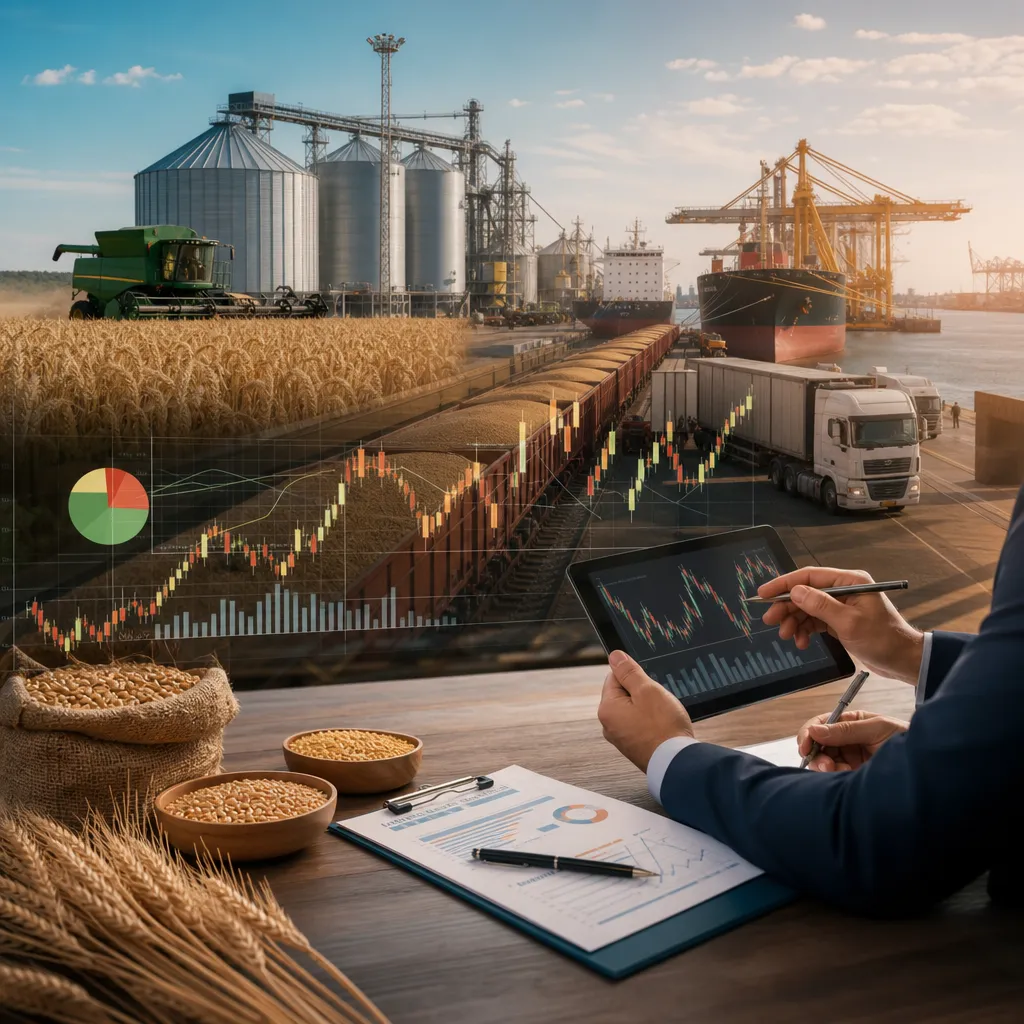
Grain market news is the daily flow of information that moves wheat, corn, soybeans, rice, barley, canola, and other grain prices in both futures markets and physical cash markets. In practice, it combines exchange prices, local elevator bids, crop and weather reports, export activity, freight conditions, policy changes, and grain quality information. The most important point for readers is that a headline about futures rising does not automatically mean a farmer or merchant can sell physical grain at that same price. To use grain market news well, you need to know where the information comes from, which market it refers to, and how to translate it into a local buying, selling, hedging, or storage decision.
What grain market news actually covers
Grain market news is broader than price commentary. It usually includes futures market moves, cash market bids, export tenders, crop condition reports, planting and harvest progress, weather risks, logistics disruptions, and policy developments such as tariffs, quotas, biofuel rules, or phytosanitary restrictions.
For farmers and physical grain buyers, the most useful news is often the information that changes the local basis, freight, or delivery opportunities. For futures traders, the focus may be contract spreads, fund positioning, volatility, and report dates. For mills, feed manufacturers, exporters, and processors, grain market news helps manage procurement timing, input costs, and inventory risk.
| News item | What it affects | How it is used |
|---|---|---|
| Futures price move | Benchmark value, hedging cost, sentiment | Sets reference levels for hedges and contract pricing |
| Local elevator bid change | Cash revenue or procurement cost | Used for actual physical sale or purchase decisions |
| Crop report | Supply outlook | Shapes price expectations and risk management plans |
| Weather event | Yield and quality risk | Can change both futures and local physical premiums |
| Export tender or port disruption | Trade flow and basis | Important for merchants, exporters, and regional cash markets |
Where grain prices are quoted and why they differ
Grain prices are quoted in two main ways: exchange futures prices and local cash prices. Futures are standardized contracts traded on regulated exchanges. Cash prices are the actual prices offered for physical grain at a specific location, for a specific quality, at a specific time.
For many international market participants, benchmark grain futures are commonly followed through exchanges such as CME Group. Contracts may represent corn, wheat, soybeans, soybean meal, soybean oil, oats, rough rice, canola, or related products depending on the exchange and region. These futures are useful as a reference, but they are not the same thing as a farmgate, elevator, mill, or port bid.
Local cash prices are usually checked through grain elevators, cooperatives, merchants, processors, feed mills, ethanol plants, crushers, exporters, or official market reporting services. A local bid may be listed as a cash price outright, or as futures plus or minus a basis. Basis is the difference between the local cash price and the relevant futures contract. It reflects freight, local supply and demand, storage pressure, quality, and buyer competition.
If a reader wants the current market, the practical approach is:
- Check the relevant futures contract on the exchange or through a broker or market-data service.
- Check local bids from elevators, cooperatives, merchants, or processors in the delivery area.
- Confirm unit, currency, and contract month.
- Compare basis levels across buyers and locations before selling or buying physical grain.
Where to find grain market news online
The most reliable grain market news usually starts with official data and regulated market information. Commentary services can be useful, but they should be checked against primary sources.
For United States and global grain markets, USDA is a core source. USDA reports commonly used by traders, farmers, and analysts include WASDE for supply and demand balances, Crop Progress for planting and crop condition updates, Export Sales for demand signals, and grain inspection data for export flow indications.
CME Group provides contract specifications, settlement and market data, trading calendars, and educational material on contract mechanics. This is essential when a market story refers to a specific futures month, delivery rules, or price limit structure.
CFTC data is widely used for futures-market positioning analysis. Its Commitments of Traders reports help readers see how different trader categories are positioned in agricultural futures and options. This is not a price forecast by itself, but it helps interpret crowding, trend strength, and possible volatility around major reports.
For international balance sheets and trade context, FAO and national agriculture ministries or statistical agencies are relevant. Customs and trade databases can also help analysts track import and export patterns, especially when local policy or logistics changes distort private trade flows.
| Source type | What it provides | Who uses it |
|---|---|---|
| Exchange data | Futures prices, contract specs, expiry, volume | Traders, hedgers, analysts, brokers |
| Government crop reports | Production, stocks, acreage, exports | Farmers, merchants, processors, researchers |
| Local bid sheets | Cash bids by location and delivery period | Farmers, grain buyers, merchandisers |
| Broker platforms | Tradable futures and options access | Speculators, hedgers, trading firms |
| Commercial analytics services | Charts, alerts, basis tools, news aggregation | Professional traders, larger farms, merchants |
How grain market news works in the physical market
Physical grain trade happens through a chain of participants, not just on a screen. Farmers may deliver to a local elevator or cooperative. Merchants may buy from elevators and move grain to processors, feed mills, exporters, or domestic users. Some transactions are negotiated directly between producers and end users, but many are intermediated through handlers with storage and logistics capacity.
When market news says wheat is higher, the practical question is: higher where, for what quality, and for which delivery point? In physical trade, price depends on protein, moisture, test weight, foreign material, falling number, damaged kernels, or other contract specifications depending on crop and market. Freight matters as much as the headline price in many regions.
A typical physical grain sale often includes:
- crop and quantity,
- grade or quality terms,
- delivery point,
- delivery window,
- pricing method, such as flat price or futures plus basis,
- weight and inspection method,
- payment terms,
- responsibility for freight and risk transfer.
Physical transactions may occur through spot sales, forward contracts, basis contracts, minimum-price structures, storage arrangements, or export contracts. In international trade, terms such as FOB, CIF, or other Incoterms may determine who pays freight, insurance, and port costs, but the exact contract wording matters.
Futures, options, and grain market news
Futures and options are tools for price risk management and speculation, not the same thing as buying a truckload of grain. Grain futures trade on regulated exchanges through a futures broker. A trader or hedger typically needs a brokerage account, margin funding, and an understanding of contract size, tick value, expiry, and delivery rules.
For example, a farmer may sell futures to hedge expected production, while still planning to deliver grain physically to a local elevator later. A feed mill may buy futures or call options to protect against higher input costs while sourcing physical grain from merchants or local suppliers. A grain merchant may hedge inventory or forward sales to manage margin risk between procurement and resale.
Options add flexibility because they provide the right, but not the obligation, to buy or sell futures at a set strike price. They involve a premium cost and can reduce some downside pricing risk, but they do not remove basis risk or execution risk in the physical market.
Key risks include leverage, margin calls, basis movement, contract mismatch, and liquidity around expiry. Grain market news often triggers sharp futures reactions, especially around major reports, but using futures without understanding margin and delivery mechanics can create losses unrelated to physical crop performance.
How to interpret grain market headlines correctly
Good grain market analysis separates market noise from market structure. A single bullish or bearish headline matters less than whether it changes the supply-and-demand balance or local cash conditions.
Useful questions to ask about any grain market news item include:
- Does it affect global supply, local supply, or both?
- Is the issue about price level, basis, freight, or quality?
- Which crop year is affected?
- Which contract month is reacting?
- Does this change export competitiveness?
- Could the market already have priced it in?
Weather is a good example. A drought headline may lift futures immediately, but the physical effect depends on crop stage, region, and whether losses are already reflected in balance sheets. Likewise, strong export sales may be bullish, but if shipments are delayed by low river levels, port congestion, rail disruption, or vessel availability, the local cash effect may not match the futures reaction.
Storage, logistics, and quality in grain market news
Storage and logistics are often underappreciated drivers of grain market news. During harvest, local cash bids may weaken because elevators are full, freight is tight, or drying and handling capacity is stretched. Later in the season, basis can improve if supplies are locked in storage and buyers need nearby grain.
Storage decisions are practical and local. Grain may be stored on-farm, at a commercial elevator, cooperative facility, warehouse, or port terminal. The best option depends on carrying costs, spoilage risk, shrink, interest costs, expected basis improvement, and available working capital.
Quality can change the market value more than the headline futures price. High moisture corn, low-protein wheat, damaged soybeans, or contaminated grain may face discounts or restricted marketability. That is why grain market news about rain at harvest, fungal disease, or heat damage can be as important as acreage or export data.
Before storing grain, operators usually check aeration, moisture, insect pressure, segregation by quality, and insurance terms. Before delivering grain, they usually confirm grading procedures, discount schedules, and whether the buyer requires specific documentation or inspection certificates.
Who uses grain market news and how
Different users read the same market news differently. Farmers focus on selling opportunities, basis trends, and input-margin protection. Elevators and cooperatives watch local origination pressure, storage use, and hedge coverage. Merchants and exporters track spreads, freight, vessel lineups, and trade-policy changes. Processors and feed companies monitor crush margins, feed substitution, and nearby procurement risk. Futures traders focus on momentum, options volatility, and report timing.
Software and data tools vary by use case. A simple farm operation may rely on local bid apps, elevator text alerts, and official reports. A commercial merchandiser may use professional charting, futures execution systems, position dashboards, and basis management tools. Analysts may use spreadsheet models, market-data terminals, government datasets, and APIs from exchanges or data vendors where commercially available.
It is important to distinguish tool categories:
- Market-data services show prices, charts, and news.
- Broker platforms allow futures and options trading.
- Physical marketplaces or merchant systems help arrange actual grain delivery and contracting.
- Farm or grain management software helps track inventory, contracts, storage, finances, and logistics.
Practical mistakes to avoid
A common mistake is confusing a benchmark futures rally with an immediately tradable local cash opportunity. Another is watching only national headlines while ignoring basis, freight, and quality discounts in the local market.
Other frequent errors include selling physical grain without confirming delivery terms, hedging the wrong contract month, underestimating margin risk on futures, or storing grain without a clear basis or carry strategy. Analysts can also overread single reports if they ignore revisions, seasonality, or the difference between committed exports and actual shipments.
The most practical routine is to combine three layers of information: benchmark futures, local physical bids, and official fundamental data. Grain market news becomes useful when it improves a real decision on pricing, hedging, procurement, storage, or logistics.
Where can I check grain prices today?
Check futures prices through the relevant exchange market data or a futures broker platform, and check local cash bids through elevators, cooperatives, merchants, processors, or official local market reporting services. The local cash bid is the price most relevant for physical sale or purchase.
Is the futures price the same as the price a farmer receives?
No. A farmer usually receives a local cash price, which reflects the futures market plus or minus local basis, along with quality adjustments, freight, and delivery terms.
Where does physical grain buying and selling usually happen?
It usually happens through grain elevators, cooperatives, merchants, feed mills, flour mills, crushers, ethanol plants, exporters, or direct contracts between producers and end users. The transaction is tied to a delivery point and quality specification.
Where are grain futures traded?
Grain futures are traded on regulated commodity exchanges through licensed futures brokers and trading platforms. This is a financial market and is separate from arranging truck, rail, barge, or vessel delivery of physical grain.
Which reports matter most for grain market news?
Widely followed reports include USDA WASDE, USDA Crop Progress, USDA Export Sales, export inspection data, exchange contract data, and CFTC Commitments of Traders. For international context, national agriculture agencies and FAO can also matter.
Can I buy physical grain online the same way I trade futures?
No, not in the same way. Futures trading is standardized and exchange-based. Physical grain purchases usually require negotiating quantity, quality, delivery location, timing, freight, and payment terms with a commercial counterparty.
Why does basis change even when futures are stable?
Basis can change because of local supply pressure, storage availability, export demand, processor demand, transport bottlenecks, weather damage, or quality shortages. It is a local market signal, not just a futures-market signal.
What should I verify before storing or forward-selling grain?
Verify quality condition, storage cost, spoilage risk, delivery window, discount schedule, freight responsibility, payment timing, and whether the contract uses a flat price, basis formula, or futures reference. These details often matter more than the headline market direction.
Sources
- USDA Agricultural Marketing Service and World Agricultural Supply and Demand Estimates
- CME Group agricultural futures and options contract information
- U.S. Commodity Futures Trading Commission Commitments of Traders