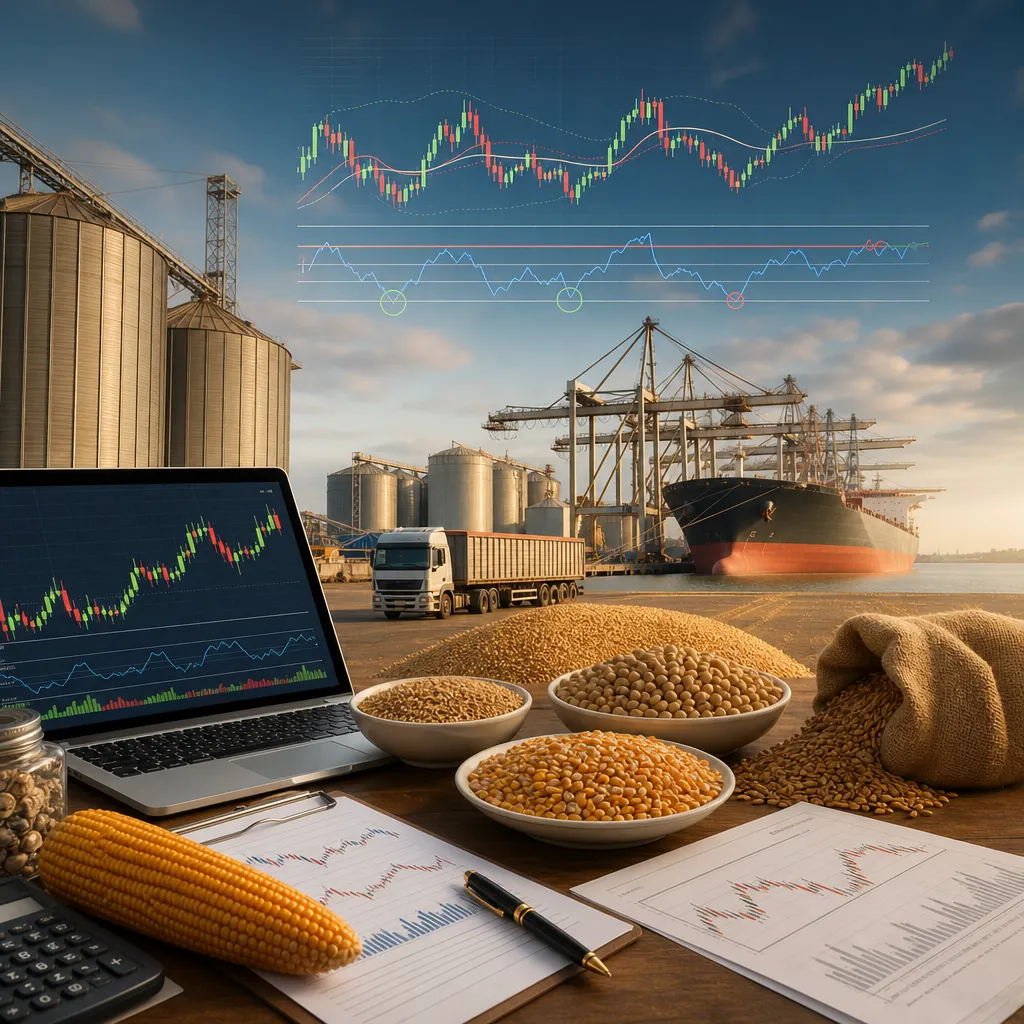





The EU corn import market is the trade in maize brought into the European Union from non-EU origins for feed, food, and industrial use. It operates across the entire EU single market, but pricing and logistics are especially visible at major entry points such as Spain, the Netherlands, Italy, Portugal, and some Black Sea-facing member states, depending on season and origin. In practice, this is a physical import market linked to global export values, ocean freight, EU demand, crop quality, and currency movements, especially the euro against the US dollar. Readers looking for prices should think in terms of imported cargo values, delivered feed-mill prices, and benchmark futures rather than a single “EU corn price.”
Within Europe, corn is usually referred to as maize in official and trade documents. Physical trade is commonly discussed in euros per metric ton, while international offers may also be negotiated against US dollar-denominated export values or freight-inclusive import prices. The most relevant benchmark for European price discovery is usually Euronext maize futures, while world trade also reflects broader global corn benchmarks and export competition from origins such as Ukraine, Brazil, and the United States.
What the EU corn import market actually is
The EU corn import market is not a single exchange or one port. It is a network of importers, grain merchants, feed compounders, starch processors, ethanol users, brokers, shipping companies, and port terminals operating under the EU customs and sanitary framework. Imported corn enters through coastal ports or, in some cases, overland routes, and then moves inland by truck, rail, barge, or short-sea shipping.
The EU is both a producer and a consumer of maize, but in years when domestic production is reduced by weather or when feed demand is strong, imports become especially important. Import demand can rise when wheat is expensive relative to corn, when livestock feeders want cheaper energy feed, or when local harvest quality is uneven. The import market therefore acts as a balancing mechanism between EU demand and global supply.
| Market element | What it means | Why it matters |
|---|---|---|
| Imported corn cargo | A vessel, barge, rail, or truck shipment arriving from a non-EU origin | This is the physical product actually bought by importers and users |
| CIF import price | Price including cost, insurance, and freight to the destination port | Common reference for seaborne import economics |
| FOB price | Price at the export origin before ocean freight | Shows origin competitiveness |
| Delivered inland price | Price to a feed mill, processor, or warehouse after inland transport | Often the most practical price for EU end users |
| Euronext maize futures | Exchange-traded futures used as a benchmark and hedging tool | Helps participants manage price risk, but is not itself the exact physical import price |
Where the market operates inside the EU
The market operates across the whole Union, but imported corn matters most in deficit areas or in regions with large feed industries. Spain is often central because of its large livestock sector and strong use of imported feed grains through coastal ports. The Netherlands and Belgium matter as trade, storage, and feed hubs. Italy is important because its feed and industrial users can require imported supply depending on local production. Portugal and some Mediterranean destinations can also rely on imports.
From a logistics perspective, imported corn may arrive by deep-sea vessel into Atlantic or Mediterranean ports, then move inland to feed mills and processors. In some years, Danube and Black Sea logistics also influence how maize circulates into southeastern Europe. The exact route depends on origin, freight economics, handling capacity, phytosanitary requirements, and where final demand is located.
Because the EU is a customs union and single market, grain imported into one member state can, after formalities are completed, move onward to demand centers in other member states. That means the “EU corn import market” is broader than any one national port market.
How prices are formed
EU corn import prices are formed by layering several price components together. At the base is the competitiveness of export origins such as Ukraine, Brazil, or the United States. To that are added freight, insurance, port handling, financing, quality adjustments, import requirements, and inland transport to the final user. Currency matters at every stage because global grain trade is often negotiated in US dollars while many EU buyers think in euros.
A practical way to understand the market is to separate price types:
- Futures price: a benchmark on an exchange, mainly used for price discovery and hedging.
- Cash price: the actual physical value offered or paid in a local market.
- Import price: the value of corn arriving into the EU, often discussed on a CIF basis.
- Delivered price: the cost to a feed mill or processor after inland movement.
- Basis: the difference between the local physical price and the benchmark futures price.
Basis is especially important. Two buyers inside the EU can face very different corn prices even on the same day because their basis differs. A coastal importer with cheap vessel access may have a different basis than an inland feed mill dependent on truck or rail. Quality also changes the number. Moisture, test weight, foreign matter, and mycotoxin risk can all affect the final bid or offer.
| Price type | Usually quoted where | What it tells you |
|---|---|---|
| Euronext maize futures | Exchange screens and broker platforms | Benchmark market sentiment and hedge level |
| Port import value | Trader indications, market reports, import assessments | Cost of imported corn at or into a port |
| Feed mill delivered bid | Direct offers from buyers to suppliers | Usable price for actual physical sales or purchases |
| FOB origin offer | Export market indications from origin suppliers | How competitive the origin is before freight |
Which benchmarks matter most
For EU participants, the most directly relevant exchange benchmark is usually Euronext maize futures. It is widely watched by merchants, importers, feed users, and risk managers because it reflects European grain market conditions more closely than a US-only benchmark. That said, global corn values also influence the EU import market through international arbitrage. If world export prices drop sharply, EU import offers usually respond even if local futures move less.
Exchange prices are not equal to the local physical import market. Futures reflect a standardized contract, while physical import values depend on cargo timing, origin, shipping route, quality, and destination. A Spanish feed buyer, for example, may use Euronext futures as a reference but still negotiate a very specific delivered import price based on vessel arrival window and local feed demand.
Where to check prices and market information online
If you need current market information, the safest approach is to combine benchmark, policy, and trade-flow sources rather than rely on a single number from social media or an unverified platform.
- Euronext: for maize futures prices, contract months, and exchange benchmark information relevant to Europe.
- European Commission: for EU market monitoring, trade policy information, and agricultural market context.
- Eurostat: for official EU external trade statistics and longer-term import patterns by member state and origin.
- USDA: especially global grain supply-and-demand context, EU balance sheet analysis, and world corn trade competition.
- National ministries and customs statistics: useful for country-specific import trends within the EU.
- Merchants, brokers, cooperatives, feed mills, and port traders: often the only realistic source of actual spot bids or offers in the physical market.
Readers should keep in mind that live exchange quotes are easier to find than spot physical import values. The physical market is often negotiated privately. That means a visible futures quote can be checked online quickly, but the exact value of a cargo into a specific EU port or delivered to a specific feed mill normally requires direct market contact or a specialist market reporting service.
How grain is actually imported, bought, and sold
Physical trade usually begins with an importer, merchant, or end user identifying a need for corn of a certain quality and shipment period. The buyer may request offers from trading houses or brokers for a cargo from several origins. The price may be stated as FOB origin, CIF destination port, or delivered inland, depending on who arranges freight and inland logistics.
The contract will normally specify key commercial points such as:
- origin, crop year, and shipment period,
- quality parameters,
- incoterms and destination,
- inspection and documentation,
- payment terms,
- dispute resolution,
- sanitary and regulatory compliance.
Once the cargo arrives, it is discharged at port and either stored, transferred directly to inland transport, or blended and allocated to users. Some transactions are done by large international merchants. Others are arranged by domestic feed manufacturers or processors buying through brokers. In all cases, the physical market depends on execution: vessel line-up, terminal capacity, customs clearance, quality conformity, and onward transport.
Counterparty risk matters. Importers and sellers need confidence that cargo quality, timing, and documentation will match the contract. This is why established trading relationships, credit support, and clear contract terms are central to the market.
How hedging works in this market
Hedging and physical trading are related but not the same thing. A company importing corn into the EU may buy physical grain from an origin supplier while separately using Euronext maize futures to manage price risk. The purpose of the futures position is not necessarily to take delivery from the exchange. It is to reduce exposure to adverse price moves while the physical shipment is being sourced, transported, or sold onward.
There are two distinct layers:
- Physical grain trade: done through merchants, exporters, importers, feed mills, processors, cooperatives, and brokers. Ownership of real grain changes hands.
- Futures and options trading: done through an authorized broker on an exchange-linked platform. This provides financial exposure and hedging tools, not automatically physical ownership.
Basis risk remains even when futures are used. A hedge can offset part of the futures-related price movement, but it cannot perfectly remove changes in freight, local port congestion, quality discounts, or local demand shifts. That is why experienced grain traders watch both the board and the basis.
Main drivers and practical market outlook scenarios
The EU corn import market is highly sensitive to supply shocks and demand substitutions. Practical analysis usually centers on scenarios rather than exact forecasts.
- Large EU domestic crop: can reduce import demand and pressure imported cargo premiums, especially if local quality is good.
- Poor EU harvest or drought: can increase import dependence and tighten delivered markets in feed-intensive regions.
- Cheaper global origin offers: can attract EU buying, especially if freight and currency also cooperate.
- Strong euro versus US dollar: generally improves EU import purchasing power.
- Freight disruption or port congestion: can widen delivered prices even if futures are stable.
- Feed demand changes: livestock margins and wheat-versus-corn substitution can shift import appetite.
- Policy or sanitary restrictions: can quickly alter usable origin choices and import flows.
In other words, the outlook is usually a balance of EU crop prospects, Black Sea and Atlantic Basin export competitiveness, exchange values, freight, and currency. No single indicator tells the whole story.
Practical guidance for following the market
For most readers, the best way to monitor the EU corn import market is to track three layers at once. First, watch Euronext maize futures for the benchmark direction. Second, follow EU and global balance-sheet and trade updates from official institutions. Third, speak directly with physical market participants if you need real executable values for a particular destination.
Buyers should avoid assuming that a visible futures quote equals a landed import price. Sellers should avoid quoting cargo values without checking freight and destination economics. Analysts should separate the question “What is the benchmark doing?” from “What can a feed mill in a specific EU region actually buy today?” Those are related, but not identical, answers.
What is the main benchmark for the EU corn import market?
Euronext maize futures are usually the most relevant European benchmark, but actual import prices also depend on origin offers, freight, quality, and destination.
Is there one single EU corn import price?
No. Prices differ by port, delivery period, quality, origin, and inland destination. A CIF port price and a delivered feed-mill price can be materially different.
In what currency and unit is EU corn usually priced?
Within the EU, maize is commonly discussed in euros per metric ton. International trade may also involve US dollar-denominated origin or freight references.
Where can I check current EU corn prices online?
You can check Euronext for benchmark futures, the European Commission and Eurostat for market context and trade data, and USDA for global supply-and-demand analysis. Actual spot import bids usually require direct contact with merchants, brokers, or end users.
What is the difference between futures and cash import prices?
Futures are exchange-traded benchmark contracts. Cash import prices are physical values for real grain at a port or delivered to a buyer. The difference is shaped by basis, freight, quality, timing, and local demand.
How is imported corn physically bought in the EU?
It is usually bought through grain merchants, importers, brokers, feed companies, or processors under private contracts specifying origin, quality, shipment window, destination, and payment terms.
Can a trader hedge EU corn imports without taking exchange delivery?
Yes. Many importers and merchants use futures for financial hedging only. They offset price risk through brokered exchange positions while handling the physical grain separately.
What are the biggest drivers of the EU corn import market?
The main drivers are EU crop size, feed demand, export competitiveness from major origins, freight costs, currency movements, quality, and policy or sanitary restrictions.
Sources
- European Commission
- Euronext
- USDA Foreign Agricultural Service