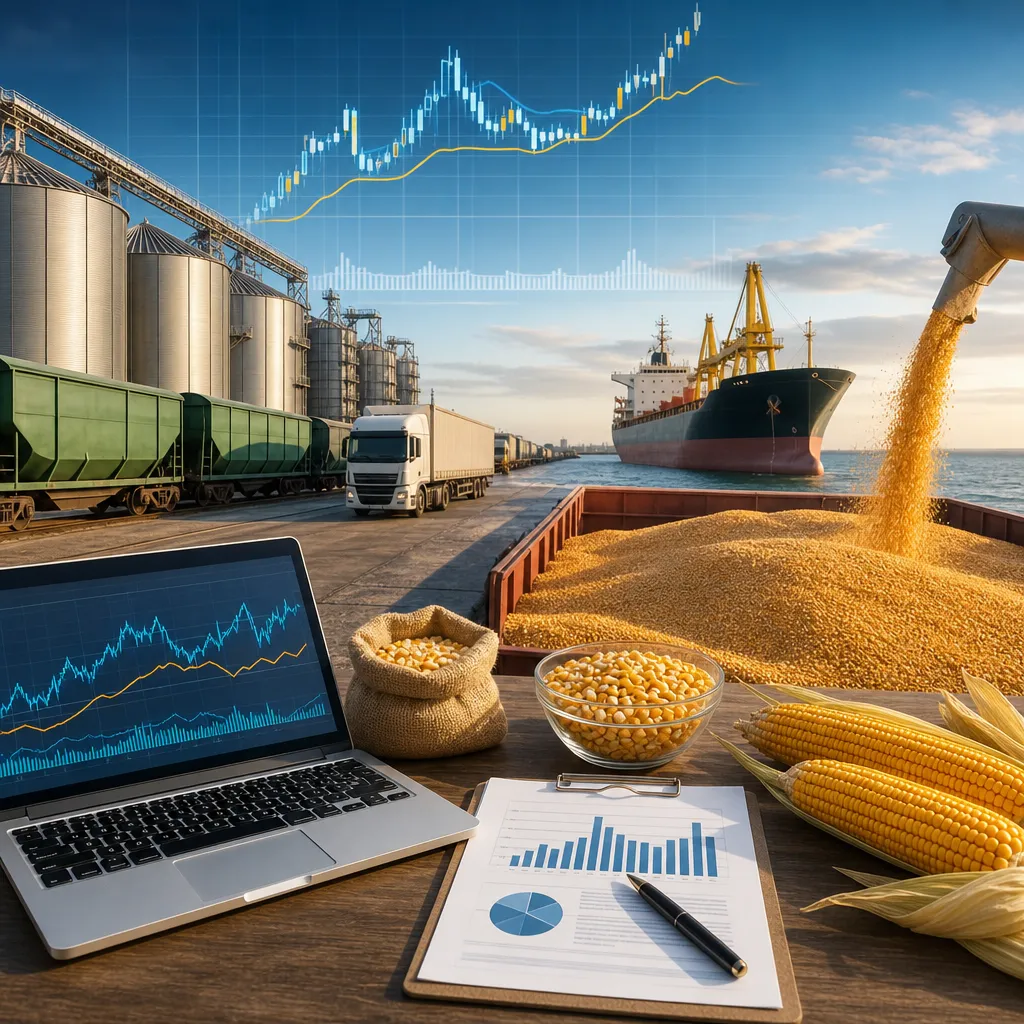








The Black Sea corn market is not a single exchange or one port. It is a regional export market centered on the countries that ship corn through the Black Sea, especially Ukraine, Romania, Bulgaria, and, in some years, Russia as a smaller corn exporter than its wheat role would suggest. In practice, traders use “Black Sea corn” to mean physical corn originating in this region and priced for domestic delivery, inland collection, or export shipment from Black Sea and nearby Danube-linked ports. The market matters because Black Sea-origin corn is a major competitor to corn from the United States, Brazil, and Argentina in feed and industrial demand markets across Europe, the Mediterranean, the Middle East, and parts of Asia.
For readers trying to understand or trade this market, the key point is that Black Sea corn prices are formed in the physical export chain first, then connected to global futures and competing origin prices. A farmer, elevator, exporter, feed mill, or importer may all talk about “the price,” but they may be referring to very different things: an inland cash bid, a delivered elevator price, a port bid, an FOB export offer, or a futures benchmark adjusted by basis. Knowing the geography, logistics, and pricing language is more important here than simply watching one screen quote.
What the Black Sea corn market means
The Black Sea corn market is the network of production areas, inland collection points, rail and truck routes, river systems, export terminals, and import demand relationships tied to corn moved out of the Black Sea region. The main export-oriented origins are:
- Ukraine — historically one of the most important Black Sea corn exporters.
- Romania — a major EU corn producer and exporter, with strong port relevance.
- Bulgaria — a smaller but relevant exporter into regional and seaborne trade.
- Russia — better known for wheat, but still part of the regional corn conversation in some seasons.
Pricing is usually discussed in US dollars per metric ton for export trade. Domestic and farm-level trade may also be discussed in local currencies per metric ton:
- Ukraine: hryvnia per metric ton in local trade, alongside dollar-linked export indications.
- Romania: Romanian leu per metric ton domestically, though export values are often compared in euros or US dollars.
- Bulgaria: Bulgarian lev per metric ton locally, with export values often referenced in euros or dollars.
- Russia: rubles per metric ton domestically and dollars for export comparison.
Because this is a seaborne export market, Black Sea corn is often priced against rival export origins rather than only against one domestic benchmark. At the same time, global futures, especially CME Group corn futures in Chicago and, for European market comparison, Euronext grain contracts, influence price discovery and hedging decisions.
Where the market operates
The market operates across inland crop regions and export corridors. It is not limited to one exchange floor or digital venue. Physical trade flows from crop-producing areas to collection points, then to domestic users or to export terminals.
In broad terms, the market works in three layers:
- Farm and inland market — farmers sell to local traders, elevators, cooperatives, feed mills, processors, or exporters.
- Domestic logistics market — grain moves by truck, rail, barge, or river-sea logistics depending on the country and corridor available.
- Export market — merchants and exporters sell cargoes FOB, CIF, or on another shipment basis to international buyers.
For Romania and Bulgaria, the Black Sea trade is closely linked with EU internal grain movement and Danube logistics. For Ukraine, the situation can be more complex because trade routes may include Black Sea ports when available, Danube outlets, overland movement into the EU, and alternate export corridors depending on infrastructure and security conditions. That means “Black Sea price” can sometimes reflect a port market and sometimes a constrained logistics-adjusted origin value.
| Market segment | Where it operates | Typical quotation style | Main users |
|---|---|---|---|
| Farm/inland cash | Local crop regions, inland elevators, merchant collection points | Local currency per metric ton, ex-farm or delivered | Farmers, local traders, feed users |
| Port or terminal market | Black Sea ports, Danube-linked export points, terminal networks | Delivered port or terminal bid, often compared in US dollars or euros per metric ton | Exporters, merchants, large producers |
| FOB export market | Seaborne cargo trade linked to loading ports | US dollars per metric ton FOB | International traders, importers, feed buyers |
| CIF import market | Destination country or importer market | US dollars per metric ton CIF | Importers, feed compounders, state buyers, private mills |
| Futures/options market | Exchange-traded, mainly outside the region | Exchange contract price, not a local physical bid | Hedgers, merchants, investors, risk managers |
How Black Sea corn prices are formed
Black Sea corn pricing starts with the value of corn to the next buyer in the chain, then adjusts for transport, quality, storage, risk, and competitive alternatives. A local farmer does not usually receive the same number as an FOB export offer because the export buyer must still cover inland freight, elevation, terminal handling, financing, losses, and margin.
The practical pricing terms matter:
- Futures price — an exchange-traded benchmark, useful for hedging and broad market direction, but not the exact local cash value.
- Cash bid — the physical price offered by a local buyer at farm, elevator, or warehouse level.
- Delivered price — the price paid if grain is delivered to a specified location such as a mill, inland warehouse, or export terminal.
- FOB price — free on board; the seller delivers the corn loaded for export at the named port.
- CIF price — cost, insurance, and freight; the delivered import price into the destination market.
- Basis — the difference between the local physical price and a relevant futures benchmark or competing export value.
In the Black Sea region, basis can be shaped by local conditions more sharply than in some more standardized domestic futures markets. Important drivers include:
- harvest size and quality,
- port access and congestion,
- railcar and truck availability,
- river logistics and water conditions,
- competition among exporters,
- currency movements,
- freight costs to destination markets,
- EU demand or import policy effects,
- competition from US, Brazilian, and Argentine corn.
This is why a Chicago corn futures move may influence Black Sea values without determining them exactly. If export freight rises, or if a port buyer urgently needs nearby supplies, the local bid may move differently from futures. Likewise, a weak local currency can support export competitiveness even if international flat prices are unchanged.
Benchmark markets and the role of futures
There is no single dedicated “Black Sea corn futures contract” that serves as the sole benchmark for the entire regional physical market. Instead, traders often watch a combination of global and European indicators.
CME Group corn futures are widely followed because the US corn market remains the main global benchmark for corn price direction and risk management. These futures help merchants and larger commercial firms hedge broad price exposure. However, CME corn is quoted in a US exchange format and reflects US contract standards, so a local Black Sea buyer still has basis and origin-specific risk.
Euronext grain markets matter particularly for participants focused on EU grain flows and substitution economics. Even when corn itself is not perfectly represented by one local benchmark for every transaction, European grain futures can still influence feed grain relationships, risk management, and merchant pricing decisions.
In practice:
- Physical traders use futures as a hedging tool, not as a direct replacement for a port bid.
- Importers compare Black Sea FOB offers with offers from other origins.
- Domestic buyers may use futures only indirectly, through the prices quoted by merchants.
A trader who buys physical corn in Romania or Ukraine may hedge price exposure on a futures exchange through a brokerage account, but the hedge does not remove local basis risk, quality risk, or logistics risk.
Where to check Black Sea corn prices and market information online
There is no single official screen that gives the exact “live Black Sea corn price” for every country, location, and quality. Readers should instead check a combination of official and market-reporting sources, then identify whether they are viewing futures, export indications, or domestic cash information.
Useful places to monitor the market include:
- CME Group — for global corn futures benchmarks used in hedging and price direction.
- Euronext — for European grain futures and broader regional benchmark context.
- USDA, especially the Foreign Agricultural Service and World Agricultural Supply and Demand reporting ecosystem — for country supply, demand, and trade context.
- European Commission market information — for EU grain trade and market context relevant to Romania and Bulgaria.
- National agriculture ministries and statistics agencies — for crop progress, production, and trade context when available.
- Local elevators, cooperatives, exporters, and grain merchants — for actual cash bids and delivered terms.
- Specialized agricultural market reporting services and brokers — for port indications, FOB market commentary, and basis discussions.
When checking price information online, always confirm:
- the origin country,
- the location such as inland, delivered terminal, or FOB port,
- the currency,
- the unit, usually metric tons,
- the delivery period,
- the quality basis, if stated.
A “futures quote” is not the same as a farmgate bid. A “port indication” is not automatically the same as what a producer receives inland. Those differences are routine and commercially important.
| Source type | What it usually shows | Best use | Main limitation |
|---|---|---|---|
| Exchange website | Futures and options benchmarks | Direction, hedging reference | Not a local physical cash bid |
| Government or official market reports | Production, trade, policy, crop conditions | Fundamental analysis | Often not real-time transactional pricing |
| Merchant or elevator bid sheets | Actual local buying prices | Selling physical grain | Location-specific and may change quickly |
| Export market commentary | FOB offers, cargo demand, freight context | Understanding export competitiveness | May reflect indications rather than executed trade |
How physical corn is bought, sold, and exported
Physical Black Sea corn trading usually begins with bilateral commercial transactions rather than exchange delivery. Farmers and local grain holders sell to:
- local elevators or warehouses,
- cooperatives where relevant,
- international grain merchants,
- feed mills or livestock integrators,
- starch, ethanol, or industrial processors where present,
- exporters sourcing for terminal shipment.
A physical contract typically specifies:
- quantity,
- quality standards,
- delivery point,
- delivery window,
- pricing method,
- payment terms,
- responsibility for transport and loading,
- claims and dispute terms.
Quality is central. Moisture, test weight, foreign matter, damage, and other grade factors can all affect discounts or acceptance. In export trade, the buyer may require a particular shipment period and origin documentation. Corn can be sold ex-farm, delivered inland, delivered port, or FOB export basis depending on the seller’s capability and the buyer’s logistics setup.
Counterparty risk matters. In practice, sellers and buyers should verify the financial reliability of the merchant, terminal, or exporter, and understand whether the price is fixed, index-linked, or “to be fixed” later against a benchmark.
How hedging and futures trading actually work
Futures and options trading is a separate activity from owning physical Black Sea corn. It normally takes place through a regulated broker with access to an exchange such as CME Group or, where relevant for broader grain risk, Euronext.
This market is used by:
- hedgers — merchants, processors, importers, and larger producers trying to reduce price risk,
- speculators — traders seeking profit from price movement without taking physical grain exposure.
The process is usually:
- Open a brokerage account.
- Meet margin requirements.
- Buy or sell futures, or use options if suitable.
- Offset the position before expiry or manage delivery risk according to the contract and strategy.
For Black Sea corn participants, the main caution is basis risk. A hedge based on exchange futures may protect against broad international corn price moves, but not against local disruptions such as port bottlenecks, origin-specific quality issues, or abrupt changes in freight, regulation, or corridor access.
So futures are best viewed as a risk-management overlay on top of physical trading, not a substitute for understanding the real grain supply chain.
Main supply, demand, and forecast drivers
Any Black Sea corn outlook should be framed in scenarios rather than certainty. The market can shift quickly because production and logistics are both highly important.
Key drivers include:
- Weather during planting, pollination, and harvest.
- Acreage decisions versus wheat, sunflower, barley, or other crops.
- Yield and quality, especially moisture and harvest condition.
- Export corridor reliability and inland transport capacity.
- Currency moves against the US dollar and euro.
- EU import demand and feed grain substitution.
- Competition from Brazil, the United States, and Argentina.
- Freight and insurance costs for seaborne trade.
- Policy and trade restrictions where applicable.
A constructive price scenario would usually involve tighter regional supply, stronger import demand, smoother export logistics, or firmer global benchmarks. A weaker scenario would typically involve large crops, aggressive competition from other exporters, softer feed demand, or logistical constraints that pressure inland values even when FOB values are stable.
Practical trading guide for market participants
For a farmer or physical seller, the most practical approach is to compare multiple nearby cash buyers and identify whether the bid is ex-farm, delivered, or port-related. If storage is available, the decision may include carry, drying cost, financing cost, and the chance of basis improvement. If immediate cash flow is needed, a straightforward nearby physical sale may be more important than trying to optimize every futures movement.
For an exporter or commercial trader, attention usually centers on spread management: inland origination cost versus terminal value, terminal value versus FOB sale, and FOB competitiveness versus rival origins. Freight, line-up timing, vessel planning, and contract performance are as important as the flat corn price.
For an importer, the relevant number is not a Black Sea inland bid, but the delivered import replacement cost. Buyers compare Black Sea corn with other origins on total landed economics, quality, reliability, shipment timing, and contract risk.
For a futures trader, the guide is different: choose the exchange and product carefully, understand margin and expiry, and remember that a profitable futures position does not mean access to physical grain, while a poor basis move can hurt a physical trader even when futures move in the expected direction.
What is the main benchmark for Black Sea corn prices?
There is no single universal Black Sea corn benchmark. Traders commonly watch CME corn futures for global direction and use regional export offers, port indications, and European market references to judge Black Sea competitiveness.
Where can I check Black Sea corn prices online?
You can check CME Group and Euronext for futures benchmarks, USDA and European Commission reporting for market context, and local merchants, exporters, elevators, and specialized market services for actual cash or port indications.
Are Black Sea corn prices quoted in dollars or local currency?
Export trade is commonly compared in US dollars per metric ton. Domestic trades may be quoted in local currency per metric ton, depending on the country and delivery point.
What is the difference between a local cash bid and an FOB Black Sea price?
A local cash bid is what a buyer offers for physical grain at a farm, elevator, or inland point. An FOB Black Sea price is the export value of corn loaded onto a vessel at the port, after inland logistics and export chain costs are covered.
Can I buy Black Sea corn through a futures exchange?
Not in the same way as buying a local physical cargo. Futures exchanges provide financial exposure and hedging tools. Physical Black Sea corn is normally bought through merchants, exporters, or direct commercial contracts.
Why do Black Sea corn prices move differently from Chicago futures?
Because local prices also reflect basis, origin quality, port demand, storage, transport, currency, freight, and regional supply-and-demand conditions. Chicago futures are a benchmark, not a full local price.
Who usually exports Black Sea corn?
Exports are typically handled by grain merchants, trading houses, exporters, and terminal operators sourcing from farmers and inland networks, then selling cargoes to foreign importers.
What are the biggest risks in trading Black Sea corn?
The biggest risks are basis volatility, logistics disruption, quality claims, counterparty performance, freight changes, currency swings, and misunderstanding the difference between futures exposure and physical ownership.
Sources
- USDA Foreign Agricultural Service
- CME Group
- European Commission