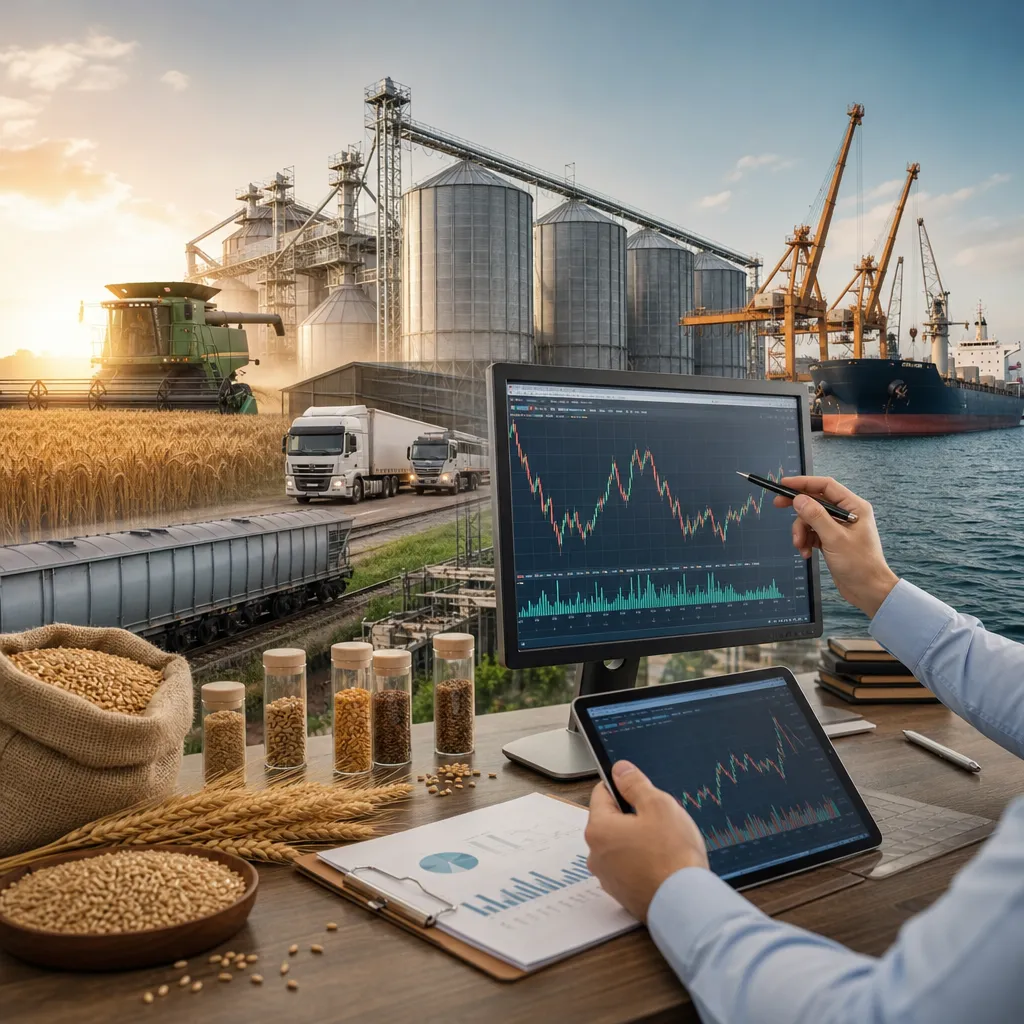










China’s grain futures market is centered in mainland China and serves the country’s large domestic agricultural economy rather than the export-oriented model seen in some other grain hubs. In practice, when people refer to the China grain futures market, they usually mean exchange-traded futures and options on crops and oilseeds listed mainly on the Dalian Commodity Exchange and the Zhengzhou Commodity Exchange. These futures markets help mills, feed companies, crushers, merchants, and investors manage price risk, but they are only one part of a much larger physical market where grain is bought, moved, stored, imported, and processed across China. Understanding the market requires separating the exchange price from the local delivered or spot price paid by a buyer in a specific province, port, or processing area.
What the China grain futures market means
China’s grain futures market is the organized exchange market where standardized contracts are traded for key agricultural commodities relevant to the Chinese food and feed system. The most important exchanges for grains and related products are:
- Dalian Commodity Exchange (DCE) for major agricultural contracts including corn, soybean-related products, and other commodity futures.
- Zhengzhou Commodity Exchange (ZCE) for several agricultural contracts important to domestic food processing and farming.
These exchanges list futures and, in some cases, options contracts that are used for hedging and price discovery. The contracts are quoted in renminbi (RMB), usually on a metric ton basis. That matters because China’s physical grain trade also commonly uses yuan per metric ton, making domestic futures relevant for local commercial users.
China is one of the world’s largest consumers of grains and oilseeds. It is a major producer of corn, rice, and wheat, but it is also a major importer of some agricultural raw materials, especially soybeans. As a result, Chinese grain futures are influenced both by domestic crop conditions and by international markets such as Chicago futures and global import prices.
Where the market operates
The exchange part of the market operates electronically through Chinese futures exchanges and licensed futures companies. The physical grain market operates across producing areas, feed and processing regions, storage networks, and ports.
Geographically, the most important production and consumption patterns shape how the market works:
- Northeast China is important for corn and soybeans.
- North China Plain is important for wheat and corn production and consumption.
- Southern coastal and river-linked regions are major feed and processing demand centers and key import receiving areas.
- Port markets matter because imported grain and oilseeds enter through coastal terminals before moving inland to crushers, feed mills, and processors.
China’s domestic grain pricing is therefore not a single national cash price. A futures contract may trade in one central market, while the physical price differs by province, warehouse, mill, feed plant, rail destination, or port discharge point.
| Market layer | Where it operates | What it does | Typical users |
|---|---|---|---|
| Futures market | DCE, ZCE electronic trading | Price discovery, hedging, speculation | Processors, feed firms, merchants, investors |
| Local cash market | Producing provinces, warehouses, inland consuming areas | Physical buying and selling of grain | Farmers, traders, mills, feed companies, state entities |
| Port import market | Coastal import terminals | Pricing of imported cargoes and distribution inland | Importers, crushers, feed buyers, merchants |
Which commodities matter most
The phrase “grain futures” in China can cover more than just wheat and corn. In commercial use, market participants often watch a broader agricultural complex because feed demand, edible oils, and import flows are connected.
Commonly followed commodities include:
- Corn, important for feed and industrial demand.
- Wheat, important for flour milling and food security.
- Rice, important domestically, though pricing behavior differs from more globally traded feed grains.
- Soybeans and soybean products, especially relevant because China is a major soybean importer and crusher.
For many Chinese commercial users, the relevant benchmark may not be only one domestic grain future. A feed company, for example, may watch corn futures, soybean meal futures, imported raw material costs, freight, and local replacement values at the same time.
How prices are formed in China
China grain prices are formed through the interaction of exchange benchmarks, local supply and demand, government policy, logistics, and international trade. The key point is that futures are not the same as cash prices.
A practical way to read the market is to separate price types:
| Price type | Usually quoted as | What it means |
|---|---|---|
| Futures price | RMB per metric ton on exchange | Standardized contract price for future delivery month; reference for hedging and market sentiment |
| Spot or cash price | RMB per metric ton in a local market | Price for physical grain traded now in a specific location and quality |
| Delivered price | RMB per metric ton to plant, mill, or warehouse | Includes transport and local logistics to the buyer’s destination |
| Import price | Usually a landed or cargo-based import valuation | Reflects international benchmark, ocean freight, exchange rate, and arrival costs |
| Basis | Cash minus futures, or premium/discount to futures | Shows the local price difference caused by location, quality, transport, and demand |
In reality, a local buyer in China may calculate a grain bid using some combination of:
- the relevant domestic futures contract,
- local inventory levels,
- government reserve buying or selling behavior,
- rail, truck, river, or port logistics costs,
- quality factors such as moisture, test weight, or damage,
- import parity for internationally traded crops,
- RMB exchange-rate effects where imports matter,
- competition among mills, crushers, feed companies, and merchants.
That is why a futures rally does not automatically mean every farmer or merchant in every province receives the same increase. The local basis can strengthen or weaken independently.
How the domestic market connects to global benchmarks
China’s grain futures market is domestic, but it is not isolated. The degree of global linkage depends on the commodity.
Soybeans and soybean products are strongly influenced by world trade because China is a major importer. International benchmarks such as Chicago soybean futures are widely watched, along with export values from major suppliers and ocean freight.
Corn and wheat are more affected by domestic policy, local production, and internal logistics, although global prices still matter when imports, substitution, or feed economics change. If world grain prices move sharply, Chinese users often compare domestic replacement cost with imported alternatives, even if trade policy limits direct transmission.
This means traders often watch both Chinese exchanges and international benchmarks. A crusher or feed manufacturer may hedge with domestic contracts for local exposure while also monitoring overseas futures to understand import economics and global sentiment.
How grain is actually bought, sold, imported, and moved
Most physical grain in China is not bought by clicking a futures contract. It is traded through commercial relationships, negotiated contracts, logistics arrangements, and quality inspection.
Physical grain trade inside China
Domestic grain is commonly sold through merchants, processors, mills, feed companies, and storage channels. The exact structure varies by crop and region, but a practical physical trade usually includes:
- Price discussion based on local market conditions and often influenced by futures.
- Quality terms covering moisture, impurity, grade, or other commercial standards.
- Delivery terms such as ex-warehouse, pickup point, or delivered to plant.
- Weighing and inspection on arrival or transfer.
- Payment terms agreed between counterparties.
For processors and feed mills, delivered price often matters more than a headline futures quote. A plant in a deficit area may pay a strong premium to attract grain, while a surplus production region may trade at a discount.
Imports and port market trade
Imported crops, especially soybeans and other internationally traded feed raw materials, are priced through global benchmarks plus freight, currency, insurance, and arrival costs. Port prices then become an inland reference for some buyers. The port market matters because it links China’s domestic consumption system to world commodity trade.
Imported grain or oilseeds typically move through:
- international sellers and trading houses,
- Chinese importers or end users,
- port terminals and discharge facilities,
- inspection and customs procedures,
- inland transport to crushers, feed mills, or storage sites.
When port supply is comfortable, inland buyers may have less urgency to bid up domestic grain. When import costs rise or arrivals tighten, local alternatives can gain value.
How futures and options are used for hedging
Exchange trading in China is mainly for risk management and financial exposure, not for ordinary farm-gate spot sales. A grain company may sell futures to protect the value of inventory, or buy futures to cover forward raw-material needs. An options strategy may be used to limit downside or upside exposure while keeping some flexibility.
It is important to separate physical ownership from financial hedging:
- A merchant can own physical corn in a warehouse and sell futures to hedge price risk.
- A feed mill can plan future purchases and buy futures or options to reduce exposure to rising prices.
- An investor can trade futures without buying or storing any grain at all.
Access to these markets normally takes place through a licensed futures intermediary in China. Traders must understand margin requirements, daily mark-to-market risk, contract expiry, and basis risk. Even a good hedge can still leave exposure if the local cash market moves differently from the futures contract.
Where to check prices and market information online
If you need current or recent China grain futures prices, the first place to check is the official exchange where the contract is listed. For domestic benchmark futures, that usually means:
- Dalian Commodity Exchange for listed agricultural contracts such as corn and soybean-related markets.
- Zhengzhou Commodity Exchange for listed agricultural contracts relevant to domestic grain and food processing.
For broader market context, readers commonly watch:
- National Bureau of Statistics of China for official macro and agricultural statistics.
- USDA Foreign Agricultural Service for external analysis of China’s grain and oilseed supply, demand, and trade.
- Commercial broker and market data platforms for charts, delayed quotes, and contract-month comparisons.
- Processors, mills, crushers, and local merchants for actual spot bids and delivered offers in specific areas.
There is an important practical distinction here: official exchange prices can usually be checked online, but the real physical price often must be confirmed locally. A mill’s delivered bid, a warehouse transfer price, and a port cargo indication may all differ from the futures screen.
If someone asks for the “China grain price today,” the correct follow-up questions are:
- Which commodity?
- Which exchange or physical market?
- Which contract month or spot location?
- Which quality specification?
- Is the price futures, spot, delivered, or import-based?
Main drivers and market outlook scenarios
Any forecast for China’s grain futures market should be handled as a scenario, not a certainty. Prices can react to a wide set of domestic and international forces.
| Driver | Why it matters | Possible market effect |
|---|---|---|
| Domestic weather and harvest | Changes production and quality | Can tighten or loosen local supply and affect basis |
| Government policy | Reserve management, import policy, and food security priorities influence trade flows | Can alter domestic price transmission and volatility |
| Feed demand | Large livestock and poultry sectors consume corn and meal | Stronger demand supports feed grain prices |
| Imports and global benchmarks | Imported alternatives affect replacement cost | Links domestic sentiment to Chicago and export markets |
| Currency and freight | Matter especially for imported crops | Can raise or lower landed costs and port competitiveness |
| Stocks and logistics | Inventory location matters as much as total supply | Creates regional premiums or discounts versus futures |
A bullish scenario for Chinese grain futures would usually involve tighter domestic supply, stronger feed or industrial demand, more expensive imports, or transport bottlenecks. A bearish scenario might involve a better crop, weaker demand, larger arrivals of imported substitutes, or softer policy support. But the actual outcome often differs by commodity and region.
Practical questions readers usually ask
Where can I check China grain futures prices?
The most reliable starting point is the official exchange site for the listed contract, mainly Dalian Commodity Exchange or Zhengzhou Commodity Exchange. Broker platforms and data vendors may also display prices, but the exchange remains the core reference.
Are China grain futures the same as the price farmers receive?
No. Futures are standardized exchange prices in RMB per metric ton, while a farmer or merchant receives a local cash bid adjusted for basis, quality, logistics, and buyer competition.
What currency and unit are normally used?
Domestic exchange and physical prices are commonly discussed in Chinese renminbi, usually quoted per metric ton. Imported cargo economics may also be compared with international benchmark values and freight-based landed costs.
Which Chinese exchanges matter most for grain markets?
Dalian Commodity Exchange and Zhengzhou Commodity Exchange are the key domestic agricultural futures venues. Their relevance depends on the specific commodity being traded or hedged.
How do imports affect China’s grain market?
Imports matter most for internationally traded crops such as soybeans and for any commodity where imported supply can compete with domestic replacement cost. Port prices and landed values can influence inland buyers and processors.
Can foreign traders use China grain futures as a direct substitute for Chicago markets?
Not necessarily. The contract structure, market access rules, domestic policy context, and relationship to local physical trade are different. Chinese contracts are mainly tools for pricing and hedging exposure within China’s own market environment.
How is grain physically sold in China?
It is usually sold through merchants, mills, feed companies, crushers, or other commercial buyers under negotiated quality and delivery terms. Online futures trading does not replace the need for local contracts, inspection, logistics, and settlement.
What is the most common mistake when reading the China grain market?
The biggest mistake is treating one futures quote as if it were the exact national cash price. China has many regional markets, and location, quality, policy, and transport can move local prices away from the exchange benchmark.
Sources
- Dalian Commodity Exchange
- Zhengzhou Commodity Exchange
- USDA Foreign Agricultural Service