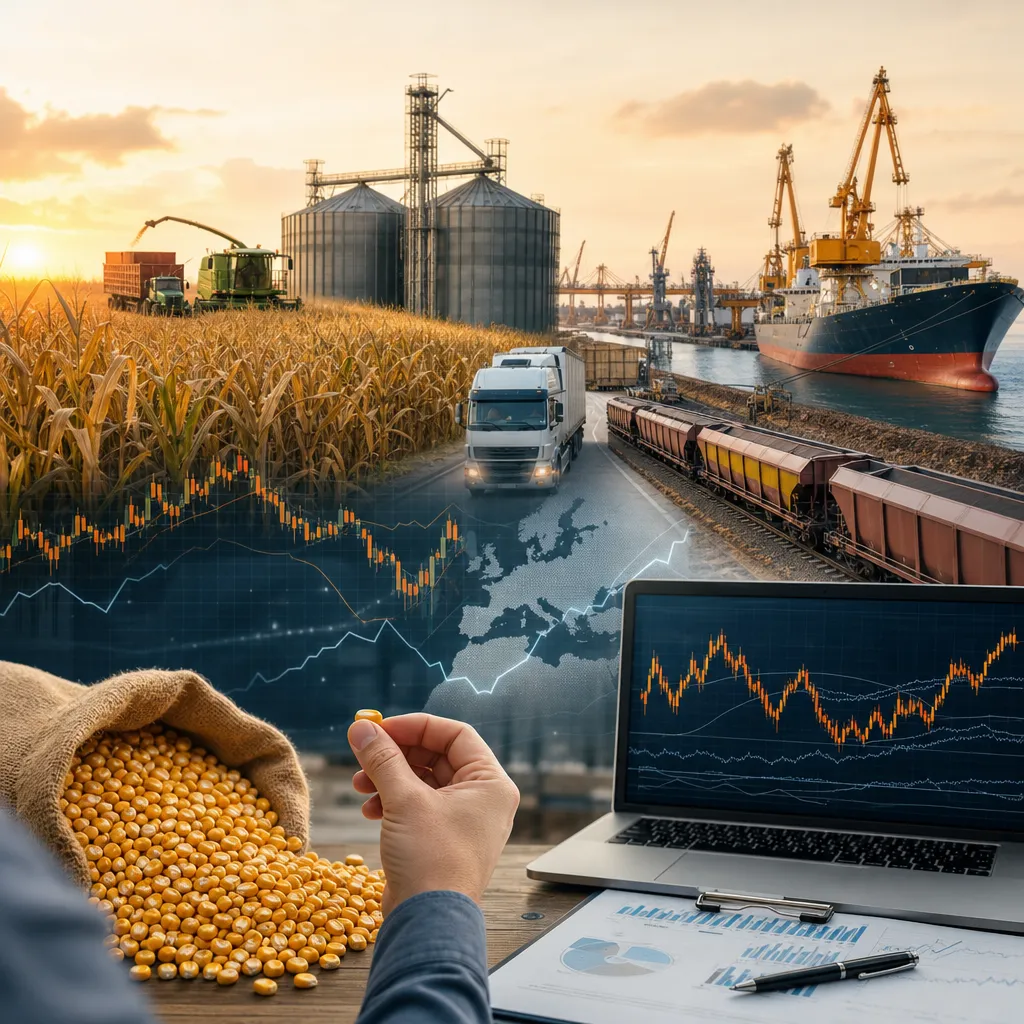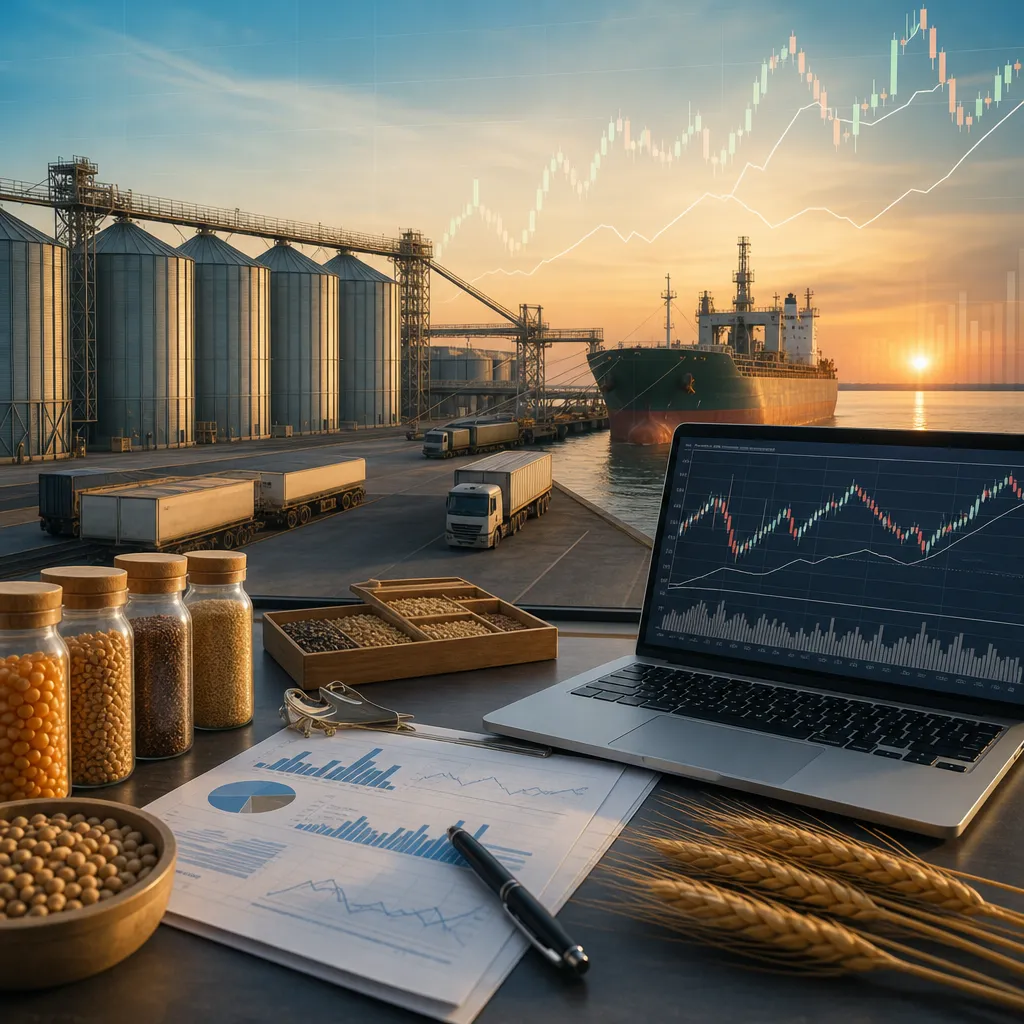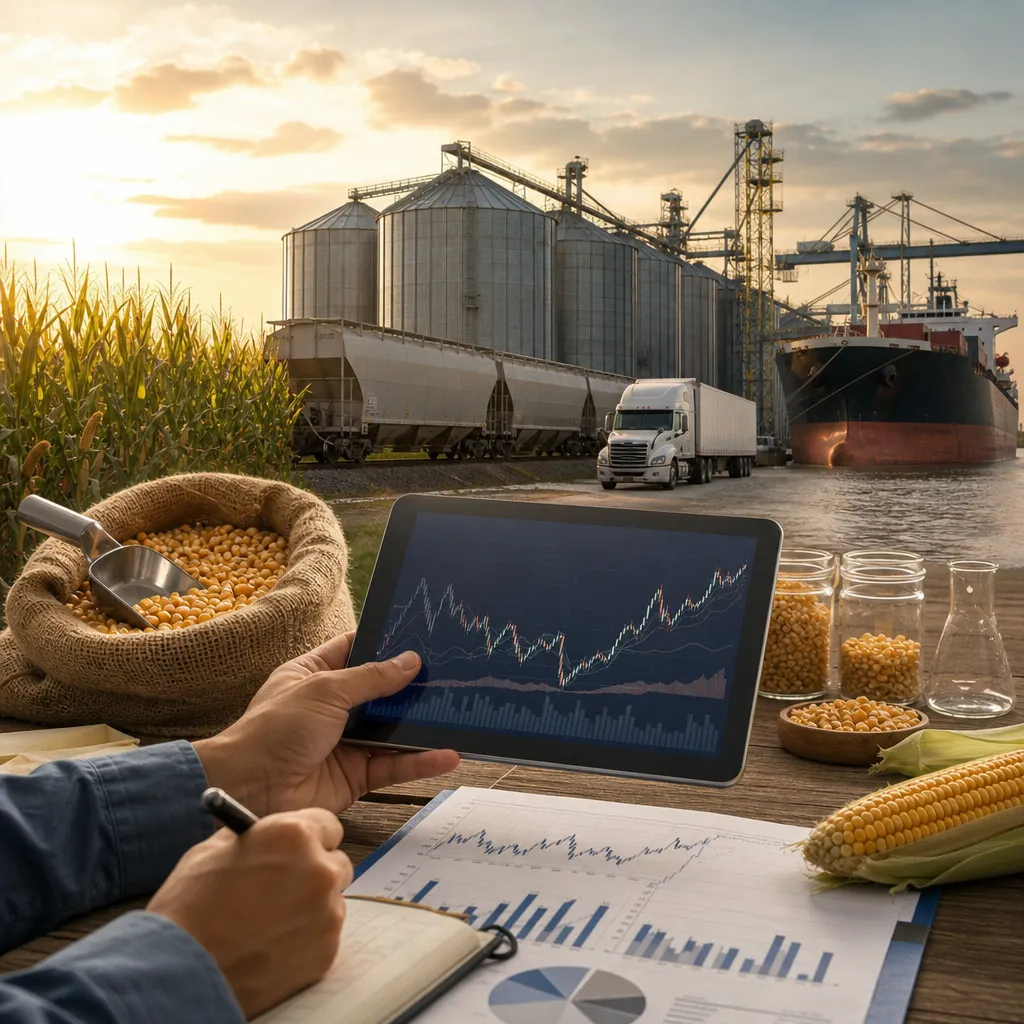
Fundamental analysis for grain is the practical study of what drives grain prices in both the futures market and the physical cash market. It focuses on supply, demand, stocks, weather, trade flows, logistics, currency moves, and policy rather than chart patterns alone. In grain, the key point is that the quoted exchange price is not automatically the price a farmer or buyer pays locally: local basis, freight, quality, and delivery terms matter. Good grain analysis therefore means knowing both where to find official market data online and how grain is actually bought, sold, stored, and moved in the real world.
What fundamental analysis means in grain
In grain markets, fundamental analysis asks a simple question: is the market becoming tighter or more comfortable? If production is likely to fall while feed, export, or crush demand stays strong, prices may strengthen. If acreage expands, yields improve, and stocks rise faster than use, prices may weaken.
This analysis applies to wheat, corn, soybeans, rice, barley, oats, rye, sorghum, canola, rapeseed, and sunflower seed, but each crop has different demand channels. Corn is heavily affected by feed and ethanol demand. Soybeans depend on crush margins, meal demand, oil demand, and Chinese imports. Wheat depends on milling quality, feed substitution, and export competition from major origins.
Fundamental analysis is used by:
- Farmers deciding when to sell old crop or hedge new crop
- Elevators and cooperatives setting bids and managing basis
- Processors such as mills, crushers, maltsters, and feed manufacturers securing supply
- Exporters and merchants managing origin, freight, and destination risk
- Futures traders and options users taking directional or spread positions
- Analysts comparing official data with market expectations
Futures prices versus cash grain prices
One of the most important practical distinctions in grain is the difference between futures and cash. Futures prices are standardized exchange-traded contracts. Cash prices are the actual bids or offers for physical grain at a local delivery point.
For example, a corn futures contract quoted on a regulated exchange reflects a benchmark for a specific contract month, quality standard, and delivery structure. A local elevator bid reflects that futures benchmark plus or minus a basis, adjusted for local supply, demand, freight, storage, and competition among buyers.
Where readers normally check futures prices:
- Exchange websites such as CME Group for benchmark agricultural futures
- Licensed futures brokers and trading platforms
- Professional market-data terminals and commercial charting services
Where readers normally check local cash grain prices:
- Grain elevators and cooperatives
- Merchants and regional grain buyers
- Processors such as mills, crushers, ethanol plants, and feed mills
- Government or exchange-linked cash reporting systems where available
- Regional agricultural market reporting services
A farmer selling physical wheat does not sell directly into a screen quote unless entering a futures hedge. The actual physical transaction is usually with an elevator, cooperative, merchant, processor, or brokered cash buyer, and the contract must specify quantity, grade, moisture, delivery location, timing, and payment terms.
| Market type | What it shows | Where it is used | Main limitation |
|---|---|---|---|
| Futures market | Standardized benchmark price for a delivery month | Hedging, speculation, price discovery | Not the same as a local farm or plant bid |
| Cash elevator bid | Actual local buying price for physical grain | Farm sales and nearby delivery | Varies by quality, freight, and local demand |
| Forward cash contract | Future physical delivery price or basis agreement | Producer and buyer risk management | Counterparty and production risk must be managed |
| Export offer market | FOB or destination pricing for international trade | Traders, exporters, importers | Includes logistics and trade terms not visible in futures alone |
The main grain fundamentals to track
Most grain market moves can be traced back to a short list of fundamentals. The skill is not just knowing them, but understanding which factor matters most at a given time.
1. Acreage and planted area
If farmers plant more corn and less soybeans, the supply outlook changes before yield is even known. Early-season acreage expectations often move new-crop futures sharply.
2. Yield and production
Yield determines how much grain is produced per acre or hectare. Weather during emergence, pollination, grain fill, and harvest can alter production dramatically. Analysts compare trend yield, model yield, and official survey-based estimates.
3. Beginning stocks and ending stocks
Stocks describe how much grain is carried from one season into the next. Tight carryout generally means the market has less room for a production problem. Large carryout usually reduces urgency unless demand improves.
4. Domestic demand
Demand differs by crop:
- Corn: feed, ethanol, industrial use
- Soybeans: crush into meal and oil, export demand
- Wheat: food use, feed substitution, exports
- Barley: feed and malting
- Canola/rapeseed/sunflower seed: crush demand and vegetable oil complex
5. Exports and imports
Grain is globally traded, so local prices can be influenced by conditions far away. A good crop in one exporting country can pressure world offers. A weather loss, export restriction, currency change, or port disruption can tighten supply for importers.
6. Weather
Weather matters before planting, during crop development, and at harvest. Fundamental analysts monitor rainfall, temperature, soil moisture, drought maps, and frost risk. Weather impacts can be local or global, especially in major exporters.
7. Currency, energy, and freight
A weaker exporting-country currency can improve competitiveness. Higher energy prices can influence drying, fertilizer, transport, and biofuel economics. Freight and port congestion can widen the gap between futures values and real export prices.
Where to find reliable grain data and how to use it
The best grain analysis starts with official and exchange-based information, then adds local market intelligence. Public reports are useful because they are widely watched and often move prices immediately.
| Report or source | Publisher | What it is used for | Typical users |
|---|---|---|---|
| WASDE | USDA | Global and U.S. supply-demand balance sheets | Farmers, traders, analysts, processors |
| Crop Progress | USDA | Planting pace, crop condition, harvest progress | Weather traders, merchants, producers |
| Export Sales | USDA | Weekly export commitments and shipments | Exporters, analysts, futures traders |
| Futures settlement and contract specs | CME Group or relevant exchange | Benchmark prices, expiry, tick size, delivery terms | Hedgers, brokers, market analysts |
| Commitments of Traders | CFTC | Positioning by trader category in futures and options | Analysts, macro traders, sentiment watchers |
How these are used in practice:
- WASDE helps estimate whether the market is moving toward tighter or looser ending stocks.
- Crop Progress is especially important during planting and summer weather markets.
- Export Sales shows whether overseas demand is keeping up with expectations.
- Exchange contract information is essential before using futures or options, because delivery months, units, and quality standards are standardized and may not match local physical terms exactly.
- CFTC positioning data helps show whether funds are heavily long or short, which can affect volatility around news.
Outside the United States, readers should also use national agriculture ministries, statistical agencies, customs databases, and exchange publications relevant to their own market. Importers and exporters often rely on port lineups, vessel data, inspection reports, and private freight intelligence, but these are usually more specialized and sometimes commercial.
How grain is physically bought and sold
Physical grain trading is not the same as clicking a futures order. It usually happens through a chain of local and regional participants.
Common physical market participants include:
- Farmers and producer groups
- Country elevators and agricultural cooperatives
- Grain merchants and originators
- Flour mills, feed mills, crushers, maltsters, and ethanol plants
- Exporters and importers
- Warehouses and inspection providers
A typical cash transaction works like this:
- The seller asks for bids from elevators, cooperatives, processors, or merchants.
- The buyer quotes a cash price or a futures-plus-basis structure for a defined delivery window.
- The parties agree on quantity, quality, moisture, grade, protein or oil if relevant, delivery point, and pricing method.
- The grain is delivered by truck, rail, barge, or vessel depending on scale and market location.
- The grain is inspected or graded under local rules or contract specifications.
- Payment is made according to the agreed commercial terms.
Where this happens in practice:
- At local grain elevators and cooperative intake points for farm-origin grain
- At processor plants for direct-delivery contracts
- At warehouses and terminals for stored grain transfers
- At ports and export terminals for international trade flows
- Through merchants or brokers arranging origin-to-destination contracts
Key commercial details to check include basis, freight responsibility, quality tolerances, dockage, moisture discounts, payment timing, title transfer, and dispute resolution. In export trade, Incoterms, sanitary rules, and inspection certificates may also matter.
How futures and options fit into grain analysis
Futures and options are mainly risk-management tools, although speculators also use them. Grain futures trade on regulated exchanges through a licensed broker or futures commission merchant. A trader needs an approved brokerage account and must post margin. That is very different from buying a truckload of physical corn from a local elevator.
A grain futures contract represents a standardized quantity and contract month. It can be offset financially before delivery, and most speculative trading never results in physical delivery. However, contract delivery rules still matter because they help anchor price relationships.
How grain businesses use these markets:
- Farmers may sell futures to hedge expected production
- Processors may buy futures to defend input costs
- Elevators may hedge inventory and basis exposure
- Exporters may hedge flat price risk while negotiating physical business
- Options users may buy puts or calls to define risk more clearly than futures alone
Main risks and limitations:
- Margin calls can be large in volatile markets
- Basis risk remains even if futures are hedged
- Options cost a premium
- Contract months and delivery grades may not perfectly match the physical exposure
- Leverage increases both profit potential and loss potential
Weather, logistics, and quality: the fundamentals beyond the balance sheet
Grain prices do not move only because of nationwide crop size. Real-world market tightness often shows up first in logistics and quality.
Weather can cut yield, delay planting, harm grain fill, or reduce quality. Excess rain at harvest can increase sprouting, disease, and drying needs. Drought can reduce test weight or oil content depending on the crop.
Logistics matter because grain must move from farm to user. River levels, rail service, truck availability, port congestion, and storage space can all affect local bids. A futures market may look stable even while local basis strengthens because a plant or exporter urgently needs nearby supply.
Quality is crucial in wheat, malting barley, rice, and oilseeds, but it matters in feed grains too. Protein, moisture, foreign material, falling number, oil content, and damage levels can create separate price tiers. A headline production number may hide a shortage of usable quality.
For this reason, practical grain analysis combines top-level supply-demand reports with local intelligence from cash buyers, inspection results, weather maps, and transportation conditions.
How to build a practical grain fundamental workflow
An effective process is usually simple and repeated regularly.
- Start with benchmark futures for the crop and contract month most relevant to your decision.
- Check local bids from elevators, cooperatives, processors, or merchants in your delivery area.
- Compare basis with recent history if you have access to local records.
- Review official reports such as supply-demand, crop progress, and export data.
- Monitor weather in key producing and exporting regions, not just your own farm or country.
- Track logistics and quality issues that may distort local cash values.
- Separate old crop from new crop because they often trade on different fundamentals.
- Use scenarios rather than one fixed forecast, especially around growing-season risk.
This workflow can be done with public data plus local market contacts. Commercial data platforms can help with speed, charting, cash aggregation, and analytics, but they do not replace understanding basis, delivery terms, and crop-specific demand.
Common mistakes in grain fundamental analysis
- Using a futures quote as if it were the exact local cash price
- Ignoring basis and freight
- Watching only one country in a globally traded crop
- Focusing on production while ignoring demand destruction or substitution
- Missing quality problems inside a large crop
- Relying on acreage or weather headlines without checking stocks
- Using leverage in futures without understanding margin risk
- Confusing online financial trading with actual physical grain procurement
Where can I check grain prices?
Benchmark futures prices are usually checked on exchange websites such as CME Group or through a futures broker or market-data platform. Local cash prices are usually checked through elevators, cooperatives, grain merchants, processors, or regional agricultural market reporting systems. The local bid is the relevant number for physical buying or selling.
What is the difference between grain futures and cash grain?
Futures are standardized exchange contracts used for price discovery and hedging. Cash grain is the physical commodity sold for actual delivery to a buyer such as an elevator, mill, crusher, or exporter. The cash price is influenced by futures, but also by basis, quality, freight, and delivery terms.
Where does physical grain trading usually happen?
It usually happens through local elevators, cooperatives, processors, merchants, exporters, and warehouses rather than directly on a retail trading platform. Deals may be negotiated by phone, email, trading desk, procurement system, or physical contract network depending on the market structure.
How do farmers use fundamental analysis?
Farmers use it to judge whether to sell at harvest, store grain, forward contract, hedge with futures, or buy options for protection. They usually combine futures trends, local basis, crop outlook, storage economics, and cash flow needs.
Which reports matter most for grain fundamentals?
Widely watched reports include USDA WASDE, USDA Crop Progress, USDA Export Sales, and CFTC Commitments of Traders. Exchange contract specifications and daily settlement data are also important when hedging or analyzing futures behavior.
Can I trade grain online without buying physical grain?
Yes. Futures and options can be traded online through a regulated broker if available in your jurisdiction. That is financial trading, not physical procurement. You still need to understand contract size, expiry, margin, and delivery rules before trading.
What should I check before selling physical grain?
Check the bid structure, basis, delivery point, acceptable quality, moisture, dockage rules, payment timing, storage alternatives, and who pays freight. Also confirm whether the contract is spot, forward, basis-only, or hedge-to-arrive if those tools are offered in your market.
Sources
- USDA World Agricultural Supply and Demand Estimates
- CME Group Agricultural Products
- CFTC Commitments of Traders