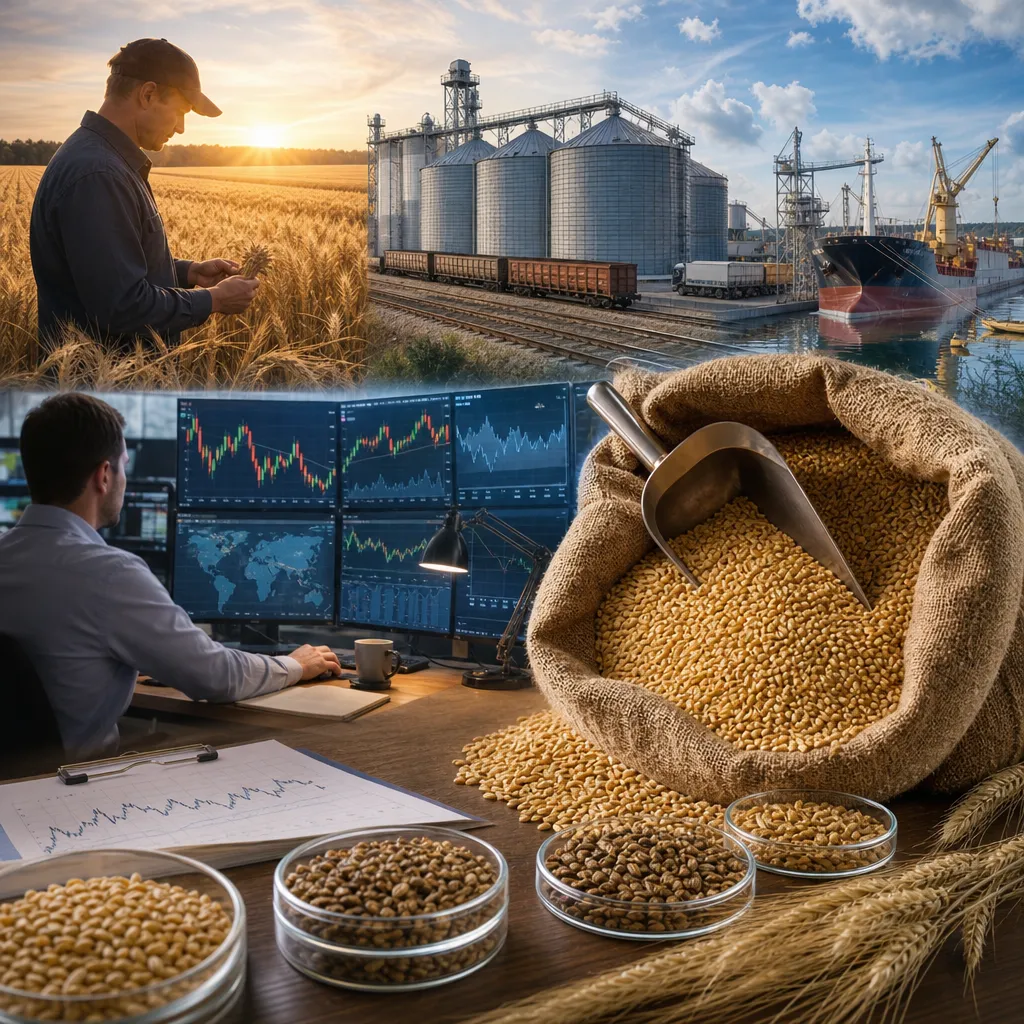





Backwardation in grain markets means nearby prices are higher than later prices. In practice, the market is paying more for grain now than for grain in a future delivery period. This usually signals tight nearby supply, urgent demand, high short-term logistics stress, or weak incentive to store grain. For farmers, elevators, processors, exporters, and futures traders, backwardation matters because it changes storage decisions, hedge outcomes, basis behavior, and the economics of when and where to move grain.
In grain, backwardation can appear in exchange futures such as wheat, corn, or soybeans, and it can also show up in the physical cash market through stronger nearby bids and inverted basis structures. A reader should not assume that a futures market in backwardation automatically means every local cash bid is high; local freight, quality, storage space, rail performance, river conditions, and export demand still matter. The key is to compare the futures curve with local basis and actual delivery opportunities.
What backwardation means in grain markets
A grain market is in backwardation when the nearby month trades above deferred months. If December corn futures are above March or May corn futures, or nearby wheat is above later contracts, the curve is inverted rather than carrying forward. The opposite structure is called contango or carry, where later months are priced above nearby months.
In normal storage markets, deferred prices often include some combination of storage cost, interest, insurance, and handling. When the curve moves into backwardation, the market is effectively saying that immediate grain ownership is more valuable than waiting. That often happens when end users need coverage quickly, export programs are active, or available deliverable stocks are tight.
Backwardation can be measured in several places:
- On regulated futures exchanges, such as CME Group markets for corn, soybeans, soybean meal, soybean oil, wheat, oats, canola-related benchmarks in relevant jurisdictions, and other agricultural contracts where applicable.
- In local cash markets, through elevator bids, processor bids, feed mill bids, ethanol plant bids, flour mill bids, crush plant bids, or export terminal bids.
- In spreads, such as nearby-versus-deferred futures spreads or old-crop versus new-crop price relationships.
How backwardation works in futures versus the physical grain market
Futures and physical grain are related, but they are not the same market. Grain futures trade on an exchange through a regulated brokerage account. Physical grain changes hands through elevators, cooperatives, merchants, processors, feed companies, mills, exporters, or direct farm-to-end-user contracts.
A futures quote tells you the exchange price for a standardized contract at a specified delivery month. A cash bid tells you what a real buyer at a specific location is willing to pay for grain of a certain quality, delivered now or in a specified period. The difference between the two is basis.
| Market | What backwardation looks like | Where to check it | Who uses it |
|---|---|---|---|
| Futures market | Nearby contract priced above deferred contract | Exchange data, broker platform, market-data service | Traders, hedgers, analysts, merchants |
| Cash market | Stronger nearby bids than later delivery bids | Elevator bids, processor bids, cooperative bid sheets, brokers | Farmers, elevators, end users |
| Basis structure | Nearby basis stronger than forward basis | Local merchandisers, bid comparison tools, contracts | Merchandisers, producers, buyers |
This distinction matters. A farmer may see a backwardated futures curve yet receive an unimpressive local bid if transportation is expensive, local stocks are adequate, or quality discounts are severe. Likewise, a crusher or mill may bid aggressively in cash even if the futures inversion is modest because the plant needs immediate supply.
Why backwardation happens in grain
Backwardation is usually a sign of nearby scarcity or near-term urgency. It can develop for fundamental, logistical, financial, or policy reasons.
| Driver | Typical effect | How market participants use it |
|---|---|---|
| Tight nearby stocks | Raises prompt demand for ownership | Merchants and end users may bid up spot positions |
| Weather risk before new crop | Supports old-crop premium until replenishment arrives | Traders watch crop progress and production risk closely |
| Export or processor demand surge | Nearby bids strengthen | Sellers compare domestic and export channels |
| Logistics bottlenecks | Prompt delivery points become more valuable | Basis can widen or invert by location |
| Weak storage incentive | Holding grain becomes uneconomic | Farmers and elevators may accelerate sales |
Examples include pre-harvest tightness in wheat, strong crush demand in soybeans, weather-related disruptions in corn regions, or port congestion affecting export channels. In some cases the inversion is driven more by location than by total national supply. A river terminal, export house, or processor can have immediate needs even when broader balance sheets look comfortable.
How farmers, elevators, and processors respond
Backwardation changes the economics of grain ownership. In a carry market, storage can be rewarded if the deferred months pay enough to cover interest, shrink, handling, and storage losses. In backwardation, the curve often penalizes waiting.
Farmers may sell more old crop sooner if the market is paying a premium for prompt movement. They still need to compare the cash bid with on-farm storage costs, local basis outlook, freight, and tax or cash-flow timing. A strong nearby futures price does not automatically outweigh drying costs, trucking constraints, or quality risks in storage.
Elevators and cooperatives often become less enthusiastic about carrying inventory when the market pays less for later ownership. They may push grain through the system faster, reduce bids for long storage, or adjust hedge structures. Their margin depends on basis, handling income, freight opportunities, and spread behavior.
Processors and feed users may bid aggressively nearby if they need physical coverage. Ethanol plants, crush facilities, flour mills, and feed mills often focus less on futures shape alone and more on immediate plant run rates, replacement costs, and local supply reliability.
Exporters and merchants pay close attention to vessel lineups, railcar availability, barge traffic, port demand, and destination buying. A grain market can appear only mildly backwardated on screen while export basis at a key terminal becomes very strong because nearby loading slots are valuable.
Backwardation and hedging: practical use and risks
Backwardation affects hedging differently for different participants. A producer hedging physical grain with futures must understand that hedge results come from both futures movement and basis movement. The shape of the curve matters, especially when rolling hedges.
If a hedger sells a nearby futures contract and later rolls to a deferred month, an inverted market can create a negative roll effect because the deferred month is cheaper than the nearby month in a way that changes the economics versus a carry market. Commercial firms that roll hedges frequently monitor spread costs very closely.
Key points for practical hedging:
- Futures trading requires a brokerage account with a regulated futures broker or futures commission merchant. It is a financial transaction, not the same as selling a truckload of grain.
- Exchange contracts are standardized by quantity, grade framework, location framework, and delivery month. Your farm grain may not match the precise exchange delivery economics or quality.
- Margin is required for futures positions. Backwardated markets can be volatile, and margin calls can rise quickly.
- Options can limit downside risk differently than straight futures, but option premiums are a real cost and implied volatility matters.
- Basis contracts, hedge-to-arrive contracts, and forward cash contracts offered by elevators or merchants may behave differently in an inverted market. Read delivery, pricing window, and roll provisions carefully.
None of these tools eliminates risk completely. Backwardation can flatten, deepen, or flip into carry as weather changes, harvest advances, imports arrive, or demand slows.
Where to check backwardation in grain markets
For futures, the standard reference point is the exchange price curve. CME Group is the main source for many globally watched grain futures, including corn, soybeans, soybean products, Chicago wheat, Kansas wheat, and oats. A broker platform or licensed market-data service may present the same contracts with spread charts and curve analysis tools. Commercial users often rely on professional terminals or ag market software, but public delayed data is widely available from exchange-related sources and financial market websites.
For physical grain, the best source is local bid information. Farmers and country merchandisers usually check:
- elevator and cooperative bid sheets, often posted online or through mobile apps,
- processor bid pages for mills, crushers, ethanol plants, and feed manufacturers,
- direct merchant bids from grain buyers and exporters,
- regional cash market reporting services where available,
- USDA Agricultural Marketing Service reports for certain cash markets and transportation indicators.
For official market reports and broader context, useful public sources typically include:
- USDA WASDE for world and U.S. supply and demand balances.
- USDA Crop Progress for planting, condition, and harvest pace.
- USDA Grain Transportation and market reporting for logistics clues and selected cash market information.
- CFTC Commitments of Traders for speculative and commercial positioning in futures markets.
- FAO and national agriculture agencies for international supply, trade, and food market context.
These sources are used differently. WASDE helps explain whether backwardation is tied to tight stocks. Crop Progress helps judge whether new supply may relieve nearby pressure. CFTC data helps show whether investor positioning is amplifying moves, although it does not replace physical market analysis.
How to analyze whether backwardation is actionable
A practical analysis starts with three comparisons: nearby futures versus deferred futures, local spot basis versus forward basis, and the cost of storage versus the value of waiting.
- Check the futures curve. Compare nearby and deferred contracts in the same crop and crop year where relevant.
- Check local bids. Compare spot delivery, next-month, and later delivery bids from elevators, processors, or export channels.
- Estimate storage economics. Include interest, aeration, shrink, insurance, quality risk, and handling losses.
- Assess logistics. Ask whether freight, rail service, river levels, or truck availability are temporarily distorting nearby demand.
- Review quality. Protein, test weight, moisture, oil content, damage, and mycotoxins can overwhelm futures signals in specific locations.
- Monitor reports. Watch crop reports, export sales, plant margins, and import tenders that may relieve or intensify nearby tightness.
Often the right question is not simply “Is the market backwardated?” but “Does this buyer, at this location, for this quality, pay enough now to beat my value of storage?”
Limits and common misunderstandings
Backwardation does not always mean grain prices are generally bullish for a long period. Sometimes it reflects a short-term squeeze that disappears quickly when harvest expands supply or imports arrive. It also does not guarantee that spot cash prices will outperform all deferred selling opportunities.
Common misunderstandings include:
- confusing futures inversion with a guaranteed profitable cash sale,
- ignoring basis, freight, and quality discounts,
- assuming all regions share the same market structure,
- rolling hedges without calculating spread costs,
- treating delayed online quotes as if they were executable local bids.
Physical grain markets remain highly local. Delivery point, inspection, loading speed, moisture limits, and payment terms still determine real value. In export-oriented regions, port basis and vessel demand may dominate. In interior regions, processor demand or storage congestion may matter more.
FAQ
Where can I see if corn, wheat, or soybean markets are in backwardation?
Check the futures curve on the relevant exchange data source or through a futures broker platform. Compare the nearby delivery month with later months. Then compare that with local elevator or processor bids, because local cash markets may diverge from the exchange structure.
Is backwardation bullish for grain prices?
It is usually supportive for nearby prices, but it is not automatically bullish for all time periods or all locations. It mainly signals stronger prompt demand or tighter nearby supply than the deferred market reflects.
Can a farmer benefit from backwardation without trading futures?
Yes. A farmer can benefit by selling physical grain into a strong nearby cash market if local bids justify movement. This usually happens through an elevator, cooperative, processor, or merchant rather than through an exchange account.
Where does physical grain actually get sold when markets are backwardated?
Usually through country elevators, agricultural cooperatives, feed mills, ethanol plants, flour mills, crushing plants, exporters, or grain merchants. The transaction depends on delivery location, quality, basis, freight, and payment terms, not just the screen price.
How is backwardation different from basis?
Backwardation refers to the relationship between futures months. Basis is the difference between the local cash price and the relevant futures contract. A market can be backwardated while basis is either strong or weak depending on local conditions.
What reports are most useful for understanding backwardation in grain?
USDA WASDE, USDA Crop Progress, USDA market reporting and transportation information, and CFTC Commitments of Traders are among the most useful public sources. They help explain stocks, production risk, logistics, and market positioning.
Does backwardation mean I should avoid storage?
Often it reduces the incentive to store, but the decision should be based on your own storage cost, cash-flow needs, quality risk, and local forward bids. In some cases basis appreciation or logistical advantages can still justify holding grain.
Can I trade backwardation directly?
Yes, experienced futures traders may trade calendar spreads through a regulated futures broker. That is a leveraged financial strategy with margin risk and is different from buying or selling physical grain. It requires understanding contract months, liquidity, spread volatility, and delivery risk.
Sources
- CME Group
- USDA World Agricultural Supply and Demand Estimates (WASDE)
- U.S. Commodity Futures Trading Commission, Commitments of Traders