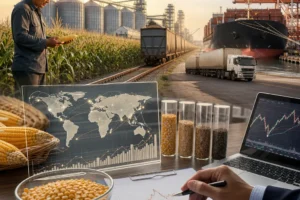
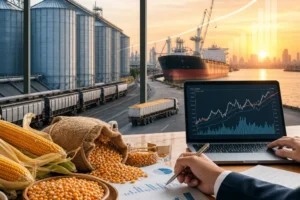
Corn futures are standardized contracts traded on a regulated exchange that let market participants lock in or speculate on a future corn price without necessarily buying or selling physical grain immediately. They are most widely used for hedging by farmers, elevators, feed users, ethanol plants, exporters, and merchandisers, and for trading by professional and retail market participants through futures brokers. The benchmark contract for global corn pricing is the CME Group corn futures contract, but that exchange price is not the same as a farmer’s local cash bid. In practice, corn futures work through contract standardization, daily margining, expiry rules, and the interaction between futures prices and local basis in the physical grain market.
To use corn futures properly, a reader needs to understand two markets at once: the exchange-traded futures market and the physical cash market. The futures market provides a transparent reference price and a hedging tool; the cash market is where actual grain is bought, sold, stored, shipped, inspected, and processed. The connection between them is basis, which is the local cash price minus the relevant futures price.
What corn futures are
A corn futures contract is a legally standardized agreement traded on an exchange. In the United States, the main benchmark is the corn contract listed by CME Group’s Chicago Board of Trade division. The contract specifies the quantity, delivery terms, quality standards, delivery locations, and contract months in advance, so traders only need to negotiate price through the market.
Although exact contract specifications should always be checked on the exchange’s official materials, the practical point is simple: one futures contract represents a fixed amount of corn, quoted in a standard unit, for delivery in a specified month. Because the contract is standardized, thousands of buyers and sellers can trade it electronically through brokers rather than negotiating separate private agreements every time.
Most futures positions are not held to physical delivery. Instead, they are usually offset before expiry. A farmer who sells futures to hedge production may later buy back those futures and sell actual grain to an elevator or processor in the cash market. A feed buyer may do the reverse, using futures to protect against rising prices before buying physical corn later.
Where corn futures trade and where prices are checked
Corn futures are traded on a regulated futures exchange, primarily CME Group. Market participants usually access the market through a registered futures broker or futures commission merchant. Trading is done electronically on broker platforms connected to the exchange.
There are several places to check prices, but each serves a different purpose:
- CME Group: official futures contract information, contract months, settlement data, and specifications.
- Broker trading platforms: live or near-live quotes, order entry, account balances, margin status, and execution tools.
- Market data vendors: charting, analytics, delayed or real-time data, spreads, historical data, and alerts.
- Local elevators and cooperatives: local cash bids, basis, delivery windows, and contract offerings for physical grain.
- USDA market reporting: regional cash prices, basis patterns, transportation indicators, export sales, and supply-demand reports.
This distinction matters. A futures quote reflects the exchange-traded benchmark. A local elevator bid reflects futures plus or minus basis, adjusted for freight, local supply and demand, handling costs, and quality terms. A farmer should not assume the screen price is the amount payable at the scale house.
| Market | What it shows | Where it is used | Main users |
|---|---|---|---|
| Futures market | Standardized exchange price for a delivery month | Broker platform, exchange data feed | Hedgers, traders, funds, merchants |
| Local cash market | Actual bid or offer for physical grain at a location | Elevator bid sheet, cooperative app, merchant quote | Farmers, processors, feed mills, exporters |
| Basis market | Difference between cash and futures | Risk management and merchandising analysis | Elevators, merchandisers, producers, end users |
How pricing works: futures, basis, and cash corn
The simplest pricing identity is:
Cash price = futures price + basis
Basis can be positive or negative. It changes by location and time. A river terminal, ethanol plant, feed mill, export house, or country elevator may all post different basis values on the same day, even when referencing the same futures month.
For example, if a buyer offers “December futures plus basis” for harvest delivery, the final cash price depends on two components:
- the selected futures contract month, and
- the local basis at the delivery point.
This is how corn futures connect to physical trade. A farmer might hedge by selling futures now, then later deliver physical corn into a local bid. The hedge protects the futures component, but not basis risk. If local basis weakens unexpectedly, the final effective price may still be worse than expected even if the futures hedge worked as intended.
Basis reflects real-world conditions such as:
- distance to processor, rail loader, river terminal, or export port,
- storage availability and harvest pressure,
- regional deficits or surpluses,
- freight and fuel costs,
- quality differences,
- barge, rail, truck, or vessel logistics.
How corn futures trading works in practice
To trade corn futures, a user normally opens an account with a regulated futures broker. That process is usually done online, although commercial hedgers may also work directly with brokerage staff or risk-management desks. The broker provides access to the exchange and handles margin, reporting, and trade clearing.
The practical process usually looks like this:
- Open a futures account. The broker will normally require identity, financial suitability, and risk disclosure documentation.
- Choose the contract month. Users select the futures month that best matches their expected buying, selling, or hedging window.
- Place an order. Orders are entered electronically, such as market, limit, or stop orders.
- Post margin. Futures are leveraged instruments, so traders post performance bond margin rather than paying the full contract value.
- Monitor daily gains and losses. Futures are marked to market every trading day. Losses can trigger margin calls.
- Offset or roll the position before expiry. Most participants close or roll positions rather than making or taking delivery.
This is financial trading, not the same thing as buying truckloads of corn. If a person wants physical grain, that is usually arranged through a grain merchant, elevator, processor, feed supplier, or direct cash contract, not through a retail futures platform.
How hedging works for farmers, elevators, and buyers
Hedging is the main commercial use of corn futures. The goal is not to guess the market direction perfectly, but to reduce price risk.
Farmers may sell futures when they expect to have corn to market later. If futures fall, the cash sale may be lower, but the short futures position may gain value. If futures rise, the hedge loses value, but the physical corn is worth more. The hedge helps stabilize the futures component of the sale price.
Elevators and cooperatives often hedge grain they buy from farmers. They may own physical stocks, offer forward contracts, or hold grain in storage while using futures to manage exposure to price changes.
End users such as feed mills, poultry integrators, livestock producers, starch manufacturers, and ethanol plants may buy futures to reduce the risk of rising corn prices before they need the physical grain.
Many cash contracts combine futures and basis in different ways. In practice, local elevators or merchandisers may offer:
- spot cash sales,
- forward cash contracts,
- hedge-to-arrive contracts,
- basis contracts,
- minimum price structures that may involve options.
Contract details vary by buyer, region, and regulation, so users need to review delivery terms, quality terms, storage charges, and pricing mechanics carefully.
| Participant | How corn futures are used | Main risk still remaining |
|---|---|---|
| Farmer | Sell futures against expected production | Basis risk, yield shortfall, margin pressure |
| Elevator or cooperative | Hedge owned grain or forward purchases | Basis moves, counterparty and logistics risk |
| Feed user or processor | Buy futures against future input needs | Basis moves, demand changes, quality fit |
| Speculator | Trade price direction or spreads | Market loss, leverage, volatility |
Delivery, expiry, and the difference between paper and physical corn
Corn futures are linked to physical delivery rules, but that does not mean every account holder wants grain delivered. Delivery provisions are part of what makes the contract meaningful as a price benchmark. They define acceptable grades, delivery locations, and procedures under exchange rules.
Still, most participants avoid delivery by exiting before first notice day or the final trading period, depending on the contract and position type. Anyone using futures should know the timing rules for the specific contract month, because holding too long can create operational and financial problems.
Physical corn transactions work differently. A physical grain sale usually involves:
- a named buyer and seller,
- a delivery point such as an elevator, mill, ethanol plant, feed yard, rail terminal, or export facility,
- quality standards and potential discounts,
- weights and inspection procedures,
- freight responsibility,
- payment terms,
- storage or loading timing.
Those terms are negotiated or embedded in the buyer’s contract and scale ticket process. In other words, a futures account gives access to a price-risk tool; it does not replace the commercial grain handling system.
What moves corn futures prices
Corn futures respond to expected supply and demand, not just current harvest conditions. The most important drivers usually include acreage, yield, weather, stocks, livestock feeding, ethanol demand, exports, currency moves, freight, and competing crops such as soybeans or wheat.
Key influences include:
- Weather: planting delays, pollination stress, drought, or harvest disruptions.
- USDA reports: especially WASDE, Acreage, Grain Stocks, Crop Production, and weekly Crop Progress.
- Export demand: sales and shipments reported by USDA and changes in global competitiveness.
- Biofuel economics: ethanol margins and policy settings can affect domestic corn use.
- Feed demand: livestock and poultry sectors influence consumption.
- Macro factors: currency, energy prices, and broad risk sentiment can affect fund positioning.
For actual market monitoring, the most practical public sources are USDA for fundamentals, CME Group for contract details and market structure, and CFTC for positioning data such as Commitments of Traders. Traders often combine those with private weather services, elevator bids, and commercial analytics.
Costs, risks, and common mistakes
Corn futures are efficient, but they are not simple or risk-free. The major risks come from leverage, timing, basis, and operational mismatch between a futures position and the physical exposure being hedged.
Important risks to check include:
- Margin risk: a correct hedge over time can still require cash to meet margin calls before grain is sold.
- Basis risk: local cash prices may not move exactly with futures.
- Contract mismatch: using the wrong contract month or quantity can weaken a hedge.
- Expiry risk: forgetting delivery deadlines or notice periods can create avoidable problems.
- Liquidity differences: nearby months are often easier to trade than distant months.
- Quality and logistics mismatch: exchange standards do not guarantee fit with a specific end user’s physical needs.
Common mistakes include treating futures as the same as a cash grain sale, ignoring basis, hedging more bushels than can actually be produced, and underestimating the cash-flow effect of adverse futures moves.
Where farmers, traders, and analysts actually use corn futures information
In day-to-day practice, different users rely on different channels.
- Farmers: local elevator websites, cooperative bid tools, farm marketing advisors, and USDA reports.
- Commercial merchandisers: broker platforms, exchange data, internal risk systems, transport markets, and buyer sales programs.
- Feed and processing buyers: supplier offers, delivered cash market quotes, basis sheets, and futures hedges.
- Analysts and traders: exchange data, CFTC positioning, USDA reports, weather models, export inspection and sales data, and historical charting platforms.
Software needs differ as well. A broker platform is for futures order execution and account management. A grain merchandising or farm management system is for scale tickets, inventory, contracts, settlements, and logistics. A market-data service is for charting, historical data, and analysis. These are related but not interchangeable tools.
Where can I check corn futures prices?
You can check benchmark corn futures through CME Group market information and through futures brokers or market-data services. For an actual local selling price, check bids from nearby elevators, cooperatives, ethanol plants, feed mills, or grain merchants.
Is a corn futures price the same as the price paid by a local elevator?
No. The local elevator bid is a cash price that reflects the futures market plus or minus local basis. Freight, storage, local supply and demand, and quality adjustments can make it quite different from the exchange quote.
Can I buy physical corn by trading corn futures online?
Usually, no. Most online futures trading is financial trading through a broker and positions are closed before delivery. Physical corn is normally bought through grain merchants, feed suppliers, elevators, processors, or direct commercial contracts.
Who uses corn futures for hedging?
Farmers, elevators, cooperatives, feed manufacturers, livestock operators, ethanol plants, exporters, importers, and processors all use corn futures to manage price risk. Speculators also trade the same contracts, but for profit rather than commercial protection.
What reports matter most for corn futures?
The most watched U.S. reports usually include USDA WASDE, Crop Progress, Acreage, Grain Stocks, Crop Production, and Export Sales. Many traders also follow CFTC Commitments of Traders for market positioning.
What is the biggest practical risk when hedging corn with futures?
For many commercial users, the biggest practical risks are basis changes and margin calls. Even when a hedge is conceptually correct, cash-flow pressure can become significant before the physical grain is sold or purchased.
Do I need a broker to trade corn futures?
Yes. Exchange-traded corn futures are normally accessed through a regulated futures broker or futures commission merchant. That is different from selling grain to an elevator or cooperative in the physical market.
How do I know which futures month to use?
The contract month should usually match the timing of your expected cash exposure as closely as practical. Farmers, buyers, and merchandisers often select the month nearest to the planned sale, purchase, or inventory period, then monitor basis and rollover timing carefully.
Sources
- CME Group
- USDA Agricultural Marketing Service and USDA World Agricultural Outlook Board
- U.S. Commodity Futures Trading Commission