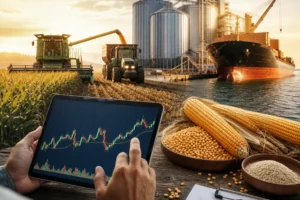
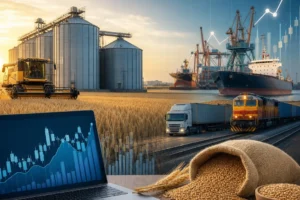
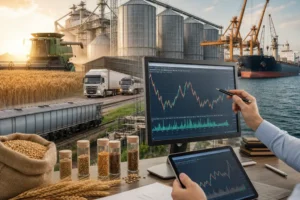
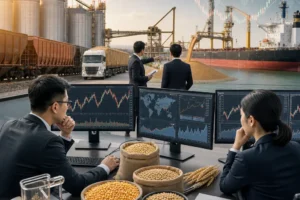
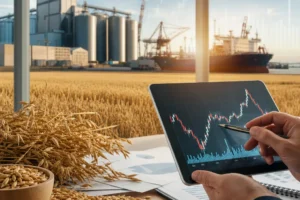


Soybean futures trading is the regulated buying and selling of standardized soybean contracts, mainly on a futures exchange rather than in the physical grain market. It is used by farmers, crushers, feed manufacturers, exporters, importers, merchants, and speculators to manage price risk or take a market view. In practice, soybean futures are not the same as local cash soybean prices, and most futures trades are closed out financially before delivery rather than resulting in truckloads or railcars of beans changing hands. To use soybean futures correctly, a reader needs to understand where prices are quoted, how the contract works, how margin and basis affect results, and where official market data can be checked.
The main global benchmark is the soybean futures contract traded at CME Group’s Chicago Board of Trade division. Traders access it through regulated futures brokers and trading platforms, while physical soybean buyers and sellers still negotiate local cash bids through elevators, cooperatives, crushers, merchants, and exporters. The futures market provides transparency and a hedging tool; the physical market determines the actual grain movement, quality, freight, and local basis.
What soybean futures are and what they represent
A soybean futures contract is a standardized agreement traded on an exchange for a set quantity and quality of soybeans for delivery in a specific month. The exchange standardizes the contract terms so buyers and sellers can trade price risk efficiently without negotiating every commercial detail each time.
For most market participants, soybean futures are a financial risk-management instrument rather than a plan to receive or deliver physical beans. A farmer may sell futures to protect a price before harvest. A crusher or feed manufacturer may buy futures to protect input costs. A trading fund may buy or sell futures purely to speculate on supply, demand, weather, export demand, or macroeconomic changes.
The important distinction is this: the futures price is an exchange benchmark, while the physical soybean price depends on basis, location, quality, delivery timing, freight, and the specific buyer. A local elevator bid may be above or below the futures price after basis is applied.
Where soybean futures trade and how traders access them
Soybean futures are primarily traded on CME Group’s CBOT market. Trading typically occurs electronically through broker platforms connected to the exchange. A trader normally needs a futures brokerage account, funding for margin, and access to a trading platform or order-entry system. This is different from opening an account with a grain elevator or cooperative to sell physical soybeans.
There are several layers in the trading chain:
- Exchange: lists the contract, matches orders, and sets standardized rules.
- Futures commission merchant or broker: provides account access, order routing, statements, and margin administration.
- Clearing system: stands between buyers and sellers and reduces counterparty risk through daily mark-to-market.
- Trader or hedger: places the order and manages risk.
Orders are usually entered online, but the trade itself is a regulated exchange transaction, not a private over-the-counter grain deal. By contrast, cash soybean sales typically happen through:
- country elevators,
- farmer cooperatives,
- grain merchants,
- soybean processors and crushers,
- exporters at river, rail, or port locations.
Those physical buyers post bids or negotiate contracts based on futures plus or minus basis.
| Market type | What is traded | Where it happens | Typical users |
|---|---|---|---|
| Futures market | Standardized soybean contracts | Regulated exchange via futures broker platform | Hedgers, merchants, funds, proprietary traders |
| Cash market | Physical soybeans | Elevators, cooperatives, crushers, exporters, negotiated contracts | Farmers, processors, feed companies, merchants |
| Forward cash contract | Future delivery of physical soybeans | Direct contract with local buyer | Farmers and grain buyers |
| OTC risk management | Customized swaps or structured contracts | Private agreement with approved counterparties | Larger commercial firms |
How soybean futures trading works in practice
When a trader buys a soybean futures contract, the position gains value if futures prices rise and loses value if prices fall. A short futures position works in the opposite direction. Because futures are margined, a trader does not pay the full notional value of the soybeans up front. Instead, the broker requires margin, and gains or losses are settled daily through mark-to-market.
This daily settlement is critical. If the market moves against the position, the trader may need to post additional funds. That is why leverage in futures is powerful but dangerous. A correct market view can still create account stress if timing is wrong or if volatility causes large short-term losses.
A simple commercial example:
- A farmer expects to harvest soybeans in the autumn.
- The farmer is worried prices may fall before delivery.
- The farmer sells soybean futures through a broker.
- Later, the farmer sells physical soybeans to a local elevator or processor.
- If futures have fallen, the futures gain may offset a lower cash sale price, subject to basis changes.
The hedge is not perfect because local basis can change. A crusher bidding aggressively in one region may strengthen basis even if futures are weak. Freight problems, barge traffic, rail performance, port congestion, storage shortages, and local supply pressure can all shift basis.
Contract months, delivery, and why most traders exit before expiry
Soybean futures trade in listed delivery months. Each contract month has its own price, reflecting market structure, storage economics, expected supply, and demand timing. Nearby contracts often respond most directly to immediate export demand, processing margins, or logistics disruptions, while deferred contracts may reflect acreage expectations, weather uncertainty, and next-crop balance sheet assumptions.
Most participants close or roll their positions before the contract reaches the delivery period. A speculator rarely wants to make or take delivery. A commercial hedger may also prefer to offset futures and handle physical grain separately through the cash market, where the required location, loading schedule, grade, and customer relationship already exist.
Delivery matters even if a trader never intends to use it, because delivery rules help anchor the contract to the physical market. Exchange delivery terms, approved delivery locations, and certification mechanisms are part of what makes the contract a credible benchmark.
How local soybean cash prices relate to futures: basis, freight, and quality
A soybean futures quote on an exchange screen is not the same thing as a farmgate price. Farmers and commercial buyers usually evaluate physical soybean values as:
Cash price = futures reference price + or – basis
Basis is the local adjustment that reflects regional supply and demand, transport costs, elevation, storage, handling, quality, export demand, crusher demand, and competitive conditions among buyers. Basis can be positive or negative relative to the futures benchmark.
Where local cash prices are usually checked:
- grain elevator bid sheets,
- cooperative bid pages or mobile apps,
- processor or crusher posted bids,
- merchant and exporter bid sheets,
- official market reporting services where available.
For export-oriented trade, buyers may also evaluate soybeans in relation to port bids, barge values, rail freight, vessel lineups, and destination demand. International soybean trade additionally depends on currency moves, import margins, and government policy in major exporting and importing countries.
| Price component | What it means | Where to check it |
|---|---|---|
| Futures price | Exchange benchmark for a delivery month | CME Group market data, broker platforms, market data vendors |
| Basis | Local adjustment for location, demand, logistics, and quality | Elevator bids, processor bids, merchant quotes, local reporting services |
| Cash bid | Actual local physical purchase price | Buyer bid sheet or contract offer |
| Delivered price | Price after considering freight to a destination | Negotiated with buyer, merchant, or logistics counterparties |
Who uses soybean futures and how they use them
Farmers use soybean futures to hedge expected production. They may sell futures alone or combine futures hedges with local cash contracts. The goal is usually price protection, not speculative leverage.
Elevators and grain merchants use futures to manage inventory and basis exposure. If an elevator buys cash beans from farmers, it may sell futures to offset flat-price risk while it seeks a better merchandising opportunity.
Crushers and processors use soybean futures as part of raw material procurement. They may also monitor soybean meal and soybean oil markets because crush margins depend on the combined value of products relative to soybeans.
Exporters and importers use futures to stabilize price exposure while physical cargoes are assembled, shipped, or purchased. Their real commercial risk also includes freight, currency, and execution risk.
Speculators and funds trade soybean futures based on chart signals, seasonal patterns, weather models, spreads, macro trends, or balance-sheet expectations. They provide liquidity but also add volatility.
What moves soybean futures prices
Soybean futures respond to both agricultural fundamentals and wider financial conditions. The most important drivers usually include:
- Weather: planting pace, drought, heat, excessive rain, and frost risk in major producing regions.
- Acreage and yields: expected planted area and productivity.
- Stocks and stocks-to-use: how tight or comfortable supplies are.
- Exports and imports: especially demand from major importing countries and competition among exporting origins.
- Crush demand: domestic processing demand for meal and oil.
- Biofuels and energy: especially where vegetable oil demand affects soybean complex pricing.
- Currency moves: exchange rates affect export competitiveness.
- Freight and logistics: river levels, port congestion, rail performance, truck availability.
- Government policy: tariffs, export restrictions, biofuel policy, farm support, and sanitary rules.
Forecasting should always be treated as conditional. A market can be bearish on large acreage but turn bullish if weather turns adverse. It can also remain weak despite a crop problem if demand deteriorates or if inventories were already ample.
Where to find soybean futures prices, reports, and analysis
For exchange prices, contract specifications, and settlement information, the primary source is CME Group. Brokers and market-data vendors may display the same market with charting and account integration, but CME remains the underlying exchange venue for the benchmark contract.
For position data, the U.S. Commodity Futures Trading Commission publishes Commitments of Traders reports. These are useful for seeing broad categories of market positioning, such as commercial and managed money activity. They do not predict price by themselves, but they help analysts understand crowding and sentiment.
For supply-and-demand fundamentals, USDA is central. The most widely used reports include:
- WASDE: global and U.S. balance-sheet estimates.
- Crop Progress: planting, emergence, condition, and harvest pace.
- Grain Stocks: inventory snapshots.
- Prospective Plantings and Acreage reports: area expectations and updates.
- Export Sales: weekly export commitments and shipments.
Outside the United States, readers may also use national agriculture ministries, customs agencies, and statistical offices, especially when assessing local basis, import demand, or origin competition. For international context, FAO can be useful for broad market background, though active traders usually rely more heavily on exchange data, USDA reports, and commercial research.
Practical risks, costs, and common mistakes
The biggest mistake in soybean futures trading is confusing hedging with speculation. A hedge is linked to a real physical exposure. A speculative trade is a market view. Both are legitimate, but they should not be managed the same way.
Key risks include:
- Leverage risk: small price moves can create large gains or losses relative to posted margin.
- Basis risk: futures may hedge flat price while local basis still changes unfavorably.
- Liquidity and rollover risk: deferred months may trade differently from nearby contracts.
- Delivery risk: holding a contract too close to delivery without understanding procedures can create avoidable problems.
- Weather volatility: soybean markets can move sharply on forecast changes.
- Execution and information risk: delayed quotes, misunderstanding contract months, or using the wrong unit can distort decisions.
Cost considerations usually include brokerage commissions, exchange and clearing fees, market-data charges where applicable, financing impact from margin calls, and for physical grain the separate costs of storage, drying, handling, shrink, freight, and quality discounts. These vary by provider and location, so they must be checked directly with the broker or grain buyer.
Where can I check soybean futures prices?
The main benchmark is quoted through CME Group and through broker trading platforms and market-data services that carry exchange data. Always note the specific contract month, unit, and currency. For a farm or local buyer decision, compare that futures quote with local basis or posted cash bids.
Where can I sell physical soybeans?
Physical soybeans are usually sold to grain elevators, cooperatives, crushers, feed manufacturers, grain merchants, or exporters. The practical sale happens through a bid sheet, a forward contract, a basis contract, or a negotiated delivered transaction, not through a retail futures brokerage account.
Is soybean futures trading the same as buying soybeans?
No. Futures trading is mainly a financial transaction on a regulated exchange. Buying physical soybeans involves grain ownership, storage, transport, quality standards, and delivery terms. Most futures traders never handle physical beans.
What reports matter most for soybean futures?
The most important regular public reports are usually USDA WASDE, Crop Progress, Export Sales, Grain Stocks, and acreage-related reports. Traders also monitor CFTC Commitments of Traders for positioning and CME contract information for market structure and delivery details.
Can farmers hedge soybeans without delivering on the exchange?
Yes. That is common. A farmer can sell futures to protect price risk and later sell actual harvested soybeans to a local elevator or processor. The exchange hedge is normally offset financially before delivery, while the physical grain moves through the local cash market.
Why is my local soybean bid different from the futures quote?
Because the local cash bid includes basis. Basis reflects freight, local supply and demand, processor demand, export competition, storage conditions, and quality. Futures are only the benchmark portion of the local price.
Do soybean futures involve margin calls?
Yes. Futures positions are marked to market daily. If the market moves against the position, additional funds may be required. This applies to hedgers and speculators alike, even if the commercial hedge is sound over the full marketing period.
What should a beginner understand before trading?
At minimum: contract size, tick value, contract month, margin requirements, daily mark-to-market, delivery timing, basis, and the difference between a futures hedge and a cash grain sale. It is also important to know where official prices and reports come from rather than relying only on delayed summaries.
Sources
- CME Group
- United States Department of Agriculture
- U.S. Commodity Futures Trading Commission