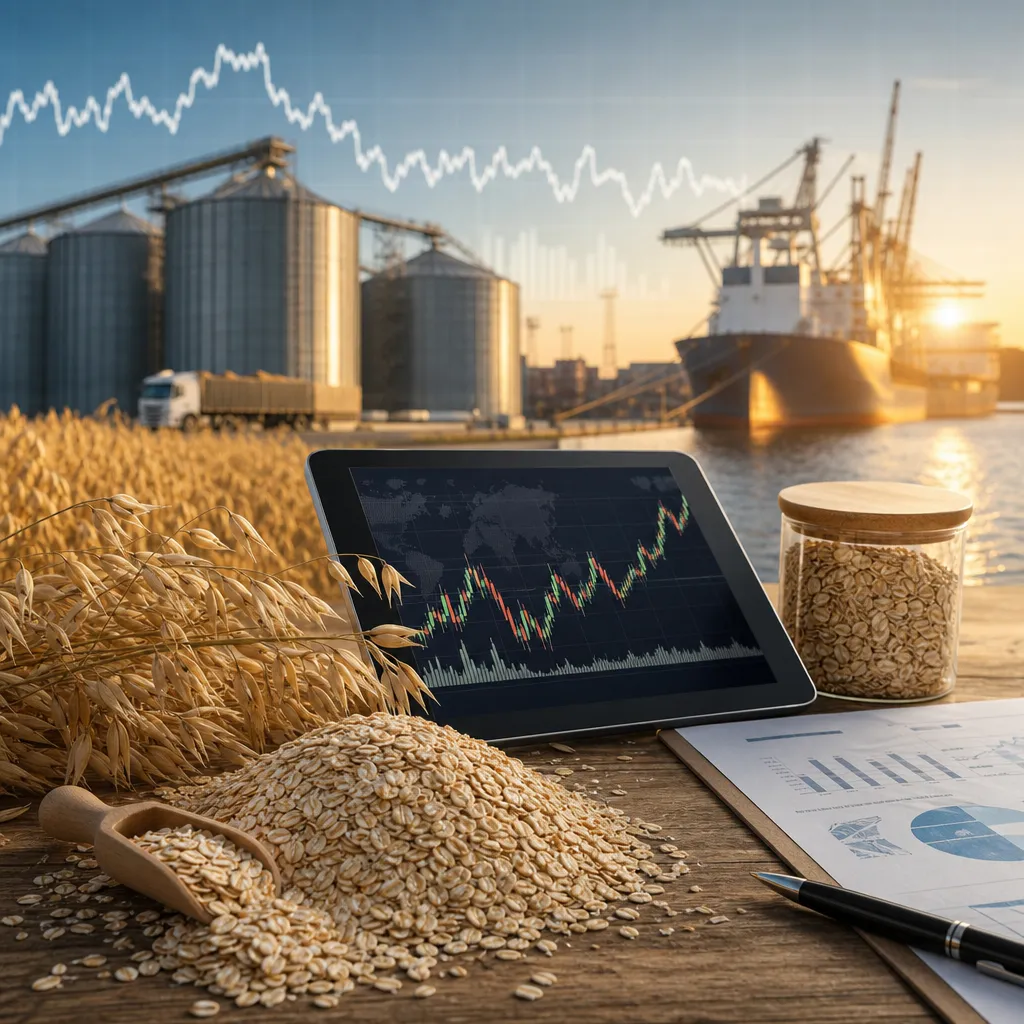






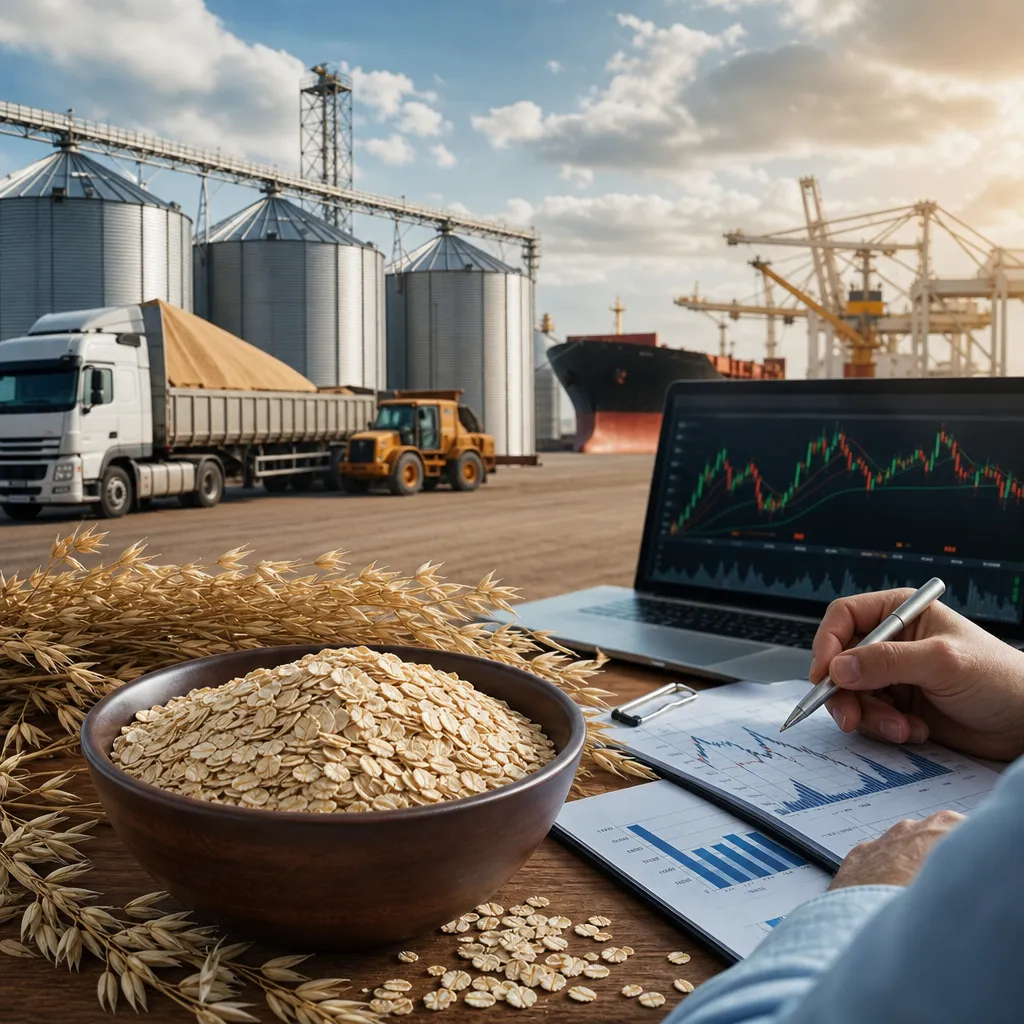
Oat prices today depend on which market you mean: an exchange-traded futures quote, a regional cash bid from an elevator, or a delivered price for food, feed, or export oats. There is no single universal oat price, and the number a farmer receives locally can differ materially from a screen price because of basis, freight, quality, and delivery terms. If you need the current market, the practical starting point is to check regulated futures data where available and compare it with local elevator or cooperative bids in your region. For physical buying or selling, the usable price is usually a negotiated cash bid tied to grade, moisture, delivery point, and timing.
Oats are traded both as a physical grain and, in some periods and markets, through exchange contracts or benchmark pricing systems. Physical trade happens through grain elevators, cooperatives, merchants, feed mills, oat processors, and exporters. Online market information comes from exchange websites, government market reports, agricultural price reporting services, and commercial data platforms. Understanding which price you are reading is the key to using oat prices correctly.
What “oat price today” usually means
When people search for oat prices, they are usually looking for one of three things:
- Futures or benchmark pricing for market direction and risk management.
- Local cash bids from elevators, cooperatives, or merchants for immediate or forward delivery.
- Wholesale physical prices for food-grade, feed-grade, or processing oats delivered to a mill, plant, or port.
These are related, but they are not identical. A futures quote is a centralized financial market price for a standardized contract. A cash bid is the real price offered in a local physical market. A delivered wholesale price may include freight, cleaning, storage, and quality premiums or discounts.
| Price type | Where it is found | What it represents | Who uses it |
|---|---|---|---|
| Futures or benchmark quote | Exchange data, broker platforms, market data services | Standardized market reference, not necessarily local farm price | Traders, hedgers, analysts, processors |
| Local cash bid | Elevators, cooperatives, merchant bid sheets, local market reports | Actual buy price at a specific location and time | Farmers, local buyers, merchandisers |
| Delivered physical price | Direct contracts, merchant offers, processor tenders | Price including delivery and contract terms | Processors, mills, feed companies, exporters, importers |
Where to check oat prices today
If you need an up-to-date oat market reading, use more than one source. The best combination is a regulated market reference plus a local physical bid source.
Exchange and futures data
Where an oat futures contract or benchmark is actively referenced, market participants normally access prices through exchange data, futures broker platforms, or commercial charting systems. CME Group is the main exchange reference many grain participants watch for North American grain market pricing and related hedging activity. Even when a reader is not trading oats directly, exchange screens help show broader grain sentiment, spreads, and risk appetite.
To view futures-related information in practice, users generally go through one of these channels:
- Exchange websites for contract specifications, settlement data, and trading information.
- Futures brokers for live or delayed quotes, charting, and order entry.
- Commercial market-data terminals or farm marketing software for integrated analysis and alerts.
Important limitation: a futures quote is not automatically a farmgate oat price. It is a benchmark. You still need local basis and quality terms.
Local elevator and cooperative bids
For producers, the most relevant “today” price is usually the local cash bid. This is commonly posted by:
- Grain elevators
- Agricultural cooperatives
- Regional grain merchants
- Oat processors and mills
- Feed manufacturers buying nearby grain
These businesses may publish bids online, in mobile apps, by text alert, or on daily bid sheets. Some only provide prices to account holders or local suppliers. In many regions, farmers compare several bids because freight, unloading policies, protein or test-weight standards, and payment timing can change the net price materially.
Government and official reporting systems
Official reporting is useful for context rather than for a firm executable bid. In the United States, USDA market reporting and broader grain reports help readers understand trends in feed demand, exports, acreage, and substitute grains. National agriculture ministries, statistical offices, or grain boards in other countries may publish regional grain indicators, though not always a live transaction price.
Use these sources for market structure, not as a replacement for confirming a trade with a buyer.
Why cash oat prices differ from futures or screen prices
The difference between a benchmark price and a local cash bid is often explained by basis. Basis is the local cash market adjustment relative to a reference futures or benchmark market. It reflects local supply and demand, transport costs, and quality.
For oats, the gap can widen or narrow because of several practical factors:
- Distance to the buyer: farther delivery points usually mean lower net farm prices unless the buyer arranges freight.
- Quality: milling oats may earn premiums over feed oats depending on test weight, moisture, foreign material, and other specifications.
- Regional supply: harvest pressure or carryover stocks can weaken local bids.
- Buyer demand: processors, feed mills, and exporters may bid more aggressively when nearby coverage is short.
- Storage and timing: post-harvest bids can differ from deferred delivery bids.
A farmer selling oats should ask not only for the gross bid, but also for the grading standard, moisture limits, dockage schedule, payment timing, and whether the bid is picked up or delivered.
How oat prices work in the physical market
Most oat transactions still happen as physical grain deals rather than purely financial trades. The transaction flow is straightforward, but pricing terms matter.
- The seller offers available tonnage or bushels, crop year, and quality details.
- The buyer may be an elevator, cooperative, merchant, processor, mill, feed company, or exporter.
- The price is quoted for a delivery point and delivery period.
- The grain is graded on receipt or by pre-agreed inspection terms.
- The final settlement may be adjusted for moisture, test weight, screenings, or other quality factors.
In practice, physical oat trade can occur in several ways:
- Spot sale: grain sold for near-term movement.
- Forward contract: price and delivery period agreed in advance for future movement.
- Basis contract or delayed pricing arrangement: used in some grain markets to separate basis from final flat price timing.
- Direct processor contract: often used for food-grade or specialty oats with stricter quality terms.
Counterparty risk matters. Sellers should confirm who is buying, what grading rules apply, who pays freight, when title transfers, and when payment is due. Buyers should verify quality, storage history, and documentation.
| Market channel | How pricing is usually set | Main advantage | Main limitation |
|---|---|---|---|
| Elevator or cooperative | Daily bid by location and delivery period | Simple execution and nearby outlets | Bid may be wide in weak local demand periods |
| Direct processor or mill | Negotiated contract with quality standards | Potential premium for food-grade oats | Stricter acceptance criteria |
| Merchant or brokered trade | Negotiated physical price, sometimes multiple destinations | Broader buyer access | Terms and counterparty quality should be checked carefully |
| Export trade | Destination and logistics-based pricing | Can support stronger bids in surplus regions | Freight and port logistics can change net value quickly |
How traders and hedgers use oat futures and related grain markets
Some users look at oat prices because they want to hedge or trade grain risk. This is different from buying truckloads of physical oats. Financial grain trading normally takes place through a regulated futures broker, with a brokerage account, margin funding, and knowledge of contract rules.
A futures contract is a standardized agreement traded on an exchange. It has contract size, delivery month, quality rules, and settlement procedures defined by the exchange. Traders can buy or sell the contract without intending to handle physical oats, while commercials may use it to manage risk associated with actual grain ownership or purchase commitments.
Key points:
- Hedging reduces price exposure but does not remove basis risk.
- Speculation seeks profit from price moves and uses leverage, which increases risk.
- Margin is required and positions can face losses larger than an initial deposit if not managed properly.
- Expiry and delivery rules matter; not every trader wants to hold a contract into delivery period.
Where such trading happens: through regulated futures exchanges and licensed brokerage firms, not through a local grain elevator. A grain elevator buys and handles physical grain; a futures broker provides market access to financial contracts.
Main factors moving oat prices today
Oat markets are heavily influenced by regional crop conditions and by the broader grain complex. Oats compete with corn, barley, wheat, and other feed grains, while food-grade demand follows processor and consumer trends.
The most important daily and seasonal drivers include:
- Weather: planting delays, drought, excessive rain, heat stress, and harvest quality losses.
- Acreage: shifts into or out of oats relative to other crops.
- Yield and quality: especially test weight and milling suitability.
- Stocks: carry-in inventory and on-farm storage availability.
- Feed substitution: when corn or barley prices change, feed demand for oats may adjust.
- Export and import flows: important in surplus and deficit regions.
- Currency moves: particularly for internationally traded oats and oat products.
- Freight and logistics: rail, truck, and port capacity can change local bids sharply.
For forecasts, it is better to think in scenarios than in fixed targets. A large crop with weak export pull may pressure cash bids, while a smaller or lower-quality crop can strengthen premiums for usable milling oats. At the same time, a broad grain rally led by corn or wheat can lift oats even if oat-specific fundamentals are mixed.
Which reports and data sources matter most
For reliable market work, combine live pricing with scheduled reports. The most useful official sources are those that help explain supply, demand, positioning, and broader grain competition.
- USDA WASDE: balance-sheet context for major grains and oilseeds, useful for substitute feed relationships and export demand signals.
- USDA Crop Progress: tracks planting, condition, and harvest progress in season.
- USDA Grain Transportation or market reporting tools: helpful for logistics and regional market context where available.
- CFTC Commitments of Traders: shows futures market positioning by participant category where relevant contracts are covered.
- CME Group contract pages: contract specifications, settlements, and trading details for exchange-traded benchmarks.
- FAO and national statistical agencies: broader international production and trade context.
These reports exist online through official agency websites and are widely used by farmers, analysts, merchants, risk managers, and procurement teams. For local execution, however, they still need to be paired with actual nearby bids.
Practical buying, selling, and storage considerations
If you want to buy or sell physical oats today, start with the destination and quality, not just the headline price. A food processor may pay more than a feed buyer, but only for oats that meet the specification. A strong nearby bid can become less attractive after trucking cost, drying, cleaning, or long unloading delays.
For sellers
- Compare bids from more than one elevator, cooperative, or processor.
- Ask whether the bid is for picked up grain or delivered grain.
- Confirm moisture, test weight, screenings, and any discount schedule.
- Check payment timing and any contract default language.
- Evaluate whether on-farm storage improves timing flexibility enough to outweigh storage losses and financing cost.
For buyers
- Specify grade, origin, lot size, and delivery window.
- Clarify inspection standards and rejection rights.
- Define freight responsibility and risk transfer point.
- Consider storage, fumigation, and traceability if oats are for food use.
Storage can help a seller avoid harvest pressure, but oats are not cost-free to hold. Opportunity cost, shrink, spoilage risk, aeration needs, and working capital all matter. The best selling month is not guaranteed just because the crop is stored longer.
FAQ
Where can I check oat prices today?
Check exchange-related benchmark data through exchange pages or broker platforms, then compare that with local cash bids from grain elevators, cooperatives, processors, or merchants. The local bid is usually the operational selling price for farmers.
Is the oat futures price the same as the price paid at my local elevator?
No. A futures or benchmark quote is a market reference. Your local elevator bid will reflect basis, freight, quality, delivery period, and local supply-demand conditions.
Where do physical oat sales normally take place?
Physical oats are commonly bought and sold through grain elevators, cooperatives, merchants, feed mills, oat processors, and exporters. Transactions can be spot, forward, or quality-based direct contracts.
Can I trade oat prices online without buying physical grain?
Yes, where a relevant futures or derivative market is accessible, trading is done through a regulated futures broker and brokerage account. That is financial trading, not physical grain ownership, and it involves margin and leverage risk.
What quality factors matter most in oat pricing?
Common factors include moisture, test weight, screenings, foreign material, and whether the oats qualify for feed or milling use. Food-grade oats often require tighter specifications than feed oats.
Which reports should I watch for oat market direction?
USDA reports such as WASDE and Crop Progress are widely followed, along with exchange contract data and official statistics from national agencies. Broader corn, barley, and wheat fundamentals also matter because they affect feed grain substitution.
How do I know whether a bid is attractive?
Compare it with nearby alternative buyers, freight-adjusted net values, historical local basis behavior, and your storage or financing cost. The highest posted bid is not always the best net return after transport and quality adjustments.
What is the biggest mistake when following oat prices?
The most common mistake is assuming an online quote is the exact local cash value. Always verify location, unit, currency, quality basis, and delivery terms before making a marketing or procurement decision.
Sources
- USDA Agricultural Marketing Service
- CME Group
- CFTC Commitments of Traders