




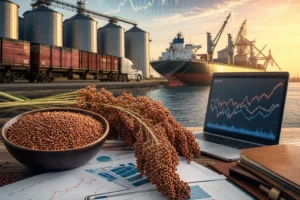

MATIF wheat prices today usually refers to the current value of milling wheat futures traded on Euronext, the exchange that took over the historic MATIF market in France. In practice, these prices are a benchmark for European wheat trade, especially for France, but they also influence pricing in wider EU export markets and nearby importing regions. The market is quoted in euros per metric tonne, and it is used by farmers, merchants, millers, exporters, and financial traders to manage price risk or track market direction. Readers looking for “today’s MATIF wheat price” should understand that the exchange quote is a futures price, not the same thing as a local farm cash bid or a port export bid.
Geographically, the contract is tied to the European grain trade and is especially important for French wheat, because France is one of the European Union’s largest wheat producers and exporters. The benchmark matters far beyond Paris because physical wheat values across much of Europe are often discussed as a premium or discount to MATIF. That makes MATIF one of the key reference points for price formation in inland cash markets, export terminals, feed markets, and milling wheat procurement. If you follow European grain, MATIF wheat is one of the first prices to watch each day.
What MATIF wheat means today
MATIF originally referred to the French futures market, the Marché à Terme International de France. Today, wheat futures formerly known as MATIF wheat trade on Euronext. In market language, however, many traders, analysts, and farmers still say “MATIF wheat” when they mean the Euronext milling wheat futures contract.
This benchmark is most relevant to milling wheat in Europe, especially wheat that can meet export or flour-milling quality standards. It is not a direct quote for every type of wheat in every location. Feed wheat, lower-protein wheat, or wheat far from export channels can trade above or below the futures benchmark depending on local conditions.
When someone asks for the “MATIF wheat price today,” they usually mean the latest futures price for a nearby or actively traded contract month. Futures prices change throughout the trading day, so any “today” quote only makes sense with the exact contract month and time.
Where the MATIF wheat market operates
The exchange market operates through Euronext, which lists European agricultural futures and options. The wheat contract is a financial and commercial benchmark for the European Union grain market, with particular relevance to France, where a large share of exportable EU wheat originates.
Its practical reach extends beyond France because buyers and sellers across Europe often use MATIF as the reference price when negotiating physical grain. Exporters shipping wheat from French ports, merchants buying from inland silos, and processors sourcing wheat for flour or feed may all work from MATIF plus or minus a basis. In that sense, the exchange is not just a screen-based market in Paris; it is embedded in the wider European physical grain trade.
| Market element | Location or scope | Why it matters |
|---|---|---|
| MATIF/Euronext milling wheat futures | European exchange benchmark, strongly linked to France | Main price reference for European milling wheat risk management |
| French inland cash market | Country elevators, cooperatives, merchants, processors | Where farmers actually sell physical grain |
| Export terminal market | French and wider EU export logistics chain | Connects inland wheat values to global demand |
How MATIF wheat prices are formed
MATIF wheat futures are formed by buying and selling on the exchange. That means the quoted price reflects what market participants are willing to pay or accept for a standardized futures contract at a given moment. It is influenced by European crop expectations, world wheat supply, Black Sea competition, weather, export demand, currency moves, and broader financial market sentiment.
But the price seen on the exchange is only the starting point. Real-world wheat transactions usually involve an additional local component known as the basis. Basis is the difference between the futures benchmark and the physical cash price in a certain place, for a certain quality, and for a certain delivery period.
For example, a local French elevator may bid wheat at a premium or discount to MATIF depending on:
- Protein and other quality specifications
- Distance from the buyer or export terminal
- Truck, rail, barge, or port logistics costs
- Storage availability and harvest pressure
- Local competition among merchants, mills, and feed buyers
- Export demand and vessel loading schedules
- Euro exchange-rate effects on export competitiveness
This is why MATIF can rise while a farmer’s local cash price rises less, or even stays flat. Likewise, cash prices can strengthen relative to MATIF when nearby demand is strong or supplies are tight in a specific region.
MATIF futures versus local wheat prices
One of the most important practical points is to separate futures prices from physical wheat prices. A futures contract is a standardized exchange instrument. A physical grain trade is a real commercial sale between counterparties, usually with agreed quality, delivery terms, timing, and payment conditions.
The most common price types in the European grain trade are not the same thing:
| Price type | What it represents | Typical use |
|---|---|---|
| MATIF/Euronext futures price | Exchange-traded benchmark for a specified contract month | Price discovery and hedging |
| Local cash bid | Price offered by an elevator, cooperative, or merchant at a local point | Farmer grain sales |
| Delivered price | Price for grain delivered to a buyer such as a mill or feed plant | Procurement and consumption markets |
| FOB export price | Price of grain loaded free on board at an export port | International trade offers |
| CIF import price | Delivered import price including cost, insurance, and freight | Importer buying decisions |
For most readers, the practical takeaway is simple: MATIF is the benchmark, not automatically the farm-gate price. The final physical price depends on basis and contract terms.
Where to check MATIF wheat prices online
If you need today’s MATIF wheat price, the most reliable first stop is Euronext, because that is the exchange where the contract trades. Market participants also monitor broker platforms and professional data terminals, but the exchange remains the core reference.
Useful places to check wheat market information include:
- Euronext for official contract information and exchange price references
- FranceAgriMer for French grain market intelligence and sector reporting
- European Commission for EU market context, trade, and agricultural information
- USDA, especially global grain outlook reports, for wider wheat supply and demand context
- Local cooperatives, merchants, and grain elevators for actual cash bids offered to farmers
- Millers, feed compounders, and exporters for delivered and procurement market signals
In practice, many producers and grain traders check futures online but still call or message local buyers for current cash bids. That is normal because the physical market includes quality and location adjustments that do not appear in the exchange quote alone.
How wheat is actually bought and sold in the MATIF-linked market
Physical grain trade
Physical wheat is usually bought and sold through cooperatives, private merchants, processors, mills, feed manufacturers, and exporters. A farmer in France or elsewhere in the EU normally does not “sell wheat on MATIF” in the literal sense. Instead, the farmer sells physical grain to a commercial buyer, often under a contract linked to the MATIF futures benchmark.
Common physical trade features include:
- Volume agreed in metric tonnes
- Price fixed now, or priced later against a futures reference
- Quality clauses such as moisture, test weight, protein, and impurities
- Delivery terms to farm pickup, silo, processor, or port position
- Payment terms and counterparty conditions
An exporter may buy wheat inland, assemble cargo-sized volumes through the storage network, move grain to port, and then sell FOB to an overseas buyer. In that chain, MATIF can be used to hedge the price risk between purchase and export sale.
Futures and options trading
Futures and options are traded through a broker or trading platform that provides access to Euronext. This is separate from taking ownership of truckloads of wheat. A futures position gives financial exposure to price moves and can be used either for hedging or speculation.
Farmers, cooperatives, merchants, mills, and exporters may hedge with futures to reduce price risk. Financial traders may trade the same contract without any intention of handling physical grain. Because futures require margin and can move quickly, they are not the same as a simple physical sale contract.
There is also basis risk: even if a physical seller hedges with MATIF, the local cash market may not move exactly in line with the futures contract.
What drives MATIF wheat prices today
Short-term and medium-term moves in MATIF wheat often reflect a combination of European and global factors. Since Europe competes in world wheat trade, the benchmark is sensitive not only to French crop conditions but also to developments in other exporting regions.
The main drivers usually include:
- French and wider EU weather during planting, winter, and grain filling
- Crop condition reports and harvest progress
- Competition from major exporters such as Black Sea origins and North America
- Import demand from North Africa, the Middle East, and other destination markets
- The euro’s value against other currencies, which affects export competitiveness
- Freight and logistics disruptions that alter trade flows
- Feed demand, milling demand, and substitution with corn or barley
- Government policy, trade restrictions, and broader geopolitical risk
At harvest, MATIF and local cash markets can come under pressure if large supplies arrive quickly. Later in the season, prices may strengthen if export demand improves, quality becomes scarce, or logistics tighten. But forecasting should always be framed as scenarios, not certainty.
Practical forecast framework for readers following MATIF wheat
Rather than trying to guess a single price target, it is more useful to think in terms of market scenarios. MATIF wheat can react very differently depending on crop size, export pace, and currency conditions.
| Scenario | Conditions | Possible market implication |
|---|---|---|
| Bearish scenario | Large EU crop, smooth harvest, weak export demand, strong competition from other origins | Futures and some cash markets may come under pressure |
| Supportive scenario | Weather problems, tighter milling quality, stronger export demand, or currency support | Futures may strengthen and basis may improve in key locations |
| Mixed scenario | Ample overall supply but uneven quality or regional logistics constraints | Futures may stay range-bound while local basis diverges sharply |
For commercial decisions, this matters because the best marketing approach is not always based on the futures trend alone. A strong or weakening local basis can materially change the final cash outcome.
How to use MATIF prices in real grain marketing
For producers and physical market participants, MATIF is most useful as a benchmark and risk-management tool. A farmer may watch MATIF daily, but the actual sale decision should be based on the local bid, storage position, quality, cash-flow needs, and basis level offered by buyers.
A practical approach might include:
- Track the relevant MATIF wheat contract month on Euronext.
- Collect local bids from cooperatives, merchants, or processors.
- Compare the local bid with the futures benchmark to understand basis.
- Check whether the bid is ex-farm, delivered, or another delivery term.
- Review quality clauses before committing grain.
- Consider hedging separately from the physical sale if you use futures or options.
For traders and importers, MATIF is often one part of a broader matrix that also includes FOB offers, ocean freight, destination demand, and competing origins. For that reason, no one screen quote tells the whole story.
Frequently asked questions
Is MATIF wheat the same as the price a French farmer receives?
No. MATIF wheat is a futures benchmark on Euronext. A farmer usually receives a local cash price adjusted for basis, quality, delivery point, and timing.
In what currency and unit is MATIF wheat usually quoted?
It is generally discussed in euros per metric tonne, which fits the European grain trade.
Where can I check MATIF wheat prices today?
The most relevant place is Euronext. For physical market context, readers should also check FranceAgriMer, the European Commission, USDA reports, and local buyer cash bids.
Why do local cash bids move differently from MATIF?
Because local prices reflect basis, which can change with quality, transport costs, export demand, storage, and buyer competition even when futures are steady.
Can an individual buy wheat directly through MATIF?
Individuals can usually access futures through a broker that offers Euronext market access, but that is a financial trade, not the same as buying physical grain in a warehouse or at a farm.
How is MATIF connected to exports?
Exporters often use MATIF as a pricing and hedging benchmark when buying inland wheat and selling export cargoes. Port values and FOB offers may be expressed relative to that benchmark.
What is the main international benchmark compared with MATIF?
For global context, traders often compare European wheat with other major wheat futures and export origins, including U.S. benchmarks and Black Sea export values. MATIF is the leading benchmark for EU milling wheat pricing.
Sources
- Euronext
- FranceAgriMer
- USDA Foreign Agricultural Service