
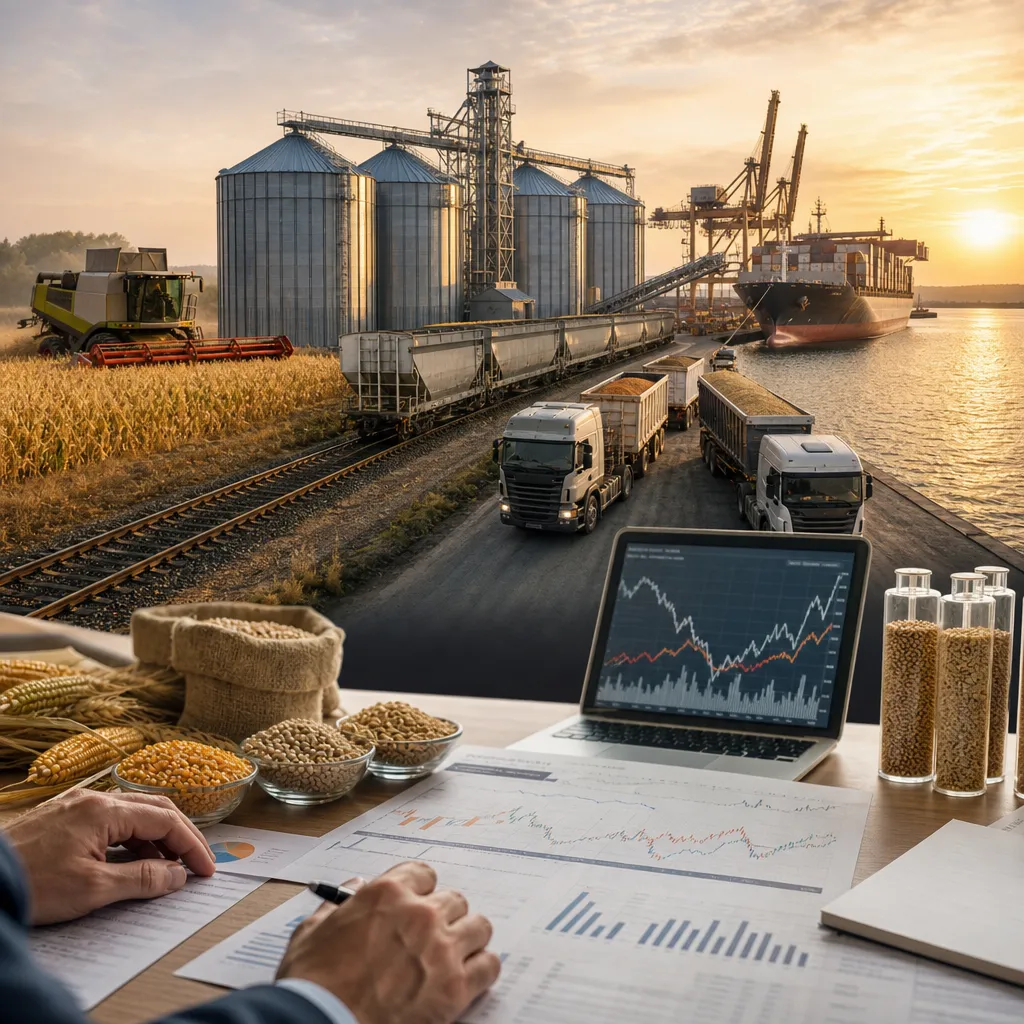
Grain market seasonality is the recurring pattern in grain prices, basis, storage decisions, and trade flows that tends to follow the crop calendar. It matters because wheat, corn, soybeans, rice, barley, canola, and other grains do not enter the market evenly throughout the year: acreage is decided in one period, weather risk dominates another, harvest pressure hits later, and export or feed demand can tighten supplies at a different time. In practice, seasonality is not a guarantee of price direction, but a framework for understanding when the market is most sensitive to weather, crop reports, logistics, and farmer selling. Readers can use it to time cash sales, hedge with futures or options, compare local bids with exchange prices, and interpret USDA or other official reports more realistically.
The most practical way to use seasonality is to separate three things: the futures market, the local cash market, and the physical grain flow. Futures may react first to weather or acreage expectations; local cash bids at elevators or processors may react more to basis, freight, and nearby demand; and physical grain movement depends on harvest pace, storage capacity, port congestion, and quality. A seasonal pattern in one does not automatically mean the same pattern in the others.
What grain market seasonality means in practice
Seasonality is the tendency for grain markets to behave differently during planting, growing, harvest, storage, and export periods. For example, many crops often face stronger weather risk during planting and pollination, heavier physical selling pressure at harvest, and basis shifts during post-harvest storage or export programs. These patterns exist because supply arrives in large seasonal waves while demand is more continuous.
For farmers, seasonality often affects when to sell old crop versus new crop, whether to store grain, and when to use forward contracts, futures hedges, or options. For feed mills, crushers, flour mills, ethanol plants, or exporters, it affects coverage strategy, inventory timing, and procurement costs. For traders and analysts, it helps frame what kind of news matters most at different times of year.
Seasonality should always be used with caution. A normal seasonal tendency can be overwhelmed by drought, excessive rain, policy changes, war, biofuel demand, currency moves, export restrictions, freight disruptions, or a surprise in official data.
How the seasonal cycle works across the crop year
While exact timing differs by crop and hemisphere, grain seasonality usually follows a similar chain:
- Pre-planting: the market starts pricing acreage competition, input costs, and expected profitability.
- Planting: delays or fast progress influence yield expectations and futures spreads.
- Growing season: weather risk becomes critical, especially during emergence, flowering, and pollination.
- Harvest: new supply enters elevators, on-farm bins, processors, and export channels, often pressuring cash prices and widening storage decisions.
- Post-harvest: the market shifts toward storage, exports, domestic use, and quality segregation.
- Late marketing season: attention turns to remaining stocks, farmer holding behavior, and transition to the next crop year.
In the Northern Hemisphere, U.S. corn and soybeans often attract peak weather attention in summer, while harvest pressure is typically concentrated in autumn. Wheat has multiple seasonal structures because winter wheat and spring wheat have different development calendars, and major exporters harvest at different times globally. Rice, barley, oats, rye, sorghum, canola, rapeseed, and sunflower seed each have their own crop-specific timing, but the same logic applies: prices respond differently when the crop is only an expectation than when it is physically available.
| Stage | Typical market focus | Where to monitor it |
|---|---|---|
| Pre-planting | Acreage intentions, input economics, old crop stocks | USDA reports, exchange futures, local forward bids |
| Planting | Planting pace, field conditions, prevented planting risk | Crop progress reports, weather services, broker platforms |
| Growing season | Yield risk, stress periods, crop condition changes | USDA Crop Progress, private weather tools, futures markets |
| Harvest | Supply surge, quality, basis, storage congestion | Local elevator bids, merchant offers, warehouse and port activity |
| Post-harvest | Storage returns, exports, domestic demand, carry structure | Cash bid sheets, futures spreads, export sales and inspections |
Futures seasonality versus cash grain seasonality
This distinction is essential. A futures price is the exchange-traded benchmark for a standardized contract. It is not automatically the local cash price received by a farmer or paid by a feed mill. Cash grain reflects futures plus or minus basis, where basis is the local adjustment for freight, nearby demand, storage pressure, quality, and handling constraints.
Futures for major grain contracts are commonly accessed through regulated exchanges such as CME Group in the United States, usually via a licensed futures broker and trading platform. Market participants use these contracts to hedge or speculate. A corn futures contract, for example, is a financial and delivery instrument tied to exchange rules, contract months, grades, and delivery locations.
Physical grain is sold through elevators, cooperatives, grain merchants, processors, exporters, mills, crushers, feed companies, or brokers. The transaction may be spot, forward, basis-only, hedge-to-arrive, minimum-price, warehouse receipt-based, or another local commercial format depending on the market. Physical contracts specify delivery point, moisture, grade, test weight, protein where relevant, dockage, freight responsibility, and payment terms.
At harvest, futures may fall because the market expects large supply, but local basis can either weaken or strengthen depending on lineups, train access, river levels, storage shortages, or strong processor demand. Conversely, futures can rise on a weather scare while local bids lag if nearby physical demand is weak.
| Market type | What it shows | Where it exists | Main risk in seasonal use |
|---|---|---|---|
| Futures market | Standardized benchmark price for a contract month | Regulated exchange via broker platform | Leverage, margin calls, timing error |
| Local cash market | Actual bid or offer at a specific location | Elevator, cooperative, processor, merchant, exporter | Basis and freight may offset futures move |
| Physical logistics market | Movement, storage, inspection, vessel or rail flow | Warehouses, ports, rail, barges, trucks, inland terminals | Congestion, quality loss, delays, higher carrying cost |
Where to check grain seasonality, prices, and reports
To analyze seasonality properly, readers usually need both exchange information and physical market information.
Exchange and derivatives data
For listed futures and options, CME Group is a primary source for contract specifications, contract months, delivery terms, and official settlement-related information for many major grain markets. A futures brokerage platform or market-data terminal is normally used for charting seasonal patterns, spreads, volume, and options activity. Commercial data vendors may also provide historical seasonal analytics, but the underlying benchmark still comes from the exchange.
Government crop and market reports
USDA provides some of the most widely used public reports for global and U.S. grain seasonality analysis. Key releases include WASDE for supply-and-demand balance sheets, Crop Progress for planting and condition updates, Grain Stocks for inventory snapshots, Prospective Plantings and Acreage for area expectations, and Export Sales for demand pace. These reports are used by farmers, merchandisers, funds, processors, and analysts because they help place seasonal moves in a statistical context.
Cash bids and physical market checks
Local cash values are usually checked through elevator bid sheets, cooperative bid pages, processor procurement sheets, merchant offers, or direct calls to buyers. In some countries, official agricultural market reporting services publish regional spot prices, delivered prices, or terminal prices. These are particularly useful because they show what is actually tradable locally, not just what a futures screen implies.
Weather and logistics
Seasonality is heavily influenced by weather and transport. Analysts typically watch meteorological services, drought maps, satellite vegetation tools, river levels, rail service conditions, and port lineups where available. Weather affects yield potential; logistics affect whether grain can move from farm to domestic user or export channel.
How farmers, merchants, and processors use seasonality
Farmers use seasonality to decide whether to market grain before harvest, at harvest, or in storage. A common practical question is whether the market carry and expected basis improvement are enough to pay storage, shrink, interest, and quality risk. If not, immediate cash sale or a hedge-and-sell approach may be better.
Elevators and merchants use seasonality to position space, hedge inventory, and manage basis exposure. During harvest they may widen or narrow bids depending on space, rail commitments, and destination demand. Their seasonal economics are often driven by storage returns, freight spreads, and export timing.
Processors such as flour mills, crushing plants, feed mills, maltsters, or ethanol plants use seasonality to cover requirements when farmer selling is active and to manage procurement risk later in the season when cash movement slows.
Importers and exporters use seasonality globally. The timing of Black Sea wheat, South American corn and soybeans, North American export pace, and Southern Hemisphere canola or barley harvests can all shift world trade flows and local basis structures.
Using seasonality in hedging and trading
Seasonality can support a hedging plan, but it should not replace risk management. A farmer expecting harvest pressure may sell futures or use options before harvest, then later deliver physical grain into the cash market. A processor concerned about summer weather risk may buy futures or call options while waiting to make physical purchases. A trader may study historical seasonal charts, but must still manage margin, liquidity, and event risk.
In futures, trading normally takes place through a regulated broker account. The participant deposits margin, which is only a performance bond, not the full value of the grain. This creates leverage, and leverage can magnify losses quickly. Options provide a different risk structure, but the premium paid can still be significant and time decay matters.
For physical hedging, the key limitation is basis risk. If a farmer hedges futures expecting a normal seasonal basis improvement, but the local elevator becomes oversupplied or freight worsens, the hedge may not protect the final cash price as expected. Likewise, if a crusher’s local basis strengthens sharply, a futures-only purchase does not fully secure physical supply cost.
- Use seasonality as a planning tool, not as a rule.
- Compare old-crop and new-crop timing separately.
- Check carrying costs before choosing storage.
- Watch report dates because seasonal patterns often break around major releases.
- Distinguish local basis behavior from board behavior.
Storage, logistics, and quality: the physical side of seasonality
Harvest seasonality is not only about price. It is also about where grain can be stored, how fast it can move, and whether quality can be preserved. On-farm bins, commercial elevators, flat storage, warehouse systems, inland terminals, and port silos all play different roles. Grain that cannot move may force wider basis or harvest sales. Grain stored in poor condition may lose value through moisture problems, insects, heating, mold, or grade deterioration.
Before deciding to hold grain for a seasonal recovery, sellers normally compare:
- commercial storage charges or on-farm operating cost,
- interest on inventory value,
- drying and aeration costs,
- possible shrink and quality loss,
- insurance and handling,
- expected basis change,
- futures carry between nearby and deferred months.
Physical grain transactions also depend on contract terms. Delivered versus ex-farm price, grade determination, weighing, inspection, freight responsibility, and payment timing all affect the net result. In export channels, shipment windows, port elevation, sanitary and phytosanitary standards, and documentation can matter more than seasonal price patterns alone.
Limits of seasonal analysis
Seasonality is a useful map, but not a forecast. Historical patterns may fail when stocks are unusually tight or unusually burdensome. A crop with low stocks-to-use can rally during periods that are seasonally weak; a crop with excess inventories can stay soft despite a calendar that is usually supportive.
Cross-market substitution also matters. Corn competes with wheat and sorghum in feed rations, vegetable oils compete with biofuel feedstocks, and protein meal demand links soybeans to livestock economics. Currency moves can reshape export competitiveness and disrupt normal seasonal trade flows. Government intervention, including export restrictions, tariff changes, biofuel policy, or procurement programs, can also break historical relationships.
That is why experienced users of seasonality combine it with current balance sheets, weather, basis maps, spreads, export pace, and logistics checks rather than relying on historical averages alone.
Practical FAQ
Where can I check grain prices if I want to use seasonality?
Check futures prices on the relevant exchange or through a regulated broker platform, and check local cash bids directly from elevators, cooperatives, processors, or merchants. The futures quote is the benchmark; the local bid is the price that reflects delivery point, basis, and quality.
Is a seasonal futures low the same as the best time to buy physical grain?
No. A low futures price can coincide with a firm local basis if nearby physical demand is strong or logistics are tight. Physical buyers should compare delivered cost, freight, quality, and supply availability, not just the exchange chart.
Where does grain trading actually take place?
Futures and options trading takes place on regulated exchanges through brokers. Physical grain trading takes place through elevators, cooperatives, merchants, processors, exporters, feed mills, and direct contracts between commercial parties. These are related markets but not the same market.
How do farmers usually use seasonality without speculating heavily?
Many farmers use it to spread sales over time, compare cash and storage opportunities, or place hedges around periods of higher weather or harvest risk. The goal is often risk reduction and margin protection rather than trying to pick the exact high.
Which official reports matter most for grain seasonality?
USDA WASDE, Crop Progress, Grain Stocks, Acreage-related reports, and Export Sales are among the most widely watched. They help explain whether a normal seasonal pattern is still supported by supply, demand, and crop conditions.
What is basis, and why is it central to seasonality?
Basis is the difference between the local cash price and the relevant futures contract. It changes with transport, storage, local supply pressure, processor demand, and export flow. Many seasonal cash opportunities come from basis movement rather than futures movement alone.
Can storage turn a weak harvest market into a better sale later?
Sometimes, but only if later basis improvement and futures carry exceed storage, interest, handling, and quality risks. Storage is an economic decision, not automatically a bullish one.
Are seasonal patterns the same worldwide?
No. They differ by crop, hemisphere, production region, and trade role. A country that is import-dependent may follow world benchmark seasonality differently from a major exporter, and local cash markets may be driven by domestic policy or logistics more than by global averages.
Sources
- USDA Foreign Agricultural Service and USDA National Agricultural Statistics Service
- CME Group
- CFTC Commitments of Traders