







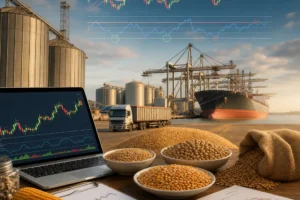


A calendar spread in grain is a futures position that buys one delivery month and sells another delivery month in the same crop, such as buying December corn and selling March corn, or the reverse. It is used to trade changes in carrying charges, storage economics, nearby tightness, harvest pressure, and seasonal supply patterns without taking a full outright flat-price view on corn, wheat, soybeans, or other grain futures. In practice, grain merchants, elevators, processors, exporters, hedgers, and speculators all watch these spreads because they connect the futures market to the physical realities of storage, freight, and timing. The spread is usually traded on a regulated futures exchange through a futures broker, while the underlying physical grain moves separately through elevators, cooperatives, mills, crushers, feed users, exporters, and warehouses.
In grain markets, calendar spreads matter because grain is storable, but storage is never free. The value difference between one futures month and another often reflects interest costs, storage costs, insurance, expected supply, demand timing, and the risk that grain is either abundant or unexpectedly scarce in the nearby period. That is why a simple month-to-month futures relationship can reveal a great deal about the real market.
What a calendar spread in grain actually is
A calendar spread, sometimes called an intra-market spread, compares two futures contract months for the same commodity on the same exchange. For example:
- Chicago corn: long December, short March
- CBOT soybeans: short November, long January
- CBOT wheat: long July, short September
- Canola futures: one crop month against another crop month
The trader is not directly buying physical grain in a warehouse or railcar. The trader is buying one futures month and selling another futures month, usually through a regulated exchange-cleared futures account. The gain or loss depends on how the difference between those two contract months changes.
If December corn is lower relative to March corn than it was when the spread was initiated, a long Dec/short Mar spread may lose value. If December strengthens relative to March, it may gain value. The exact result depends on whether the spread was established as a bull spread or bear spread.
How grain calendar spreads work in practice
The key concept is the price relationship between delivery months. Grain futures can trade in carry or inverse.
- Carry means deferred futures months trade above nearby months. This is common when grain is plentiful and the market needs to pay storage.
- Inverse means nearby months trade above deferred months. This often signals tighter immediate supplies or urgent nearby demand.
For storable crops like corn, soybeans, wheat, oats, canola, and in some regions barley, the spread often reflects whether the market is willing to pay holders of grain to store it. If the March futures premium over December is wide enough to cover storage and financing, a commercial grain firm may hedge stored grain against the deferred month. If the carry is too small, grain may be sold sooner instead of stored.
Commercial firms often think in terms of “earning the carry.” A country elevator, cooperative, or grain merchant that owns physical grain may sell a later futures month and hold inventory if the spread compensates for:
- warehouse storage cost,
- interest on inventory,
- quality risk or shrink,
- insurance,
- handling loss,
- basis risk.
Speculators may trade the same spread without owning physical grain, but the spread still tends to be anchored by commercial behavior over time.
| Spread condition | What it often suggests | Typical physical market meaning |
|---|---|---|
| Nearby below deferred month | Carry market | Grain is generally available and the market is paying for storage over time |
| Nearby above deferred month | Inverse market | Immediate supply is tight or nearby demand is unusually strong |
| Carry widening | More bearish nearby structure | Storage is being encouraged; harvest pressure or weak prompt demand may be present |
| Carry narrowing or turning inverse | More bullish nearby structure | Commercial users may need grain now; stocks may be tighter than expected |
Where calendar spreads are traded and where prices are checked
For major grain markets, calendar spreads are normally traded as futures spreads on regulated exchanges. In the United States, the core venue is CME Group, including CBOT grain contracts such as corn, soybeans, soybean meal, soybean oil, wheat, oats, and rough rice. In Canada, canola market participants also follow inter-month relationships on the relevant futures market. Other grain and oilseed products may trade on regional exchanges depending on the commodity.
To trade, a participant normally needs:
- a futures brokerage account with exchange access,
- approval for futures trading,
- sufficient margin capital,
- a trading platform that shows individual contract months and spread quotes.
Many broker platforms allow direct spread entry rather than legging two contracts separately, although execution methods differ by broker and exchange functionality. Traders should verify whether a platform offers native calendar spread quoting, margin offsets for recognized spreads, and exchange fee treatment for spread trades.
To check prices, market users commonly rely on:
- CME Group contract information and futures data for benchmark months,
- broker trading platforms for executable spread markets,
- commercial market-data terminals and charting systems for historical spread analysis,
- grain merchandising software and elevator systems for commercial hedge decisions.
These are exchange futures prices, not local cash bids. A farmer selling physical corn or wheat to a local elevator will usually see a cash price built from a local basis level plus or minus the relevant futures month. Local bids are commonly checked through elevator bid sheets, cooperative websites, merchant bid apps, text alerts, or direct conversations with buyers. That local cash market is related to the futures spread structure, but it is not the same thing.
Why calendar spreads matter to elevators, farmers, and grain merchants
Calendar spreads are a direct window into storage economics. Elevators and merchants use them to decide whether to buy grain at harvest, store it, hedge it forward, and deliver or sell later. The spread helps answer a practical question: is the market paying enough carry to justify ownership?
For farmers, the spread can influence whether to make a harvest sale, store unpriced grain, hedge futures and wait on basis, or use a deferred cash contract. A farm does not need to trade spreads directly to be affected by them. If futures carries are weak and local basis is poor, storing grain may be less attractive unless there is a strong reason to expect basis appreciation later. If nearby supplies are tight and spreads invert, the market may be urging prompt movement.
Processors, feed mills, ethanol plants, crushers, and exporters also monitor spreads because they show the market’s urgency for supply at different times. A crusher facing strong nearby soybean demand may bid aggressively in the cash market even while a later futures month remains weaker relative to nearby contracts.
| Participant | How they use the spread | Where activity occurs |
|---|---|---|
| Farmer | Evaluates storage versus sale timing; may hedge deferred bushels | Farm, local elevator, cooperative, broker platform |
| Country elevator or cooperative | Hedges inventory and captures carrying opportunities | Physical grain origin network plus exchange-cleared futures account |
| Processor or mill | Manages nearby coverage and forward input cost | Procurement desk, cash contracts, futures hedge account |
| Exporter or merchant | Aligns origin ownership, freight timing, and shipment program | Port terminals, execution desks, exchange and OTC logistics chain |
| Speculator or spread trader | Takes a view on spread tightening or widening | Broker platform and exchange futures market |
Main drivers of grain calendar spreads
Grain spreads move for both fundamental and technical reasons, but commercial fundamentals are usually the core anchor.
Stocks and stocks-to-use
Tighter inventories tend to support nearby months relative to deferred months. Large carryout and comfortable stocks generally support wider carries.
Harvest pressure
At harvest, corn and soybean supply floods into the pipeline. Nearby months can weaken relative to deferred months because storage capacity fills and sellers are active. Later, once the crop is in storage, spreads may tighten if movement slows.
Weather and crop risk
During the growing season, weather can rapidly alter new-crop spreads. Adverse weather may strengthen nearby new-crop timing relationships if markets fear production losses or delayed harvest.
Export pace and logistics
Strong export loadings, river disruption, rail bottlenecks, port congestion, or low water can change when grain is needed and where. The futures spread does not equal freight, but logistics stress can influence nearby demand and hedge behavior.
Storage costs and interest rates
Higher financing costs can affect how much carry is needed to justify holding grain. Commercial firms compare expected carry with actual ownership cost.
Government reports
USDA reports such as WASDE, Grain Stocks, Prospective Plantings, Acreage, Crop Production, Crop Progress, and Export Sales can quickly reshape inter-month values. Traders also monitor CFTC Commitments of Traders for positioning context, although that report is not a direct measure of physical tightness.
How to analyze a grain calendar spread
A practical spread analysis usually combines exchange pricing, seasonal history, physical market observations, and report timing.
- Choose the correct crop and month pair. Old-crop and new-crop spreads behave differently. July/September wheat is not the same type of trade as December corn/March corn.
- Check exchange specifications. Use the exchange contract page to confirm contract size, tick value, delivery months, and delivery mechanism.
- Look at the spread history. Compare current structure with seasonal patterns, but do not assume history must repeat.
- Compare spread value with commercial economics. Ask whether the market is offering enough carry for on-farm bins, elevator storage, or terminal storage.
- Check basis and local bids. A promising futures spread can still be undermined by weak local basis or expensive trucking.
- Review report calendar. Major USDA releases and expiration periods can sharply affect spread volatility.
- Know delivery risk. Nearby grain spreads can behave differently as first notice day or delivery period approaches.
For physical operators, the spread should never be analyzed in isolation. The real margin often depends on basis, freight, drying, condition loss, quality grade, and storage constraints. A futures carry that looks attractive on screen may be unattractive once all physical costs are included.
Calendar spreads versus physical grain transactions
This distinction is essential. A calendar spread is a futures market relationship. It is not the same as a cash forward contract, spot grain sale, warehouse receipt transaction, or export shipment.
Physical grain is usually bought and sold through:
- country elevators,
- agricultural cooperatives,
- grain merchants and trading houses,
- mills, crushers, maltsters, ethanol plants, and feed manufacturers,
- exporters and importers,
- licensed warehouses or storage handlers.
Those transactions involve delivery point, quality and grade, moisture, test weight, freight responsibility, inspection terms, settlement timing, and sometimes Incoterms for export trade. The futures spread may influence pricing decisions, but the physical contract itself is negotiated separately.
A farmer cannot assume that because March corn is above December corn on the exchange, storing grain will automatically pay. The local elevator bid may weaken, storage charges may apply, or basis may not improve enough. Conversely, a weak spread does not always prevent profitable storage if local basis appreciation is likely and farm storage cost is low.
Risks, costs, and limitations
Calendar spreads are usually less volatile than outright futures positions, but they are not low-risk by definition. They still involve leverage, mark-to-market variation, and margin calls.
- Margin risk: Futures spreads require capital and can generate losses before the trade thesis plays out.
- Liquidity risk: Some month pairs are liquid; others are less active and may have wider bid-ask spreads.
- Delivery-period behavior: Nearby spreads can move sharply as delivery mechanics matter more.
- Basis mismatch: A physical hedger may be right on the spread but wrong on local basis.
- Execution risk: Legging into separate months rather than using a quoted spread can expose the trader to slippage.
- Storage miscalculation: Commercial users may underestimate shrink, quality deterioration, or financing cost.
- Report shock: USDA surprises can rapidly reprice nearby and deferred months.
Before using grain spreads for hedging or speculation, participants should understand contract specifications, margin treatment, expiration procedures, and whether their objective is to hedge real inventory, capture carry, or express a market opinion.
Where to find reliable data and reports for grain spreads
The most practical sources depend on whether the user is trading futures, merchandising grain, or researching fundamentals.
- CME Group: Contract specifications, delivery months, settlement data, and official exchange information for listed grain futures.
- USDA: WASDE, Crop Progress, Grain Stocks, Acreage, Crop Production, Export Sales, and other reports used to interpret supply, demand, and seasonal spread pressure.
- CFTC: Commitments of Traders for broad positioning by participant category.
- Local elevators and cooperatives: Current cash bids, basis schedules, delayed pricing terms, and storage programs.
- Commercial data vendors and charting software: Historical spread charts, seasonal analytics, and comparative contract analysis.
For a farmer or local merchandiser, the workflow is usually split between online and physical channels. Futures months and spreads are monitored online through exchange data or a broker platform. Cash bids and grain movement opportunities are checked through local buyers and delivery points in the physical market.
Where can I check grain calendar spread prices?
Spread prices are normally checked on a futures broker platform, market-data service, or exchange-related futures data screen. For benchmark contract details and settlement context, CME Group is the main reference for CBOT grain contracts. Local elevator bid pages usually show cash prices, not exchange spread quotes.
Can a farmer use calendar spreads without delivering on futures?
Yes. Many farmers use spread information to decide when to sell or store grain without ever making exchange delivery. Some also hedge through a broker account, but most physical grain is still sold to elevators, cooperatives, processors, or merchants rather than delivered on futures.
Is a calendar spread the same as basis?
No. A calendar spread is the difference between two futures months. Basis is the difference between a local cash price and a specific futures month. Both matter in grain marketing, but they measure different things.
Where does physical grain trade if not on the futures exchange?
Physical grain usually trades through country elevators, cooperatives, grain merchants, processors, feed mills, ethanol plants, crushers, and exporters. Those transactions involve actual movement, grade, moisture, freight, and payment terms, which are separate from exchange futures trading.
Which reports are most useful for grain spread analysis?
USDA WASDE, Grain Stocks, Crop Progress, Acreage, Crop Production, and Export Sales are widely used. Traders also watch CFTC Commitments of Traders for positioning and the exchange contract calendar for first notice day and expiration timing.
Are grain calendar spreads safer than outright futures?
They are often less sensitive to broad flat-price moves, but they still carry risk. A spread can move sharply because of delivery pressure, logistics problems, surprises in government reports, or sudden shifts in nearby supply and demand.
Can grain calendar spreads be used for storage hedging?
Yes. Commercial firms frequently compare the spread carry with their cost of ownership. If the market pays enough carry, they may store physical grain and hedge with deferred futures. The trade only works if all real costs and basis outcomes are considered.
Do all grain crops have useful calendar spreads?
Most exchange-traded grains and oilseeds do, but liquidity varies widely by crop and month. Corn, soybeans, and major wheat contracts are typically the most watched. Smaller contracts or less active month pairs may be harder to trade efficiently.
Sources
- CME Group
- USDA National Agricultural Statistics Service and World Agricultural Outlook Board
- U.S. Commodity Futures Trading Commission