


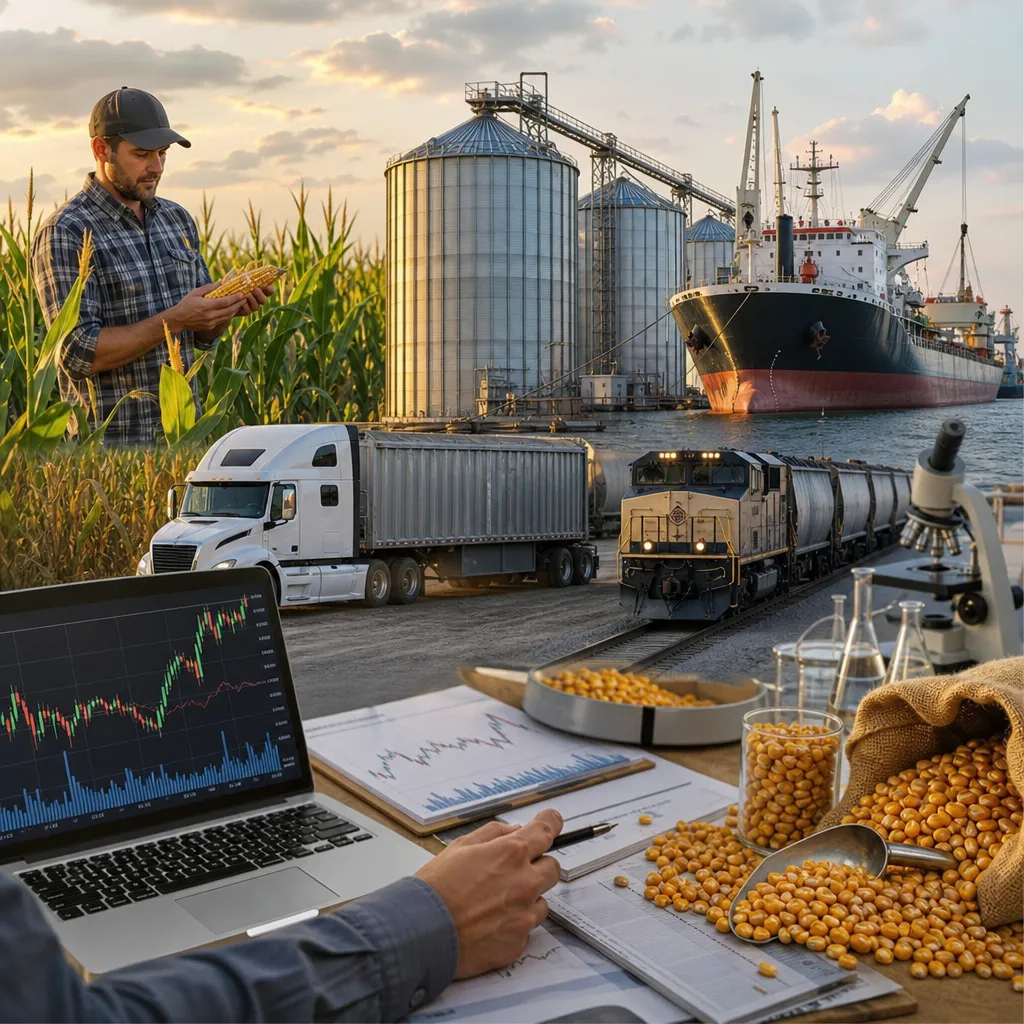
The phrase corn price per bushel usually refers to one of two different markets: the exchange futures price for corn, most commonly quoted from CME Group, or the local cash price offered by an elevator, cooperative, ethanol plant, feed mill, or grain merchant. Those two prices are related, but they are not the same. If you want the price a farmer can actually sell at today, the most useful number is normally the local cash bid; if you want the broader market benchmark used by traders and hedgers, the main reference is the CME corn futures contract. Understanding how the bushel price is formed requires separating futures, basis, freight, quality, and location.
What “corn price per bushel” means
In the United States, corn is commonly quoted in U.S. dollars per bushel. A bushel is a volume-based unit used in grain marketing, but for corn the trade also links it to a standard weight convention. This is why futures, cash bids, farm budgets, and market commentary often use the same unit even when the underlying transaction may eventually involve truckloads, railcars, barges, or export vessel cargoes.
When someone asks for the corn price per bushel, they may mean:
- Futures price quoted on CME Group for a specific delivery month such as March, May, July, September, or December.
- Cash price posted by a local buyer for nearby delivery or later delivery.
- Forward contract price offered by an elevator or processor for harvest or another future period.
- Net farm price after drying, trucking, shrink, storage, or other deductions.
That distinction matters because a futures quote on a screen is not automatically the price paid at a country elevator.
Where corn prices are quoted and how to check them
The most widely used benchmark for corn is the CME Group corn futures market. This is the regulated exchange market where commercial hedgers and financial traders buy and sell standardized contracts. Prices are quoted by contract month, not as one single universal cash value.
Readers normally check corn prices in several places:
- CME Group market data for futures prices by delivery month.
- Broker trading platforms if they have a futures account and need real-time or delayed exchange data.
- Local elevator, cooperative, or ethanol plant bid sheets for actual cash bids.
- Agricultural market reporting services operated by USDA Agricultural Marketing Service and regional cash market reporters where applicable.
- Farm management or grain marketing software that consolidates futures, basis, and local bids from participating buyers.
In practice, a producer selling physical corn usually starts with local bids, not only the exchange screen. A trader managing price exposure usually watches both.
| Price type | Where it is found | What it represents | Who uses it most |
|---|---|---|---|
| Futures price | CME Group and futures broker platforms | Benchmark exchange value for a specific contract month | Traders, hedgers, analysts, merchandisers |
| Cash bid | Elevators, cooperatives, processors, merchants | Actual local buy price for physical corn at a stated location | Farmers, local buyers, feed users |
| Forward cash contract | Elevator or processor contracting desk | Future delivery price for physical grain under contract terms | Farmers, commercial buyers |
| Basis quote | Local buyers and merchandisers | Difference between local cash price and futures | Hedgers, merchandisers, producers |
How corn price per bushel is formed
The practical formula behind many local market prices is:
Cash price = futures price + basis
Basis is the local adjustment to the exchange market. It reflects supply and demand at a specific place and time. Basis may be stronger or weaker depending on:
- distance from feed demand, ethanol plants, or export channels,
- local harvest pressure,
- storage availability,
- rail, truck, barge, or port logistics,
- grain quality, moisture, and test weight,
- regional competition among buyers.
For example, a strong nearby basis can occur when processors need grain urgently. A weak harvest basis is common when many farmers are selling at once and storage is tight. The same futures market can therefore support very different local cash prices across counties, states, or export regions.
In export markets, physical prices may also be referenced in other units such as metric tons and may include port premiums, freight, and contract terms. Merchants and exporters convert between those formats when comparing global values.
Futures price versus local cash price
The biggest misunderstanding in grain marketing is assuming that the futures quote equals the farmgate selling price. It does not. Futures are a standardized financial and delivery contract traded on an exchange. Cash grain is a physical commodity moved through the supply chain.
The CME corn futures contract is used for price discovery and hedging. Commercial firms can offset physical price risk by using futures, but the physical transaction still depends on local basis, delivery point, grade, and logistics. Farmers rarely deliver against futures contracts directly; most sell physical bushels to elevators, cooperatives, or processors and use futures only if they want a separate hedge.
| Feature | Futures market | Physical cash market |
|---|---|---|
| Where it trades | Regulated exchange through futures brokers | Elevators, cooperatives, merchants, processors, exporters |
| What is traded | Standardized contract | Actual physical corn |
| Price format | Exchange quote by delivery month | Cash bid at named location and time |
| Key adjustments | Margin, rollover, contract expiry | Basis, freight, moisture, grade, drying, shrink |
| Typical users | Hedgers and speculators | Farmers, merchandisers, mills, feed users, processors |
How farmers, buyers, and traders use the bushel price
Farmers
Farmers use corn price per bushel to decide when to sell old crop, when to forward-contract new crop, and whether storage is worth the cost. In practical terms, many compare:
- today’s spot cash bid,
- deferred delivery bids,
- their storage, drying, and interest costs,
- expected basis improvement after harvest.
A farmer can sell corn in several ways: at-harvest cash sale, hedge-to-arrive contract, basis contract, forward cash contract, delayed pricing arrangement, or direct futures hedge through a broker. Each method handles futures and basis differently, so contract terms should be reviewed carefully.
Elevators, cooperatives, and merchants
These firms buy physical grain from farmers, manage storage and logistics, and often hedge their inventory or purchase commitments using CME futures. Their posted bid is usually built from futures plus a location-specific basis, adjusted for quality rules and commercial margins.
Processors and feed users
Ethanol plants, feed mills, livestock producers, and food processors follow both the bushel price and nearby basis because corn is a major input cost. Many buy through cash contracts with local suppliers, while larger firms may hedge price risk in futures or options.
Speculators and financial traders
They trade corn futures or options through regulated brokerage accounts. They are taking price risk rather than buying truckloads of grain. This is not the same activity as purchasing physical corn in the country market.
Where to buy or sell physical corn
Physical corn is normally bought and sold through the grain handling system, not through a retail trading app. Common channels include:
- Country elevators that receive grain by truck from farms.
- Agricultural cooperatives that market members’ grain and offer storage and contracting options.
- Grain merchants and originators that buy for domestic processors or export programs.
- Ethanol plants, feed mills, and processors that may bid directly in surplus regions.
- Export elevators and terminal markets where grain is assembled for rail or vessel shipment.
- Grain brokers in some markets, especially for negotiated physical trades between commercial firms.
A physical transaction usually involves more than the bushel price alone. The parties normally confirm:
- delivery period,
- delivery point,
- grade and quality specifications,
- moisture limits and discounts,
- freight responsibility,
- weighing and inspection method,
- payment timing,
- whether the price is fixed, basis-only, or futures-related.
Commercial export trades may also use Incoterms and vessel loading terms, but farm-level transactions usually rely on elevator or processor contract language instead.
How to trade corn futures or options
If the goal is to trade corn as a financial market, access is usually through a regulated futures broker that offers CME agricultural contracts. The trader opens a futures account, posts margin, and trades standardized contracts electronically.
Key practical points:
- Choose a regulated brokerage that offers agricultural futures and options access.
- Understand the contract month and the difference between nearby and deferred contracts.
- Know that margin is required; futures are leveraged instruments and losses can exceed initial margin posted.
- Monitor expiry and delivery rules; most speculative traders close or roll positions before delivery notice periods.
- Use options if appropriate when defined premium-based risk structures are preferred, though options still carry complexity and time-value risk.
This market is designed for hedging and speculation on price movement, not for casually buying a small amount of physical corn. Anyone needing actual grain for feed or processing usually buys through commercial grain sellers, not through a futures account.
What moves corn prices per bushel
Corn prices respond to both global commodity drivers and local basis conditions. No single report or weather map explains the whole market.
- Acreage and yield expectations influence production potential.
- Weather matters especially during planting, pollination, grain fill, and harvest.
- Ending stocks and stocks-to-use shape how tight or comfortable supply appears.
- Exports affect demand, especially when major exporters compete on price.
- Feed demand rises or falls with livestock economics.
- Ethanol demand and energy markets can influence domestic corn usage.
- Currency moves change export competitiveness.
- Freight and logistics alter regional basis and delivered values.
- Government policy can affect biofuels, trade flows, and producer decisions.
Forecasting should therefore be treated as a scenario exercise. A bullish weather scare can be reversed by good late-season yields; weak futures can be offset locally by strong processor basis. Users should evaluate both the board and the basis.
Best reports, data sources, and tools for checking corn prices
For reliable information, the core public sources are well established.
- CME Group provides official futures contract information and market quotes for corn.
- USDA Agricultural Marketing Service publishes many cash grain market reports, terminal prices, and regional bid information where covered.
- USDA World Agricultural Supply and Demand Estimates is a benchmark report for supply, use, and ending stocks.
- USDA Crop Progress helps the market track planting, crop condition, and harvest pace.
- USDA Export Sales is closely watched for international demand.
- CFTC Commitments of Traders shows how broad trader categories are positioned in futures and options markets.
Commercial data vendors and farm software may package this information with charting, basis maps, alerts, and local bid comparisons. Those tools can be useful, but users should still know whether a quoted price is delayed exchange data, indicative bid information, or an actionable physical offer from a named buyer.
Practical limitations, costs, and risks
A bushel price on its own can be misleading if the user ignores the transaction details.
- Location risk: a strong river or processor bid may not be available at a distant farm.
- Quality risk: high moisture or damaged grain can reduce the net price materially.
- Storage cost: on-farm bins and commercial storage may allow better timing but are not free.
- Basis risk: a futures hedge does not lock local basis unless basis is contracted separately.
- Counterparty risk: physical contracts depend on the buyer’s performance and payment terms.
- Leverage risk: futures trading can generate rapid losses if the market moves against the position.
For decision-making, the best comparison is often net delivered value, not just the headline bushel quote. That means subtracting freight, drying, shrink, and any marketing fees where relevant.
Where can I check the current corn price per bushel?
For futures, check CME Group or a futures broker platform. For the actual local selling price, check nearby elevator, cooperative, ethanol plant, or processor bid sheets. Local cash bids are usually more relevant for farm marketing than the exchange quote alone.
Why is my local corn bid different from the futures price?
Because the local bid includes basis, which reflects location, freight, storage pressure, nearby demand, and quality factors. Cash price is not the same as futures price.
Can I buy physical corn online at the quoted bushel price?
Usually not in the same simple way as a financial asset. Physical corn is normally purchased through grain merchants, elevators, cooperatives, feed suppliers, or processors under commercial terms covering delivery point, quantity, and quality.
Where does corn futures trading take place?
The main benchmark market is CME Group. Access is typically through a regulated futures broker that offers agricultural contracts and margin accounts.
How do farmers lock in a corn price per bushel?
Common methods include cash sales, forward cash contracts, hedge-to-arrive contracts, basis contracts, or a direct futures hedge. Each locks a different part of the price and leaves different risks open.
What reports matter most for corn price direction?
USDA WASDE, USDA Crop Progress, USDA Export Sales, and CFTC Commitments of Traders are among the most watched public reports. CME futures price action and local basis trends are also essential.
Does a bushel price include trucking, drying, or storage?
Not necessarily. Many posted cash bids are before farm-specific costs such as trucking to the buyer, drying wet corn, shrink, or commercial storage charges. Always verify the net value.
Is trading corn futures the same as buying grain from an elevator?
No. Futures trading is a financial market activity using standardized contracts and margin. Buying from an elevator is a physical grain transaction involving actual corn, delivery terms, and quality specifications.
Sources
- CME Group
- USDA Agricultural Marketing Service
- USDA World Agricultural Supply and Demand Estimates