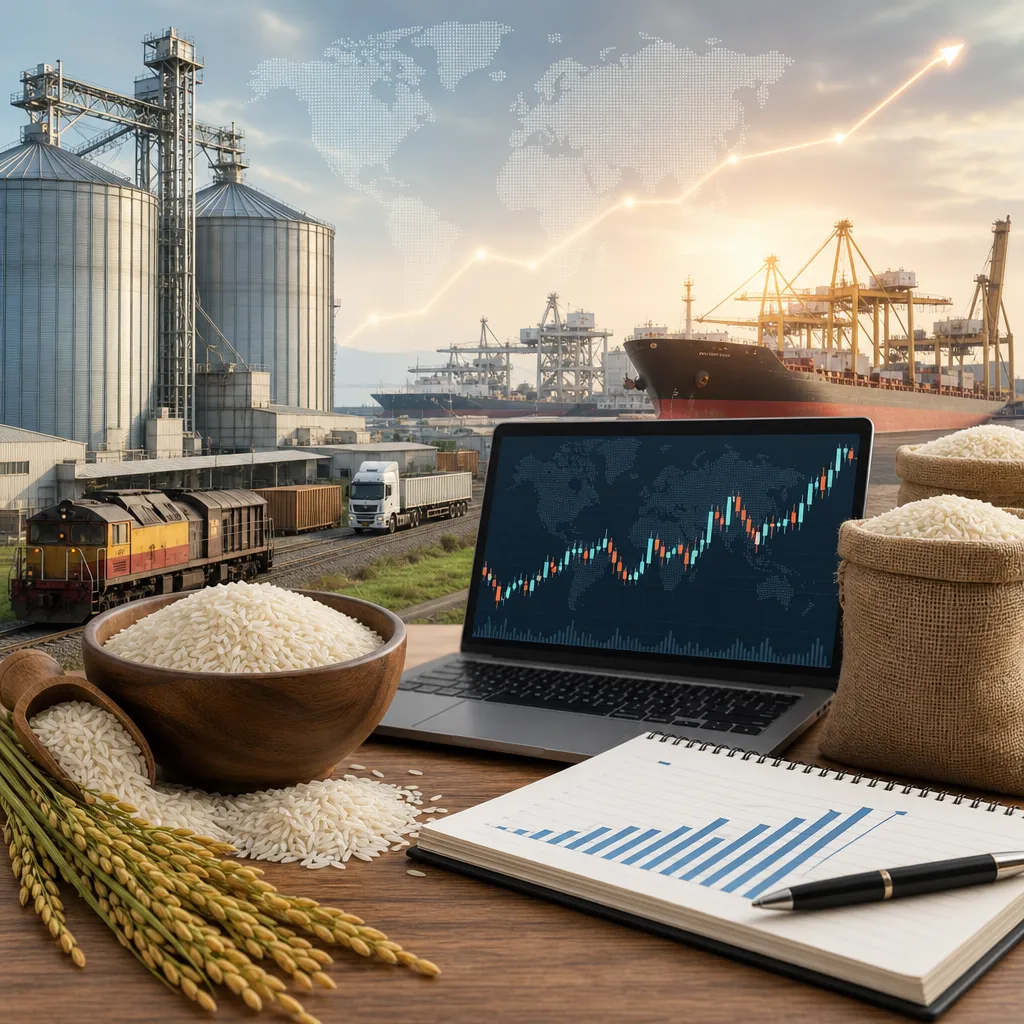







China’s rice futures market is part of the country’s broader grain risk-management system, but it does not work in the same way as the globally watched futures markets for corn, soybeans, or wheat. In practice, China is one of the world’s largest rice producers and consumers, and domestic rice pricing is heavily shaped by government policy, regional supply-demand conditions, milling demand, and the relationship between paddy, milled rice, and competing grains. For anyone trying to understand “China rice futures,” it is essential to distinguish between exchange-traded contracts, the physical paddy and rice trade inside China, and import flows that influence coastal and southern markets. The market operates mainly within China’s domestic commodity and grain system, with prices usually discussed in renminbi yuan per metric ton.
Unlike some commodities where one benchmark dominates all pricing, China’s rice market is more fragmented. Different rice types, quality standards, producing provinces, storage policies, transport costs, and state reserve activity all affect what buyers actually pay. That means a futures price, when available for a relevant contract, should not be treated as the same thing as a mill’s delivered purchase price or a farmer’s local paddy sale price.
What the China rice futures market means
In China, “rice futures market” usually refers to exchange-traded contracts linked to rice-related farm commodities, especially early indica rice and late indica rice, which have been listed on the Zhengzhou Commodity Exchange (ZCE). These are domestic Chinese agricultural futures contracts used for price discovery and risk management rather than a direct quote for all rice traded in China.
The key geographic center for this futures activity is Zhengzhou, Henan Province, where ZCE is based. However, the physical rice economy is spread across major producing and consuming regions across China. Important producing areas include provinces in the middle and lower Yangtze basin and southern China, while major consumption and milling demand is distributed across large urban and coastal markets.
It is also important to separate:
- Paddy: unhusked rice as harvested from the field.
- Milled rice: finished rice after processing.
- Exchange futures: standardized contracts traded financially on an exchange.
- Physical spot or cash market: real grain bought by mills, traders, processors, feed users, reserve systems, or merchants.
China’s domestic rice market often focuses more on paddy procurement, milling margins, reserve policy, and regional cash quotations than on a single nationally dominant rice futures benchmark.
Where the market operates in China
The financial market operates through the Zhengzhou Commodity Exchange, one of China’s major agricultural futures exchanges. Exchange trading is electronic and accessed through licensed futures brokers serving domestic market participants. The exchange provides the formal contract structure, quotation system, and delivery framework for eligible contracts.
The physical market operates across a very different network. Rice is actually bought and sold through:
- farm-level procurement in producing provinces,
- grain traders and merchants,
- rice mills,
- state-related reserve and procurement channels,
- wholesalers in consuming regions,
- import channels for certain rice grades and origins.
China’s rice logistics depend heavily on internal transport. Surplus-producing regions move paddy or milled rice to deficit regions by road, rail, and river systems, especially in central and southern China. Coastal demand can also be influenced by imported rice, particularly when imported supplies are competitive in quality or price for specific end uses.
| Market segment | Where it operates | Main purpose | Typical users |
|---|---|---|---|
| Rice futures | Zhengzhou Commodity Exchange | Price discovery and hedging | Traders, processors, hedgers, investors |
| Paddy procurement | Producing provinces and local grain markets | Physical purchase from growers or collectors | Mills, merchants, local buyers |
| Milled rice wholesale trade | Urban wholesale and regional distribution markets | Food supply and regional redistribution | Wholesalers, distributors, food buyers |
| Import market | Coastal and southern entry channels | Supplement domestic supply for specific qualities or price windows | Importers, traders, processors |
How rice prices are formed in China
Rice prices in China are formed through a combination of market forces and policy influences. The most important drivers are not always the same as in export-focused grain markets. Domestic production conditions, government reserve policy, procurement behavior, and consumer food demand often matter more than international rice futures benchmarks.
In practice, the price chain usually starts with paddy values at origin. Farmers or collectors sell paddy based on local moisture, variety, quality, harvest timing, and nearby buying competition. Mills then calculate whether they can profitably process that paddy into milled rice, broken rice, bran, or other by-products. Their bid depends on expected sales prices for finished products and transport costs to end markets.
When a rice-related futures contract is active and relevant, the exchange price can serve as a reference for expectations. But the final cash price still depends on local fundamentals. This difference is often called basis, meaning the gap between a local cash price and the benchmark futures price. In China’s rice market, the basis can reflect:
- quality and variety differences,
- province of origin,
- distance to mills or consumption centers,
- delivery and storage costs,
- policy intervention or reserve rotation,
- import competition in some regions,
- seasonal harvest pressure.
Readers should also distinguish several price types:
| Price type | What it means | Why it differs |
|---|---|---|
| Futures price | Exchange-traded standardized contract price | Reflects market expectations and contract terms, not every local physical deal |
| Cash price | Spot price for real paddy or rice in a local market | Depends on quality, timing, buyer demand, and local supply |
| Delivered mill price | Price paid with transport to a mill or buyer included | Includes freight, handling, and often tighter quality requirements |
| Import price | Price for foreign-origin rice, often discussed on a CIF basis for landed supply | Affected by ocean freight, origin prices, tariffs or quotas, and currency |
| Wholesale rice price | Price in regional distribution or wholesale markets | Reflects packaging, brand, transport, and urban demand conditions |
The role of Zhengzhou Commodity Exchange
Zhengzhou Commodity Exchange is the relevant Chinese exchange when discussing domestic rice futures. Its agricultural markets serve Chinese participants who need a regulated venue for hedging or trading standardized exposure. The exchange’s role is to centralize quotations, list contracts, manage clearing, and define delivery and quality rules for listed products.
For commercial users, futures are mainly a risk-management tool. A processor or trader exposed to rice-related price changes may use futures to reduce risk, but that does not eliminate differences between the contract and the exact physical rice they handle. That mismatch is basis risk.
For investors and speculators, the futures market offers price exposure without owning warehouses of grain. They can buy or sell contracts through a broker, post margin, and close positions before delivery. This is very different from buying physical rice, which requires quality control, logistics, storage, and settlement with real counterparties.
Because Chinese agricultural futures markets are domestically structured and regulated, international users should never assume access works the same way as on Chicago or European exchanges. Contract access, account requirements, and participation rules depend on Chinese market regulation and broker arrangements.
How physical rice is actually bought and sold in China
Most rice in China is not traded through futures delivery. It is traded physically through the domestic grain chain. Farmers sell paddy at harvest or from storage, often to local merchants, collection points, cooperatives, or mills. The paddy is then dried, transported, stored, and milled before entering wholesale, retail, foodservice, or institutional channels.
A practical physical transaction usually involves:
- Price negotiation based on variety, moisture, quality, and delivery point.
- Sampling and inspection for grain condition and milling quality.
- Delivery terms, such as ex-farm, warehouse, or delivered mill basis.
- Weight and quality confirmation at the receiving point.
- Payment settlement according to the contract or standard commercial practice.
Commercial buyers may include rice mills, food processors, feed users for lower-grade material, wholesalers, reserve operators, or regional traders. The most important practical issue is that each buyer may value the same lot differently depending on intended use and logistics cost.
For imported rice, traders and processors focus more on landed cost, customs procedures, quality specifications, and inland distribution. Imported rice does not set all domestic prices, but it can cap prices in some regions or quality segments when international supply is competitive.
How rice futures and hedging work in practice
A hedge is not the same as a cash sale. In China’s rice market, a physical participant may sell paddy or rice to a commercial counterparty while using futures separately to reduce exposure to adverse price moves. The cash market and the futures market are connected, but they are not identical.
Two practical examples help explain this:
- A rice mill expects to buy paddy later. If it fears prices may rise, it might use futures to protect against higher input costs. The actual paddy still has to be bought physically from suppliers at local market terms.
- A trader with inventory fears prices may fall before resale. It may hedge by selling futures. If cash values weaken, the futures position may offset part of the loss, though basis changes can still affect the outcome.
Anyone using futures must understand margin, daily mark-to-market settlement, contract expiry, and the risk of leverage. A futures account is opened through a broker; physical rice ownership requires separate commercial arrangements. Monitoring futures online is easy compared with organizing transport, storage, finance, and quality control in the physical market.
Where to check China rice prices and market information online
If you need current China rice futures prices, the first place to check is the Zhengzhou Commodity Exchange. The exchange is the primary official source for listed contract information, quotations, and contract documentation. Market participants may also monitor prices through licensed broker platforms and commodity data terminals that distribute Chinese futures market information.
For physical market information, there is no single perfect nationwide quote for all rice. Readers usually need a combination of sources:
- Zhengzhou Commodity Exchange for official rice-related futures contract information.
- National Bureau of Statistics of China for broad production and economic context.
- USDA Foreign Agricultural Service for external analysis of China’s rice supply, demand, imports, and policy environment.
- Local grain trade channels such as mills, merchants, and wholesale market quotations for actionable cash prices.
This distinction matters. A futures quote on an exchange screen is a standardized financial benchmark. A local cash bid in Hunan, Jiangxi, Hubei, or another producing province may differ because of quality, storage condition, transport, and buyer competition. Likewise, a rice wholesaler in a coastal consuming city may quote a very different delivered price because milling, freight, and packaging are already built in.
Main factors that drive the China rice market
The Chinese rice market is shaped by a mix of domestic fundamentals and policy variables. Forecasting the market therefore requires scenarios rather than certainty.
| Factor | Typical effect | Why it matters |
|---|---|---|
| Weather and yields | Can tighten or loosen domestic supply | Rice remains highly sensitive to planting and growing conditions |
| Government policy | May support or restrain prices | Procurement, reserves, and market management are important in China |
| Import competitiveness | Can pressure some domestic segments | Coastal users may compare domestic rice with landed imported supply |
| Milling margins | Affects how aggressively mills buy paddy | Processors buy based on expected resale values of outputs |
| Transport and storage costs | Widen or narrow regional price gaps | China’s rice market is large and regionally diverse |
| Competition from other grains | Influences feed substitution and land use decisions | Relative values between grains matter for some demand channels |
In a supportive scenario, weather problems, tighter stocks available to the market, or strong procurement could strengthen domestic prices. In a softer scenario, comfortable supply, weak milling margins, or competitive imports could limit upside. Because policy can matter so much, official signals are often as important as purely commercial indicators.
Practical guidance for readers using this market
If your goal is to buy or sell physical rice in China, focus on local trade channels first. Speak with mills, merchants, processors, importers, or regional grain buyers, and confirm quality specifications, delivery point, transport, payment terms, and counterparty risk. The trade is usually negotiated in yuan per metric ton, but the exact quotation basis must be clear.
If your goal is to trade or hedge futures, focus on the exchange and your broker. Confirm the exact contract, expiry month, quality and delivery framework, margin requirements, and whether your exposure is to paddy-type contracts rather than all categories of milled rice. A futures position provides price exposure, not automatic physical ownership.
For analysis, it is usually best to watch both markets at the same time:
- exchange futures for benchmark sentiment and risk management,
- local cash quotations for real procurement conditions,
- policy and stock signals for domestic direction,
- import economics for coastal and southern market pressure points.
Frequently asked questions
Where is China’s rice futures market located?
The relevant exchange market is centered on the Zhengzhou Commodity Exchange in Zhengzhou, Henan Province. Physical rice trade, however, takes place across producing, milling, wholesale, and consuming regions throughout China.
What is the main benchmark for rice futures in China?
China’s domestic benchmark role is associated with rice-related contracts listed on Zhengzhou Commodity Exchange, particularly for indica rice categories. These are domestic benchmarks and should not be confused with all local milled rice prices across China.
In what currency and unit are rice prices usually discussed in China?
Domestic prices are usually discussed in Chinese yuan, also called renminbi, and commonly quoted per metric ton in commercial grain trade. Retail or consumer prices may use different units, but wholesale and procurement trade usually focuses on tonnage.
Why is a local rice cash price different from a futures price?
A futures price is a standardized exchange quotation. A local cash price reflects the exact rice or paddy being bought, including quality, variety, moisture, location, freight, storage, timing, and buyer competition. The difference between the two is basis.
Where can I check current China rice futures prices?
The official starting point is the Zhengzhou Commodity Exchange. Market participants may also use licensed broker platforms and commodity market data services. For physical cash values, readers usually need direct market quotes from mills, traders, processors, or wholesale channels.
How is rice physically traded inside China?
Physical rice is bought and sold through farm procurement, merchant networks, mills, wholesalers, and import channels. Transactions rely on negotiated terms covering quality, delivery point, transport, inspection, and payment rather than simply matching an exchange price.
Can foreign readers use China rice futures as a direct guide to export prices?
Not reliably. China is primarily a huge domestic rice market, and internal policy and regional cash conditions are major price drivers. Export or import values, where relevant, are shaped by separate logistics, landed costs, and trade policy considerations.
What matters most for forecasting China’s rice market?
Weather, yields, reserve and procurement policy, milling margins, domestic consumption, import competitiveness, and regional logistics all matter. Forecasts should be scenario-based because policy and local market conditions can change the outcome quickly.
Sources
- Zhengzhou Commodity Exchange
- USDA Foreign Agricultural Service
- National Bureau of Statistics of China