


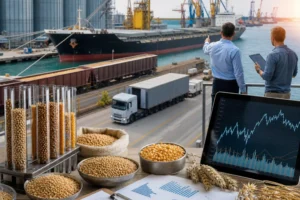







The Black Sea grain export market is not a single exchange or one port. It is a regional physical export market centered on the Black Sea and the Sea of Azov, linking grain-producing areas in Eastern Europe and the former Soviet region with buyers in the Middle East, North Africa, Europe, and Asia. In practice, people usually mean export trade from countries such as Russia, Ukraine, Romania, and Bulgaria, with wheat, corn, and barley as the main commodities. Prices in this market are mostly quoted in U.S. dollars per metric ton for export cargoes, while domestic cash markets inside each country may trade in local currency and under local delivery terms.
This market matters because it is one of the world’s key origins for milling wheat and feed grains. It strongly influences nearby import demand from Mediterranean and Middle Eastern buyers, and it also competes directly with European Union, U.S., and South American grain exporters. For farmers, merchants, millers, and importers, understanding Black Sea pricing means understanding the relationship between inland cash grain, port logistics, export bids, freight, quality, and international benchmarks.
What the Black Sea grain export market means
The Black Sea grain export market is the network of physical grain trade flowing through Black Sea export corridors rather than a centralized marketplace. It includes farm-level suppliers, inland elevators, rail and truck networks, river systems where relevant, port terminals, inspection services, exporters, shipbrokers, and import buyers.
The core commodities are:
- Wheat, especially milling wheat but also feed wheat
- Corn, mainly feed corn
- Barley, especially feed barley
- Sunflower products may matter regionally, but they are outside the strict grain focus
The regional concept is important because cargoes are often compared origin against origin. A buyer may compare Russian wheat FOB with Romanian wheat FOB, then compare both with French or U.S. supplies after adding freight. That means the Black Sea market is both local and global at the same time.
Where the market operates
Geographically, the market is built around grain-producing inland regions and export ports with access to the Black Sea. In commercial discussion, the most important origins are usually Russia, Ukraine, Romania, and Bulgaria. Moldova may appear in regional trade, but on a smaller scale. Trade conditions can differ sharply by country because of policy, infrastructure, war risk, sanctions-related banking friction, insurance costs, and available export routes.
Typical pricing references are linked to export ports rather than to one nationwide average. Grain may be bought inland, moved to an elevator or terminal, and then sold on a delivered-to-port basis or as an export cargo.
| Country/origin | Role in Black Sea trade | Typical grains | Common export pricing language |
|---|---|---|---|
| Russia | Major wheat export origin | Wheat, barley, corn | Usually U.S. dollars per metric ton, often FOB at export port |
| Ukraine | Major grain and oilseed export origin, logistics highly route-dependent | Corn, wheat, barley | Usually U.S. dollars per metric ton, FOB or alternative corridor delivery terms depending on route |
| Romania | EU Black Sea export gateway | Wheat, corn, barley | Export values often discussed in euros or U.S. dollars per metric ton |
| Bulgaria | Important regional exporter within the EU | Wheat, corn, barley | Usually euros or U.S. dollars per metric ton depending on trade context |
The export market is therefore not limited to one legal jurisdiction or one pricing system. It is a cross-border trade arena where grain quality, shipping access, and political risk can affect price as much as crop size.
How prices are actually formed
Black Sea grain prices are formed through negotiation in the physical market, but those negotiations usually reflect wider international benchmarks. Exporters watch global wheat and corn futures, competing origins, tender results from importing countries, vessel freight, and local supply conditions.
The main price concepts are different, and they should not be confused:
- Futures price: a standardized derivatives price on an exchange such as CBOT or Euronext. It reflects the financial market for a specific contract month, not an exact Black Sea cargo price.
- Local cash bid: the price a farmer or inland supplier can receive from an elevator, merchant, or processor in a specific location.
- Delivered price: the value paid if grain is delivered to a named location, such as a port terminal, mill, or feed plant.
- FOB price: free on board, meaning the seller prices the grain loaded on a vessel at the export port.
- CIF price: cost, insurance, and freight to the destination port. Importing buyers often think in CIF terms.
- Basis: the difference between the local physical price and a futures benchmark or another reference price.
For example, a Black Sea wheat FOB offer can rise even if futures are flat, if vessel lineups are busy, inland supplies are tight, or buyers need prompt shipment. The opposite can also happen: futures may rally while local export bids lag because port congestion, policy changes, or weak overseas demand reduce exporter margins.
Price formation often includes these variables:
- protein and other quality specifications
- crop size and harvest pace
- farmer selling speed
- port capacity and logistics costs
- freight and marine insurance
- currency movement against the U.S. dollar or euro
- government policy, taxes, quotas, licensing, or informal restrictions where relevant
- import tender activity from major buyers
Benchmarks, exchanges, and the role of futures
The Black Sea grain export market is primarily a physical market, but it is heavily influenced by futures exchanges. Wheat exporters and importers commonly monitor exchange-traded contracts as reference points for risk management and relative value.
The most relevant international benchmarks are usually:
- CME Group wheat and corn futures, especially for global directional price signals
- Euronext wheat and corn futures, particularly for European and Black Sea comparisons
These exchanges are not where most Black Sea physical grain changes hands. Instead, they are where commercial firms and financial participants hedge price risk or express market views. A trading company may buy physical wheat in the Black Sea, then hedge part of its exposure using wheat futures. That hedge reduces outright price risk but does not eliminate basis risk, quality risk, or logistics risk.
| Price type | Where quoted | What it means in practice |
|---|---|---|
| Futures | CME Group or Euronext | Financial benchmark for hedging and price discovery, not the exact local cargo value |
| Inland cash bid | Local buyer, elevator, merchant, processor | What a farmer or supplier may receive at a specific inland point |
| Delivered port price | Merchant or exporter quote | Physical grain value delivered to terminal or port location |
| FOB export price | Export market reports, brokers, trade assessments | Price of grain loaded on board at export port |
| CIF destination price | Import tenders, destination market reports | Delivered landed value paid by importer including freight and insurance |
How grain is bought, sold, exported, and imported
Physical grain trading in the Black Sea usually starts inland. Farmers sell to local elevators, traders, cooperatives where relevant, processors, or directly to merchants. The contract can be spot, forward, or based on later delivery, depending on local practice and counterparty confidence.
Commercial steps often include:
- Grain is sampled and checked for quality, such as protein, test weight, moisture, foreign matter, or damage.
- A buyer offers an inland cash price or a delivered price to a storage or port point.
- The grain is moved by truck, rail, barge where relevant, or a combination of routes.
- An exporter aggregates enough tonnage to form a vessel cargo.
- The cargo is sold to an overseas buyer, often through direct negotiation or in response to a government or private tender.
- At the port, the grain is loaded after logistics, documentation, and inspection requirements are met.
Importers may include state grain agencies, private millers, feed manufacturers, and trading houses. Many large destination markets buy by tender, especially for wheat. Tender results can immediately affect Black Sea export values because they reveal which origin is cheapest or most available for a particular shipment period.
For online access, traders and analysts typically use broker screens, exchange data, shipping and market reporting services, and tender news. But the actual grain itself is usually bought and sold through contracts between physical counterparties, not by clicking a retail trading button and taking ownership of a ship cargo.
Where readers can check prices and market information
If you want a current Black Sea grain price, the first step is to define exactly what you need: wheat or corn, which origin, what quality, what shipment month, and whether you mean inland cash, delivered port, FOB export, or a futures benchmark. There is no single official “live Black Sea grain price” that covers all of these.
Practical sources normally include:
- CME Group for wheat and corn futures benchmarks
- Euronext for European wheat and corn futures benchmarks
- USDA Foreign Agricultural Service for regional market context, trade flows, policy changes, and country reports
- USDA WASDE and related grain reports for global supply and demand context
- European Commission market information for EU grain trade and market background relevant to Romania and Bulgaria
- Local merchants, exporters, cooperatives, processors, and port-linked buyers for actual cash bids and delivered offers
- Import tender results reported through recognized market channels, because they reveal executable destination demand
Readers should be careful with price comparisons. A futures quote seen online is not the same as a Black Sea FOB offer. A port bid is not the same as a farm-gate bid. A headline about “wheat up” may refer to a benchmark contract while local Black Sea cash values stay unchanged because basis weakens.
Main supply, demand, and logistics drivers
The Black Sea export market is highly weather-sensitive because harvest size strongly affects exportable surplus. Winter wheat conditions, spring development, summer heat, and harvest weather all matter. Corn is especially sensitive to growing-season moisture and late-season heat in parts of the region.
Beyond production, export competitiveness depends on logistics and policy. Inland transport availability, waiting times at ports, financing conditions, insurance costs, and trade restrictions can all influence the spread between inland and export values.
Key market drivers include:
- Crop conditions and yield potential: larger harvests can pressure local prices if logistics cannot keep pace
- Farmer holding behavior: slow selling can tighten nearby port supply
- Currency: local currency weakness can support export competitiveness, while strength can reduce it
- Freight: ocean freight changes alter destination competitiveness
- Buyer tenders: large tenders from import-dependent countries can quickly reprice nearby offers
- Competing exporters: French, U.S., Argentine, Brazilian, or other supplies can cap Black Sea prices
- Policy and geopolitical risk: export rules, sanctions-related frictions, and security conditions can reshape routes and costs
Forecasting the Black Sea grain export market
Forecasting this market is best done in scenarios rather than fixed predictions. The region is too exposed to weather, logistics, and policy shifts for false precision to be useful.
| Scenario | Conditions | Likely market implication |
|---|---|---|
| Large crop, smooth logistics | Good yields, steady exports, no major bottlenecks | Export offers may become more competitive, especially during harvest pressure |
| Large crop, weak logistics | Good production but port or transport constraints | Inland cash prices may weaken more than FOB values due to congested movement |
| Smaller crop, active demand | Lower output with steady import buying | FOB prices can strengthen and nearby supply may tighten quickly |
| Policy or route disruption | Trade restrictions, corridor changes, insurance or shipping disruption | Price spreads between origins may widen and cash market volatility can increase |
For practical forecasting, watch crop conditions, export pace, import tenders, marine logistics, and benchmark futures together. No single indicator is enough on its own.
How participants hedge or manage risk
Physical grain firms in the Black Sea market usually manage risk in two separate but connected ways.
Physical grain risk management involves choosing reliable counterparties, setting quality tolerances, using clear delivery terms, checking payment conditions, and managing storage and logistics exposure. This is the real-world commercial side of the trade.
Futures and options risk management takes place on organized exchanges through a broker. A merchant or processor may hedge price direction using wheat or corn futures, or sometimes options where suitable. This creates financial exposure, not physical ownership of the Black Sea grain itself.
Important caution: a hedge reduces outright market risk but does not remove basis risk. A company can be correctly hedged on futures and still lose money if local basis, quality discounts, freight, or execution costs move against it.
Frequently asked questions
Is there one official Black Sea grain price?
No. The market has many prices depending on origin country, commodity, quality, location, shipment period, and trade term such as inland cash, delivered port, FOB, or CIF.
What is the main benchmark for Black Sea wheat?
There is no single perfect benchmark. Market participants often use CME Group or Euronext wheat futures for direction, then adjust for basis, quality, and freight to arrive at a Black Sea physical value.
Where can I check current Black Sea grain prices online?
For benchmark futures, check CME Group and Euronext. For broader regional context, check USDA market and country reports and European Commission grain information where relevant. For actual executable cash or export prices, market participants usually rely on local merchants, exporters, brokers, and trade reporting channels.
Why is a local cash bid different from a futures price?
Because the cash bid includes location, transport, handling, quality, storage, buyer competition, and local supply-demand conditions. Futures reflect a standardized financial contract, not a farm-gate or port-specific cash transaction.
How is Black Sea grain usually sold to foreign buyers?
Most export grain is sold by merchants or exporters through negotiated contracts or import tenders. Cargoes are commonly priced on FOB terms at the export port, while buyers may compare them on a CIF destination basis.
Can an individual trader buy Black Sea grain through a futures account?
No, not in the practical physical sense. A futures account gives financial exposure to exchange-traded contracts. Physical Black Sea grain trade requires commercial contracts, logistics, quality control, documentation, and shipping arrangements.
What units and currencies are most common?
Export trade is commonly discussed in U.S. dollars per metric ton. Domestic cash markets may also use local currency per metric ton, depending on the country and buyer.
What moves the market most quickly?
Major weather shifts, import tenders, export policy changes, logistics disruptions, and large moves in global wheat or corn benchmarks can all move Black Sea grain values rapidly.
Sources
- USDA Foreign Agricultural Service
- CME Group
- European Commission