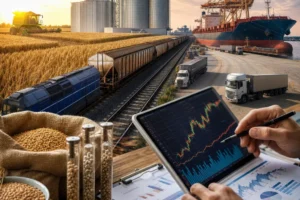


“EU wheat prices today” usually refers to the European Union wheat market, with the main tradable benchmark centered on milling wheat futures listed on Euronext in Paris and a large network of physical cash markets across member states. In practice, there is no single farm-gate wheat price for the whole EU at any moment, because wheat is bought and sold locally by quality, destination, and logistics route. Readers looking for today’s price need to distinguish between exchange futures, domestic cash bids, and export quotes at ports. They also need to note the currency, unit, protein specification, and delivery point before comparing values.
The EU is one of the world’s major wheat-producing and wheat-trading regions, but it is not a single physical marketplace. France, Germany, Poland, Romania, and other member states all contribute to supply, while mills, feed manufacturers, traders, and exporters create different layers of demand. As a result, “today’s EU wheat price” is best understood as a set of connected prices rather than one number.
What “EU wheat prices today” means
In the EU context, wheat pricing most often revolves around common wheat, especially milling wheat. The most widely watched financial benchmark is the Euronext milling wheat futures contract, often still referred to in the trade as the MATIF wheat price because of the market’s older branding. That benchmark is quoted in euros per metric tonne.
However, the futures quote is not the same as the price a farmer in northern France, a cooperative in Germany, or an exporter in Romania receives on a physical sale. Physical wheat changes hands through local cash markets, inland collection points, mills, feed plants, river terminals, and seaports. Prices can therefore differ materially from the exchange benchmark.
When people say “EU wheat prices today,” they may actually mean one of several things:
- the latest Euronext milling wheat futures price,
- a local cash bid from an inland buyer,
- a delivered price to a mill or feed compounder,
- an export offer or bid quoted FOB at a port,
- an import value quoted CIF into a consuming region.
Where the EU wheat market operates
The EU wheat market operates across many national and regional physical markets, but the main financial benchmark is associated with Euronext Paris. That futures market is especially relevant because France is a major wheat producer and exporter and because Euronext pricing is widely used by merchants, cooperatives, mills, exporters, and risk managers across Europe.
Physical wheat trade takes place across:
- farm-to-cooperative and farm-to-merchant sales,
- domestic mill and feed market procurement,
- river and inland terminal networks,
- port export channels, especially in major exporting member states,
- cross-border EU trade between surplus and deficit regions.
Within the EU, wheat can move from inland production areas to domestic users or export terminals by truck, rail, barge, or vessel depending on geography. In some member states, port values are especially influential; in others, domestic milling and feed demand can dominate local price formation.
| Market layer | Where it operates | Typical quotation basis | Main users |
|---|---|---|---|
| Futures market | Euronext Paris | EUR per metric tonne | Hedgers, traders, funds, merchants, processors |
| Local cash market | Country and regional buying points across the EU | Local bid in EUR per tonne, often ex-farm or delivered | Farmers, cooperatives, merchants, mills, feed buyers |
| Export market | Major seaports and export terminals | FOB or vessel-related values | Exporters, international traders, importers |
| Import/consumption market | Deficit regions, mills, feed users | Delivered or CIF-equivalent values | Millers, compound feed producers, merchants |
How EU wheat prices are formed
EU wheat prices are formed by a combination of global benchmark sentiment and highly local physical factors. The Euronext wheat contract provides a transparent reference point, but real trade is priced through a negotiation between benchmark futures and basis.
Basis is the difference between a local cash price and the relevant futures reference. A local cash bid may be above or below futures depending on supply, quality, freight cost, buyer competition, and export demand.
Key price types include:
- Futures price: a standardized exchange-traded reference for a delivery month.
- Cash bid: a local buyer’s price for physical wheat at a named location and quality.
- Delivered price: the price for wheat delivered to a mill, feed plant, or warehouse.
- FOB price: free on board at an export port, reflecting wheat loaded for shipment.
- CIF price: cost, insurance, and freight into an importing destination.
In the EU, the final physical price usually reflects:
- the current futures level on Euronext,
- protein and other quality specifications,
- distance to port or processor,
- truck, rail, or barge availability,
- harvest pressure or post-harvest storage tightness,
- competition between exporters and domestic users,
- the euro exchange rate versus competing origins,
- world wheat conditions in the Black Sea, North America, and other exporting regions.
Where to check EU wheat prices online
For a reliable “today” view, readers should check both benchmark futures and physical market reporting. Because local cash prices are fragmented, no single public source captures every transactional value across the EU.
Useful places to check include:
- Euronext for official milling wheat futures and contract information.
- European Commission market information and agriculture monitoring for EU grain context.
- USDA, especially global grain balance and trade analysis, for the wider supply and demand picture affecting EU values.
- National ministries, market observatories, or statistics offices where member states publish grain market updates.
- Cooperatives, merchants, and grain buyers for actual local cash bids, often available through grower portals or direct commercial contact.
- Broker and market data platforms for intraday futures, delayed quotes, and charting.
When checking a price, confirm all of the following before using it:
- is it futures or physical cash,
- is it old crop or new crop,
- what delivery month is shown,
- what quality or protein standard applies,
- what location is quoted,
- whether the number is in euros per tonne.
| Source type | What it usually shows | Best use |
|---|---|---|
| Euronext | Benchmark wheat futures and contract details | Tracking the main EU futures reference |
| European Commission | EU agricultural market context and reporting | Understanding regional supply, demand, and trade conditions |
| USDA | Global wheat outlook, balance sheets, and trade analysis | Comparing EU trends with world market drivers |
| Local buyers and cooperatives | Cash bids and delivery terms | Seeing actual nearby physical selling opportunities |
Why local EU cash prices differ from futures
This is the most important practical point for farmers, merchants, and analysts. A futures quote from Paris is a benchmark, not a universal cash settlement price. The local value in France, Germany, Poland, Spain, Romania, or the Baltic region may be higher or lower depending on basis.
Common reasons for divergence include:
- Quality: milling wheat, feed wheat, protein level, test weight, moisture, and falling number all matter.
- Location: wheat near an export terminal or major mill may command a different premium than wheat in a remote interior zone.
- Timing: harvest can pressure cash bids even if futures stay relatively firm.
- Storage economics: when space is tight, buyers can widen discounts.
- Export competitiveness: if EU origin is competitive versus rival exporters, port demand can strengthen inland bids.
- Currency: the euro’s movement against other currencies can influence export demand and therefore basis.
For that reason, a grower who watches Euronext online still needs to ask a local buyer for the exact bid at the intended delivery point. The basis can be just as important as the futures move.
How wheat is actually bought and sold in the EU physical market
Physical wheat trade in the EU usually takes place through commercial channels rather than through an exchange delivery process. Farmers typically sell to cooperatives, private merchants, mills, feed manufacturers, or exporters. Contracts can be arranged before harvest, at harvest, or from storage later in the marketing season.
Common physical selling structures include:
- Spot or nearby cash sale: wheat is priced and moved in the short term.
- Forward contract: price or pricing formula is agreed before delivery.
- Minimum price or pool-style arrangements: in some markets offered by commercial grain handlers, depending on local practice.
- Stored grain sale: the farmer keeps ownership in storage and prices later.
Physical contracts normally specify:
- commodity and crop year,
- quality terms,
- quantity,
- delivery window and location,
- pricing method,
- payment terms,
- rejection or discount rules for off-spec grain.
Export wheat is often accumulated inland, moved to terminal positions, and sold by merchants or trading houses into international tenders or private import demand. In that chain, inland prices are linked to export parity: if port demand improves, interior values may firm after transport and handling costs are accounted for.
How futures and hedging work in the EU wheat market
Futures and options are used mainly for price risk management, not for routine physical ownership. A farmer, cooperative, merchant, or mill may use Euronext wheat futures to hedge exposure, while speculative participants trade the same contract for financial reasons.
It helps to separate the two worlds clearly:
- Physical grain market: actual wheat is bought, sold, stored, transported, and processed through commercial contracts.
- Futures/options market: price exposure is managed through a brokerage account on an exchange-cleared market.
A merchant buying physical wheat from farmers may sell futures to reduce price risk until the wheat is resold domestically or exported. A mill may buy futures to protect against rising wheat prices before securing physical coverage. A farmer may track futures online to judge pricing opportunities but still make the physical sale to a local buyer.
Futures trading generally requires:
- a broker or futures-enabled trading intermediary,
- margin funding,
- understanding of contract month and expiry,
- awareness of basis risk, since local cash prices do not move exactly one-for-one with futures.
That last point is crucial. Hedging reduces benchmark price risk, but it does not eliminate local basis risk.
Key drivers of EU wheat prices in the near term
Any forward-looking view on EU wheat prices should be framed as scenarios rather than certainty. Prices can react quickly to weather, policy, export demand, and currency changes.
The main drivers to watch are:
- EU weather and crop conditions: rainfall, heat, frost, and disease pressure affect yield and quality.
- Harvest pace: rapid harvest can weigh on nearby cash markets; delays can tighten prompt supply.
- Protein and milling quality: a crop large in volume but weaker in quality can shift premiums between feed and milling wheat.
- Export demand: competitiveness in world tenders matters for port values and inland basis.
- Black Sea and other exporter competition: rival origins can strongly influence EU export pricing.
- Euro exchange rate: a stronger or weaker euro changes the attractiveness of EU wheat in global trade.
- Domestic feed and milling demand: local users can support prices even when export conditions are softer.
- Freight and logistics: inland transport and port capacity can amplify regional price differences.
| Driver | How it can affect prices | Where it is most visible |
|---|---|---|
| Weather and yield | Can tighten or loosen supply expectations | Futures and new-crop cash bids |
| Quality profile | Can widen spread between feed and milling wheat | Local cash markets and exportable grades |
| Export demand | Can improve port values and inland basis | FOB market and terminal bids |
| Currency moves | Can alter EU competitiveness in world trade | Export market and futures sentiment |
Practical reading of “today’s” market
The most practical way to read the market today is to combine three layers of information. First, look at the latest Euronext wheat futures level for the relevant contract month. Second, check whether local buyers are widening or narrowing basis in your region. Third, watch export market tone, especially if your area is linked to port demand.
If you are a producer or commercial buyer, it is usually better to ask: What is the futures benchmark today, what is my local basis today, and what is the all-in delivered or ex-farm value today? That gives a more accurate trading picture than relying on a headline quote alone.
Where can I find today’s EU wheat price?
The most widely used benchmark is the Euronext milling wheat futures price in euros per metric tonne. For actual physical values, check local cooperative or merchant bids, because farm-gate and delivered prices vary by region and quality.
Is the Euronext wheat price the same as the farm price?
No. Euronext is a futures benchmark. Farm prices are local cash prices and can differ due to basis, quality, freight, storage, and buyer competition.
What unit is EU wheat usually priced in?
EU wheat is typically quoted in euros per metric tonne. Physical contracts may also specify quality measures such as protein, moisture, and test weight.
How do exporters price EU wheat?
Exporters generally work from international demand and port values, often thinking in FOB terms. Inland procurement prices are then adjusted for transport, handling, elevation, storage, and quality.
Can farmers hedge EU wheat prices online?
Yes, but usually through a broker with access to futures and options markets such as Euronext. Hedging manages price exposure; it does not replace the need to sell physical grain through a commercial buyer.
Why do wheat prices differ so much between EU countries?
Because the EU is a network of linked but separate physical markets. Local prices depend on crop size, quality, domestic consumption, export access, logistics, and regional buyer demand.
What is the main benchmark for EU wheat?
The main benchmark is Euronext milling wheat futures in Paris. It is the most commonly referenced exchange price for European wheat risk management and market analysis.
Sources
- Euronext
- European Commission
- USDA Foreign Agricultural Service