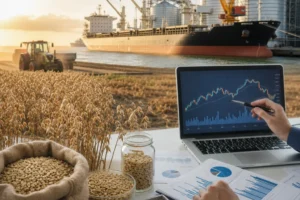

Grain futures are standardized contracts traded on regulated commodity exchanges that let market participants lock in or speculate on the future price of crops such as corn, wheat, soybeans, oats, rough rice, canola, and rapeseed. They are used very differently from the physical grain market: a futures price is an exchange benchmark, while the price a farmer or buyer actually pays in a local market is usually a cash price adjusted by basis, freight, quality, and delivery terms. In practice, grain futures help producers, elevators, feed mills, ethanol plants, crushers, exporters, and traders manage price risk, but they do not automatically mean anyone will load a truck or receive grain at a farm gate. To use them properly, it is essential to understand where they trade, how contracts work, and how they connect to real grain movement.
What grain futures are and what they are for
A grain futures contract is a legally standardized agreement to buy or sell a specific quantity and quality of grain for delivery in a named future month, under rules set by an exchange. The purpose is price discovery and risk transfer. A farmer worried about falling corn prices can sell futures to reduce downside risk. A feed manufacturer worried about rising corn prices can buy futures to protect input costs. A speculative trader may use the same contract without any intention of handling physical grain.
The standardization matters. Exchange rules define the contract size, listed delivery months, minimum tick movement, delivery procedures, and acceptable grades or substitutes. Because every contract is standardized, buyers and sellers can trade electronically through a futures broker instead of negotiating every term each time.
Major grain futures are commonly associated with large benchmark exchanges. In the United States, many widely watched contracts trade through CME Group markets, including corn, soybeans, soybean meal, soybean oil, Chicago wheat, Kansas wheat, oats, and rough rice. In Europe, milling wheat, corn, and rapeseed benchmarks are widely followed on Euronext. In Canada, canola futures are an important benchmark on ICE Futures Canada. These exchange prices are reference markets; they are not the same thing as a local elevator bid.
How grain futures actually work
Each futures trade takes place through a regulated exchange and is cleared through a clearing system. To access the market, a trader normally opens an account with a registered futures broker or futures commission merchant. Orders are entered on an electronic platform, and the exchange matches buyers and sellers.
Unlike a cash grain sale, a futures position usually does not require paying the full value of the grain upfront. Instead, traders post margin, which is a performance bond. Because only margin is posted, futures are leveraged. That leverage can magnify gains, but it can also create rapid losses and margin calls if prices move the wrong way.
Most grain futures positions are closed before delivery. If a seller has sold corn futures and later buys them back, the gain or loss is realized financially. A hedger may then separately sell physical corn to an elevator or processor. A small minority of contracts go into the delivery process, and delivery rules are specific to the exchange and contract month.
| Market type | What it represents | Where it is used | Main users |
|---|---|---|---|
| Futures market | Standardized exchange-traded contract for a future month | Commodity exchanges through licensed brokers and trading platforms | Farmers, elevators, processors, exporters, funds, speculators |
| Cash market | Actual physical grain bought and sold for local delivery | Elevators, cooperatives, merchants, mills, feed companies, crushers, exporters | Farmers, buyers, handlers, processors |
| Forward or cash contract | Privately negotiated physical deal for a future delivery period | Directly with local buyer, cooperative, merchant, or processor | Farmers and commercial grain buyers |
| Options on futures | Right, not obligation, to buy or sell a futures contract | Exchange-traded through futures brokers | Hedgers and traders seeking flexible risk management |
Futures price versus local cash grain price
This distinction is the most important practical point. The futures market provides a benchmark price for a delivery month at exchange-specified locations and terms. The local cash price is what a buyer in a specific place is willing to pay for real grain today or for a delivery window. The difference between local cash price and futures is called basis.
Basis reflects local supply and demand, freight, storage pressure, quality, export programs, barge or rail logistics, and competition among buyers. If a region has strong feed demand or tight nearby supplies, basis may strengthen. If harvest pressure is heavy and storage is full, basis may weaken.
That is why a farmer should not assume a headline corn futures quote equals the farm gate price. To check the actual available cash price, farmers and grain sellers normally look at bids published by local elevators, cooperatives, ethanol plants, grain merchants, feed mills, processors, or exporters. In some countries, government or exchange-linked market reporting systems also publish regional cash indications, though local negotiated bids still matter.
Physical buyers also evaluate grade and condition. Moisture, test weight, protein, falling number, dockage, foreign material, damage, mycotoxins, and other specifications can change the final settlement price in the cash market even when futures are unchanged.
Where grain futures trade and where physical grain is bought and sold
Grain futures trade online through regulated exchanges and broker platforms. A trader usually needs a futures account, identity verification, risk disclosures, and funding for margin. Depending on jurisdiction, the broker may be regulated by a financial authority and may route orders to exchanges such as CME Group, Euronext, or ICE-related markets.
Physical grain is bought and sold in a different network. The most common real-world channels are:
- Local grain elevators and agricultural cooperatives
- Country merchants and grain brokers
- Flour mills, feed mills, maltsters, crushers, and ethanol plants
- Export houses and port terminals
- Warehouses and storage operators
- Direct contracts between producers and end users
These cash transactions may happen by phone, in person, through a buyer portal, or through farm-grain marketing software integrated with local buyers. The terms usually specify delivery point, delivery window, grade, moisture limits, discounts, freight responsibility, and payment timing. In export or cross-border trade, contracts may also include Incoterms, inspection requirements, vessel or container terms, and documentary conditions.
| Where to check or use it | What it provides | Who normally uses it |
|---|---|---|
| Exchange websites | Contract specifications, delayed quotes, expiry months, delivery rules | Traders, analysts, hedgers, students |
| Futures brokers and trading platforms | Live trading access, account management, margin monitoring | Commercial hedgers and speculative traders |
| Local elevators or cooperatives | Cash bids, delivery schedules, storage availability, contract offers | Farmers and local grain sellers |
| Processors and feed manufacturers | Direct purchase bids tied to quality and delivery needs | Commercial sellers and merchandisers |
| Government and official reporting services | Crop, export, stocks, market, and quality reports | Farmers, analysts, traders, lenders |
How hedging with grain futures works in practice
Hedging means using futures or options to reduce price risk in a real business exposure. The goal is not to predict the market perfectly. The goal is to make the combined result of the physical and futures sides more stable.
A simple producer hedge works like this:
- A farmer expects to harvest grain later and is concerned prices may fall.
- The farmer, or sometimes an elevator or broker acting within the producer’s marketing plan, sells futures equivalent to part of expected production.
- If futures prices fall before harvest, the futures position may gain value.
- The farmer later sells the physical grain in the local cash market, possibly at a lower flat cash price but with the futures gain offsetting part of that decline.
A simple buyer hedge is the reverse. A feed mill or processor that needs grain later may buy futures to protect against rising prices while continuing to source physical grain through normal procurement channels.
Options can be used when a hedger wants downside or upside protection with more flexibility. For example, a put option can help a grain seller establish a minimum futures price exposure while preserving some upside if the market rises. But options involve premiums, time decay, and strategy complexity.
Hedging is never perfect. The biggest limitation is basis risk. Futures may move one way while local basis moves another way because of freight bottlenecks, weak export demand, river problems, rail congestion, or a change in local processing demand. Quantity risk also matters: if production is lower than expected, a producer can become overhedged.
What moves grain futures prices
Grain futures react to a mix of global and local fundamentals. Weather is often the most visible driver during planting and growing seasons, but it is only one part of the picture.
- Acreage and planting pace: how much area is seeded and whether planting is delayed
- Yield expectations: crop condition, rainfall, heat stress, frost, disease pressure
- Stocks and stocks-to-use: how tight or comfortable supplies appear
- Export demand: tenders, trade policy, currency competitiveness, shipping pace
- Imports: buying by major importers can tighten the market
- Feed and industrial demand: livestock feeding, ethanol, milling, crushing, biofuels
- Energy and fertilizer: production costs and biofuel economics
- Freight and logistics: barge movement, rail service, port congestion, container availability
- Government policy: tariffs, quotas, sanctions, blending mandates, stock releases
For wheat, traders often watch protein, weather in several exporting regions, and Black Sea or other export competition. For corn, U.S. acreage, ethanol demand, feed use, and South American supply can be major variables. For soybeans, crushing demand, soybean meal and oil dynamics, and Chinese import demand are often central.
Where to find prices, contract details, and market reports
Reliable grain market analysis starts with combining exchange data, local cash bids, and official reports.
For futures and contract rules, exchange websites are the primary source. They typically provide contract specifications, listed months, settlement data, and delivery information. Traders often supplement exchange data with broker platforms or commercial data terminals for live quotes and charting.
For U.S. grain fundamentals, USDA reports are widely used. Important examples include:
- WASDE: broad supply and demand estimates by commodity and country
- Crop Progress: planting, emergence, condition, and harvest progress
- Grain Stocks: inventory snapshots that can shift price outlooks
- Prospective Plantings and Acreage: expected and actual seeded area
- Export Sales: weekly export commitments and shipments
- AMS market news: cash bids, transportation, and regional market reporting in some sectors
For market positioning, the U.S. Commodity Futures Trading Commission publishes Commitments of Traders data, which shows how different trader categories are positioned in futures and options markets. Analysts use this to gauge whether funds or commercials are heavily long or short, but it is not a timing signal by itself.
Outside the United States, readers should also consult official agricultural ministries, national statistical agencies, exchange publications, customs or trade databases, and FAO for global context. Exporters and importers often combine these with port lineups, vessel activity, and commercial freight intelligence.
Costs, risks, and common mistakes
The practical costs and risks depend on whether the reader is hedging, trading, or moving physical grain.
In futures trading, the main risks are leverage, margin calls, volatility, rollover decisions, and using the wrong contract month or wrong exchange benchmark. A corn buyer exposed to local cash prices may not hedge effectively with a loosely related contract if basis behavior is unstable.
In physical grain trade, the biggest risks are often commercial rather than financial: quality disputes, moisture discounts, freight cost surprises, storage losses, delayed unloading, counterparty risk, and unclear payment terms. Warehouse receipts, inspection certificates, grading rules, and written contracts matter.
Common mistakes include:
- Confusing futures price with local sale price
- Ignoring basis and logistics
- Hedging too much of expected production too early
- Not understanding exchange delivery months and first notice or expiry procedures
- Using leverage for speculation without a risk plan
- Failing to match hedge timing to actual physical exposure
- Overlooking quality specifications in the cash contract
How different market participants use grain futures
Farmers often use grain futures indirectly through a marketing adviser, cooperative, or elevator contract structure, or directly through a futures broker if they are comfortable managing margin and basis separately. Elevators and merchants hedge inventory and forward contracts to manage flat price exposure. Processors hedge input costs. Exporters hedge purchases and sales tied to shipment periods. Funds and proprietary traders add liquidity and speculation, but they are usually not involved in handling physical grain.
This means a reader should first decide what market problem needs solving. If the goal is to sell harvested corn from a farm, local cash bids and physical contract terms are central. If the goal is to manage price risk before the grain is sold, futures or options may help. If the goal is to analyze market direction, exchange data must be read alongside crop, stocks, export, and weather information.
Where can I check grain futures prices?
You can normally check grain futures prices on the relevant exchange website, through a futures broker platform, or via commercial market-data services. Exchange sites are best for contract specifications and reference pricing, while broker and data platforms are typically used for live or near-live trading information. Always identify the exact contract month, unit, and currency.
Where can I find the local cash price for my grain?
Local cash prices are usually available from nearby grain elevators, cooperatives, processors, feed mills, crushers, ethanol plants, or merchants. Many buyers post bids online or through mobile tools, but phone quotes and negotiated bids are still common. The final cash price may depend on basis, quality, moisture, and delivery timing.
Can I buy physical grain through a futures exchange?
Usually, no in any practical retail sense. Futures exchanges are primarily for standardized financial and commercial risk transfer, not for routine spot purchase of truckloads for end use. Physical grain is normally bought through merchants, elevators, mills, feed companies, processors, brokers, or import-export contracts.
Do grain futures always end in delivery?
No. Most contracts are offset before delivery. Commercial firms may use delivery when it fits their logistics and contract needs, but many hedgers and most speculators close or roll positions before the delivery process begins.
What is basis in grain marketing?
Basis is the difference between the local cash price and the relevant futures price. It reflects local supply and demand, freight, storage pressure, quality, and buyer competition. Basis can strengthen or weaken independently of futures.
What reports matter most for grain futures?
Widely followed reports include USDA WASDE, Crop Progress, Grain Stocks, Acreage-related reports, and Export Sales, along with CFTC Commitments of Traders for positioning. Traders also monitor weather data, export tenders, and exchange contract notices.
What is the main risk of using grain futures for hedging?
The main financial risk is that margin calls can occur even when the hedge supports the physical business overall. The main market risk is basis risk, because local cash prices do not move exactly with futures. Hedge quantity and timing must also match real exposure.
How do options differ from futures for grain hedging?
Futures create direct exposure to price moves and require margin. Options give the right, but not the obligation, to take a futures position, and they usually involve paying a premium upfront. Options can offer more flexibility, but they have their own cost and time-decay considerations.
Sources
- CME Group
- U.S. Department of Agriculture
- U.S. Commodity Futures Trading Commission