









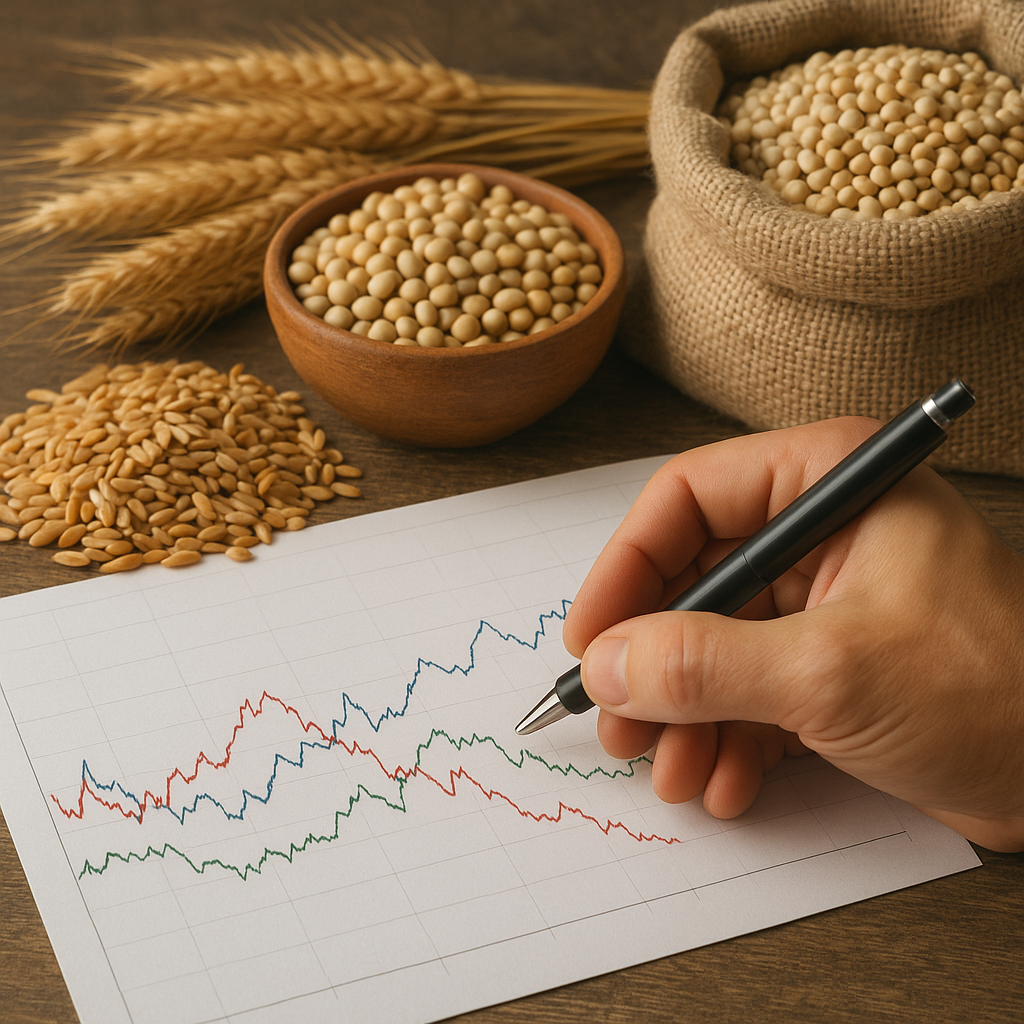
Understanding how producers, traders, and risk managers navigate the complexities of grain markets calls for a deep dive into cross-commodity hedging techniques. This article explores the theoretical underpinnings, practical strategies, and real-world examples that demonstrate how participants leverage relationships among grains to optimize their positions and protect against adverse price movements.
Fundamental Concepts and Market Dynamics
At its core, cross-commodity hedging involves taking positions in a related but distinct commodity to offset price risk in the primary grain of interest. Instead of hedging corn risk with corn futures exclusively, a market participant might use soybean or wheat contracts. This method relies on statistical relationships and economic linkages among grains to deliver effective risk management solutions.
Correlation Analysis
Determining which commodities to pair hinges on measuring historical price movements. Analysts compute correlation coefficients to assess how closely two grain prices move together. A high positive correlation suggests that price changes in one grain mirror those in another. Conversely, a negative correlation indicates that when one grain’s price rises, the other tends to fall. Effective cross-commodity hedging exploits these patterns to reduce net exposure.
Basis Risk and Its Implications
The term basis risk arises when the price difference between the physical grain and the futures contract fluctuates unpredictably. In cross-commodity hedging, basis risk multiplies because one must account for the spread between two contracts plus the local basis for each. While cross-commodity strategies can reduce outright price risk, they introduce additional layers of basis uncertainty—requiring robust models and constant monitoring.
- Correlation decay over time can erode hedge effectiveness
- Seasonal shifts may impact the relative strength of commodity linkages
- Local supply-demand factors influence basis spreads unpredictably
Strategies for Cross-Commodity Hedging
Market participants employ various techniques to implement cross-commodity hedges. The choice of strategy depends on objectives, time horizon, and tolerance for complexity. Key approaches include:
Ratio Spreads and Cross Hedges
Ratio spreads involve taking offsetting positions in two different futures contracts at a specified ratio. For example, a producer expecting to harvest corn might sell 100 corn futures and simultaneously buy 60 soybean futures. The ratio reflects historical price volatilities and correlations. This strategy aims to capture relative performance rather than absolute price moves.
Differential Hedges
Differential hedges focus on the price spread between two commodities. Traders might sell wheat futures and buy corn futures if the wheat-corn spread appears overvalued relative to historical norms. When the spread reverts, the hedge delivers gains regardless of the overall market direction. This diversification-oriented tactic can outperform pure directional bets during sideways markets.
Options-Based Cross Hedges
Using options allows for non-linear payoff structures. A risk manager may purchase puts on one grain while writing calls on another. This setup can provide protection against extreme price moves while generating premium income. Options-based hedges require careful attention to implied volatilities and time decay, yet offer flexibility unmatched by linear futures positions.
- Long put on soybeans + short call on corn
- Straddles on wheat combined with offsetting positions in barley
- Delta-neutral structures to isolate spread fluctuations
Practical Applications and Case Studies
Applying cross-commodity hedging in real markets necessitates a blend of quantitative rigor and operational know-how. Below are illustrative scenarios:
Case Study 1: Corn Producer in the Midwest
A large-scale corn grower faces the risk of falling prices after planting. Conventional hedges via corn futures offer direct protection but lock in a basis risk. By selling a reduced quantity of corn futures and buying nearby wheat futures, the grower hedges against widespread adverse weather that typically affects both crops. This approach mitigates losses when drought conditions depress multiple grain prices simultaneously.
Case Study 2: Elevator Operator’s Inventory Management
An elevator operator holds significant inventories of both soybeans and wheat. Instead of hedging each separately, the operator employs a cross-commodity ratio spread: selling 150 soybean futures and buying 100 wheat futures. Historical analysis shows that in years of strong soybean harvest, wheat prices often outperform. The operator uses this ratio to balance exposure, optimizing margin requirements and maintaining liquidity.
Case Study 3: Exporter Navigating Global Demand Shocks
During periods of shifting international demand, an exporter might see wheat prices jump due to geopolitical events while corn lags. By buying corn futures and selling wheat futures, the exporter hedges the relative strength in wheat and captures potential upside in corn. This price volatility-driven strategy preserves profit margins even when global markets present asymmetric swings.
- Combine historical spread analysis with forward curves
- Adjust hedge ratios monthly to reflect evolving correlation metrics
- Use dynamic hedging algorithms to automate rollovers
Challenges, Tools, and Future Trends
Implementing cross-commodity hedges successfully requires overcoming practical hurdles and leveraging advanced tools.
Liquidity and Execution Risk
Not all grain futures offer the same trading volume. Thinly traded contracts introduce liquidity risk, widening bid-ask spreads and increasing execution costs. Traders must balance the theoretical hedge ratio against market depth to avoid slippage.
Technological Solutions
Modern futures contracts platforms and risk management software incorporate real-time correlation matrices and automated rebalancing algorithms. These solutions enable participants to:
- Monitor cross-commodity spreads across multiple exchanges
- Trigger alerts when correlation thresholds break down
- Simulate hedge performance under stress scenarios
Seasonality and Climate Considerations
Seasonal patterns affect planting, harvest, and regional supply conditions. Producing regions in North America, South America, and Europe experience time-lagged cycles that can be exploited. Incorporating weather derivatives alongside grain futures adds an extra layer of protection against crop-specific risks.
Emerging Trends
Looking forward, research in machine learning and big data analytics promises to refine cross-commodity hedging models. Advanced algorithms can detect non-linear dependencies and regime shifts more effectively than traditional statistical methods. As markets evolve, participants able to integrate climate forecasts, satellite imagery, and macroeconomic indicators into cross-commodity frameworks will gain a competitive edge.
Cross-commodity hedging in grain markets remains a sophisticated tool for risk mitigation and strategic positioning. By understanding the interplay among different grains, leveraging modern analytics, and addressing execution challenges, market participants can harness this approach to navigate an ever-changing agricultural landscape.