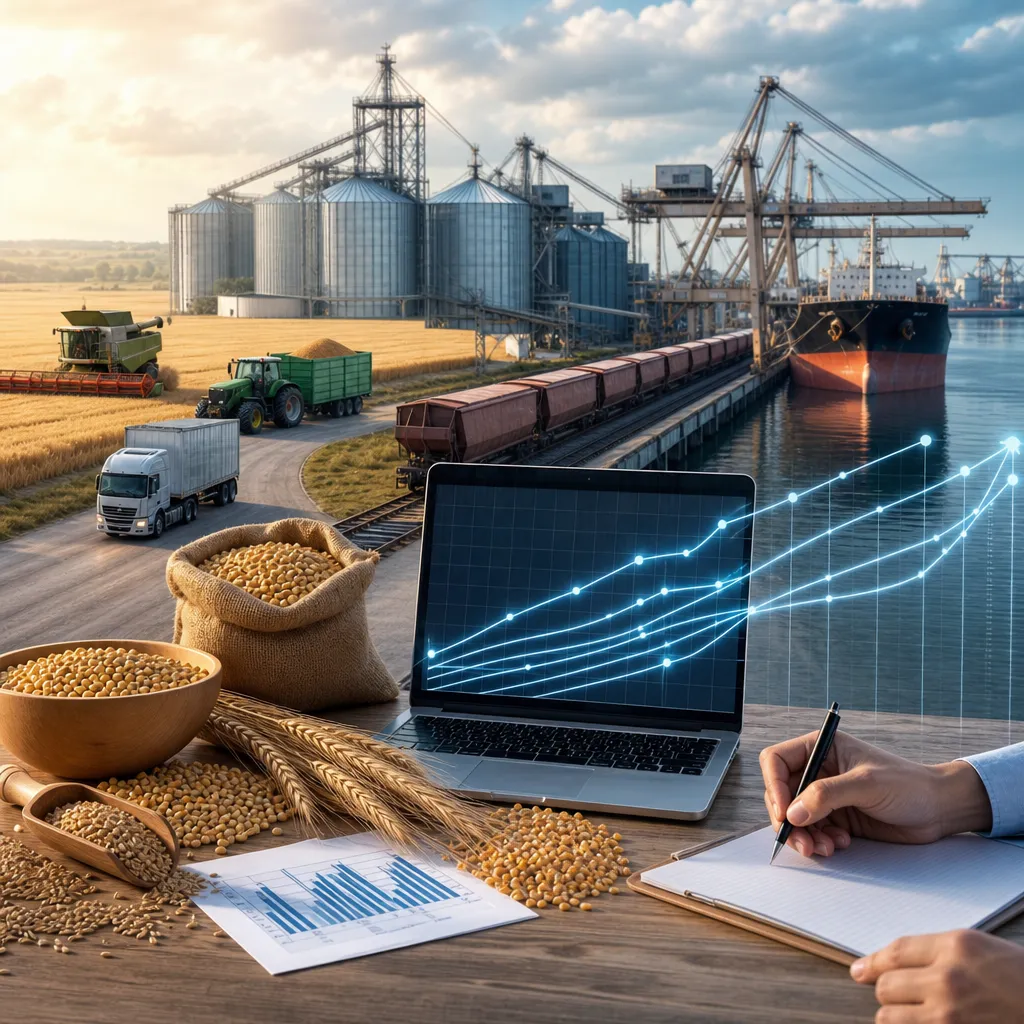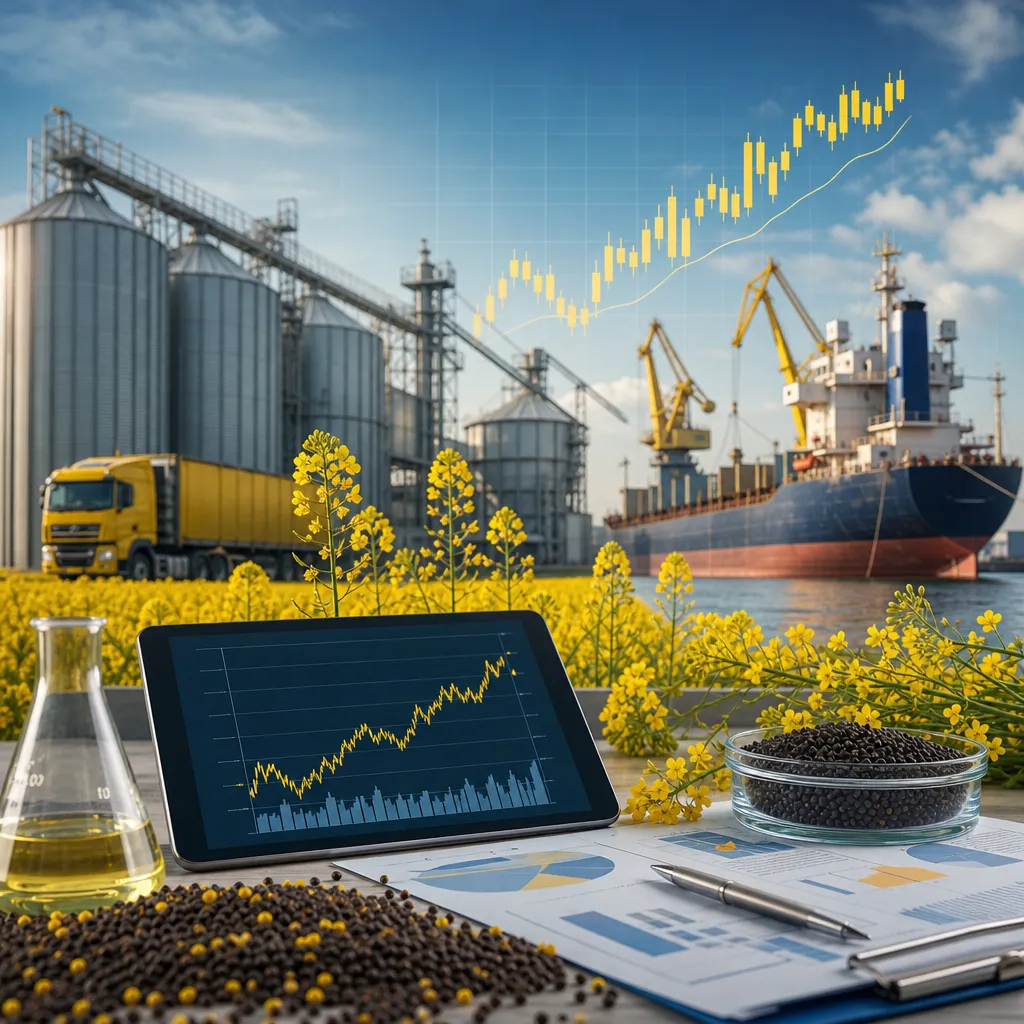
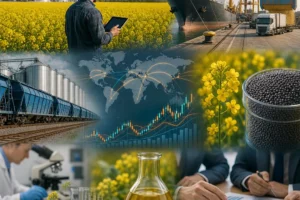


The EU rapeseed market is the largest and most influential rapeseed complex in Europe, centered on the European Union’s production, crushing, biodiesel demand, and import flows. In practice, the market is not a single physical location but a network of farm-gate, inland processor, export-import, and futures markets spread across major producing and consuming member states such as France, Germany, Poland, Romania, and the Baltic countries. Prices are usually discussed in euros per metric tonne, while the most widely watched benchmark for European rapeseed is the Euronext rapeseed futures contract. To understand the market properly, readers need to separate futures prices from local cash prices, and inland bids from import or export parity values.
Rapeseed matters in the EU because it sits at the intersection of food oils, animal feed, and renewable fuels. The seed is crushed into rapeseed oil and rapeseed meal, so demand depends not only on crop size but also on vegetable oil markets, feed demand, energy economics, and biodiesel policy. That makes the EU market both agricultural and industrial. It is regional in production, but heavily connected to global oilseed trade.
What the EU rapeseed market is and where it operates
The EU rapeseed market covers production, trade, processing, and pricing of rapeseed across the European Union. The main crop is commonly called rapeseed in Europe, while international trade may also refer to canola for similar low-erucic-acid oilseed grades, especially from Canada and Australia. Within the EU, the market operates through several layers: farmers and cooperatives sell physical seed; crushers buy for oil and meal production; traders manage domestic and import flows; and financial participants use exchange-traded futures for price discovery and hedging.
France and Germany are central to EU rapeseed pricing because of their production base, crusher presence, and role in the Euronext pricing ecosystem. Poland, Romania, the Czech Republic, and some Baltic and Central European origins are also important. The EU is a major rapeseed producer, but it is also structurally linked to imports in many seasons because domestic crushing demand can exceed internal supply.
The market’s commercial geography includes inland crop regions, rail and truck corridors, oilseed crushing plants, storage networks, and seaports that handle imported seed and exported products such as oil or meal. Port relevance varies by season and trade flow, but northwest European and Black Sea-connected logistics can both matter for price formation.
Why the EU rapeseed market matters globally
The EU is one of the world’s biggest rapeseed-consuming regions because its crushing sector is large and because rapeseed oil plays a role in food and biofuel demand. This means the EU market responds not only to local weather and acreage, but also to global oilseed competition from soybeans, sunflower seed, canola, and palm oil.
In practical terms, the EU market often balances itself through imports when domestic harvests are smaller or crusher demand stays strong. Imported seed can come from origins such as Ukraine, Australia, or Canada, subject to trade conditions, quality requirements, freight economics, and regulatory constraints. That import dependence makes the EU rapeseed market sensitive to global shipping conditions, origin crop prospects, and currency movements, especially the euro against major trading currencies.
Because rapeseed competes in the broader vegetable oil and protein meal complex, traders also watch soybean futures, soymeal, soyoil, sunflower oil, and crude oil. The EU market does not price in isolation.
How prices are formed in the EU rapeseed market
The benchmark most market participants watch is Euronext rapeseed futures, quoted in euros per metric tonne. That futures price is a reference point, not the same thing as the exact price a farmer receives or a crusher pays for a specific load. Local cash prices depend on the benchmark plus or minus a basis, which reflects quality, timing, location, transport, and local buyer competition.
Several price layers operate at the same time:
| Price type | Where quoted | What it means |
|---|---|---|
| Futures price | Euronext | Exchange-traded benchmark used for price discovery and hedging |
| Local cash bid | Cooperative, merchant, crusher, or local buyer | Actual bid for physical rapeseed at a local collection point or plant |
| Delivered price | Inland processor or end user | Price including transport to a specified destination |
| Import parity | Trader or crusher economics | The cost of supplying seed from an external origin into the EU market |
| FOB/CIF price | Export-import trade | FOB is loaded at origin port; CIF includes cost, insurance, and freight to destination |
A farm-gate or inland cash price may be below or above the nearby futures contract depending on whether local supply is burdensome or nearby crusher demand is tight. A processor with urgent nearby needs may bid aggressively. Conversely, during harvest pressure, local bids may weaken even if futures are holding steady.
Quality also matters. Moisture, impurities, oil content, and contract specifications can all change the effective value of rapeseed. So can shipment period. Old-crop and new-crop values may differ significantly when stock levels are tight or crop prospects are uncertain.
The role of Euronext rapeseed futures
The main financial benchmark for the EU rapeseed market is the rapeseed contract traded on Euronext. This is the contract many merchants, processors, importers, exporters, and speculative participants use to monitor market direction and manage price risk. It is not the same as a physical country elevator bid, but it is the central reference for much of Europe.
Futures serve two main purposes. First, they help the market discover a transparent reference price. Second, they allow hedging. A crusher buying physical seed may hedge price exposure on the exchange. A merchant holding inventory may also use futures to reduce market risk. Speculators and funds may participate as well, but they usually do not handle the physical commodity.
Access to Euronext futures normally takes place through a broker or trading platform that offers exchange access. That is a financial market activity involving margin and mark-to-market risk. It is very different from buying or selling a truckload or vessel parcel of physical rapeseed.
| Market layer | Main users | Purpose | Key risk |
|---|---|---|---|
| Physical cash market | Farmers, cooperatives, merchants, crushers | Actual movement of seed | Quality, logistics, counterparty, basis |
| Export-import market | Trading houses, importers, exporters, processors | International supply balancing | Freight, origin risk, currency, policy |
| Futures/options market | Commercial hedgers, funds, brokers | Hedging and price discovery | Margin calls, volatility, basis mismatch |
How physical rapeseed is bought, sold, imported, and hedged
Physical rapeseed in the EU is commonly sold by farmers to cooperatives, local merchants, crushers, or processors. Contracts may be spot, forward, or formula-based. The buyer typically specifies delivery window, quality terms, moisture, impurities, oil-related factors where relevant, and payment conditions. Large commercial flows may move by truck, rail, barge, or vessel, depending on origin and destination.
A crusher may buy from domestic origin, from another EU member state, or from non-EU origins through import channels. A trading house may assemble cargoes for delivery into a processor or terminal. In cross-border trade, price discussions can use delivered terms, FOB origin terms, or import parity calculations.
Hedging happens alongside physical trade, not instead of it. For example, a merchant who buys rapeseed from farmers may sell futures to protect against a drop in benchmark prices before the seed is resold. A crusher may buy futures or use other oilseed complex hedges when physical seed needs to be secured for future processing. The remaining exposure is often basis risk: the futures hedge may work, but the local cash relationship to futures can still move unexpectedly.
Options may also be used for hedging, but they are financial tools requiring specialist understanding. They can help manage price floors or ceilings while preserving some upside or downside participation. They do not remove execution, logistics, or quality risk in the physical market.
Where to check EU rapeseed prices and market information online
Readers looking for current market levels should start with the benchmark and then move to local cash channels. For futures, the primary reference is Euronext, which publishes contract information and market data. Depending on the level of detail required, a broker platform, market data vendor, or commercial information service may also be used.
For EU-wide supply, trade, and balance-sheet context, the European Commission is a core source, especially for market outlooks and agricultural information. Eurostat is useful for trade and production statistics at the EU and member-state level. For global oilseed context, USDA reports are widely used by commercial participants, particularly for world oilseed supply-demand comparisons.
For actual physical bids, farmers and local traders usually need to check with cooperatives, crushers, merchants, or grain trading firms active in their own region. Those are the places where farm-gate or delivered prices are formed. A futures quote on its own will not tell a producer what a local buyer is paying today after deductions for transport, storage, quality, or timing.
Useful places to monitor include:
- Euronext for rapeseed futures benchmark information.
- European Commission for EU agricultural market outlook and policy context.
- Eurostat for official trade and production statistics.
- USDA for global oilseed balance-sheet context and competitor crop developments.
- Local cooperatives, crushers, and merchants for actual cash bids and delivery terms.
Main drivers of the EU rapeseed outlook
The outlook for the EU rapeseed market depends on a combination of domestic crop conditions and external supply. Weather remains the first variable. Rapeseed is sensitive to establishment conditions, winter survival, spring moisture, and heat stress during reproductive stages. Acreage decisions also matter, especially when farmers compare rapeseed margins against cereals or other oilseeds.
Crush demand is another critical factor. Rapeseed oil demand is linked to food use and renewable fuel economics, while rapeseed meal demand depends on feed markets and competition with soymeal and sunflower meal. Energy prices, biodiesel policy, and blending economics can therefore affect the crush margin and ultimately seed demand.
Imports are often decisive. If domestic harvest prospects weaken, the market may need larger inflows from external origins. In that situation, freight costs, export availability from origin countries, port logistics, geopolitical disruptions, and sanitary or regulatory issues can become price-setting factors.
The euro also matters. A weaker euro can make imported rapeseed more expensive and can support euro-denominated futures. A stronger euro can have the opposite effect. Meanwhile, broader vegetable oil price trends can pull rapeseed values higher or lower even when the local crop situation is stable.
Outlook scenarios for the EU rapeseed market
Because reliable forecasting depends on changing weather, policy, and trade conditions, it is better to think in scenarios rather than certainty.
| Scenario | Conditions | Likely market implication |
|---|---|---|
| Supportive price scenario | Poor EU crop conditions, firm crush demand, constrained imports, stronger vegoil complex | Tighter supply balance, firmer basis in some regions, stronger futures support |
| Neutral scenario | Average yields, manageable imports, steady crusher demand | Prices remain closely tied to broader oilseed and energy markets |
| Bearish price scenario | Large EU crop, comfortable imports, weaker biodiesel economics, softer global oils | Weaker basis during harvest pressure and less urgency from processors |
In most years, the key question is not simply whether the EU crop is large or small, but whether total available supply can comfortably meet crusher demand at competitive margins. That is why traders watch both field conditions in Europe and export availability in major supplying countries.
Practical guidance for market participants
For physical sellers such as farmers, the practical process usually begins with monitoring the Euronext benchmark and then collecting bids from local buyers. The important comparison is not only headline price, but also delivery month, deductions, payment timing, storage terms, and whether the bid is ex-farm, collected, or delivered. Counterparty quality matters: a slightly higher nominal bid is not always better if payment or execution risk is weak.
For crushers and merchants, the market requires active management of flat price risk, basis, logistics, and product margins. Buying seed without considering oil and meal values can create margin pressure. Likewise, using futures without understanding local basis can leave a firm exposed even if the benchmark hedge is correct.
For financial traders, rapeseed futures offer exposure to the European oilseed complex, but this is not the same as participating in the physical crop trade. Futures positions involve leverage, expiry, and margin risk. A trader can gain or lose on paper without ever taking ownership of seed. Commercial firms, by contrast, must also manage storage, transport, quality, contracts, and operational execution.
FAQ
What is the main benchmark for EU rapeseed prices?
The main benchmark is Euronext rapeseed futures, quoted in euros per metric tonne. It is the standard reference for much of the European market, but it is not the same as a local physical bid.
Where can I check current EU rapeseed prices?
For benchmark futures, check Euronext or a broker platform with Euronext access. For actual cash prices, check local cooperatives, crushers, merchants, or grain buyers in the relevant member state or region.
Why is my local rapeseed bid different from the futures price?
Because local cash prices include basis. Basis reflects transport costs, local supply-demand conditions, buyer competition, quality terms, storage, and delivery timing. A futures contract is just the benchmark layer.
Is the EU a net exporter or importer of rapeseed?
The EU is a major producer and processor, but in many seasons it also depends on imports to balance crusher demand. The exact trade position changes with crop size, demand, and availability from external origins.
How is rapeseed physically sold in the EU?
Usually through cooperatives, merchants, crushers, or processors under spot or forward contracts. Trade terms specify quality, quantity, delivery period, location, and payment conditions.
Can I trade EU rapeseed online?
You can trade rapeseed futures online through a broker that offers Euronext market access. That gives financial exposure, not physical ownership. Physical trading still takes place through commercial grain channels.
What are the biggest drivers of the EU rapeseed outlook?
The main drivers are EU weather and yields, acreage, crusher demand, biodiesel economics, vegetable oil prices, import availability, freight, and the euro exchange rate.
What unit and currency are normally used?
EU benchmark rapeseed prices are usually discussed in euros per metric tonne. Local physical transactions in member states may use the same unit, although contract details vary by buyer and region.
Sources
- Euronext
- European Commission
- USDA