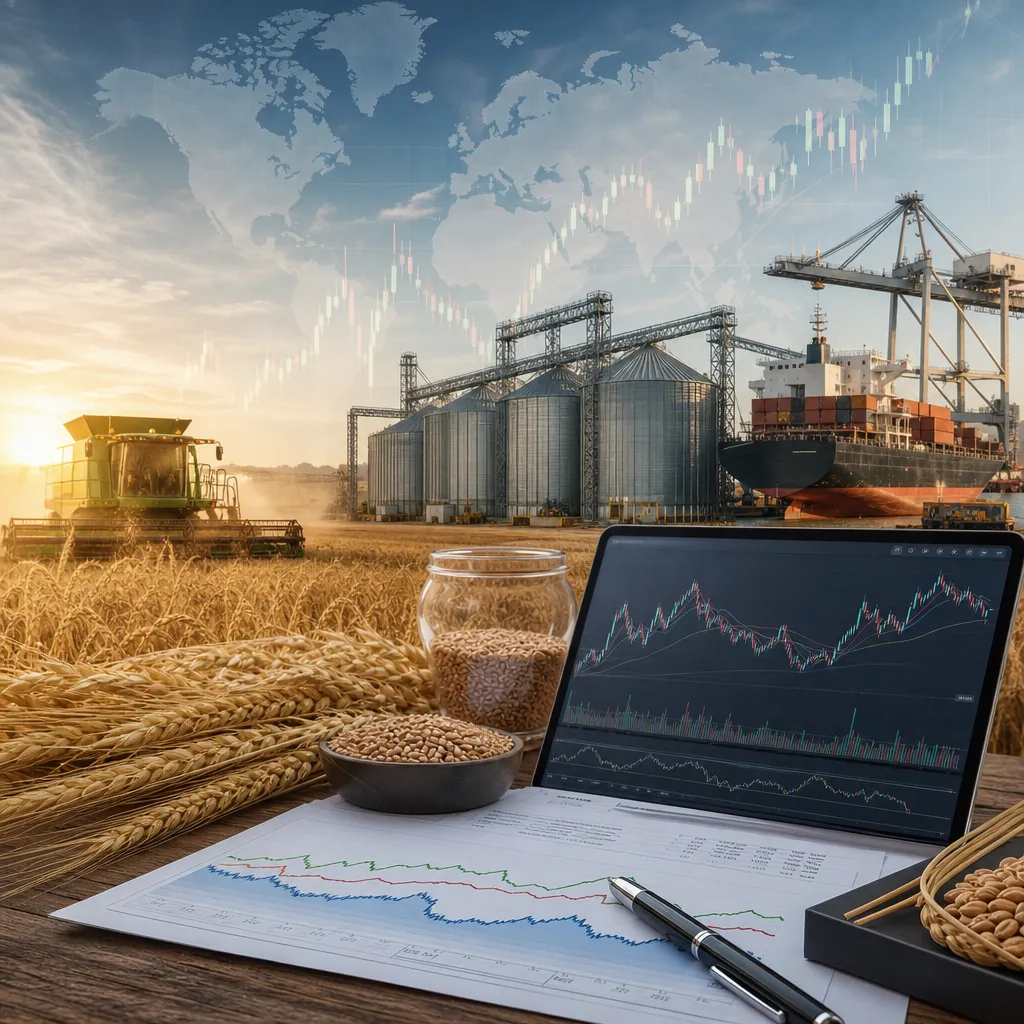
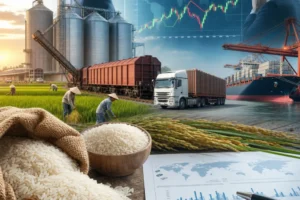

War moves grain prices through a few channels at once: supply disruption, export blockage, freight and insurance costs, currency swings, and government policy. The effect is rarely limited to the country at war, because wheat, corn, soybeans, barley, sunflower products, and canola are priced within an international trade network that connects farms, ports, futures exchanges, crushers, mills, feed users, and governments. In practice, the first price reaction often appears on regulated futures markets such as CME Group or Euronext, while the real economic shock is transmitted through local cash bids, vessel lineups, rail movement, quality discounts, and rationing by buyers. That is why understanding “grain prices and war” requires separating exchange prices from the physical price actually paid at an elevator, port, mill, or feed plant.
War does not create one single grain price. It changes the relationship between benchmark futures, local basis, freight, insurance, storage, and availability of deliverable grain. A wheat future can rise because export supply is threatened, while a farmer in another region may still face weak local cash bids if elevators are full, freight is expensive, or quality is poor. Conversely, cash prices near a deficit area, import terminal, or processor may rise much faster than futures if physical grain becomes hard to source.
How war affects grain prices in practice
The market mechanism is usually straightforward, even if the timing is messy. Grain prices rise when traders expect less exportable supply, more logistical risk, or stronger import demand from buyers trying to secure coverage early. Prices may also fall in the war zone itself if grain cannot move to port, financing disappears, or elevators fill up and local sellers become trapped.
The key transmission channels are:
- Production risk: planting, fertilizing, spraying, harvesting, and field access may be disrupted.
- Export risk: ports may close, inspections slow, or buyers avoid the origin entirely.
- Logistics risk: rail, river, trucking, and warehousing become less reliable or more expensive.
- Insurance and freight: vessel insurance, war-risk premiums, and rerouting can raise landed costs.
- Sanctions and policy: export bans, quotas, payment restrictions, and licensing can reshape trade flows.
- Currency and energy: war often affects oil, natural gas, fertilizer, and exchange rates, which feed into crop margins.
| War-related factor | Typical price effect | How it works |
|---|---|---|
| Port closure or export corridor risk | Usually bullish for world benchmarks | Importers must replace threatened supply from other origins, tightening nearby exportable stocks elsewhere. |
| Internal transport disruption | Can depress local cash prices inside the conflict zone | Farmers may have grain but no efficient route to market, widening basis and increasing discounts. |
| Higher marine insurance and freight | Raises import costs and supports replacement-origin prices | Buyers pay more landed cost even if the commodity value itself changes less. |
| Sanctions, export controls, or payment limits | Creates price distortion between regions | Some buyers lose access while others gain discounted access, fragmenting the market. |
| Energy and fertilizer shocks | Supports longer-term crop price volatility | Input costs change planted area and yield potential in later seasons, not just current shipments. |
Futures prices versus local cash grain prices
This distinction is essential. A futures quote is a benchmark traded on an exchange. A cash grain price is the actual bid offered for physical grain at a location, with a specific quality, delivery period, and freight situation.
For example, wheat futures may be quoted on CME Group in Chicago or Kansas City, and milling wheat futures may be quoted on Euronext. Those prices are useful global signals, but they are not automatically the price at a country elevator, flour mill, crush plant, river terminal, or export port.
Local cash prices are normally checked through:
- grain elevators and agricultural cooperatives,
- grain merchants and exporters,
- mills, crushers, maltsters, and feed manufacturers,
- regional agricultural market reporting services,
- government cash market reports where available.
Cash price formation often follows a simple structure: futures price plus or minus basis. Basis reflects local supply and demand, transport costs, handling charges, quality premiums or discounts, and delivery timing. During war, basis can become much more volatile than futures because localized shortages or logistical blockages matter more than the benchmark itself.
| Market type | Where it exists | What price it shows | Who uses it |
|---|---|---|---|
| Futures market | Regulated exchanges such as CME Group or Euronext | Standardized contract price for a future month | Hedgers, traders, funds, processors, merchants |
| Local cash market | Elevators, co-ops, mills, crushers, feed plants, export terminals | Bid for physical grain at a named location and quality | Farmers, merchants, end users |
| Export market | Ports, trading houses, tenders, merchant networks | FOB or other export-related values subject to freight and terms | Exporters, importers, state buyers, shipowners |
| OTC physical contract | Direct negotiation between commercial counterparties | Privately agreed price, basis, quality, and delivery terms | Farmers, merchants, processors, feed companies |
Where readers can check grain prices and war-related market data
Reliable price checking starts with identifying the correct layer of the market.
For exchange futures
Use official exchange sources and licensed market-data providers. CME Group is relevant for contracts such as corn, soybeans, Chicago wheat, Kansas City wheat, soybean meal, soybean oil, oats, and canola-related risk often cross-referenced through oilseed markets. Euronext is widely followed for European milling wheat, corn, and rapeseed benchmarks. These sites show contract specifications, delivery months, and benchmark market structure.
For government crop and trade reports
USDA is one of the main sources for global grain analysis. Readers usually use:
- WASDE for global supply and demand balance sheets,
- Crop Progress for U.S. field conditions and planting pace,
- Export Sales for weekly U.S. export commitments,
- Grain Transportation Report for barge, rail, and export logistics insight.
FAO is useful for broader food and trade context, especially when war affects importing countries and food security rather than only futures pricing.
For positioning and sentiment
CFTC Commitments of Traders reports show how different categories of traders are positioned in U.S. futures markets. This does not tell you physical availability directly, but it helps explain how much speculative length or short covering may be influencing price action during a geopolitical shock.
For local physical prices
Readers should check:
- local elevator bid sheets,
- cooperative cash bid pages,
- merchant offers and processor bid portals,
- official agricultural market reporting services where published.
These may be online, by phone, through merchant representatives, or through farm grain marketing software. Physical bids are often time-sensitive and may depend on grade, moisture, protein, test weight, falling number, oil content, delivery window, and freight terms.
How war changes physical grain trade
Physical grain does not move because a futures chart goes up. It moves when counterparties can agree on price, quality, delivery point, terms, and payment, and when a practical route exists. War damages that process by raising non-price risk.
A normal physical transaction may involve:
- A farmer, cooperative, or originating merchant offers grain.
- A buyer such as a mill, crusher, feed company, exporter, or importer seeks coverage.
- The parties negotiate quality specification, quantity, shipment period, delivery point, and pricing method.
- Freight, inspection, documentation, and payment terms are confirmed.
- Grain is delivered to elevator, warehouse, processor, rail point, river terminal, or port.
In wartime or conflict-affected regions, each step becomes more fragile. A port may be open in theory but not commercially workable if inspections are slow, vessel owners refuse the route, banks delay payment instruments, or quality deteriorates in storage waiting for movement.
Important physical-market terms include:
- Delivery point: where title and responsibility transfer.
- Quality and grade: protein, moisture, foreign material, damage, oil content, or other crop-specific standards.
- Basis: local premium or discount relative to a futures benchmark.
- Freight: truck, rail, barge, or ocean cost.
- Incoterms: internationally used delivery terms in cross-border trade.
- Counterparty risk: the risk the other side cannot perform or pay.
Hedging, speculation, and wartime volatility
War increases volatility, which makes hedging more necessary and more difficult. Farmers, exporters, importers, mills, feed companies, and crushers often use futures or options to manage price risk, not to replace physical business.
Futures are standardized exchange contracts. They are accessed through a regulated futures broker and require a brokerage account, margin deposits, and daily mark-to-market. A wheat buyer may buy futures to protect against rising prices. A farmer or merchant with unsold inventory may sell futures to protect against a decline.
Options provide the right, but not the obligation, to buy or sell a futures contract at a strike price before expiration. They are often used when market participants want defined downside protection while keeping some upside opportunity, but they involve premium cost and can still be complex.
During war, several risks become more visible:
- Basis risk: futures may hedge part of the move, but local cash markets can diverge sharply.
- Margin risk: adverse futures moves can trigger large margin calls even if the hedge is economically sensible.
- Liquidity shifts: nearby contracts can become disorderly when trade routes or deliverable supplies are questioned.
- Cross-hedging risk: some physical grains or regions lack a perfect futures contract, so users hedge with a related benchmark.
Buying physical grain from an elevator or merchant is not the same as trading futures online. One is a commercial transaction for real grain; the other is a financial position on a regulated exchange. They interact, but they are not interchangeable.
Storage, quality, and logistics during conflict
War can create a paradox: global prices may rise while local storage economics worsen. If exports stall, grain piles up inland. That can widen basis, increase storage pressure, and raise quality risk. Wheat may lose milling value, corn may face moisture or damage issues, and oilseeds may deteriorate if handling is delayed or storage is poor.
Where grain is stored matters:
- On-farm storage: offers marketing flexibility but requires aeration, monitoring, and security.
- Commercial elevators and warehouses: provide handling and merchandising access but add storage and service charges.
- Processor-linked storage: may simplify delivery but can limit buyer competition.
- Port storage: useful for export flow, but highly exposed to shipping disruption in conflict zones.
Users should verify warehouse receipts, insurance arrangements, shrink and drying rules, quality claim procedures, and payment timing. In unstable periods, document quality clearly and understand whether grain is sold spot, stored under warehouse terms, or committed under a forward contract.
How analysts and traders interpret war-related grain news
Not every military or political headline should be read as a direct grain-price signal. Good analysis starts with a practical checklist:
- Which crop is affected: wheat, corn, sunflower, barley, canola, or soybeans?
- Is the risk about acreage, harvest, storage, export movement, or payment?
- Which region or port is involved?
- How large is that origin in global exports or regional feed supply?
- Can importers switch to another origin?
- Are futures moving because of fundamentals, fund positioning, or both?
- What is happening to local basis and freight, not just futures?
In many wars, the immediate shock is larger than the lasting supply effect. Markets may initially price worst-case export disruption, then partially retrace if alternative routes open, crops in other exporting countries improve, or importers reduce consumption. That is why scenario analysis is more useful than certainty.
Practical ways market participants respond
Farmers often respond by diversifying sale timing, monitoring local basis more closely, checking storage quality more often, and using conservative hedging where margin exposure is manageable.
Processors and feed users may extend coverage, diversify origins, and use options or phased purchasing to avoid being fully exposed to a single region.
Exporters and importers focus on vessel access, inspection delays, letters of credit, sanctions screening, and replacement-origin economics rather than headline prices alone.
Analysts and traders combine exchange data, shipping updates, government balance sheets, crop conditions, and local cash indications. No single screen captures the whole wartime grain market.
Where should I check grain prices when war is affecting the market?
Check both exchange futures and local cash bids. Use CME Group or Euronext for benchmark futures, then verify actual elevator, cooperative, merchant, mill, or processor bids in your region. The futures market shows benchmark sentiment; local bids show the price for real grain at your location.
Why can global wheat futures rise while a farmer’s local bid stays weak?
Because local cash price depends on basis, freight, storage congestion, and quality, not just futures. If elevators are full or transport is restricted, local buyers may lower bids even when exchange prices are higher.
Can I buy grain online the same way I trade futures?
No. Futures are traded through a regulated futures broker on an exchange and represent financial contracts. Physical grain is normally bought through elevators, cooperatives, merchants, processors, or direct commercial contracts with delivery, quality, and payment terms.
Which reports matter most during wartime grain volatility?
USDA WASDE, USDA Export Sales, USDA Crop Progress, USDA Grain Transportation Report, and CFTC Commitments of Traders are widely used. They help separate actual supply-and-demand changes from speculative positioning and logistical disruption.
How do importers and mills protect themselves when war disrupts supply?
They often diversify origin, secure forward physical coverage, hedge with futures or options, and monitor shipping and payment risk closely. The key is not only price protection but also supply continuity.
Does a futures hedge fully protect a physical grain position during war?
Usually not. Futures can reduce benchmark price risk, but basis risk may widen sharply when local logistics or export routes are disrupted. A good hedge manages part of the exposure, not every commercial risk.
Where do war-related costs show up besides the grain price itself?
They often appear in freight, drying or storage pressure, marine insurance, inspection delays, financing conditions, and quality discounts. Sometimes these costs matter more to the final buyer than the move in futures.
Sources
- USDA World Agricultural Supply and Demand Estimates
- CME Group contract specifications and market data
- CFTC Commitments of Traders