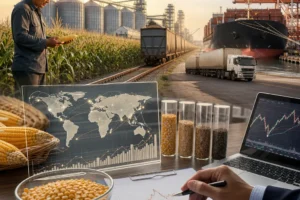
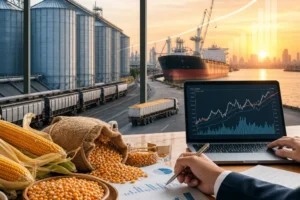
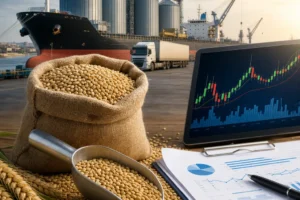

The U.S. dollar matters to grain prices because most internationally traded grain is priced, quoted, or benchmarked in dollars. When the dollar strengthens, U.S. wheat, corn, soybeans, and other grains usually become more expensive for foreign buyers using local currencies, which can slow export demand and pressure prices. When the dollar weakens, U.S. grain often becomes more competitive, which can support futures and cash markets. The effect is real, but it is never the only driver: weather, crop size, freight, stocks, policy, and basis can easily outweigh currency moves for days or weeks at a time.
For practical use, readers should separate three different prices: exchange futures, export values, and local cash bids. A stronger or weaker dollar often shows up first in export competitiveness and futures sentiment, then filters into bids at elevators, processors, feed mills, and ports. That is why a farmer or grain buyer should not look at currency charts alone, but compare them with local basis, freight, and demand at actual delivery points.
Why the dollar matters in grain markets
Grain is a global commodity. Even when a truckload of corn is sold locally to a feed mill or elevator, that local bid is influenced by a wider market structure that includes export demand, futures prices, substitute origins, and currency relationships.
The dollar affects grain prices mainly through competitiveness. If U.S. corn is priced in dollars and the dollar rises against the euro, yen, peso, or other currencies, importers may need more local currency to buy the same tonnage. That can shift demand toward other exporters such as Brazil, Argentina, the Black Sea region, or the EU, depending on the crop and season.
This mechanism is strongest in crops with active export competition and transparent global benchmarks, especially corn, wheat, soybeans, canola-related oilseed trade, and to some extent sorghum and barley. It is weaker in purely local markets where transport costs, domestic shortages, or quality requirements dominate.
How the transmission works from currency to grain price
The dollar does not change grain prices by itself. It changes the relative price between one origin and another. A buyer in North Africa, Southeast Asia, or Mexico is usually comparing delivered offers from several origins, not just watching Chicago futures.
- Currency move: The dollar rises or falls against importing-country currencies and against currencies of competing exporters.
- Export offer adjustment: U.S. grain becomes relatively more or less attractive in world tenders and private trade.
- Futures reaction: Traders on exchanges such as CME Group may adjust expectations for exports, stocks, and spreads.
- Basis and cash adjustment: Export elevators, interior elevators, processors, and merchandisers adjust basis and bids depending on demand, freight, and ownership needs.
- Farmgate impact: The final price received by a farmer may move, but not one-for-one, because local cash prices also reflect storage, trucking, quality, moisture, protein, and regional supply.
In other words, the exchange price may react quickly, while the cash market reacts through basis and local competition. A strong dollar can pressure futures without immediately collapsing local bids if a nearby ethanol plant or crusher still needs grain. The reverse is also true: a weak dollar may help export values while a harvest glut weakens local cash prices.
| Channel | How the dollar affects it | What to check |
|---|---|---|
| Export demand | Changes affordability of U.S. grain for foreign buyers | Export sales reports, tender results, FOB offers |
| Futures prices | Shifts expectations for exports and ending stocks | CME futures, spreads, options volatility |
| Local basis | Indirect effect through exporter demand and interior logistics | Elevator bids, processor bids, river or port basis |
| Farmer cash price | Depends on futures plus basis, not dollar alone | Local cash bid sheets, contracts, settlement statements |
Which grains are most sensitive to dollar moves
Soybeans are often highly sensitive because they are heavily traded internationally and compete directly with Brazilian supplies. Dollar moves matter most when global buyers are actively switching among origins.
Corn also responds to the dollar, especially when U.S., Brazilian, Argentine, and Black Sea export offers are close. Feed demand and ethanol margins can partly offset the currency effect in domestic markets.
Wheat is globally traded and highly competitive across many origins. Currency effects can be large because importers often buy by tender and compare landed cost very closely, including protein and freight.
Rice is internationally traded too, but policy action, government reserves, quality specifications, and regional trade structures can be just as important as the dollar.
Barley, sorghum, oats, rye, canola, rapeseed, and sunflower seed can all be affected, but the size of the effect depends on export exposure, local crushing or feed demand, and the number of realistic substitute origins.
Where to check the dollar effect in practice
To analyze whether the dollar is influencing grain prices, a reader usually needs both financial-market data and physical-market information.
Online market and report sources
- CME Group: Use it for benchmark futures and options on corn, soybeans, soybean meal, soybean oil, wheat, oats, canola-related references where applicable through relevant exchanges, and contract specifications. This is where many traders judge the financial market response.
- USDA: Use WASDE for supply-and-demand balance sheets, Export Sales for actual export commitments, Crop Progress for weather-related crop condition context, and Grain Transportation reports for logistics clues.
- CFTC: Use Commitments of Traders to see how managed money and commercial participants are positioned in major grain futures.
- FAO and national agriculture ministries or statistics agencies: Use them for broader global grain trade, production, and food-market context.
For currency data itself, market participants usually monitor foreign exchange markets through banks, financial news terminals, broker platforms, or exchange-related market data vendors. The key point is not just whether the dollar is up or down, but against which currencies and relative to which competing exporters.
Physical market sources
- Country elevators and cooperatives: Farmers usually check daily cash bids here. These bids reflect futures plus local basis.
- Processors: Ethanol plants, soybean crushers, flour mills, and feed manufacturers may post direct bids that differ from elevator bids.
- Export elevators and merchants: River, rail, and port locations show whether export demand is strengthening or weakening basis.
- Market reporting services: In some regions, official or semi-official cash reporting systems publish regional bid ranges or basis values.
If you are a producer, the most practical test is simple: compare local bids over several days with moves in nearby futures and with export news. If futures fall on a stronger dollar but your local basis improves, local demand may be offsetting the currency effect.
Futures price versus local cash price
This distinction is essential. Grain futures are standardized exchange contracts. Local cash grain is a physical commodity sold at a specific place, in a specific quality, for a specific delivery window.
For example, corn futures on CME are financial and delivery-linked benchmark instruments. A farmer selling corn to a local elevator is entering a physical grain transaction, not simply selling the board. The actual price received is usually:
Cash price = futures reference price + basis
Basis can be positive or negative depending on location, freight, storage, local supply, quality, and immediate demand. The dollar may influence the futures side through export expectations, but the local basis is determined in the physical market.
| Market type | Where it exists | What price means | Who uses it |
|---|---|---|---|
| Futures market | Regulated exchange through a futures broker platform | Benchmark contract value for a standardized month and grade | Hedgers, funds, merchants, processors, speculators |
| Cash market | Elevators, cooperatives, processors, merchants, direct farm contracts | Actual physical bid at a delivery point with local terms | Farmers, buyers, feed mills, exporters, handlers |
| Export market | Port terminals, global tenders, merchant networks, shipping channels | FOB or delivered value for international trade | Exporters, importers, governments, trading houses |
How traders, farmers, and buyers use dollar analysis
Farmers and grain sellers
Producers do not normally hedge the dollar directly unless they also have separate currency exposure. Instead, they watch whether dollar strength is hurting export demand for their crop and then decide whether to sell cash grain, store grain, forward contract, hedge with futures, or buy options.
A practical workflow is to:
- Check local bids from elevators, cooperatives, and processors.
- Compare those bids with nearby and deferred futures.
- Watch export demand indicators such as USDA Export Sales and port basis.
- Monitor the dollar as a competitiveness signal, not a stand-alone selling trigger.
- Evaluate storage cost, interest cost, shrink, and quality risk before delaying sales.
Buyers, processors, and importers
Feed companies, crushers, mills, and importers often track the dollar more directly because it affects replacement cost. Importers may hedge grain and currency separately. Processors may secure physical coverage through cash contracts while hedging futures exposure through a regulated broker.
In the physical market, transactions usually occur through grain merchants, cooperatives, brokers, exporters, or direct supplier contracts. Important terms include delivery point, grade, moisture, test weight, protein where relevant, freight responsibility, timing, and payment terms.
Speculators and market traders
Financial traders may express a view on grain using futures or options through regulated exchanges, typically accessed via a futures commission merchant or broker. This is different from buying physical grain. Futures require a margin account, are leveraged, and can create rapid gains or losses. A dollar-based grain trade is therefore not just a “currency trade”; it is a view on how currency may affect supply-demand expectations.
Other forces that can override the dollar
The dollar is important, but crop fundamentals often dominate. A weather shock during pollination, a drought in a major exporter, a surprise acreage revision, river freight disruption, or a major policy change can matter far more than currency in the short term.
Key variables to evaluate alongside the dollar include:
- Weather: U.S., Brazilian, Argentine, Black Sea, EU, Canadian, and Australian conditions can quickly shift supply expectations.
- USDA balance sheets: Stocks-to-use and ending stocks often set the broader tone.
- Freight and logistics: River levels, rail performance, port congestion, and ocean freight change delivered competitiveness.
- Energy and biofuels: Ethanol and biodiesel economics influence corn and oilseed demand.
- Government policy: Export restrictions, tariffs, quotas, and phytosanitary rules can redirect trade flows.
- Quality: Protein, falling number, moisture, damage, and contamination can separate one origin from another even when currency is supportive.
Practical limitations and common mistakes
A common mistake is assuming that a weaker dollar automatically means higher farm prices. It can help, but only if export channels are actually relevant to the local market and if other bearish factors are not stronger.
Another mistake is using a futures quote as if it were a physical bid. Futures are easy to see online. Actual bids require checking with real buyers such as elevators, processors, cooperatives, or merchants. Delivery terms matter.
It is also risky to trade grain futures only because the dollar moved. The relationship changes over time. Sometimes currency is the lead driver; sometimes it is background noise. Traders should define whether they are hedging a physical exposure or speculating on a market reaction.
For storage decisions, remember that even if the dollar turns favorable later, carrying grain has costs: interest, handling, shrink, spoilage risk, and possible basis deterioration. On-farm bins, commercial elevators, and warehouse arrangements all have different operational and financial trade-offs.
FAQ
Where can I check grain prices affected by the dollar?
Check benchmark futures on CME Group for the exchange market, then compare them with local cash bids from elevators, cooperatives, ethanol plants, crushers, mills, or feed buyers. For export impact, use USDA Export Sales and market commentary from merchants or official reporting services where available.
Does a stronger dollar always lower grain prices?
No. It often hurts U.S. export competitiveness, which can pressure prices, but weather problems, tight stocks, stronger domestic demand, or logistics disruptions can offset or exceed that effect.
Is the dollar effect the same for wheat, corn, and soybeans?
No. The effect depends on how export-exposed the crop is, the season, which origins are competing, and how easily buyers can switch suppliers. Soybeans and wheat often show clear currency sensitivity, but domestic demand can change the picture.
Where does grain trading actually take place?
Futures and options trade on regulated commodity exchanges through brokerage accounts. Physical grain trades through elevators, cooperatives, grain merchants, processors, mills, feed companies, exporters, and direct contracts. These are related markets but not the same transaction.
How can a farmer use dollar information without trading currency?
Use it as a signal for export competitiveness. Compare dollar trends with futures, basis, and export sales, then decide whether to make a cash sale, use a hedge-to-arrive or forward contract if offered locally, store grain, hedge futures, or buy options through a broker.
Can local cash prices rise even if futures fall because of the dollar?
Yes. If a nearby buyer urgently needs grain, local basis can strengthen enough to support or even raise the cash bid despite weaker futures.
What reports are most useful for tracking this relationship?
USDA WASDE, USDA Export Sales, USDA Crop Progress, and CFTC Commitments of Traders are among the most useful. CME contract data helps track futures response, while local bid sheets show whether that response is reaching the physical market.
What is the biggest risk in using dollar analysis for grain decisions?
The biggest risk is oversimplifying. Currency matters, but grain is still driven by supply, demand, logistics, quality, and basis. Decisions based only on the dollar can miss the real local pricing factors.
Sources
- USDA Foreign Agricultural Service and USDA World Agricultural Supply and Demand Estimates
- CME Group
- U.S. Commodity Futures Trading Commission