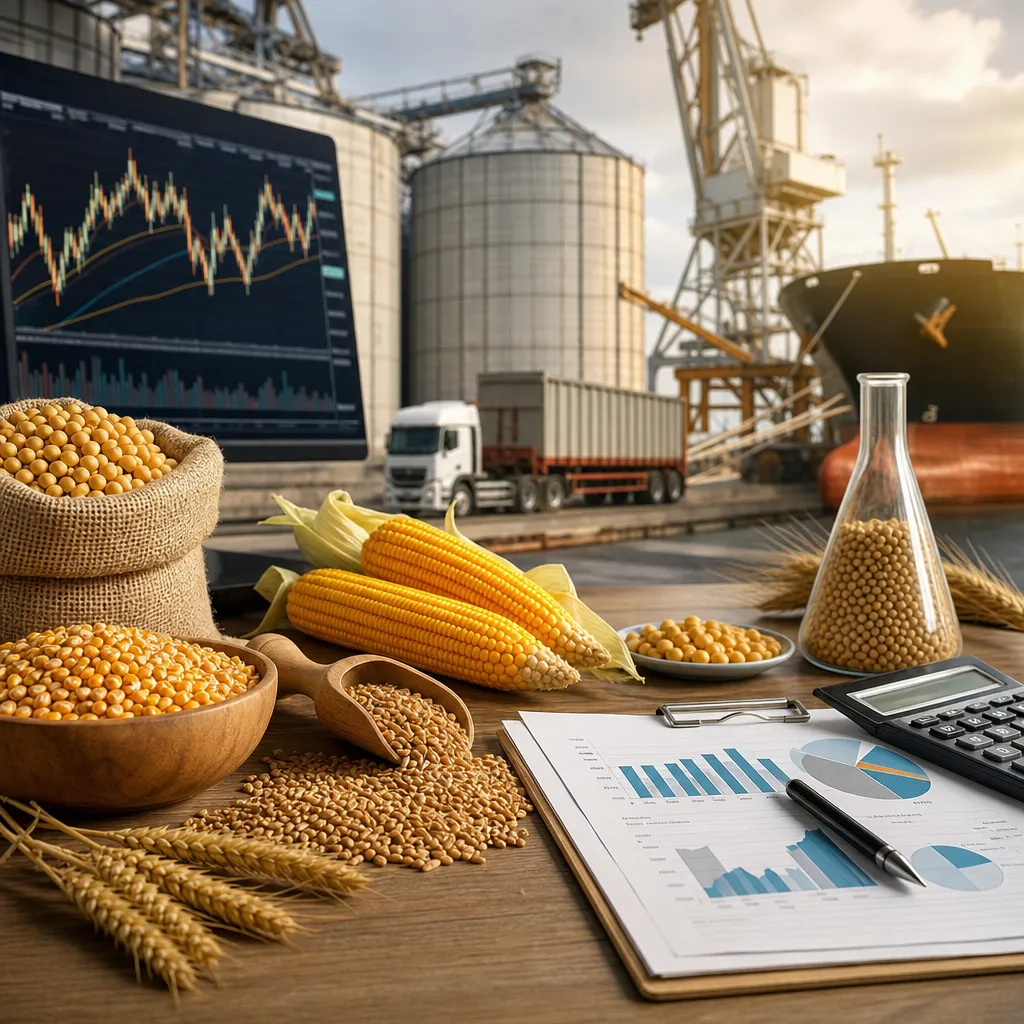
Grain prices are one of the fastest transmission channels into food inflation, but the link is neither immediate nor one-to-one. Wheat, corn, rice, soybeans, barley, oats, and oilseeds matter because they feed into bread, noodles, animal feed, edible oils, meat, dairy, and many processed foods. When grain prices rise, food manufacturers, feed mills, retailers, and importers face higher input costs; when they fall, consumer prices may ease later, depending on energy, labor, packaging, and transport.
To understand food inflation properly, readers need to separate exchange prices from physical cash prices. Futures quoted on exchanges such as CME Group or other commodity exchanges are financial benchmarks for standardized contracts, while the price a farmer or grain buyer actually pays depends on local basis, freight, quality, storage, and delivery point. That distinction is essential when checking price moves online or assessing whether higher grain prices will hit bread, animal protein, or cooking oil prices in the real economy.
In practice, grain prices and food inflation are monitored through a mix of public reports, exchange data, physical market bids, trade flows, and crop conditions. Farmers, merchants, processors, importers, analysts, and policymakers all use different pieces of that system. The main task is to identify which grain market is moving, where the benchmark is quoted, and how that move reaches mills, feed rations, port cargoes, and supermarket shelves.
How grain prices feed into food inflation
Food inflation rises when costs increase somewhere along the chain from farm to processor to retailer. Grain is a direct ingredient in some foods and an indirect cost in others.
- Wheat affects flour, bread, biscuits, pasta, and some noodles.
- Corn matters for animal feed, starch, sweeteners, ethanol-linked demand, and industrial use.
- Soybeans feed into soymeal for livestock and soybean oil for food products.
- Rice has a more direct effect in countries where it is a core staple.
- Barley, oats, rye, sorghum, canola, rapeseed, and sunflower seed influence feed, edible oils, cereals, and specialty food uses.
The inflation effect depends on the product. A loaf of bread contains wheat, but also milling, baking, packaging, labor, rent, transport, and retail margins. Meat and dairy respond through feed costs, often with a lag. Vegetable oil prices can move rapidly when oilseed supply tightens or export restrictions disrupt trade.
That is why grain inflation can be large in commodity markets while supermarket inflation is more muted, delayed, or uneven across countries. Local currency depreciation, import dependence, subsidies, and tax policy can amplify or reduce the pass-through.
Where grain prices are quoted and what those prices mean
Most widely followed grain benchmarks are quoted on regulated commodity exchanges as futures contracts. These are not automatically the same as a local physical grain price.
For example, wheat, corn, and soybeans are commonly tracked through exchange-traded futures. Market participants check these through exchange websites, broker platforms, financial terminals, charting services, and agricultural data vendors. CME Group is a key source for major U.S.-referenced agricultural futures data. Some countries and regions also have domestic exchange benchmarks or official cash market reporting systems.
Physical grain prices are usually found through:
- local elevator or cooperative bids,
- merchant and processor bid sheets,
- port bids from exporters,
- government or exchange cash market reporting services,
- brokered cash grain markets, where available.
A farmer selling wheat to a nearby elevator is typically paid a cash price, often expressed as a futures reference plus or minus a basis. Basis reflects location, freight, local supply and demand, storage pressure, and quality specifications such as protein, moisture, test weight, or damage.
| Price type | Where found | What it represents | Main limitation |
|---|---|---|---|
| Futures price | Commodity exchange data, broker platform, market data service | Standardized contract for future delivery month | Not the same as local cash price |
| Cash elevator bid | Elevator, cooperative, merchant, processor | Local price for immediate or nearby delivery | Varies by delivery point and quality |
| Port/export bid | Exporter, merchant, terminal market | Price near export channel | Freight and basis can differ sharply inland |
| Retail food price | Official inflation statistics, retailers, consumer data services | Final consumer price | Includes many non-grain costs |
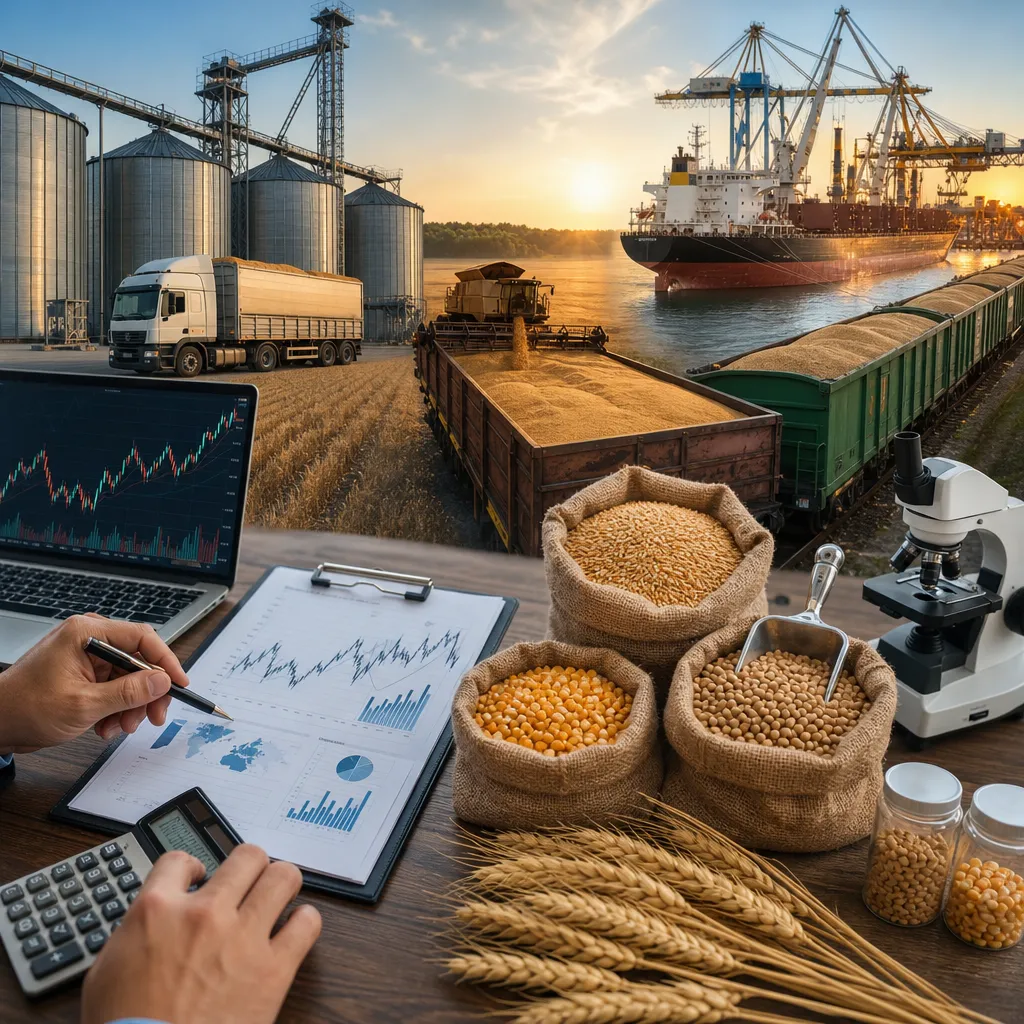
The transmission chain: from field to supermarket
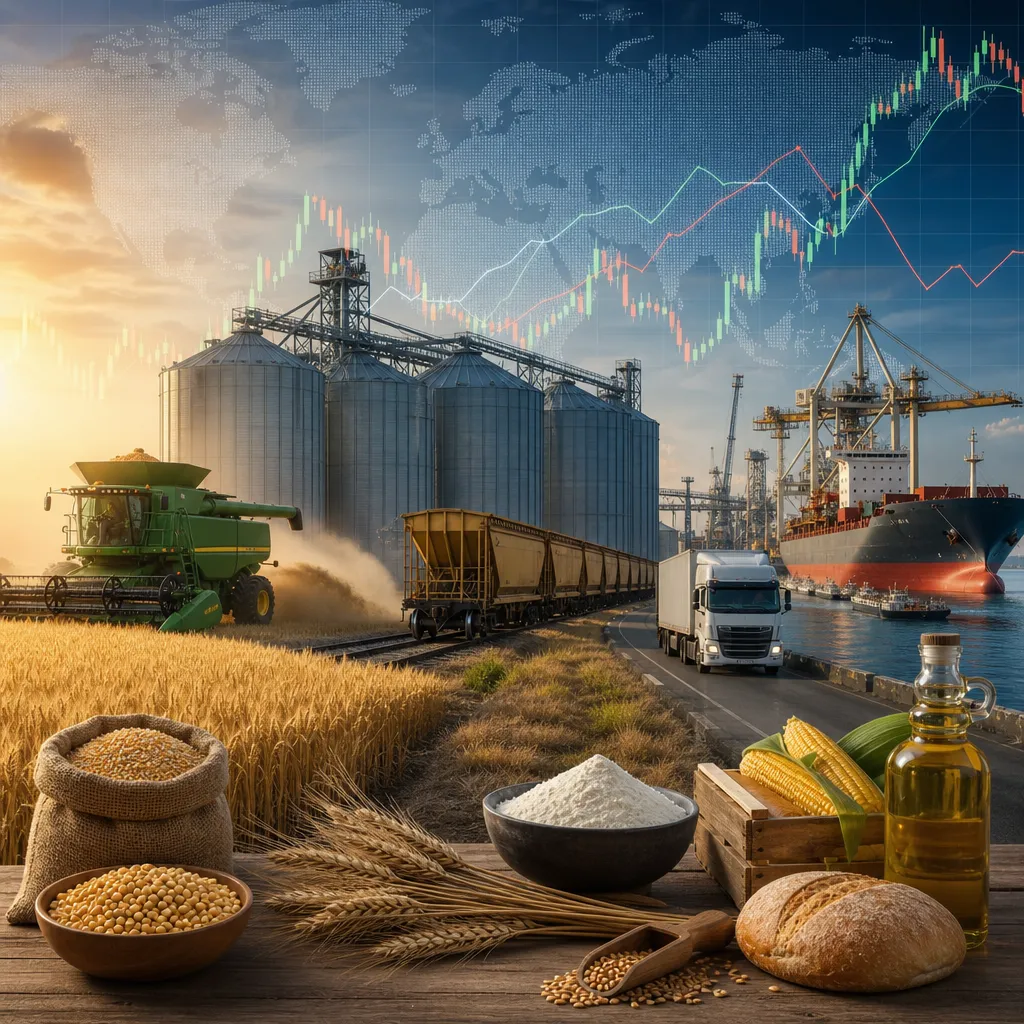
The grain-to-food chain typically runs through several physical and financial layers. Understanding this helps explain why grain market shocks can be delayed or diluted before appearing in food inflation data.
- Production: farmers grow and harvest grain.
- First handling: grain is delivered to an elevator, cooperative, merchant, on-farm storage, or processor.
- Conditioning and storage: grain may be dried, graded, blended, and stored.
- Movement: it is shipped by truck, rail, barge, or vessel to mills, feed plants, crushers, maltsters, or export terminals.
- Processing: wheat becomes flour, soybeans are crushed into meal and oil, corn becomes feed, starch, or ethanol-related coproducts.
- Manufacturing and retail: food companies package and sell products to wholesalers and retail channels.
Every step adds cost and risk. If a drought lifts wheat futures, the effect on flour may depend on whether mills already secured stocks, whether imports are available, whether currency moves offset the increase, and whether bakers can pass on costs.
For livestock sectors, corn and soybean meal often matter more than wheat. Higher feed costs can raise the cost of poultry, eggs, pork, and dairy over time. This is why food inflation can persist after a grain rally, even if the headline futures market later stabilizes.
What moves grain prices in practice
Grain markets are driven by supply, demand, policy, and logistics. The strongest price moves usually come when several factors change at once.
| Driver | How it affects grain prices | How it can affect food inflation |
|---|---|---|
| Weather | Changes yield and quality through drought, heat, flood, frost | Can tighten staple or feed supply and lift input costs |
| Stocks | Low carryout or low stocks-to-use reduces buffer against shocks | Makes food systems more sensitive to further disruptions |
| Exports and imports | Strong export demand or import buying can tighten local availability | Raises costs especially in import-dependent countries |
| Currency | Local currency weakness raises import cost in domestic terms | Imported food and feed become more expensive |
| Energy and fertilizer | Affects production, drying, storage, and freight cost | Broadens inflation beyond raw grain value |
| Government policy | Export bans, tariffs, reserves, subsidies can tighten or release supply | Can sharply change domestic food prices |
Biofuel demand, especially for corn and vegetable oils, can also matter. So can freight congestion, river levels, rail performance, port disruption, and war risk around export corridors.
Where to check reliable grain and food inflation data
Readers should use official or primary market sources first, then commercial analytics if deeper coverage is needed.
For grain futures and contract specifications
CME Group is a primary source for benchmark agricultural futures data and contract details. It shows contract months, units, delivery terms, and general market information. This is useful for traders, hedgers, analysts, and anyone checking how benchmark prices are quoted.
For crop, supply, and demand reports
USDA is central for global grain analysis. Key publications include:
- WASDE for world agricultural supply and demand balances,
- Crop Progress for U.S. planting and crop condition updates,
- Grain Stocks for inventory data,
- Export Sales for weekly demand signals.
These reports are widely used by farmers, grain merchandisers, feed buyers, and macro analysts. Even outside the United States, USDA reports can move world grain prices because they influence expectations for exportable supply.
For speculative positioning
CFTC Commitments of Traders shows how different classes of market participants are positioned in futures and options. This is useful for understanding whether funds are heavily long or short, but it does not replace physical supply-demand analysis.
For food inflation and international food price monitoring
FAO provides global food price monitoring and market context, especially useful for comparing cereals, vegetable oils, and other food groups internationally. National statistics offices and central banks provide domestic CPI food inflation data, which is the most relevant measure for consumers in a specific country.
For local cash markets, readers should check the websites or daily bid sheets of nearby elevators, cooperatives, processors, mills, feed manufacturers, and merchants. In some regions, official agricultural market reporting services publish representative cash bids or wholesale trade values.
Futures, options, and hedging versus physical grain buying and selling
Grain trading happens in two different worlds that interact constantly: the regulated futures market and the physical grain market.
In the futures market, standardized contracts are traded on exchanges through a licensed broker or futures commission merchant. A trader needs an account, posts margin, and gains exposure to price changes without necessarily owning grain. Futures can be used for hedging or speculation. Options on futures add the right, but not the obligation, to buy or sell at a strike price, usually in exchange for a premium.
In the physical market, actual grain changes ownership through contracts between farmers, elevators, cooperatives, merchants, processors, feed companies, mills, or exporters. The key terms are not just price, but also:
- delivery location,
- quantity,
- quality and grade,
- moisture and other discount schedules,
- freight responsibility,
- timing of delivery,
- payment terms,
- inspection and dispute process.
A wheat mill buying physical wheat does not simply click a futures quote and receive grain at that price. It sources grain through merchants, direct farm contracts, cooperatives, or logistics channels, and pays a location- and quality-specific cash price. Futures are often used to hedge that purchase, not replace the physical trade itself.
How businesses manage grain-price inflation risk
Different users manage price risk in different ways.
- Farmers may forward contract with an elevator, hedge futures, buy put options, or store grain and wait for basis improvement.
- Feed mills may buy physical grain forward and hedge input exposure using futures.
- Flour mills and crushers often manage both ingredient risk and basis risk.
- Food manufacturers may lock in part of raw material needs and update product pricing periodically.
- Importers must also manage freight and currency risk.
None of these methods removes all risk. Futures reduce exposure to benchmark price moves but can leave basis risk. Options limit downside or upside risk differently but involve premium cost. Storing grain can improve timing flexibility, but storage creates quality risk, financing cost, shrink, and possible spoilage.
Physical buyers also face counterparty risk. Before signing a grain contract, they normally check delivery terms, inspection standards, and payment timing carefully. Export and import contracts may also use trade terms such as Incoterms, which affect who pays freight and who bears risk during shipment.
Why local food inflation can diverge from global grain markets
A sharp move in global wheat or corn futures does not guarantee the same move in domestic food prices. Several filters stand in between.
- Country structure: a major exporter experiences grain shocks differently from a net importer.
- Currency: a weak domestic currency can make imported grain and oilseeds expensive even if global benchmarks are flat.
- Subsidies and controls: some governments cushion consumers through food subsidies, stock releases, or trade measures.
- Processing margins: food inflation may be driven more by energy, wages, and transport than by farmgate prices.
- Crop substitution: feed users can sometimes shift between corn, wheat, barley, or sorghum depending on relative values.
For analysts and procurement teams, the practical lesson is to watch both the international benchmark and the local physical market. A port basis blowout, rail disruption, or quality downgrade can matter more to a buyer than the futures board itself.
Practical checklist for tracking grain prices and food inflation
- Identify the relevant crop: wheat, corn, soybeans, rice, or edible oilseed.
- Check the benchmark futures market and contract month, if one is relevant.
- Check local cash bids from elevators, processors, mills, or merchants.
- Review major reports such as USDA WASDE, Crop Progress, Grain Stocks, and Export Sales.
- Monitor weather in key producing regions and logistics at ports, rivers, and rail corridors.
- Check currency moves if the market is import-dependent.
- Compare raw grain moves with consumer food inflation from the national statistics office or FAO context.
This approach gives a much better picture than relying on a single headline such as “wheat prices up” or “corn futures down.”
Where can I check current grain prices?
Use exchange sources such as CME Group for futures benchmarks and local elevator, cooperative, merchant, or processor bid sheets for physical cash prices. These are different markets, so local bids can differ materially from futures quotes.
Why are grain futures prices different from what a farmer receives?
Because the farmer is paid a local cash price, not the exchange benchmark alone. Cash price reflects basis, freight, quality, delivery point, and nearby supply-demand conditions.
Where does physical grain actually get bought and sold?
Mostly through elevators, cooperatives, grain merchants, processors, feed manufacturers, mills, exporters, and direct contracts between commercial counterparties. The transaction usually specifies quantity, quality, location, and delivery timing.
Do higher grain prices always cause food inflation?
No. They often contribute, but final food prices also depend on energy, labor, packaging, transport, exchange rates, taxes, and retail competition. Some products show fast pass-through, while others move slowly.
What official reports are most useful for grain market analysis?
USDA WASDE, Crop Progress, Grain Stocks, and Export Sales are widely used. CFTC Commitments of Traders helps interpret futures positioning, while FAO and national statistics offices help track broader food price trends.
Can a business hedge grain-price risk without buying physical grain on an exchange?
Yes. A business can use futures or options through a regulated broker to hedge benchmark price exposure while sourcing physical grain separately from a merchant, elevator, or processor. The hedge and the physical transaction are related but distinct.
What are the main risks in storing grain instead of selling immediately?
Storage can expose the owner to quality loss, moisture problems, insects, spoilage, financing cost, and weaker future basis. Storage only works well when the expected price or basis improvement exceeds those risks and costs.
How should import-dependent countries monitor food inflation risk from grain markets?
They should follow international grain benchmarks, freight conditions, port logistics, domestic currency moves, and government trade policy, then compare those with local wholesale and consumer price data.
Sources
- USDA World Agricultural Supply and Demand Estimates
- CME Group Agricultural Products and Contract Specifications
- FAO Food Price Index