



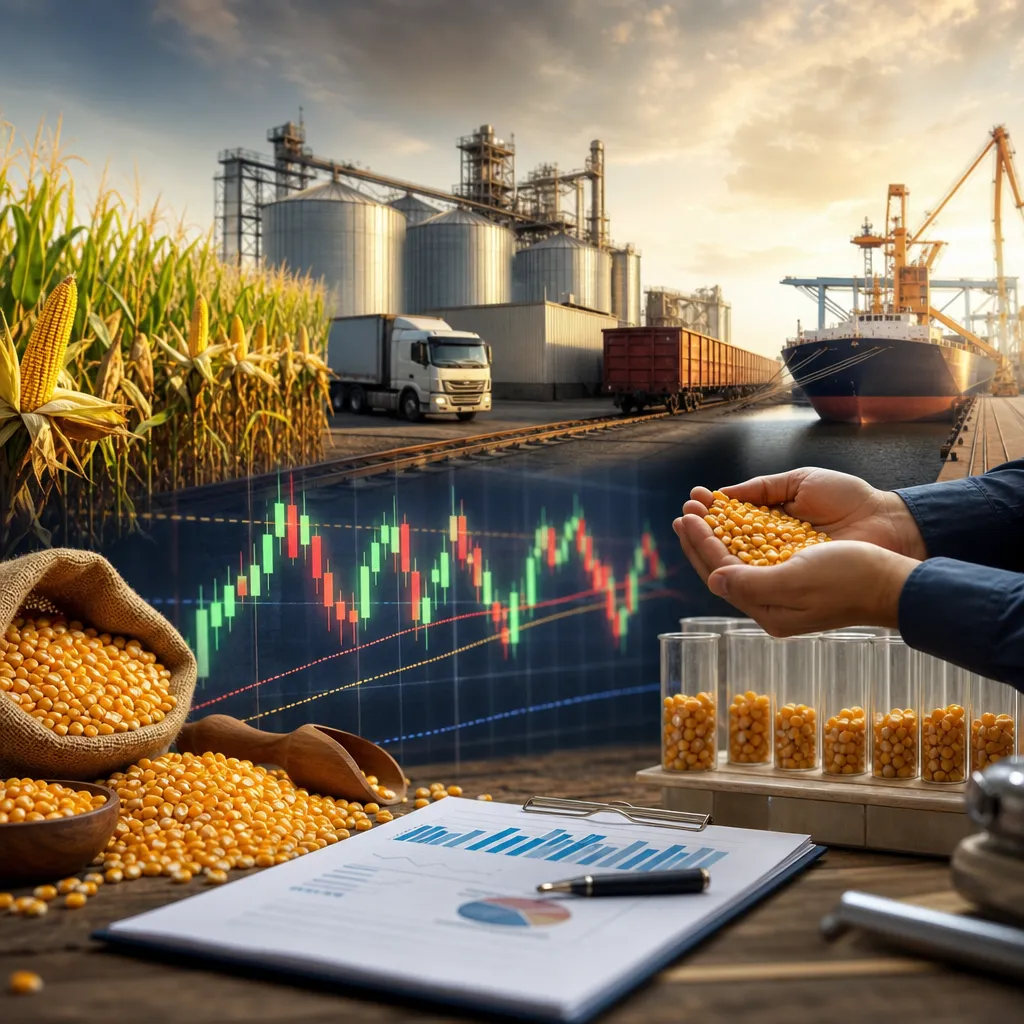
Corn price today depends on which market you mean. A live futures quote on the Chicago Board of Trade is a global benchmark, but the physical price paid to a farmer or grain seller is usually a local cash bid adjusted for basis, quality, delivery point, and freight. If you need the current price right now, the practical approach is to check both: exchange futures for the reference market and local elevator, cooperative, processor, or merchant bids for the actual nearby cash market. Those two prices are related, but they are not the same thing.
For most readers, the key distinction is simple: futures prices are financial exchange prices, while cash prices are physical grain transaction prices. Corn may be priced in cents per bushel, dollars per bushel, dollars per metric ton, or local currency, depending on region and buyer. That is why “corn price today” can produce different numbers across websites, ports, feed mills, ethanol plants, and futures platforms.
If current data is not displayed on the page you are using, the best sources are usually the CME Group for futures contract information, USDA for U.S. market reports, and local grain buyers or official agricultural market reporting systems for cash bids. Export-oriented markets may also rely on port bids, FOB offers, customs flow data, and merchant indications rather than only exchange prices.
What “corn price today” usually means
In practice, corn prices are quoted in several different ways:
- Futures price: the exchange-traded benchmark, most commonly CBOT corn futures.
- Cash price: the price for physical corn delivered to a local buyer such as an elevator, cooperative, feed mill, ethanol plant, or exporter.
- Basis: the difference between the local cash price and the relevant futures contract.
- Forward contract price: a price offered today for physical delivery in a future month.
- Port or export price: a price for corn delivered to an export terminal or quoted FOB in international trade.
A futures quote is useful because it provides a transparent benchmark with continuous trading. But a farmer, grain merchant, or end user making a real physical transaction needs the cash bid for a specific location, grade, moisture level, delivery period, and payment arrangement.
Where to check corn prices today
The right source depends on whether you want a benchmark, a tradable financial price, or a physical bid.
| Source type | What it shows | Who uses it | Where it is used |
|---|---|---|---|
| CME Group futures data | Benchmark corn futures contracts, months, settlement data | Traders, hedgers, analysts, grain firms | Online market data screens, broker platforms, exchange pages |
| Local elevator or cooperative bids | Nearby or forward cash bid for physical delivery | Farmers, local grain sellers, feed buyers | Buyer websites, mobile apps, call-in markets, bid sheets |
| Processor bids | Corn price at ethanol plants, mills, feed facilities | Commercial farmers, truckers, merchants | Direct buyer postings and procurement desks |
| Government market reports | Regional cash market summaries, export data, production and stocks reports | Analysts, farmers, merchandisers | Official agricultural reporting portals |
| Broker or data terminals | Live futures, options, charts, spreads, order entry | Speculators, hedgers, commercial desks | Trading software and brokerage platforms |
For U.S. corn, local bids are often posted by country elevators, cooperatives, ethanol plants, and river terminals. In export markets, merchants and port operators may quote bids on a delivered basis to inland warehouses or origin collection points. In importing countries, users often watch CIF import parity, feed mill demand, and domestic wholesale prices rather than only U.S. futures.
Futures price versus local cash price
This is the most important practical issue. A corn futures contract is not automatically the amount received at your local delivery point.
Futures reflect the exchange market for standardized contracts. Cash reflects what a real buyer will pay for real corn at a defined place and time. The difference is the basis.
Basis can strengthen or weaken depending on local supply, export demand, truck availability, river conditions, rail performance, storage pressure, processor demand, and crop quality. During harvest, basis often weakens in areas with heavy deliveries and limited storage. In tight nearby supply periods, basis can strengthen sharply if feed mills or processors need prompt grain.
| Market type | What is traded | How price is formed | Main limitation |
|---|---|---|---|
| Futures market | Standardized corn contracts | Exchange trading through bids and offers | Does not equal a local physical bid |
| Cash elevator market | Physical corn for nearby or forward delivery | Futures reference plus or minus basis, adjusted for local terms | May vary widely by location and quality |
| Direct processor contract | Physical corn delivered to end user | Procurement bid reflecting immediate need and logistics | Specifications and delivery schedules can be tighter |
| Export market | Corn delivered to port or sold internationally | Benchmark price plus freight, port demand, quality, trade terms | Highly sensitive to freight and destination demand |
How corn is bought and sold in the physical market
Physical corn trade usually takes place through a chain of local and commercial participants rather than directly on a financial exchange.
Typical sellers and buyers
- Farmers selling to country elevators or cooperatives
- Merchants buying for domestic resale or export programs
- Feed mills buying for livestock rations
- Ethanol plants and starch processors buying for industrial use
- Exporters sourcing corn for shipment through ports
- Importers or domestic wholesalers in deficit regions
How a physical transaction works
- Bid collection: the seller checks nearby cash bids from elevators, cooperatives, processors, or merchants.
- Terms review: the parties confirm quantity, quality, moisture, grade, delivery window, and payment terms.
- Price mechanism: the trade may be a flat cash price, a basis contract, a hedge-to-arrive contract where available, or a forward contract for future delivery.
- Delivery: corn is trucked or railed to the agreed point, such as an elevator, mill, or port facility.
- Inspection and weighing: the buyer checks moisture, test weight, damage, foreign material, and other quality factors if required.
- Settlement: payment is made according to contract terms, often after final weights and grades are confirmed.
In international trade, the physical market may also involve warehouses, surveyors, inspection certificates, shipping documents, and Incoterms such as FOB, CFR, or CIF. The quoted price then depends not only on corn value, but also on ocean freight, port costs, and destination risk.
How corn futures trading works
Corn futures are commonly used by hedgers and speculators, but trading a futures contract is not the same as buying truckloads of grain. Futures trade on regulated exchanges through licensed brokerage relationships, subject to margin requirements and contract rules.
The best-known benchmark is CBOT corn futures, part of CME Group. A futures contract represents a standardized quantity and quality under exchange specifications. Most participants close or roll positions before delivery; they are managing price risk or taking a market view, not arranging physical movement of grain.
Who uses corn futures
- Farmers: to hedge expected production against falling prices
- Elevators and merchants: to manage inventory and basis exposure
- Processors and feed users: to protect against rising input costs
- Funds and traders: to speculate on price direction, spreads, or volatility
What you need to trade futures
- A futures brokerage account
- Risk disclosures and account approval
- Sufficient margin capital
- A trading platform or broker-assisted order access
- Understanding of contract month, tick value, expiry, and delivery rules
Options on corn futures are also widely used. They allow market participants to define risk more clearly than naked futures in some situations, but they still involve time value, volatility, and pricing complexity. They are not a simple substitute for cash marketing discipline.
What moves corn prices today
Corn prices can change quickly because the market constantly reprices crop size, demand, and logistics. The most important drivers are usually a mix of production risk and demand shifts.
- Weather: planting delays, drought, heat, storm damage, and harvest disruptions
- Acreage and yield expectations: changes in planted area and crop condition
- Stocks and stocks-to-use: tight inventories generally raise sensitivity to supply shocks
- Export demand: major importer buying, competition from other origins, and port activity
- Feed demand: livestock sector margins and ration substitution with wheat or sorghum
- Ethanol and biofuel demand: energy markets and policy can affect domestic corn use
- Currency moves: exchange rates affect export competitiveness
- Freight and logistics: rail, barge, truck, river, and port efficiency alter delivered values
- Government reports: official revisions to production, ending stocks, or trade flows
For “today’s” price action, short-term volatility often follows weather model changes, export sales data, government reports, broader risk sentiment, and fund positioning. Commercial users tend to focus not only on futures direction but also on basis, carry, and nearby physical availability.
Best reports and data sources to follow
Reliable market analysis depends on official and exchange-based data, not social media snapshots or delayed generic finance pages.
Key sources and what they provide
- USDA WASDE: global and U.S. supply and demand balance sheets used for medium-term price analysis.
- USDA Crop Progress: weekly crop condition and harvest progress, especially important during the growing season.
- USDA Grain Transportation and market reporting: useful for freight, basis, and regional pricing context.
- USDA Export Sales: weekly export commitments and shipments, important for demand tracking.
- CME Group: contract specifications, futures settlements, expiration details, and options information.
- CFTC Commitments of Traders: shows positioning by broad trader category, often used to assess fund exposure.
- FAO and national agricultural agencies: useful for international production and trade context outside the U.S.
These sources help in different ways. Futures traders often prioritize intraday exchange prices, options volatility, and CFTC positioning. Farmers and commercial grain handlers often care more about local bids, basis trends, storage economics, and seasonal delivery opportunities.
Storage, basis, and logistics: why local prices differ
Two locations can have very different corn prices on the same day even when they reference the same futures contract. That usually reflects logistics and local supply conditions.
If storage is available, sellers may compare the immediate cash bid with later delivery bids to decide whether to move corn now or store it. That decision should include shrink, drying, interest cost, handling, spoilage risk, and whether the market is paying enough carry to justify storage.
Basis can improve after harvest in some markets, but that is never guaranteed. Areas with weak transportation, burdensome stocks, or limited processor demand may not recover enough to cover storage costs. Quality also matters: moisture issues, mycotoxins, low test weight, and damage can reduce the sale price or narrow the list of buyers willing to take the grain.
Practical ways to use today’s corn price
Different users should treat “today’s corn price” differently.
- Farmers: compare local bids across multiple elevators and processors, not just a national futures quote.
- Feed buyers: watch nearby basis, substitution economics, and freight into the plant.
- Exporters: monitor port spreads, inland origination, vessel lineup, and competing origins.
- Traders: separate chart-based futures moves from actual physical market strength or weakness.
- Analysts: connect price moves to reports, weather, currencies, and logistics rather than assuming one simple cause.
A practical daily checklist is: identify the benchmark futures month, check local or destination basis, confirm quality specs, compare delivery periods, and account for freight. That gives a usable market price instead of a headline number with limited commercial value.
Where can I check corn prices today online?
You can usually check benchmark futures on CME-related market data pages or through brokerage and financial data platforms. For real cash prices, the most relevant sources are local elevator, cooperative, processor, and merchant bid pages or official market reporting services where available.
Is the CBOT corn futures price the same as the cash price?
No. The CBOT futures price is an exchange benchmark. The cash price is the physical grain price at a specific location and time, adjusted by basis, quality, freight, and delivery terms.
Where do farmers usually sell physical corn?
Most farmers sell to country elevators, cooperatives, feed mills, ethanol plants, processors, or grain merchants. Some also enter forward contracts or deliver into export-oriented channels through merchants or terminal facilities.
How do I trade corn without buying physical grain?
You normally trade regulated corn futures or options through a futures broker. That requires an approved brokerage account, margin capital, and understanding of leverage, expiry, and contract risk. This is different from arranging truckloads or warehouse delivery of actual corn.
Why do local corn bids vary so much between buyers?
Because each buyer has different freight exposure, storage position, processing demand, export commitments, and quality requirements. Basis can change significantly even within the same region.
What reports matter most for corn prices?
The most widely used are USDA WASDE, USDA Crop Progress, USDA Export Sales, and CFTC Commitments of Traders. CME Group contract data is also essential for understanding benchmark futures and options markets.
Can I use futures to hedge my physical corn sale?
Yes, many farmers, elevators, and processors use futures to reduce price risk. But hedging still leaves basis risk, and it requires careful management of margin calls, contract month selection, and timing versus the physical sale.
What unit is corn usually priced in?
In the U.S., corn is commonly quoted in cents or dollars per bushel. Internationally, corn may also be quoted in dollars per metric ton or in local currency per metric ton, depending on the market and delivery basis.
Sources
- USDA Agricultural Marketing Service
- CME Group
- USDA World Agricultural Supply and Demand Estimates