




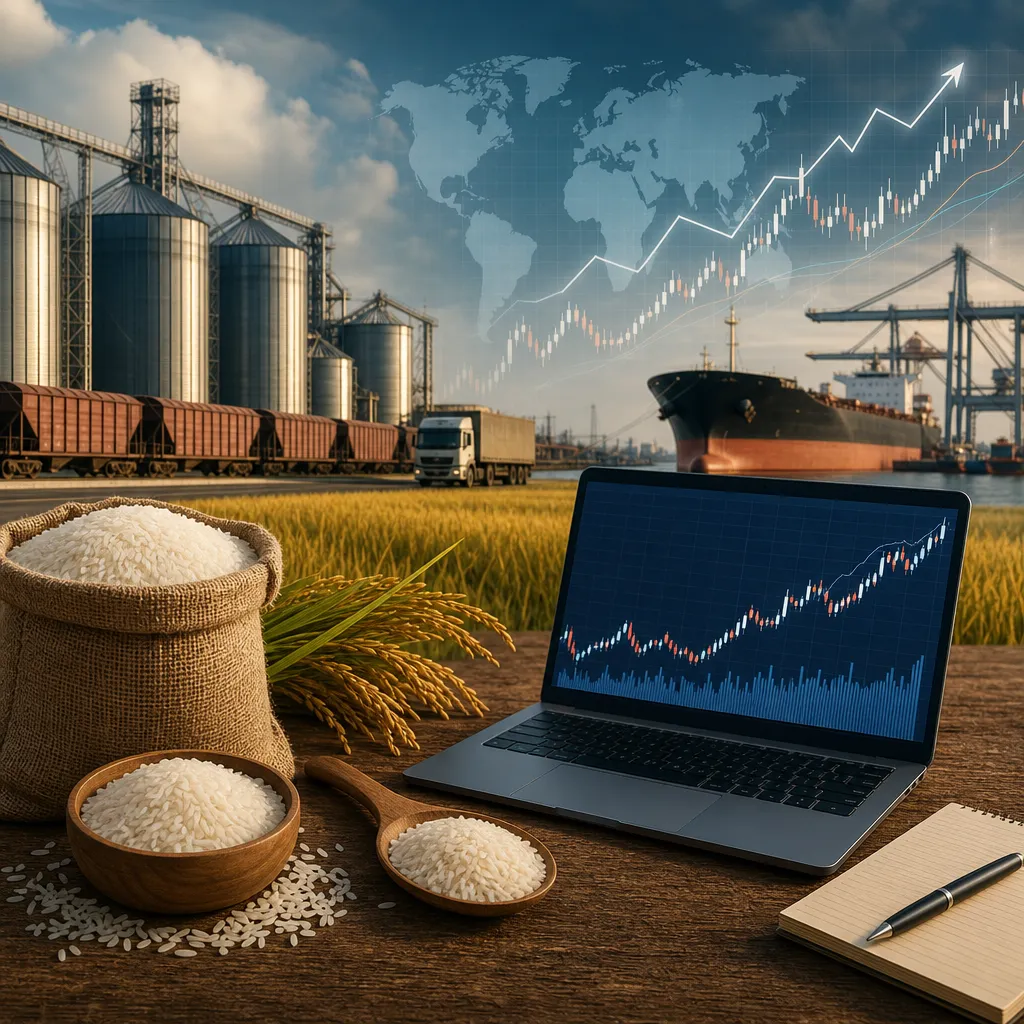
Rice price forecasts are usually built from a small set of variables that matter a great deal: production, stocks, trade policy, weather, freight, and currency moves. The most practical way to think about the market is not as a single global rice price, but as a network of regional cash markets linked to export quotes, government policies, and, in some countries, futures markets. A useful forecast therefore starts with scenarios rather than one exact number. For farmers, millers, importers, and traders, the key is to know which price benchmark they are actually exposed to, where to check it, and how to manage the risk.
Unlike corn or wheat, rice is less centralized around one dominant global futures benchmark. Much of the price discovery happens in the physical market through exporters, import tenders, mills, merchants, wholesalers, and government procurement programs. That makes rice forecasting highly practical: you need to track not only broad supply and demand, but also grade, origin, freight route, and policy risk.
How rice price forecasting works in practice
A rice price forecast is an estimate of how prices may evolve under different market conditions. It is not just a guess about whether prices will go up or down. It is a structured view of what could happen to paddy prices at the farm gate, milled rice prices in domestic wholesale markets, and export prices quoted by origin and grade.
In practice, analysts usually start with a balance-sheet approach:
- Beginning stocks carried into the season
- Production based on acreage, yield, and weather
- Imports and exports by country and origin
- Domestic use for food, seed, and industrial demand where relevant
- Ending stocks and stocks-to-use tightness
They then overlay commercial factors such as milling margins, transport bottlenecks, export restrictions, government tenders, currency changes, and substitution with wheat or corn in feed channels where relevant. For rice, policy can matter more than in many other grains because major exporters and importers often intervene directly.
| Forecast driver | Typical effect on rice prices | Why it matters |
|---|---|---|
| Acreage and planting progress | Lower acreage can support prices | Less planted area may reduce available supply before harvest. |
| Yield and weather | Poor yields can lift prices sharply | Rice is sensitive to rainfall, irrigation availability, floods, and heat at key growth stages. |
| Government policy | Export limits or procurement can tighten supply | Rice markets react quickly to export bans, minimum prices, public stocks, and import tenders. |
| Currency movements | Weak exporter currency can pressure dollar prices | Rice is widely traded internationally in U.S. dollars, while domestic costs are local-currency based. |
| Freight and logistics | High transport costs can raise import prices | Port congestion, container shortages, and inland trucking can materially change landed values. |
Which rice prices matter: farm, wholesale, export, and futures
One of the biggest mistakes in rice forecasting is treating all prices as the same market. They are not.
Farm-gate or paddy prices are what growers may receive locally, often subject to moisture, variety, impurities, and delivery timing. These are usually discovered through mills, cooperatives, local traders, procurement programs, or nearby buyers.
Milled rice wholesale prices are prices for processed rice sold into domestic consumption channels. They reflect milling yield, quality, broken percentage, packaging, and local demand.
Export prices are origin-specific quotations for grades such as white rice, parboiled rice, or broken rice. They are often discussed in U.S. dollars per metric ton and depend heavily on freight terms, port position, and quality specification.
Futures prices, where available, are financial market prices for standardized contracts. A futures quote is not automatically the same as the physical price received by a farmer or paid by an importer.
For U.S. market participants, rough rice futures traded on CME Group can be relevant for hedging or price discovery in that market. In other regions, many physical rice transactions occur without a highly liquid local futures benchmark, so participants rely more on cash quotes, tender results, exporter offers, and negotiated contracts.
| Market type | Where it is found | Who uses it | Key limitation |
|---|---|---|---|
| Local cash or paddy market | Elevators, mills, cooperatives, traders, local procurement systems | Farmers, local merchants, mills | Highly location- and quality-specific |
| Wholesale milled rice market | Domestic wholesale markets, processors, distributors | Millers, food companies, wholesalers | Hard to compare across grades and packaging formats |
| Export physical market | Exporters, brokers, tenders, merchant networks, port markets | Importers, traders, governments, food companies | Quotes change with freight, origin, quality, and policy |
| Futures market | Regulated exchange through a futures broker | Hedgers, funds, speculators, merchants | May not track every local physical rice market closely |
Where to check rice prices and forecast inputs
Reliable rice market work starts with reliable data. No single website gives the full picture, so users typically combine official reports, exchange data, and physical market intelligence.
USDA is one of the most practical public sources. Its reports are used globally, not just in the United States. Traders and analysts commonly use:
- WASDE for world and U.S. supply-demand balance sheets
- Prospective Plantings and Acreage for area expectations where relevant
- Crop Progress for planting and condition updates in the U.S.
- Grain Transportation and logistics publications when freight and movement affect basis and export competitiveness
FAO is useful for a global view, especially for food-security-oriented market interpretation, production trends, and trade context.
CME Group provides contract specifications and market information for rough rice futures. This matters for traders and hedgers who need the exact contract size, delivery terms, tick value, and expiry structure before using futures.
Government agriculture ministries and statistical agencies in major producing and consuming countries are important for country-level forecasts. They may publish planted area, procurement, crop estimates, stock policies, or tender information.
Physical market sources include local grain elevators, mills, cooperatives, exporters, grain merchants, brokers, and market reporting services. These sources are essential for local bids and real transaction levels, because official global reports may not capture current basis, freight, or quality discounts.
For commercial users, specialist data terminals, ag market platforms, and broker research may add cash indications, shipping intelligence, tender results, and historical spreads. Those tools are often used by merchants, procurement teams, and professional traders rather than by small farms.
Key drivers of a rice price forecast
Weather and water
Rice is uniquely exposed to water management. Monsoon performance, reservoir levels, irrigation access, and flood risk are often as important as temperature. A forecast should ask not only whether weather is favorable, but whether water arrives at the right time for transplanting, vegetative growth, and grain filling.
Stocks and stocks-to-use
Large stocks can soften the impact of a poor crop. Tight stocks amplify weather and policy shocks. Analysts focus on whether inventories are commercially available, government-held, or concentrated in one country, because not all stocks are equally accessible to the world market.
Trade policy
Rice can react strongly to export controls, tariffs, procurement programs, subsidies, and phytosanitary restrictions. A forecast that ignores policy risk is incomplete, especially when major exporters change selling rules or large importers enter the market with tenders.
Currency and energy
A weaker currency in a major exporting country can make that origin more competitive in dollar terms. Energy prices matter through irrigation, drying, milling, and transportation costs. Freight moves can be especially important for import-dependent countries.
Substitution and food demand
Rice demand is relatively stable as a food staple in many countries, but some shifts occur through consumer income, substitution with wheat products, or changes in feed use for by-products and broken rice. Forecasting demand still matters, even if it is often less volatile than supply.
Scenario-based rice price outlook
The most accurate way to present a rice price forecast is by scenario, not certainty.
Bullish scenario: weather problems reduce yield, irrigation becomes constrained, export restrictions limit available supply, and importing countries accelerate tenders. In this case, export quotes can rise quickly and local paddy markets may strengthen if mills compete for supply.
Neutral scenario: acreage is stable, major origins produce near trend, stocks remain adequate, and freight is manageable. Prices in this environment often trade in ranges, with quality premiums and regional basis doing more of the work than outright benchmark moves.
Bearish scenario: production recovers strongly, stocks rebuild, exporter competition intensifies, and importer buying slows. Prices may soften, but local markets can still remain firm if domestic government support or logistics constraints keep cash bids above international weakness.
This is why a forecast should specify which rice market is being discussed: rough rice futures, local paddy bids, domestic milled rice, or FOB export values. They can move together, but not always by the same amount or at the same time.
How farmers, millers, and traders use forecasts
Farmers use forecasts mainly to decide when to price, whether to store, and whether a hedge or forward contract is sensible. Millers use them to manage raw material coverage, crushing or milling schedules, and inventory risk. Importers and exporters use them to time purchases, price tenders, and manage exposure between origin and destination.
In the physical market, transactions typically occur through:
- Local mills buying paddy from farmers
- Cooperatives aggregating member production
- Grain merchants or brokers arranging purchases
- Exporters buying from mills or merchants for port shipment
- Government agencies conducting procurement or tenders
The practical details matter. Price is usually tied to quality, moisture, milling yield, delivery point, timing, and payment terms. Freight may be included or deducted. Storage conditions can change quality and therefore effective sale price. A strong export market does not guarantee a strong farm bid if inland transport is expensive or mills are well covered.
In the futures market, where used, a participant normally needs a futures brokerage account. Trading takes place on a regulated exchange platform, not by taking physical possession of rice in most cases. Futures require margin, are leveraged, and can generate losses quickly. They are most useful when the contract has a meaningful relationship to the user’s cash exposure and when basis risk is understood.
Forecasting tools, software, and market workflows
Different users need different tools.
- Farmers and producer groups usually need local bids, storage economics, weather, and simple forward-pricing records.
- Millers and merchants need procurement tracking, inventory, freight, hedging records, and customer sales coverage.
- Traders and analysts need charting, historical prices, trade flow data, crop reports, tender intelligence, and position monitoring.
Online access usually comes through one of four channels:
- Exchange websites for contract specifications and official futures market information
- Broker platforms for trading listed contracts and viewing account-level positions
- Government portals for crop reports, trade estimates, and statistical releases
- Commercial market-data services for dashboards, charting, news, basis reporting, and export market intelligence
These are not substitutes for each other. A broker platform is for financial execution; it does not replace a grain merchant. Government data is valuable for macro balance sheets; it does not replace local cash quotes from mills or elevators. Real physical trade still depends on contract terms, inspection, logistics, and counterparty reliability.
Main risks and limitations in any rice price forecast
Rice price forecasting is especially vulnerable to policy surprises and regional fragmentation. A global balance sheet may look comfortable while a specific origin or grade is tight. Likewise, a futures market indicator may be stable while physical export prices move sharply because of freight or a tender result.
Common limitations include:
- Quality mismatch between benchmark and actual rice being bought or sold
- Basis risk between futures and local cash values
- Policy shocks such as export restrictions or import tariff changes
- Opaque cash markets where many deals are negotiated privately
- Logistics distortions from port congestion, inland freight, or warehouse availability
- Currency volatility between domestic procurement and export sale
For storage decisions, remember that carrying rice is not free. Interest, shrink, spoilage risk, insurance, pest control, warehouse charges, and quality deterioration can all offset expected price gains. A forecast should therefore be compared with the full cost of carry, not just with the current spot price.
Practical approach to building your own rice price view
A disciplined forecast can be built in a few steps.
- Define the exact market: local paddy, milled rice, export FOB, import CIF, or futures.
- Collect the benchmark data: official supply-demand reports, crop progress, and trade updates.
- Add local cash intelligence: mill bids, elevator bids where relevant, cooperative offers, and freight indications.
- Map policy risk: export rules, tenders, procurement, tariffs, and import quotas.
- Build scenarios: favorable crop, normal crop, poor crop.
- Compare forecast with action options: spot sale, forward contract, storage, or hedge.
- Recheck basis and quality: confirm that the benchmark matches the rice actually being traded.
This is how practical users make forecasts useful. The goal is not to predict every move. The goal is to improve pricing, purchasing, storage, and hedging decisions under uncertainty.
Where can I check current rice prices?
Check the price source that matches your market. For futures, use CME Group if U.S. rough rice futures are relevant. For physical trade, check local mills, cooperatives, grain merchants, exporter offers, wholesale markets, and official market reporting services where available. International export values are often discussed by origin and grade, not as one global spot price.
Is rice mainly priced through futures exchanges?
No. Rice has futures relevance in some markets, but much of global rice pricing happens in the physical market through negotiated cash trade, tenders, exporter offers, mill procurement, and government programs. Futures can help with price discovery or hedging in certain regions, but they do not replace physical cash negotiation.
What is the difference between rough rice futures and local cash rice prices?
Rough rice futures are standardized exchange-traded contracts. Local cash prices are real-world bids or offers for a specific location, quality, and delivery period. The difference between them is often shaped by basis, freight, quality discounts, and local supply-demand conditions.
Who normally buys rice directly from farmers?
Depending on the country, buyers may include mills, cooperatives, local traders, grain merchants, procurement agencies, and sometimes processors or exporters through collection networks. The sale terms usually depend on moisture, variety, impurities, delivery point, and speed of payment.
Where do importers and exporters transact physical rice?
They usually work through grain merchants, exporters, brokers, tender systems, or direct commercial contracts. Trade is arranged around quality specifications, shipment period, origin, freight terms, inspection requirements, and payment terms. Port logistics and counterparty reliability are critical.
Which reports are most useful for a rice price forecast?
USDA WASDE is widely used for global and U.S. balance sheets. USDA crop and acreage reports matter for the U.S. market. FAO is useful for broader global context. Country-specific agriculture ministries and statistical agencies are important for local production, trade policy, and procurement updates.
Can a farmer hedge rice prices online?
Possibly, where an appropriate listed contract exists and access is available through a regulated futures broker. But hedging is not the same as selling physical rice. It requires margin, creates basis risk, and works best when the futures contract tracks the local cash exposure reasonably well.
Does a bullish global forecast guarantee higher local farm prices?
No. Local prices may lag or diverge because of quality issues, storage pressure, weak milling demand, freight costs, government intervention, or a wide basis. A farm-level marketing decision should always be checked against actual local bids and delivery terms.
Sources
- USDA World Agricultural Supply and Demand Estimates
- CME Group contract specifications and market information for Rough Rice futures
- Food and Agriculture Organization of the United Nations (FAO)