







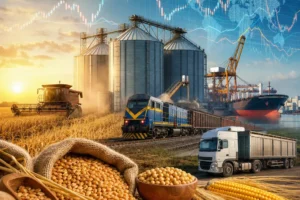


The Black Sea corn market is not a single exchange or one port price. It is a regional export and domestic physical market centered on countries surrounding or connected to the Black Sea, especially Ukraine, Romania, Bulgaria, and, in some trade discussions, southern Russia. In practice, “Black Sea corn supply and demand” usually means the balance between production, domestic feed and industrial use, export availability, and import demand from nearby and global buyers. Prices are formed through a mix of world benchmarks, local cash conditions, freight, currency, quality, and port access rather than by one universally quoted local number.
Geographically, the most important corn-exporting origins on the western side of the Black Sea are Ukraine, Romania, and Bulgaria, with shipments moving through Black Sea and Danube-linked routes toward importers in the Mediterranean, the European Union, the Middle East, and beyond. The market is usually discussed in metric tonnes, while export values are commonly referenced in U.S. dollars per tonne for FOB or CIF trade. Domestic farm and inland cash prices may also be discussed in local currency per tonne, depending on the country. For hedging and price discovery, participants often look to international futures benchmarks rather than a dedicated “Black Sea corn futures” contract with deep regional dominance.
What the Black Sea corn market means
Black Sea corn supply and demand refers to the regional balance sheet for maize produced in countries with export access through Black Sea logistics. The term is used by grain merchants, feed buyers, analysts, and importers to assess how much corn is available, how competitive it is against other origins, and how easily it can reach international buyers.
The market matters because the region has become an important origin for feed corn in years of normal production and open export logistics. Corn from this area competes with supplies from the United States, Brazil, and Argentina, especially into Mediterranean and nearby import markets. When Black Sea logistics are disrupted, the effect is not only local: buyer demand can shift to other exporters, and regional inland prices can disconnect sharply from global futures.
Where the market operates
The Black Sea corn market operates across several layers at once:
- Farm and inland cash markets: farmers sell to local elevators, collectors, traders, feed mills, starch users, or cooperatives where they exist.
- Domestic delivered markets: buyers quote delivered prices into feed mills, livestock integrators, ethanol or starch plants, or storage sites.
- River and port markets: traders buy corn delivered to Danube points, rail transfer points, or export terminals tied to Black Sea shipment.
- Export markets: merchants trade cargoes on an FOB basis at loading ports or CIF basis into destination markets.
- Futures and risk markets: price risk is often managed through major futures exchanges rather than through the physical Black Sea market itself.
Romania and Bulgaria are also part of the European Union, so their corn markets are influenced by EU internal trade, regulation, and common statistical reporting. Ukraine remains central to regional corn supply because of its scale and its role in export trade, but logistics can change the practical trade geography from season to season.
| Market layer | Where it operates | Typical quotation style | Main users |
|---|---|---|---|
| Farm-gate or local cash | Producing regions inland | Local currency per tonne | Farmers, local traders, feed buyers |
| Delivered domestic | Mills, feed plants, storage sites | Delivered price per tonne | Processors, livestock sector, merchants |
| Port or river export market | Black Sea ports, Danube-linked hubs | Port bid, FOB price, sometimes USD per tonne | Exporters, shippers, brokers |
| Import destination market | Mediterranean, EU, Middle East, other buyers | CIF price | Importers, feed compounders, state buyers, mills |
| Futures and options | Major exchanges accessed online via brokers | Exchange futures quote | Hedgers, trading firms, speculators |
How Black Sea corn prices are formed
There is no single “Black Sea corn price” that automatically applies to every farmer, trader, or buyer. The number most people need depends on whether they mean a futures benchmark, an inland cash bid, a port bid, a delivered domestic price, an FOB offer, or a CIF import value.
Futures price is the exchange-traded benchmark used for price discovery and hedging. For corn, many international participants watch CME Group corn futures, and in the European context some buyers and sellers also watch Euronext grain markets as a broader regional reference. A futures quote is not the same as a local Romanian, Bulgarian, or Ukrainian cash price.
Local cash bid is what a buyer offers at a farm, elevator, warehouse, or local collection point. It reflects the benchmark price adjusted for basis, logistics, handling costs, local supply pressure, storage conditions, and buyer competition.
Export bid or port bid is what an exporter may pay for corn delivered to a port, terminal, or river loading point. This usually sits closer to international trade values but still reflects line-up congestion, barge or rail access, quality needs, and loading risk.
FOB price means free on board at the export point. It reflects the value of the commodity loaded onto the vessel, before ocean freight to the destination.
CIF price means cost, insurance, and freight into the destination market. Importers often compare origins on a CIF basis because that is the landed cost they face.
Basis is the difference between the local cash price and the relevant futures benchmark. In the Black Sea region, basis can be highly sensitive to harvest pressure, inland transport bottlenecks, currency swings, export policy, and disruptions to port access.
Main supply and demand drivers
Supply begins with acreage, weather, yields, and harvest quality. Corn is especially sensitive to summer moisture and heat during key development stages, so regional weather can quickly alter production expectations. A large crop in Romania or Ukraine tends to pressure inland harvest prices unless logistics and export demand absorb it efficiently.
Demand has several layers:
- Domestic feed demand: poultry, hog, and cattle sectors consume corn where it is price-competitive against wheat or barley.
- Industrial demand: starch, sweetener, and ethanol demand matters in some markets more than others.
- Export demand: often the decisive factor for surplus-producing origins around the Black Sea.
- Substitution demand: buyers compare corn with feed wheat, barley, and sometimes imported alternatives.
Currency is another major driver. Export cargoes are often valued in U.S. dollars, while farm transactions and inland costs occur in local currency. A weaker local currency can support export competitiveness and domestic cash prices in local terms, even if world dollar prices are flat.
Freight and logistics are unusually important in this region. River levels, rail capacity, border clearances, terminal access, insurance conditions, and vessel availability can materially change the spread between inland prices and export values. In years of logistics stress, the regional basis can matter more than the futures move itself.
| Factor | Typical market effect | Why it matters in the Black Sea |
|---|---|---|
| Weather and yields | Changes supply expectations | Corn output is highly sensitive to summer conditions |
| Export logistics | Widens or narrows basis | Port, river, rail, and border access can alter realizable value |
| Global benchmark futures | Sets broad price direction | Importers compare Black Sea corn with other global origins |
| Currency | Affects local currency returns | Exports are internationally priced, while inland trade is local |
| Domestic feed demand | Supports cash market when exports slow | Livestock and feed sectors can absorb part of the crop |
| Competing origins | Affects export competitiveness | Buyers compare the Black Sea with the Americas and EU supplies |
How grain is actually bought, sold, exported, and imported
Physical grain trade
In the physical market, corn is normally bought and sold through bilateral contracts rather than on a public retail screen. A farmer may sell ex-farm, delivered to a local warehouse, or delivered to a processor or export collection point. The contract will usually specify quantity, moisture, other quality parameters, delivery window, location, price formula or flat price, and payment terms.
Local merchants aggregate grain from farms and move it inland or toward export channels. Exporters buy enough volume to assemble cargoes for shipment through a port or river-linked route. Importers, feed manufacturers, and trading houses may buy on an FOB basis from origin exporters or on a CIF basis into destination markets.
Quality matters. Corn can be discounted or rejected for moisture, damage, foreign material, test weight, or mycotoxin risk, depending on contract terms and buyer requirements. In practical terms, two loads from the same district may not earn the same price if quality differs.
Counterparty and execution risk also matter. Physical sellers should assess not only the nominal price but the buyer’s reliability, payment terms, delivery flexibility, and dispute resolution process.
Futures and options trade
Futures and options are different from physical grain ownership. A trader, farmer, merchant, or feed buyer can use a regulated exchange through a broker to hedge price risk without shipping corn anywhere. This is online financial trading, not the same as selling a truckload or vessel cargo.
For example, an exporter with physical long exposure may sell futures to reduce downside price risk before buying is completed or before export sale pricing is finalized. A feed buyer may buy futures or options to protect against rising corn prices while still sourcing physical grain locally. This introduces basis risk: the futures hedge may work while the local physical differential changes unexpectedly.
Futures trading involves margin, daily mark-to-market, contract expiry, and leverage. That makes it useful for risk management, but unsuitable to confuse with warehouse ownership or guaranteed access to physical grain.
Where to check Black Sea corn prices and market information
Because local Black Sea corn prices are fragmented, readers should always check the type of quote first. A futures screen, a farm bid, and an FOB offer answer different questions.
Practical places to check information include:
- CME Group: widely used for world corn futures benchmarks.
- Euronext: relevant for European grain market context and risk management reference.
- USDA: production, trade, and global balance-sheet context through WASDE, PSD, and FAS reporting.
- European Commission: useful for EU grain market monitoring, especially for Romania and Bulgaria as EU member states.
- National statistics offices and agriculture ministries: for planted area, production, trade, and domestic market context where published.
- Local elevators, merchants, processors, and exporters: the most practical source for actual physical bids and delivery terms.
- Specialized brokers and market bulletins: often used by commercial participants to track FOB, CIF, and inland indications.
A reader looking for a “current Black Sea corn price” should verify all of the following: origin country, delivery point, crop year, quality basis, currency, unit, and whether the quote is farm-gate, delivered, FOB, or CIF. Without that, the number can be misleading.
Forecasting Black Sea corn supply and demand
Forecasts in this market should be framed as scenarios rather than certainty. A useful approach is to think through production, logistics, and demand in combination.
Supportive scenario: favorable weather, stable acreage, normal harvest progress, and open export routes increase available supply. In that case, the region can become more competitive in nearby export destinations, especially if freight is manageable and competing exporters are less aggressive.
Tighter scenario: drought, reduced yields, harvest quality issues, or logistics bottlenecks reduce exportable surplus. Domestic users may then need to compete more actively for available corn, and importers can shift demand to other origins.
Mixed scenario: a decent crop with restricted logistics can produce weak inland prices but firmer export values, because the problem is not total production alone but movement from interior regions to the vessel.
Analysts therefore watch not just crop conditions, but also river traffic, border flows, insurance conditions, freight, currency, and the price of substitute feed grains. In the Black Sea, logistics can be as important as agronomy.
Relationship to global benchmarks
Black Sea corn competes in a global market, so international benchmarks matter even when local fundamentals dominate day to day. U.S. corn futures are often the first reference for broad world price direction. Buyers then compare origin differentials, freight, and quality. For EU-linked trade, broader European grain market sentiment also matters, even if it is not a like-for-like quote for local corn.
This means a farmer or local trader should not assume that a rally in futures guarantees the same move in the local cash market. If transportation costs rise, ports are congested, or local harvest pressure is intense, the basis can weaken enough to offset higher futures. The reverse is also true: a strong export pull can lift local bids even if futures are sideways.
Practical points for commercial users
For producers, the key question is usually not “What is corn futures doing?” but “What is my bid for this quality, at this location, for this delivery window?” For feed buyers, the key issue is often replacement cost and delivered availability, not simply flat price. For exporters, margin depends on origination cost, freight chain performance, vessel execution, and hedge management together.
Anyone active in the Black Sea corn market should separate three decisions:
- Physical decision: when and where to buy or sell real corn.
- Logistics decision: how to move it and what transport risk exists.
- Price-risk decision: whether and how to hedge with futures or options.
Keeping those decisions separate helps avoid a common mistake: assuming that a financial hedge solves a physical logistics problem, or that a favorable FOB indication automatically translates into a good farm-gate bid.
What is the main geography of the Black Sea corn market?
It mainly refers to corn supply and trade from Black Sea-connected exporters such as Ukraine, Romania, and Bulgaria, with regional trade shaped by Black Sea and Danube logistics.
In what currency and unit is Black Sea corn usually priced?
Export trade is commonly discussed in U.S. dollars per metric tonne, especially for FOB or CIF cargoes. Domestic cash prices may be quoted in local currency per tonne.
Where can I check current Black Sea corn prices?
There is no single official live regional price. Check local merchants, processors, elevators, or exporters for physical bids, and use CME Group, Euronext, USDA, and European Commission reporting for benchmark and market context.
What is the difference between Black Sea cash corn and corn futures?
Cash corn is the real physical grain price at a specific location and quality. Futures are exchange-traded financial benchmarks used for price discovery and hedging, and they do not equal a local farm or port bid.
How is Black Sea corn exported?
Exporters buy inward from farms and inland traders, assemble volume to contract quality, move it by truck, rail, barge, or combinations of these to export points, and sell cargoes on FOB or CIF terms to international buyers.
Can a farmer or trader hedge Black Sea corn online?
Yes, if they have access to a regulated broker and appropriate futures or options markets. But this is a financial hedge only; it does not replace the need to arrange a physical buyer, delivery, and logistics.
Why do local Black Sea corn prices sometimes diverge from world benchmarks?
Because local basis can change due to harvest pressure, quality, inland transport, river and port conditions, buyer competition, currency movements, and export accessibility.
Who buys Black Sea corn?
Domestic feed users, processors, merchants, exporters, and overseas importers all participate. End users often include feed compounders and livestock sectors in nearby importing regions.
Sources
- USDA Foreign Agricultural Service
- European Commission
- CME Group