
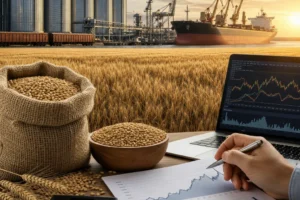
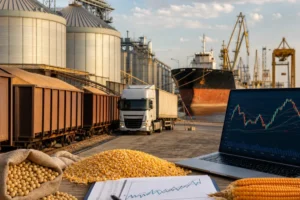

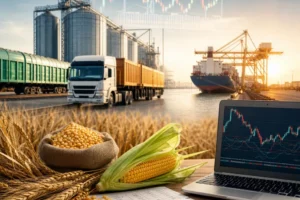
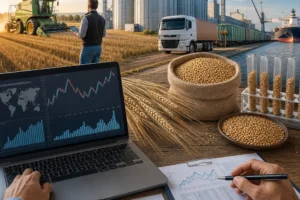

The European Union barley market is not a single exchange or one local cash market. It is a regional grain system spanning major producing countries such as France, Germany, Spain, Romania, Denmark, and several Central and Eastern European members, with demand coming from feed users, maltsters, livestock sectors, and export channels. In practice, “EU barley supply and demand” refers to the balance between production, stocks, imports, domestic use, and exports across the EU-27, with prices influenced by both internal crop conditions and global grain trade. Readers following this market need to separate benchmark futures, country cash prices, malt and feed premiums, and export values at ports.
Barley in the EU is usually discussed in metric tonnes, and physical prices are commonly quoted in euros per tonne. The most relevant financial benchmark for broad western European grain pricing is Euronext milling wheat futures, even though barley itself is often priced more through physical trade, tender activity, and relative value against wheat and corn than through a deep standalone barley futures benchmark. That makes the EU barley market highly practical: quality, destination, and logistics matter as much as headline futures direction.
What “EU barley supply and demand” means
Supply and demand in the EU barley market is the interaction of several moving parts:
- Supply: harvested production, opening stocks, imports, and carry-in from the previous season.
- Demand: feed use, malting and brewing demand, industrial use, seed, exports, and ending stocks.
- Regional variation: some member states are structural exporters, while others are more dependent on internal EU flows or imported feed grains.
Barley in the EU is broadly divided into two commercial categories:
- Feed barley, used mainly in animal rations and traded in competition with feed wheat and corn.
- Malting barley, which requires stricter quality standards and feeds the brewing and malting industries.
Because those two segments can behave differently, “EU barley” is never just one price or one balance sheet story. A year with ample feed barley may still be tight in malting quality, and a year with decent production can still feel bullish in some importing zones if logistics or quality fail.
Where the EU barley market operates
The market operates across the EU’s internal grain corridor, from farmgate and inland collection points to feed mills, maltsters, river terminals, and seaports. France is typically central in export pricing because of its role in western EU grain trade and access to seaborne markets. Germany, Denmark, and parts of Central Europe are important for both feed and malting barley. Spain is often influential on the demand side because its livestock sector can pull grain into deficit areas depending on domestic crops.
Trade occurs through several layers:
- Farm and cooperative level: farmers sell to cooperatives, merchants, or collectors.
- Domestic processors: feed compounders, livestock integrators, and maltsters buy directly or through traders.
- Intra-EU trade: grain moves by truck, rail, barge, and vessel between member states.
- Export market: merchants compete for shipments to third countries, especially when EU barley is price-competitive against Black Sea, Australian, or other origins.
For external trade, port values matter more than inland prices. Export business is typically discussed in FOB terms, while importing buyers may think in CIF terms. Inland values, however, depend on what the grain is worth at destination minus transport, handling, storage, and commercial margins.
| Market layer | Where it operates | Main users | Typical pricing focus |
|---|---|---|---|
| Farmgate cash market | Local silos, cooperatives, merchants | Farmers, collectors, first buyers | Net local bid in euros per tonne |
| Delivered inland market | Feed mills, maltings, processors | Processors and merchants | Delivered specification and freight-adjusted value |
| Export market | Ports and export terminals | Exporters, international traders, importers | FOB competitiveness and vessel logistics |
| Futures/hedging market | Exchange and broker platforms | Traders, merchants, hedgers, investors | Benchmark risk management rather than exact local barley price |
How EU barley prices are formed
EU barley prices are formed by a mix of local fundamentals and broader grain benchmarks. There is no single “EU barley price” that applies equally from a French export terminal to a Spanish feed mill or a Danish malting contract. Instead, prices are built from several layers.
Benchmark influence
Euronext wheat futures are often the closest regional benchmark for grain risk sentiment in western Europe. Corn values, Black Sea export competition, and world feed grain balances also matter. Barley frequently trades at a discount or premium to wheat depending on feed demand, crop size, and quality.
Cash market reality
A local cash bid is the actual physical buying price offered by a cooperative, merchant, or processor. It reflects:
- benchmark grain markets,
- local basis,
- barley quality,
- nearby supply pressure at harvest,
- distance to end-user or port,
- transport and drying costs,
- competition between buyers.
Export pricing
At ports, barley is often valued as an export parcel. An FOB price means the grain value loaded on board at the port of shipment. An importer may think in CIF price terms, which include freight and insurance to the destination port. Inland cash values are then derived backward from export parity.
Basis and spreads
Basis is the difference between a local physical price and a benchmark futures price or replacement market reference. In the EU barley trade, basis may be discussed more loosely than in some North American grain markets, but the concept is the same: the local premium or discount reflects freight, quality, urgency, and buyer competition.
Malting barley introduces another spread. A parcel that meets malting specs can command a premium over feed barley, but that premium can shrink sharply if quality is abundant or if brewing demand softens.
| Price type | What it means | Why it matters |
|---|---|---|
| Futures benchmark | Exchange-traded reference price for grain risk | Useful for hedging and market direction, not the same as a farm bid |
| Cash bid | Price offered for physical barley at a local point | What farmers or merchants can actually transact at |
| Delivered price | Price including transport to a processor or user | Important for feed mills and maltsters |
| FOB export price | Value loaded at export port | Key for export competitiveness |
| CIF import price | Delivered cost into destination port | Relevant for importers comparing origins |
Main supply drivers in the EU barley balance sheet
The most important supply variable is the EU harvest itself. Barley is grown across a wide geography, so weather problems in one country do not automatically define the whole bloc, but large producers can still swing the market.
Key supply drivers include:
- Acreage: planting decisions relative to wheat, rapeseed, and other crops.
- Yield: spring and early summer weather, especially moisture and heat during grain fill.
- Quality: protein, germination, screening, and other malting criteria.
- Carry-in stocks: old-crop availability before the new harvest arrives.
- Imports: usually less central than domestic production, but still relevant in deficit regions or specific quality situations.
Spring barley and winter barley can face different weather risks and serve slightly different end-use channels. Traders therefore watch crop development country by country, not just at an EU aggregate level.
Main demand drivers: feed, malt, and exports
Demand for EU barley rises or falls according to three main channels.
Feed demand
Feed barley competes directly with feed wheat and corn. If corn imports into the EU are cheap or domestic feed wheat is abundant, barley may need to price competitively to clear. If wheat quality disappoints or corn is expensive, feed barley can gain support.
Malting demand
Malting barley demand depends on the malting industry, beer production, and the willingness of maltsters to pay for specification grain. Even in weak feed markets, malting premiums can hold if high-quality grain is scarce. But malting demand is not only about quantity. Contract terms, germination, nitrogen, and sorting standards are crucial.
Export demand
The EU can be an important barley exporter when supply is ample and prices are competitive against other global origins. Export demand often depends on world feed grain values, tender business from importing countries, freight conditions, and exchange rate moves. A weaker euro can improve EU export competitiveness; a stronger euro can do the opposite.
How barley is actually bought, sold, exported, imported, or hedged
In the real economy, most EU barley is traded physically through contracts between farmers, cooperatives, merchants, processors, and exporters.
Physical barley trade
- Farmers deliver barley to on-farm storage, cooperatives, merchants, or local collection points.
- Buyers assess moisture, test weight, screenings, and where relevant malting quality.
- Barley is sold on spot terms, forward contract, pool arrangements, or specification contracts.
- Grain may then move inland to feed users or toward ports for export.
For malting barley, contract detail matters more than for feed barley. Price structure, quality tolerances, rejection rules, delivery windows, and payment terms should all be checked carefully. A buyer may offer an attractive headline premium, but the effective value depends on whether the crop meets contract specifications.
Export and import mechanics
Exporters assemble parcels large enough for vessel loading and manage inland freight, storage, quality blending, port elevation, and shipping schedules. Importers, by contrast, usually buy on delivered or CIF terms and compare EU barley against alternative origins.
Internal EU trade is often simpler than extra-EU trade because the single market reduces some barriers, but payment risk, contract law, and logistics still require normal commercial diligence.
Futures and options hedging
Barley itself is often hedged imperfectly through correlated grain markets rather than a universally used dedicated EU barley futures benchmark. Merchants or processors may use Euronext grain futures, depending on their exposure, to manage directional price risk. This does not eliminate basis risk: physical barley in a local market can move differently from the futures hedge.
Access to futures or options normally requires a brokerage account, margin funding, and understanding of leverage, expiry, and contract structure. Futures provide financial price exposure; they do not automatically mean ownership of physical barley. A farmer may watch futures online but still sell the crop physically to a cooperative. A merchant may buy barley in the cash market and separately hedge price risk through an exchange.
Where to check EU barley prices and market information online
Readers should use multiple sources because no single screen shows every relevant EU barley value.
- European Commission: useful for EU crop, trade, and market monitoring publications, including cereal balance-sheet context.
- Eurostat: helpful for official trade and structural agricultural data across member states.
- Euronext: relevant for benchmark grain futures used by commercial participants to gauge broader grain price direction.
- USDA: the Foreign Agricultural Service and World Agricultural Supply and Demand Estimates are widely used for global grain balance and trade context, including EU barley outlook discussion.
- Local cooperatives and merchants: often the best place to check actionable local cash bids.
- Maltsters, feed mills, and domestic buyers: important for delivered prices and quality premiums.
When checking prices, always note:
- the location,
- whether the quote is futures, cash, delivered, FOB, or CIF,
- the crop year,
- the quality standard,
- the currency, usually euros per tonne.
A futures price on Euronext is not the same as a local barley bid in Spain, Romania, or northern France. Local cash prices can differ materially because of freight, nearby shortages, export demand, storage pressure, and quality.
Practical outlook framework for EU barley
The best way to think about forward EU barley supply and demand is through scenarios rather than certainty.
- Bearish scenario: large EU crop, good malting quality, weak export demand, and heavy competition from other feed grain origins.
- Supportive scenario: weather damage, reduced quality, stronger feed substitution demand, or improved export competitiveness through currency moves or rival-crop problems elsewhere.
- Mixed scenario: ample total barley supply but a shortage of malting-grade grain, leading to weak feed values but firmer malting premiums.
In practice, traders watch not only harvest size but also whether barley can clear into feed channels, displace wheat or corn, or win export tenders. A seemingly comfortable crop can still create firm regional prices if logistics tighten or if production is stranded far from demand centers.
FAQ
What is the main benchmark for EU barley prices?
There is no single universal EU barley benchmark equivalent to a dominant barley futures contract used everywhere. Commercial participants often watch Euronext grain futures, especially wheat, alongside physical barley export and inland cash markets.
Are EU barley prices quoted in euros or dollars?
Within the EU, physical barley is typically quoted in euros per tonne. International trade comparisons may also refer indirectly to dollar-denominated global grain competitiveness, but regional trade is usually discussed in euros.
Where can farmers or traders check actual barley prices?
The most practical places are local cooperatives, grain merchants, processors, and maltsters for cash bids, plus Euronext for benchmark futures and the European Commission or USDA for market context. Always confirm location and quality specifications.
Why is my local barley bid different from futures?
Because futures are only a benchmark. Your local bid includes basis, freight, handling, storage, buyer demand, quality, and regional supply conditions. Harvest pressure can also widen the gap between benchmark markets and farmgate values.
How is malting barley priced differently from feed barley?
Malting barley can earn a premium if it meets contract specifications such as germination and protein standards. If quality fails, it may fall back to feed value, so the headline premium is never guaranteed.
Does the EU mainly export or import barley?
That depends on the season and member-state balances, but the EU is often a meaningful barley exporter when production is strong and prices are competitive. At the same time, some internal regions can be deficit areas and rely on inflows from other member states or alternative feed grains.
Can barley be hedged on an exchange?
Yes, but often indirectly through related grain futures rather than a single widely used EU barley contract for every exposure. Hedgers must manage basis risk because physical barley values and futures do not move identically.
What matters most for the EU barley outlook each year?
Weather during the growing season, harvested area, feed grain competition, malting quality, export demand, and the euro’s competitiveness against other exporters are usually the biggest factors.
Sources
- European Commission
- Euronext
- USDA Foreign Agricultural Service