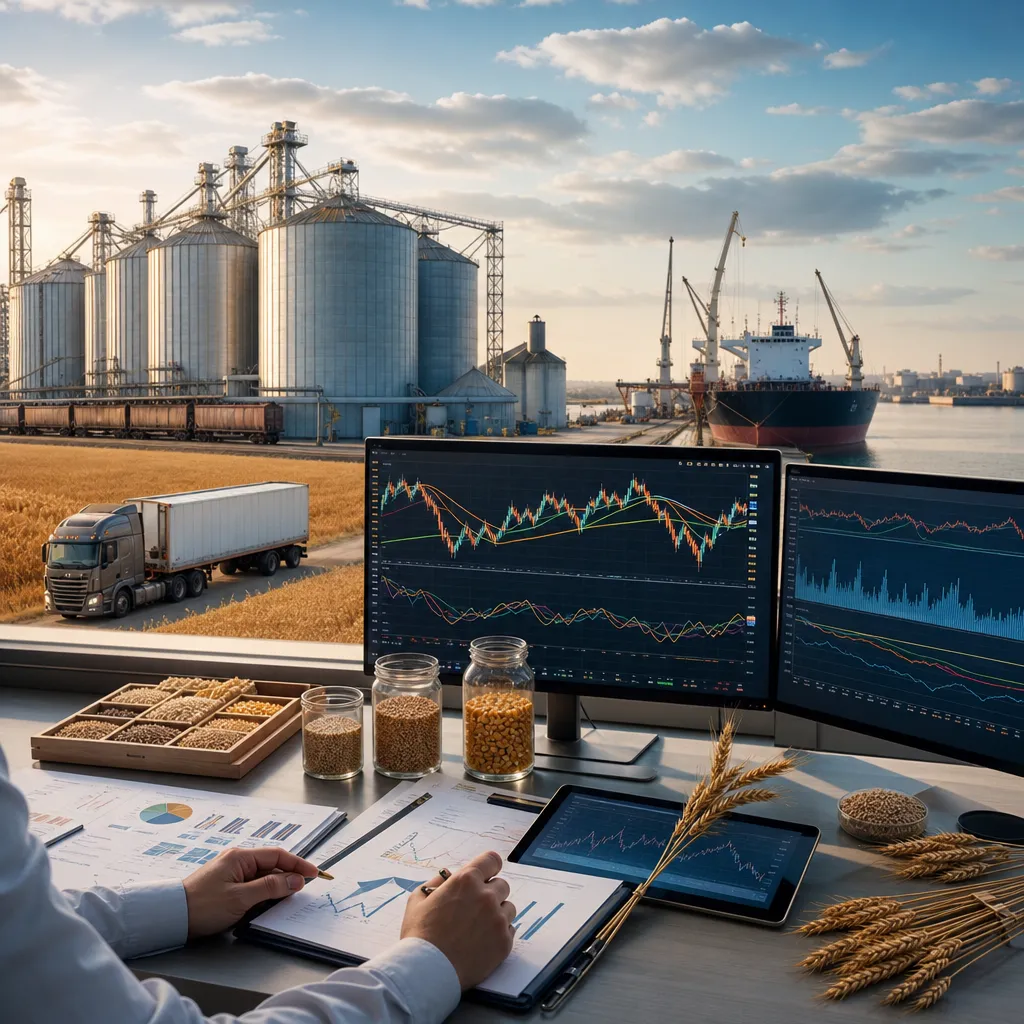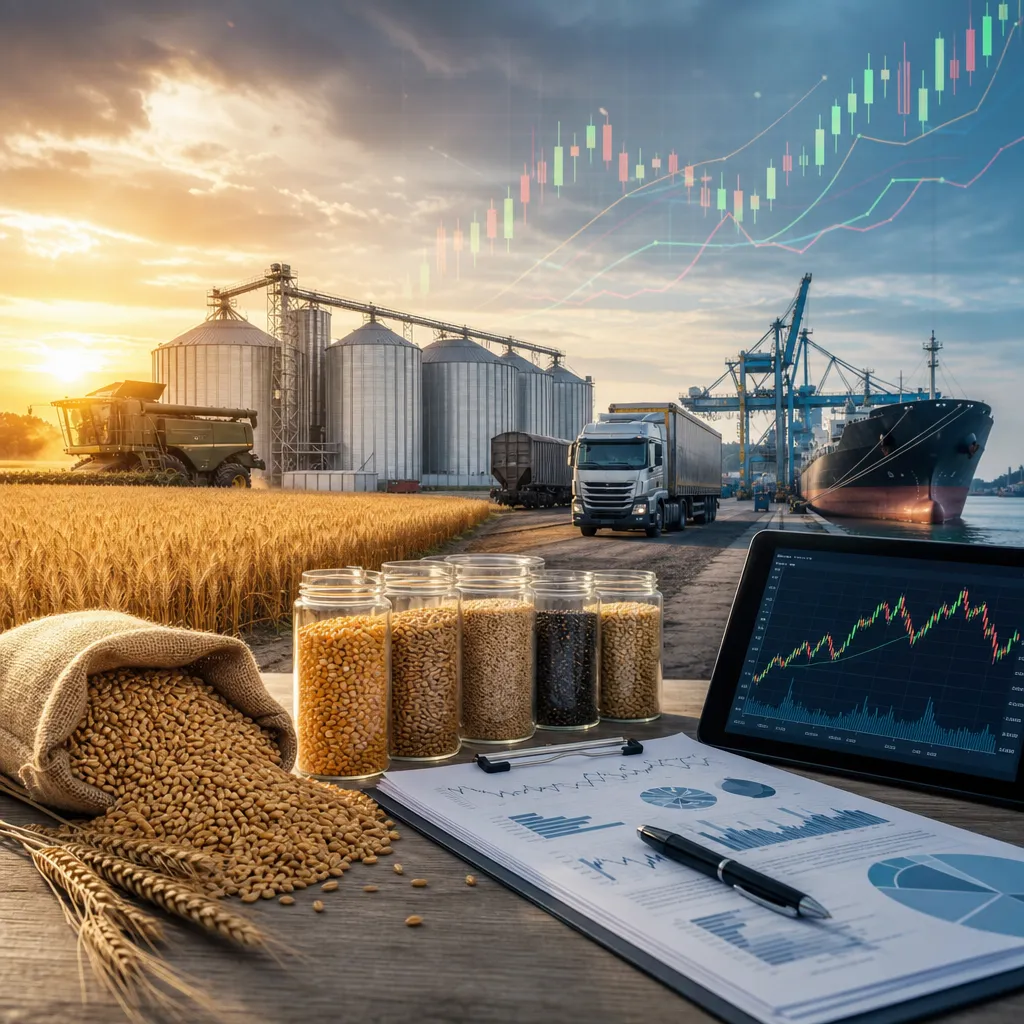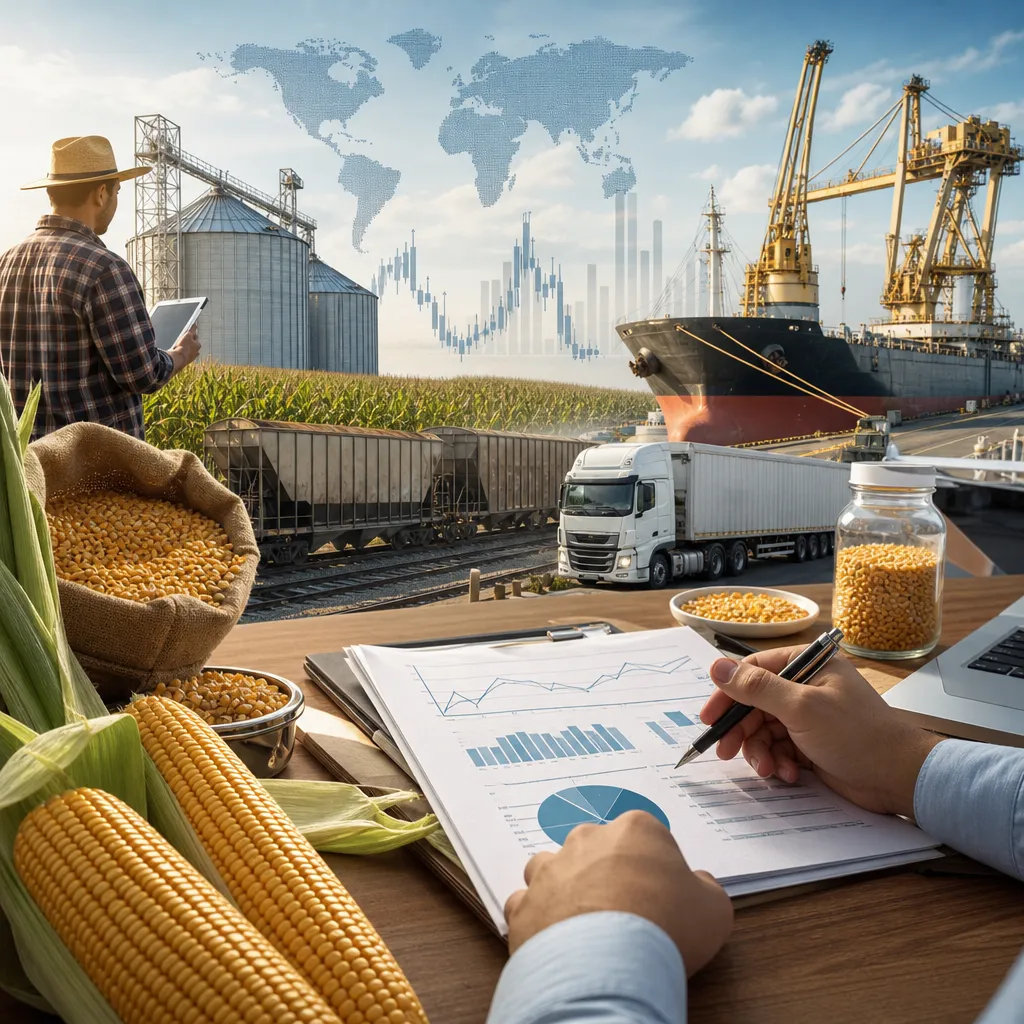
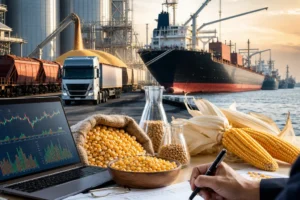
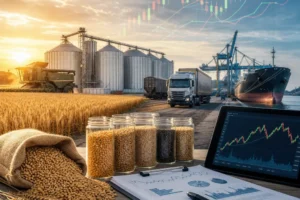
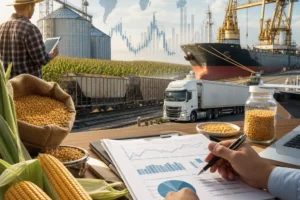
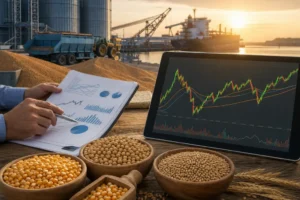

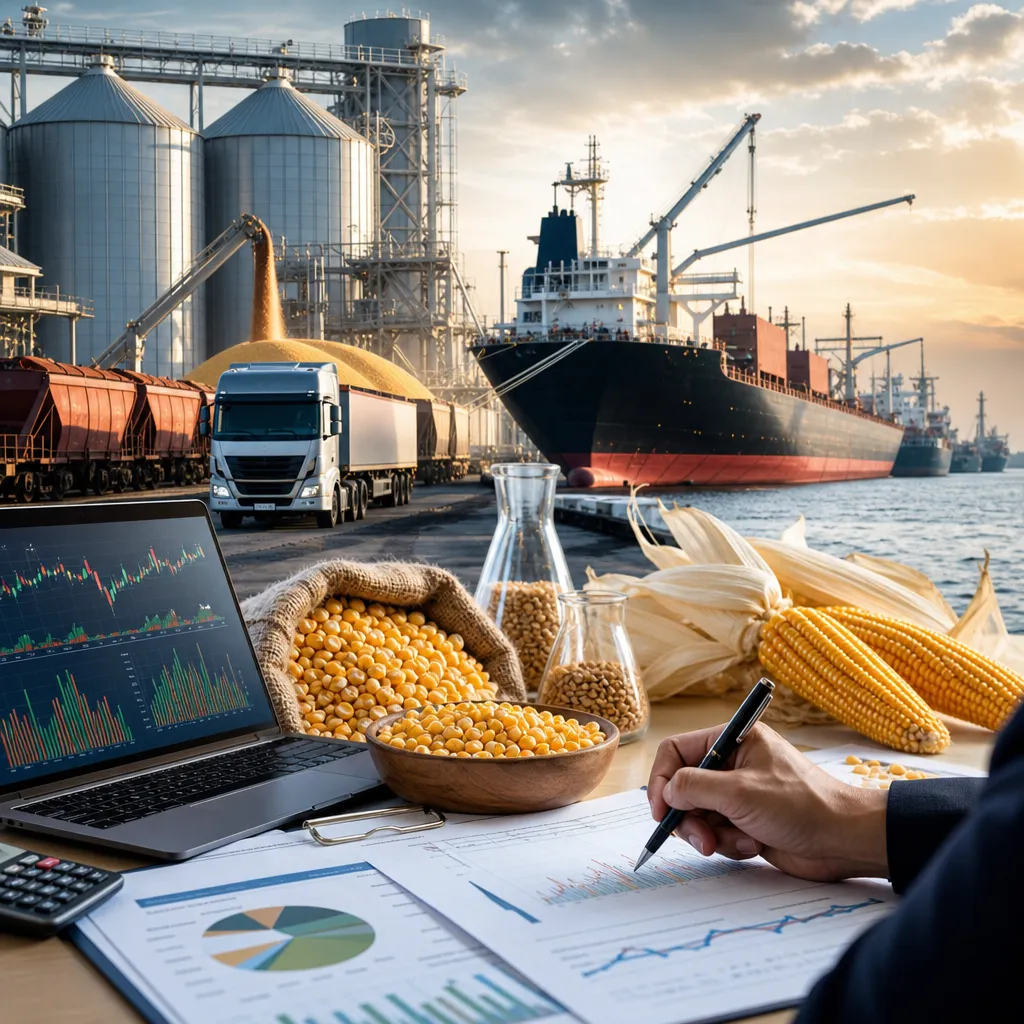
The EU corn export market is the network through which maize grown in European Union member states is sold from inland production areas to export terminals and then shipped to buyers outside the EU. In practice, this is not one single market located in one place: it functions across producing countries such as Romania, France, Hungary, Bulgaria, and others, and through ports connected to the Black Sea, the Danube corridor, the Atlantic, and the Mediterranean. Prices are usually discussed in euros per metric tonne, but export trade may also be negotiated in U.S. dollars per metric tonne depending on destination and merchant practice. For anyone following this market, the key point is that export prices are shaped by a combination of Euronext corn futures, local cash basis, grain quality, freight, currency, and competition from major global exporters.
Corn in this context means maize, used mainly for feed, starch, ethanol, and food processing. The EU is both a producer and a trader of corn, but its role changes by season because some years the bloc exports meaningful volumes while in other years it relies more heavily on imports. That is why the phrase EU corn export market usually refers less to a fixed export machine and more to the tradable surplus available after domestic feed and industrial demand are met.
What the EU corn export market includes
The EU corn export market covers the physical sale of maize from EU origin to non-EU destinations. It includes farmers, cooperatives, inland elevators, merchants, exporters, port terminals, shipping companies, feed buyers, and importers. Grain may be sold ex-farm, delivered to a silo, moved by truck or rail to a river or seaport terminal, and ultimately priced on an export basis such as FOB.
Within the EU, the market is fragmented by geography and logistics. Romania and Bulgaria matter because of Black Sea access. France matters because of its broad grain infrastructure and links to western European and export channels. Danube logistics can also be relevant for moving grain from inland areas toward export corridors. The market therefore operates through a set of regional physical hubs rather than through a single central cash exchange.
| Market element | What it means | Typical users |
|---|---|---|
| Farm or inland cash market | Physical maize bought from growers or collectors in producing regions | Farmers, cooperatives, local merchants, feed mills |
| Delivered inland market | Price for grain delivered to a silo, feed mill, or processor | Processors, compound feed makers, merchants |
| Export terminal market | Price for grain assembled at port or river terminal for shipment | Exporters, terminal operators, traders |
| FOB export market | Price of grain loaded on board vessel at export port | Exporters, importers, trade houses |
| Futures market | Financial benchmark used for hedging price risk, not the same as local physical price | Merchants, processors, funds, brokers, hedgers |
Where the market operates inside the EU
The geography matters because export competitiveness depends on where the corn is grown and how efficiently it can reach port. Romania is often central to EU corn export discussions because it combines meaningful maize production with Black Sea export access. Bulgaria also participates through Black Sea channels. France plays a major role in EU grain markets generally, although its corn trade position depends on crop size, domestic demand, and destination demand.
Other member states may contribute to exportable surplus or cross-border flows, but not all are naturally export-oriented every year. Inland producers far from port may be structurally less competitive in export markets if freight costs are high. As a result, the same EU-wide futures benchmark can produce very different local cash markets depending on distance to terminal and buyer demand.
The main pricing currency inside the EU is usually the euro. However, global grain trade often references U.S. dollar values, especially when EU sellers compete with exporters from the Black Sea, the Americas, or other world origins. That makes currency movements important: even if the euro-denominated inland market is stable, export competitiveness can change when the euro strengthens or weakens against the dollar.
How EU corn export prices are formed
EU corn export prices are built in layers. The starting point is often a benchmark futures market, most commonly Euronext corn for European price discovery, while world values are also influenced by broader international benchmarks such as U.S. corn futures. But no exporter simply takes a futures quote and calls that the export price.
The actual export price reflects:
- Benchmark futures: a reference price for broader market direction.
- Basis: the premium or discount of the local physical market relative to the benchmark.
- Quality: moisture, test weight, impurities, damage, and contract specifications.
- Location: distance from farm to elevator, river point, or seaport.
- Freight and handling: trucking, rail, barge where available, storage, terminal costs.
- Currency: euro-dollar movements affect export parity.
- Local supply and demand: feed demand, harvest pressure, storage availability, seller willingness.
- Buyer competition: whether exporters, feed mills, or processors are the strongest bidders.
If an exporter buys corn inland, he must calculate whether that grain can be moved, elevated, loaded, and sold competitively into the destination market. That means an inland cash bid is usually lower than a port FOB value because the exporter still has to cover logistics, shrink, finance, and risk.
| Price type | Where it is used | What it does not mean |
|---|---|---|
| Futures price | Exchange-based benchmark for hedging and price discovery | Not the exact farm-gate or port cash price |
| Local cash bid | Price offered by elevator, merchant, or processor in producing area | Not necessarily export-equivalent |
| Delivered price | Price including delivery to a specified inland destination | Not the same as FOB vessel value |
| FOB price | Export price loaded at port | Does not include ocean freight to buyer |
| CIF price | Import-side price including cost, insurance, and freight to destination | Not the seller’s inland procurement value |
The role of Euronext and international benchmarks
For Europe, Euronext is the most relevant exchange benchmark when discussing corn futures risk management. Traders, merchants, processors, and analysts use it to track market direction and hedge exposure. The exchange market is financial in nature: it provides a standardized contract and a transparent price reference, but most physical grain still moves through negotiated commercial contracts in the cash market.
Euronext corn futures are especially useful for understanding price direction in the EU context. However, export competitiveness also depends on the global market. EU exporters compete with origins influenced by U.S. corn values, Black Sea pricing, freight economics, and destination buying interest. So even if Euronext futures rise, an EU exporter may not be able to pass the entire increase into the FOB market if rival exporters are cheaper.
This is an important distinction for readers: futures can be watched online in real time or near real time through exchange data vendors and brokers, but a farmer or merchant selling physical corn still faces basis risk. A hedge can offset part of the futures risk, yet the local cash relationship to the hedge may change.
How corn is physically bought, sold, and exported
In the physical market, EU corn is usually bought through private contracts rather than through an exchange delivery system. A farmer may sell to a cooperative, local collector, merchant, feed mill, starch plant, or exporter. The contract can be spot, forward, or storage-based. It will normally specify quantity, quality, delivery point, delivery period, and payment terms.
Exporters then assemble grain into larger commercial parcels. This can involve multiple inland purchases, storage, blending within contractual limits, and transport to a terminal. At port, grain is loaded into a vessel under an export sales contract, often on FOB terms. The overseas buyer may be a feed manufacturer, importer, distributor, or state buyer depending on destination.
Key commercial issues include:
- Quality testing and tolerance levels
- Moisture and drying costs
- Contaminant and phytosanitary compliance
- Loading window and shipping schedule
- Counterparty credit risk
- Storage costs and financing costs
For smaller participants, the practical route is usually to sell physically to a local buyer and let that buyer manage export logistics. Direct export participation normally requires scale, contracts, logistics access, and trade finance.
How hedging and futures access work
Hedging is different from selling grain physically. A merchant, processor, or large producer may use futures or options through a broker to manage price risk. That requires a brokerage account, margin funding, and understanding of contract expiry, liquidity, and basis exposure. The futures position gives financial price exposure; it does not automatically move or sell physical corn.
A simple export hedge example is this: an exporter buys physical corn inland for shipment later and sells futures to reduce the risk of falling prices before the export sale is completed or loaded. When the physical grain is sold, the hedge may be lifted. The final result depends not only on futures movement but also on how basis changed between the inland purchase and the export sale.
Speculators may trade the same futures market without owning any grain at all. That is normal in derivatives markets. Their activity can add liquidity, but it should not be confused with the physical export business.
Where to check EU corn prices and market information online
If you need a current or recent view of the EU corn export market, the safest approach is to combine exchange data with official market reporting and direct physical quotes from commercial buyers. No single screen shows the full market.
Useful places to check include:
- Euronext for corn futures benchmarks and contract information.
- European Commission for agricultural market information, trade context, and policy-related updates.
- Eurostat for trade and production statistics useful for longer-term market analysis.
- USDA, especially global grain balance sheets and trade outlook, for world context that affects EU export competitiveness.
- Local cooperatives, merchants, and processors for real cash bids in producing areas.
- Specialized brokers and market reporting services for port indications, FOB discussions, and regional trade sentiment.
Readers should be careful about what each source is actually showing. An exchange quote is not a farm bid. A local buyer bid may include delivery terms and quality assumptions. An export indication may be for FOB port loading in a specific month. These are related prices, but they are not interchangeable.
Main drivers of the market and practical outlook scenarios
The EU corn export market is highly sensitive to crop size and trade competitiveness. Because the EU has substantial feed demand, exports expand mainly when production is strong enough and export parity works. In tighter years, the internal market may absorb more corn and reduce exportable surplus.
The main drivers to watch are:
- Weather and yield: drought or heat can sharply change the EU balance sheet.
- Harvest timing: seasonal pressure often weighs on cash markets when supplies first arrive.
- Feed demand: livestock margins and feed substitution matter.
- Import competition: if imported corn is attractive, domestic pricing adjusts.
- Competing exporters: Black Sea, U.S., and South American offers affect destination choices.
- Currency moves: the euro can either improve or weaken export competitiveness.
- Freight and logistics: inland transport bottlenecks or port congestion can widen basis.
- Policy and sanitary rules: trade policy and quality compliance can shift trade flows.
In a bearish scenario, a large EU crop combined with weak internal demand and heavy competition from other exporters could pressure inland and port values unless currency or freight offset the effect. In a firmer scenario, weather-reduced supplies elsewhere, stronger feed demand, or a weaker euro could improve EU export opportunities. These are scenarios, not predictions.
Practical points for farmers, traders, and importers
For EU farmers, the export market matters even if they never deal directly with a vessel. Export parity often sets the ceiling or floor for inland bids once domestic buyers and exporters compete for the same grain. Monitoring nearby futures, local basis, and delivery terms is more useful than watching a headline world price alone.
For physical traders, margin comes from procurement discipline, quality control, logistics execution, and risk management. A strong FOB sale can still lose money if inland basis moves against the trader or loading logistics fail. Good market practice means separating flat price risk, basis risk, freight risk, and credit risk.
For importers, EU corn may be attractive when quality, freight, and timing suit destination needs. However, availability can be variable because the EU is not purely export-oriented every season. Buyers therefore often compare EU offers against other world origins rather than assuming constant supply.
What is the main benchmark for the EU corn market?
Euronext corn futures are the main European benchmark for price discovery and hedging, but actual physical export prices depend on local basis, quality, and logistics.
Where can I check current EU corn prices?
Check Euronext for futures, then compare that with bids from local merchants, cooperatives, processors, and market reporting services for inland, delivered, or port values. Official trade and market context can be followed through the European Commission, Eurostat, and USDA.
Is the futures price the same as the export price?
No. Futures are a benchmark. Export prices are usually quoted on a physical basis such as FOB and include the local market premium or discount, quality, timing, and freight considerations.
In what currency and unit is EU corn usually priced?
Inside the EU, corn is commonly discussed in euros per metric tonne. In international export negotiations, U.S. dollars per metric tonne may also be used.
How do farmers usually sell corn into the export chain?
Most farmers sell physically to a local buyer such as a cooperative, merchant, or processor. That buyer may then move the grain through storage and logistics into the export market.
Can an individual trader export corn directly from the EU?
Direct export is possible only with sufficient scale, access to grain origination, quality control, logistics, trade finance, and export documentation. Most smaller participants trade through established merchants.
How is basis important in the EU corn export market?
Basis is the difference between the futures benchmark and the local cash price. It reflects location, transport, buyer demand, storage conditions, and market tightness, and it can change independently of futures.
What usually moves the EU corn export market the most?
The biggest drivers are weather and yields in EU producing countries, feed demand, global export competition, currency moves, and freight or logistics disruptions.
Sources
- Euronext
- European Commission
- USDA Foreign Agricultural Service