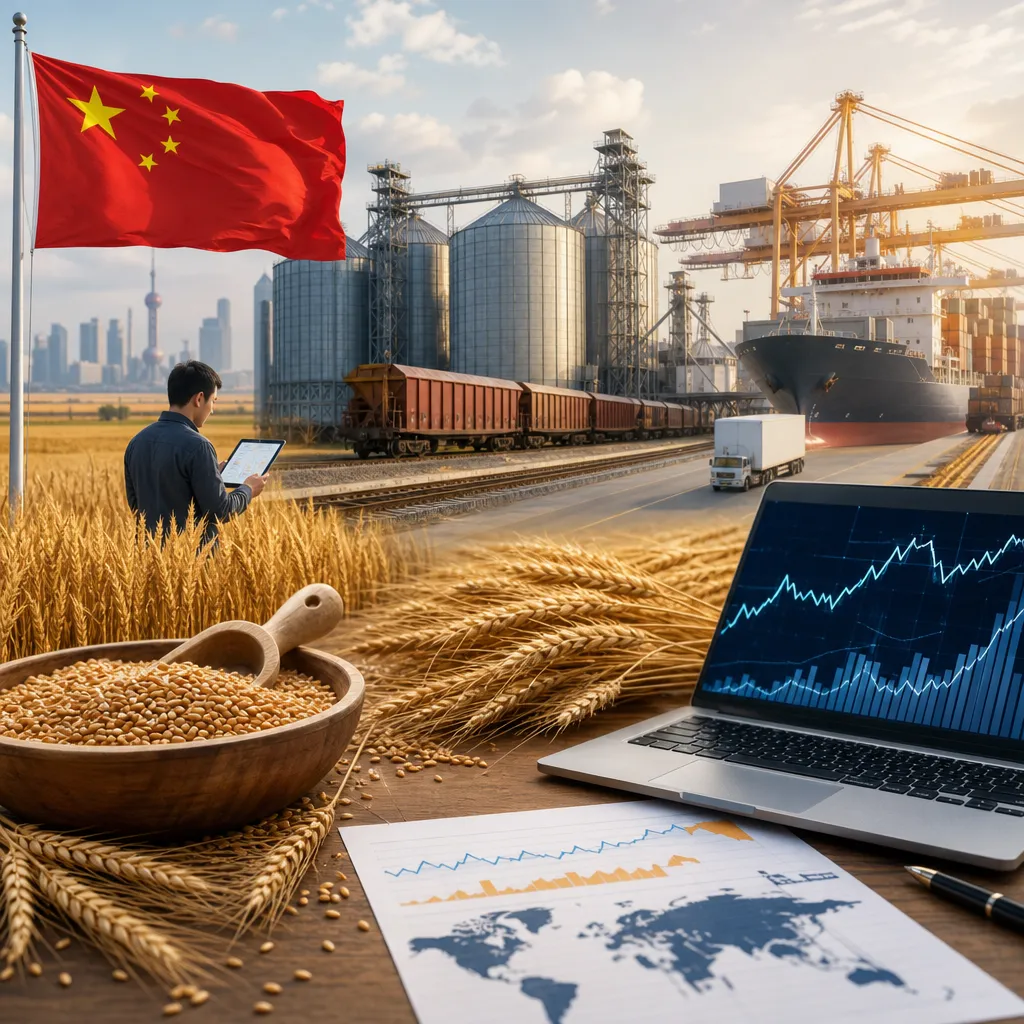








China’s wheat market is the domestic market for wheat grown, milled, consumed, stored, imported, and occasionally exported within the People’s Republic of China. It is one of the world’s most important wheat markets because China is a major producer and also a major consumer, with wheat central to flour, noodles, steamed breads, industrial processing, and part of the feed ration when economics allow. In practice, the market is driven less by a single “China wheat price” than by a network of provincial cash markets, flour mill demand, state reserves policy, import management, and futures pricing on China’s domestic commodity exchanges. For anyone trying to understand the outlook, it is essential to separate exchange prices from real physical grain values and to know where market information can actually be checked.
Geographically, the core wheat belt is in northern and central China, especially provinces such as Henan, Shandong, Hebei, Anhui, Jiangsu, and parts of Hubei. Wheat prices are usually discussed domestically in renminbi, also called yuan, per metric ton. Internationally, market participants often compare China’s domestic values with benchmark wheat futures in Chicago or Kansas City, but China’s physical wheat market is also shaped by domestic policy, quality requirements, freight inside China, and import parity costs at Chinese ports.
What the China wheat market includes
The China wheat market is not only a futures market and not only a farm-gate market. It includes several layers of activity:
- Farm production in China’s winter wheat belt, where harvesting usually occurs in late spring to early summer depending on region.
- Provincial cash trade between farmers, local traders, storage companies, cooperatives, and processors.
- Flour milling demand for food-use wheat, often with strict quality preferences.
- Feed substitution demand when wheat becomes competitive with corn in feed rations.
- State reserve activity, including procurement, auctions, or stock management involving government policy.
- Imports through coastal channels when domestic supply, quality, or price relationships make imported wheat attractive.
- Futures and derivatives used mainly for domestic price discovery and risk management.
Because of this structure, the market outlook depends on much more than harvest size. It also depends on reserve releases, mill buying behavior, feed economics, internal freight, and policy choices affecting imports and stocks.
Where the market operates inside China
China’s wheat market operates across inland producing provinces, major consuming regions, and port-based import channels. The main physical market starts in the wheat belt of north and central China, where grain moves from farms into local collection points, traders, warehouses, and processors. Flour mills are key buyers, and their quality requirements can create strong price differences between standard wheat and higher-protein or better test-weight wheat.
On the logistics side, wheat moves by truck, rail, and in some cases waterborne routes to consuming centers. Coastal areas and major ports matter when imported wheat enters China, especially if imported supplies are aimed at specific quality segments or are used to supplement domestic availability.
The financial side of the market operates primarily through Chinese commodity exchanges. For wheat market monitoring, the Zhengzhou Commodity Exchange is the most relevant domestic exchange reference because it is a major agricultural futures venue in China. However, not every physical wheat transaction in China is directly priced from a futures quote, and many cash deals still reflect local negotiation and buyer-specific quality terms.
| Market layer | Where it operates | Why it matters |
|---|---|---|
| Farm and local collection market | Major wheat-producing provinces such as Henan, Shandong, Hebei, Anhui, Jiangsu | Sets the first physical price farmers receive, adjusted for quality and local demand |
| Processor and milling market | Flour milling centers and feed demand regions across China | Creates premiums and discounts based on protein, moisture, and end-use quality |
| Reserve and policy market | National and provincial stockholding system | Can tighten or loosen spot availability through procurement or auctions |
| Import market | Chinese ports and coastal consuming regions | Links domestic prices to world wheat values and import policy |
| Futures market | Domestic exchange trading, especially Zhengzhou Commodity Exchange | Provides a benchmark for price discovery and hedging, but is not the same as farm cash price |
How wheat prices are formed in China
China wheat prices are formed through a combination of domestic supply and demand, policy guidance, quality differences, regional freight, and international replacement cost. A farmer or local trader in Henan is not simply paid “the wheat futures price.” Instead, the actual physical value usually reflects:
- Local harvest pressure or local shortage
- Protein, moisture, test weight, falling number, and other quality traits
- Distance to mills, warehouses, feed users, or ports
- Competition among buyers in the area
- Government reserve buying or auction releases
- Availability and cost of imported wheat alternatives
- Substitution versus corn in feed demand
- Domestic currency conditions and internal financing costs
In market language, several price concepts need to be kept separate. A futures price is the exchange-traded price of a standardized contract. A cash price is the physical price paid for actual wheat in a local market. A delivered price includes transport to the buyer’s location, such as a flour mill. An import price may be discussed on a CIF basis, meaning cost, insurance, and freight into China, while an exporter’s offer elsewhere may be on an FOB basis, meaning free on board at the export port.
The difference between a local cash price and a benchmark futures price is often called the basis. In China, basis can move because of quality, provincial supply conditions, reserve policy, freight, and buyer urgency. That is why a futures chart alone does not tell a producer or importer their exact executable physical wheat price.
Where to check wheat prices and market information
If readers want the current China wheat market, the safest approach is to check several layers of information rather than relying on a single quote. Reliable current prices change constantly, and local physical values may differ sharply from exchange pricing.
Useful places to check include:
- Zhengzhou Commodity Exchange for Chinese domestic agricultural futures market references and contract information.
- National Bureau of Statistics of China for official macro data relevant to production and broader agricultural conditions.
- Ministry of Agriculture and Rural Affairs of the People’s Republic of China for policy signals, agricultural updates, and sector information.
- USDA Foreign Agricultural Service for structured analysis of China’s wheat supply, demand, and import outlook from an international trade perspective.
- USDA Production, Supply and Distribution reports for comparable balance-sheet context, though these are analytical estimates rather than local cash bids.
- Domestic mills, grain merchants, and local procurement buyers for actual spot bids in producing provinces.
- Chinese financial data providers and brokerage platforms for exchange prices, charts, and domestic market commentary, subject to account access and language.
When checking prices online, readers should verify four things: the commodity grade, the location, the unit, and whether the quote is futures or physical cash. A quote in yuan per metric ton for an exchange contract is not automatically the same as delivered mill wheat in Shandong or farm-gate wheat in Henan.
| Source type | What it usually shows | Practical use |
|---|---|---|
| Exchange website | Futures prices, contract information, trading data | Tracking domestic benchmark sentiment and hedging reference |
| Government agriculture sources | Crop, policy, procurement, and sector updates | Understanding policy-driven price influence |
| USDA analytical reports | Supply, demand, stocks, and trade outlook | Comparing China with global wheat balance trends |
| Local mills and merchants | Spot bids, quality terms, delivery requirements | Actual executable physical market pricing |
| Broker and market terminals | Charts, order access, market commentary | Monitoring exchange activity and managing risk exposure |
China’s role in world wheat supply and trade
China is one of the world’s key wheat producers and consumers, but its role in global trade is different from that of major export origins such as Russia, the European Union, Australia, Canada, or the United States. China is better understood as a large domestic market with periodic import demand rather than a consistently export-led wheat market.
That distinction matters for outlook analysis. When world wheat prices move, China is affected through import parity and feed substitution economics, but domestic prices do not always move one-for-one with global benchmarks. Strong domestic stocks, reserve policy, and internal procurement can partially dampen international volatility. On the other hand, poor weather, quality losses, or stronger-than-expected demand can make imported wheat more relevant and tighten domestic supply conditions.
Imports can matter particularly for quality balancing, coastal consumption, or when world prices are attractive relative to internal Chinese values. The import side is also sensitive to trade policy, phytosanitary rules, and the broader agricultural trade relationship between China and major exporting countries.
Physical buying and selling: how wheat actually moves
Most physical wheat in China is bought and sold through real-world commercial channels, not by clicking on a futures screen. Farmers typically sell to local buyers, collection points, cooperatives, merchants, or directly to processors if scale and logistics allow. Buyers then aggregate, store, clean, transport, and resell wheat to flour mills, feed users, reserve systems, or other traders.
Physical wheat trade usually depends on:
- Quality specifications, such as moisture, protein, impurity limits, and other milling characteristics
- Delivery terms, including ex-farm, warehouse, or delivered-to-mill terms
- Payment terms, which matter for working capital and counterparty risk
- Storage availability, especially during harvest pressure
- Transport access, since inland freight can materially change the local net price
Imported wheat follows a different path. Importers and large users typically work through international grain merchants, approved supply chains, port discharge logistics, inspection, and inland distribution. Those transactions are linked to international wheat origins and shipping terms, but the final value inside China still depends on port costs, customs procedures, internal freight, and buyer demand.
Futures, hedging, and online trading
Futures and options are financial risk-management tools, not the same as owning grain in a warehouse. In China’s wheat market, exchange-traded products can be used by commercial firms and traders to manage price exposure, while speculators may participate for directional trading. Access normally takes place through a licensed broker or trading platform approved for the relevant Chinese exchange framework.
A wheat hedger might be a flour mill worried about rising prices or a grain holder worried about falling prices. The objective is to reduce price risk, not necessarily to take delivery through the exchange. A futures hedge can offset part of a move in the physical market, but it does not eliminate basis risk, meaning the local cash market may move differently from the futures contract.
This distinction is practical:
- Physical market: You negotiate actual wheat, actual quality, actual delivery, and actual payment.
- Futures market: You trade standardized contracts, post margin, face leverage, and manage expiry risk.
Someone watching wheat online may only be seeing the futures side. A producer or buyer still needs local bids from merchants or processors to know the real physical price.
Key drivers of the China wheat market outlook
The outlook for China wheat is best framed in scenarios rather than certainties. Several drivers matter repeatedly.
Weather and crop conditions
Winter wheat development depends on moisture, temperature, winter survival, and spring grain filling. Adverse rain at harvest can also hurt quality even if production volume remains reasonable.
State reserves and policy
Procurement support, reserve auctions, stock rotation, and broader grain security policy can strongly influence domestic availability and price tone.
Feed demand versus corn
When wheat is price-competitive against corn, feed use can increase. When it is not, demand returns more toward food milling channels.
Imports and global replacement cost
If world wheat values and ocean freight make imports attractive, imported grain can cap domestic price rallies in some regions, especially coastal markets. If imports become less attractive, inland domestic wheat gains pricing support.
Currency and internal logistics
Even without a dramatic change in world prices, exchange-rate moves and freight inside China can alter local competitiveness and delivered pricing.
Quality spread
A market can be well supplied in total volume but still tight in desirable milling quality. That can widen premiums for stronger-quality wheat.
In a bearish scenario, a solid harvest, manageable weather, active reserve releases, and weak feed demand could soften prices. In a supportive scenario, weather damage, stronger mill demand, tighter quality supply, or less competitive imports could keep domestic values firm.
Practical reading of the market
For growers, traders, mills, or outside observers, the most useful way to read China’s wheat market is to combine three views at once. First, watch domestic crop and policy developments. Second, compare Chinese values with global wheat benchmarks and import parity. Third, follow local execution prices from mills and merchants because those are what settle real business.
China’s wheat market outlook is therefore not a simple question of whether “world wheat is up or down.” It is a question of how domestic production, reserve management, food demand, feed substitution, import economics, and regional logistics interact inside one of the world’s largest grain systems.
FAQ
What currency and unit are used in the China wheat market?
Domestic wheat prices in China are usually discussed in renminbi, or yuan, per metric ton. International comparison may involve other currencies and benchmark futures, but the domestic physical market is generally thought of in yuan per ton.
What is the main benchmark for China wheat futures?
The Zhengzhou Commodity Exchange is the key domestic exchange reference for wheat-related futures pricing in China. However, local physical trades may not match futures exactly because of basis, quality, and freight.
Where can I check current China wheat prices online?
Check the Zhengzhou Commodity Exchange for futures references, official Chinese agricultural and statistical agencies for market context, USDA reports for international analytical balance sheets, and local mills or merchants for real executable cash bids.
Why is the local cash price different from the futures price?
Because cash wheat reflects local supply and demand, quality, storage, transport, buyer competition, policy effects, and delivery terms. Futures are standardized financial contracts, while cash grain is a specific physical lot in a specific place.
Is China mainly a wheat exporter or importer?
China is primarily a major domestic producer and consumer, with import demand that can become important in some years or quality segments. It is not typically treated as a consistently export-driven wheat market.
How is physical wheat bought and sold in China?
Usually through local traders, collection points, warehouses, cooperatives, processors, and mills. Sales depend on quality testing, delivery terms, payment conditions, and inland logistics rather than only on exchange quotes.
Can foreign investors trade the China wheat market directly?
Access depends on regulatory structure, broker arrangements, and the specific contract. In practice, many outside observers follow the market through public exchange data and global wheat benchmarks even when direct participation is limited or specialized.
What are the biggest price drivers for the next season?
The main drivers are crop weather, harvest quality, reserve policy, feed substitution with corn, import economics, freight, and the relationship between domestic prices and world wheat values.
Sources
- Zhengzhou Commodity Exchange
- Ministry of Agriculture and Rural Affairs of the People’s Republic of China
- USDA Foreign Agricultural Service