
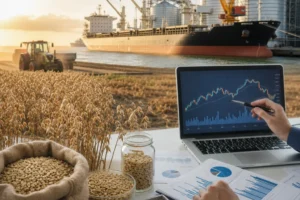


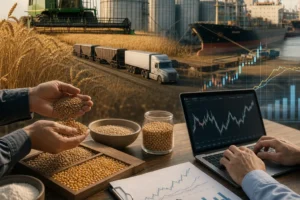
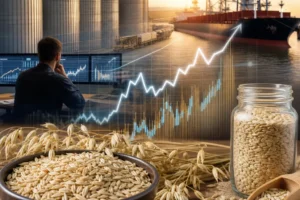
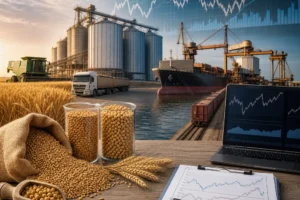
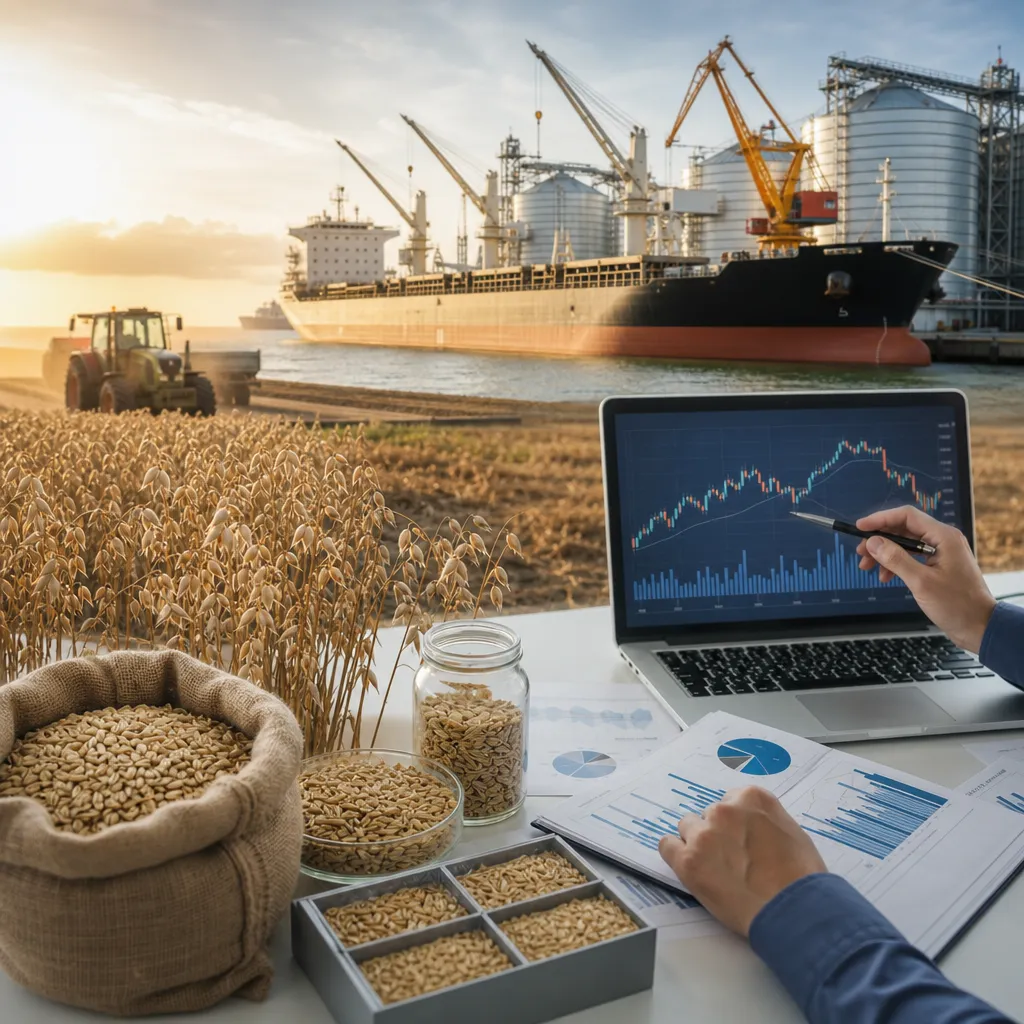
The US oat export market is the part of the grain trade where oats grown or assembled in the United States are sold to buyers in other countries. It is a physical commodity market tied to inland cash markets, rail and port logistics, export elevation, and global feed and food demand. Although oats are not one of the largest US export grains, the market matters for merchants, processors, livestock feed users, and international buyers because oat prices can react quickly to North American supply changes. Understanding this market requires separating exchange-traded price signals from the real export business of buying, loading, shipping, and managing quality risk.
In geography, this is a US market, but it operates across several locations rather than one single exchange floor or port. Oats are produced in northern US regions, often in states close to the Canadian border and Upper Midwest growing areas, while export movement depends on domestic rail links and available export channels. Prices are usually discussed in US dollars, with physical grain commonly quoted in US dollars per bushel or per metric ton depending on the stage of trade and the buyer.
For many readers, the most important point is that there is no single “US oat export price” that perfectly represents every transaction. Export values depend on origin, quality, freight, timing, loading point, and buyer requirements. A futures quote, when used as a benchmark, is not the same thing as a local farm cash bid or an FOB export offer.
What the US oat export market includes
The US oat export market covers the commercial chain from country origination to overseas shipment. That includes farmers, country elevators, cooperatives, grain merchants, rail carriers, export terminals, brokers, and foreign importers. Oats may be exported as raw grain for feed or processing, and market value can differ depending on test weight, moisture, cleanliness, and end use.
Compared with corn, soybeans, or wheat, oats are a smaller and more specialized US grain market. That matters because liquidity is lower, local premiums can be more pronounced, and regional supply-demand conditions can influence prices more sharply. In practice, export activity may be opportunistic in some periods rather than continuously deep in every month of the year.
The US also exists inside a broader North American oat balance sheet. Canada is a major player in oats, so US export pricing and domestic values can be influenced by Canadian production, cross-border trade flows, and competition for mill-quality or feed-quality supplies.
Where the market operates in the United States
US oats are associated mainly with northern production zones and nearby merchandising networks. The physical market starts in farm country, where oats are sold to local elevators, cooperatives, feed users, or processors. Grain may then move by truck to local storage, by rail to domestic users or export channels, or through merchant positions that combine physical ownership with freight planning and hedge management.
Export business is not only a farm-state issue. It also depends on where exporters can assemble sufficient volume and access vessel-loading infrastructure or cross-border routes. In some cases, the most important logistics decision is not whether oats can be sold internationally, but whether export demand can outbid domestic processors and other buyers after transport costs are considered.
Because oats are lighter and less globally standardized than some larger grains, a buyer’s location and required specification matter a great deal. A theoretically attractive overseas value may not translate into active US export movement if freight, handling costs, or competing origins make the deal unworkable.
How US oat export prices are formed
Price formation starts with the underlying value of oats in the domestic cash market, then adds or subtracts quality, location, and logistics factors. Exporters do not simply take a single national number and sell from it. They build a workable price from the cost of buying grain inland, moving it to the shipping point, storing and handling it, and loading it for an overseas customer.
Several price concepts are important:
| Price type | Where it appears | What it means |
|---|---|---|
| Local cash bid | Elevator, cooperative, processor, merchant | The price offered for physical oats at a local delivery point, often in US dollars per bushel. |
| Delivered price | Processor or export supply chain | The price after transport to a named destination such as a mill, rail point, or terminal. |
| Export bid or offer | Merchant or exporter negotiation | The buying or selling value for oats intended for international shipment, often quality-specific. |
| FOB price | Port export market | Free on board: the value of grain loaded for export at the port, before ocean freight paid by the buyer. |
| CIF price | Import market | Cost, insurance, and freight included to the destination port; more relevant for import buyers than for US farm sellers. |
| Futures benchmark | Exchange market | A financial reference price used for risk management, not the exact export cash value. |
The difference between the futures benchmark and the local or export cash price is the basis. Basis reflects transport cost, local supply, buyer competition, storage conditions, quality, and timing. If export demand strengthens, basis can improve even if the benchmark futures market is unchanged. The opposite can also happen: futures may rise while nearby local cash bids stay weak because of freight problems or burdensome stocks.
Benchmarks, futures, and hedging
For US oats, exchange pricing matters mainly as a benchmark and hedging tool rather than as the full expression of the export market. In US grain trade practice, market participants often watch futures to judge broad price direction, but physical oats are bought and sold through negotiated cash contracts. Exporters and merchants may hedge flat-price risk while still carrying basis risk and quality risk.
CME Group is the main institutional reference point for US grain futures markets, including oats. Futures are standardized contracts, while export business is customized around shipment period, grade, loading point, and destination terms. A merchant might buy physical oats from country elevators, hedge the futures exposure through a broker, then later offset the hedge once the export sale is fixed or shipment is completed.
This matters because a futures contract does not equal physical ownership for an overseas buyer. A trader can gain or reduce price exposure online through a brokerage account without ever handling grain. By contrast, a company shipping oats abroad must manage origination, inspection, documentation, loading, and counterparty performance in the physical market.
How oats are actually bought, sold, and exported
The physical trade usually begins with farmers selling to a local elevator, cooperative, processor, or merchant. Contracts may be spot sales, forward contracts for later delivery, or arrangements tied to a benchmark with basis fixed separately. Quality terms are essential, especially for oats intended for food or premium processing use.
After origination, merchants aggregate volume and assess the best outlet. That could be a domestic mill, feed market, or export sale. Export trade generally requires enough uniform grain to fill rail movements or terminal positions, plus compliance with inspection and destination requirements. The exporter must also manage storage, timing, documentation, and marine or cross-border logistics.
The commercial chain can be summarized as follows:
| Stage | Typical participants | Main commercial issue |
|---|---|---|
| Origination | Farmers, elevators, cooperatives | Cash bid, grade, moisture, delivery terms, payment timing |
| Aggregation | Merchants, handlers, processors | Building exportable lots, storage, blending limits, quality consistency |
| Risk management | Merchants, brokers, hedgers | Using futures or options to manage flat price risk while basis remains variable |
| Export sale | Exporters, trading houses, overseas buyers | FOB or other terms, shipment window, quality, documents, payment security |
| Shipment | Terminal operators, inspectors, carriers | Loading, inspection, freight coordination, timing risk |
For importers, purchases are typically made through exporters or trading firms rather than directly from US farm gates. For farmers, export demand is often felt indirectly through stronger elevator bids or basis improvement, not through direct vessel-side sales.
Where to check US oat prices and market information online
If you need a current market view, it is important to check both benchmark and physical sources. There is no universally reliable single screen showing a true nationwide “live US oat export price.” Instead, readers usually combine futures references, USDA reporting, and direct cash indications from commercial buyers.
Useful places to check include:
- CME Group for oat futures market information, contract months, and benchmark price discovery.
- USDA Agricultural Marketing Service for cash grain market reports where available, including regional price information and market commentary relevant to physical grains.
- USDA Foreign Agricultural Service for export-related information, trade context, and overseas market developments.
- Local elevators, cooperatives, processors, and grain merchants for actual cash bids and delivery terms.
- Broker and trading platforms for futures access and hedging, if the user needs market exposure rather than physical grain.
When checking prices, confirm the following before making comparisons: whether the quote is cash or futures, whether it is quoted in US dollars per bushel or per metric ton, whether quality specifications are included, and whether the price is local pickup, delivered, or export-related. These details explain why two “oat prices” can differ substantially on the same day.
Main drivers of the US oat export market
US oat export values are influenced by both domestic and international variables. Since oats are a smaller market than corn or wheat, localized disruptions can have an outsized effect. Weather in the northern growing belt, crop quality, freight availability, and competition from other origins all matter.
Key drivers include:
- US planted area and yield, especially in northern states.
- Canadian oat production, because North American supply is interconnected.
- Domestic processor demand, which can compete directly with export channels.
- Feed demand, particularly if relative prices versus corn or other feed grains change.
- Rail and terminal logistics, which affect the cost of assembling exportable volume.
- Ocean freight and destination demand, which influence whether US origin is competitive.
- Currency moves, especially the US dollar versus currencies of importing countries and competing exporters.
- Quality outcomes, since oats for food use may command different interest than feed-grade material.
Forecasting this market should be done through scenarios rather than certainty. A smaller North American crop can tighten milling and export supplies, but the price effect depends on how much demand is rationed by higher values. Likewise, a large crop does not automatically produce large exports if domestic use absorbs the surplus or if international competition remains cheaper.
Practical guide for market participants
Physical grain sellers
Farmers and country holders normally sell physical oats to local buyers, not on an exchange. The practical steps are to compare cash bids, understand discounts and premiums by grade, verify delivery windows, and assess counterparty reliability. If export demand improves, the benefit usually appears through stronger local bids or basis, not through direct participation in vessel trading.
Exporters and merchants
Exporters work margin between inland origination and outbound sale. They need line-of-sight on quality, freight, execution risk, and buyer performance. They may be long physical grain while hedging futures exposure, but they still face basis changes, logistics disruption, and specification risk.
Futures and options users
Anyone using futures or options does so through a licensed broker or approved trading platform connected to the exchange market. This is financial exposure with margin requirements, leverage, and expiry risk. It is not the same as owning exportable oats in storage. Users should keep basis risk in mind: even a well-timed futures hedge may not perfectly offset local cash movement.
Outlook and market interpretation
The best way to read the US oat export market is as a niche but commercially meaningful segment of the broader North American grain system. It is less liquid and less globally transparent than some larger grains, but that also means quality premiums, local competition, and freight conditions can be unusually important. Market participants should focus on regional crop conditions, Canadian supply, domestic milling demand, and the relationship between inland bids and export replacement value.
For current decisions, the most useful practice is to combine three layers of information: benchmark futures, verified local cash bids, and trusted USDA-based trade reporting. That gives a much better picture than relying on a single quoted number. In oats especially, the difference between a screen price and a workable export transaction can be the difference between theory and actual business.
FAQ
Where is the US oat export market located?
It is a national market centered on US oat-producing regions and linked to rail, storage, and export infrastructure. The market does not operate from one single location; it connects inland cash markets with export channels.
What currency and units are usually used?
US prices are commonly discussed in US dollars. Cash grain inside the United States is often quoted in dollars per bushel, while export trade may also be discussed in dollars per metric ton depending on the buyer and shipping terms.
Is there a live US oat export price online?
Not as one universal number that fits every transaction. Readers normally check exchange benchmarks, USDA market information, and direct bids from elevators or merchants, then compare location, quality, and delivery terms.
What is the difference between oats futures and a cash export bid?
Futures are standardized exchange-traded contracts used for price discovery and hedging. A cash export bid is a negotiated physical price that includes basis, quality, loading point, freight, and shipment timing.
How do farmers participate in the export market?
Usually indirectly. Most farmers sell to local elevators, cooperatives, or processors. If export demand is strong, it can improve local cash bids or basis, but farmers typically do not sell directly onto ships.
Who uses oat futures?
Merchants, hedgers, processors, and some financial traders may use futures. Physical firms use them mainly to manage price risk, while speculators use them for financial exposure without handling grain.
What most often moves US oat export prices?
North American crop size and quality, Canadian supply, domestic processing demand, relative feed values, freight conditions, and the strength of international buying interest.
Where can importers check official US trade and market information?
USDA Foreign Agricultural Service and USDA Agricultural Marketing Service are practical starting points, alongside CME Group for benchmark futures information and direct discussion with commercial exporters for actual offers.
Sources
- USDA Agricultural Marketing Service
- USDA Foreign Agricultural Service
- CME Group