






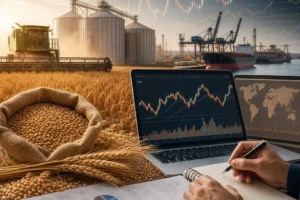



US corn price trends refer to the way corn prices move across the United States over time in both the futures market and the physical grain market. The US is one of the world’s largest corn producers, consumers, and exporters, so price changes in the Midwest often influence feed, ethanol, and export markets far beyond the country. In practice, there is no single “US corn price”: market participants watch Chicago futures, then adjust for local basis, quality, freight, and buyer demand to arrive at a cash price. Understanding US corn prices therefore means understanding both the national benchmark and the many regional markets where grain is actually bought and sold.
Most public discussion of US corn prices starts with futures traded in Chicago, but a farmer in Iowa, an ethanol plant in Nebraska, a feed mill in Georgia, and an exporter on the Gulf may all face different physical prices on the same day. Those differences are normal. They reflect logistics, storage, local supply and demand, export competitiveness, and commercial risk.
What “US corn price trends” means
In the United States, corn price trends usually describe movement in several related markets rather than one official fixed price. The most watched benchmark is the corn futures market connected to the Chicago Board of Trade, now part of CME Group. That benchmark helps the trade discuss direction: higher, lower, firm, weak, inverted, carry, harvest pressure, or weather premium.
But physical corn is traded in many forms. A local country elevator may post a nearby cash bid in US dollars per bushel. An ethanol plant may quote a delivered bid. An export merchant may think in terms of rail, barge, or FOB export economics. A feed buyer may compare nearby coverage with deferred needs. For that reason, reading US corn price trends correctly means separating the benchmark from the local transaction.
| Price type | Where it is quoted | What it means |
|---|---|---|
| Futures price | CME Group corn futures | A financial benchmark used for hedging and price discovery, not the exact farm-gate price. |
| Cash bid | Elevator, cooperative, ethanol plant, feed mill | The local buying price for physical grain, usually futures plus or minus basis. |
| Delivered price | Processor or end user | Price including transport to a specified destination. |
| Export bid | Export channels such as Gulf or Pacific Northwest trade | Commercial value tied to global demand, freight, terminal capacity, and competing origins. |
| FOB export price | Port export market | Value free on board at the export point, before ocean freight to the buyer. |
Where the US corn market operates
The US corn market is geographically broad, but its center of gravity is the Corn Belt, including states such as Iowa, Illinois, Nebraska, Minnesota, Indiana, and parts of surrounding states. These are major production areas and also important locations for storage, feed use, and ethanol demand. Corn also matters in livestock-heavy states and in export logistics corridors connected to the Mississippi River system, the Gulf Coast, the Pacific Northwest, and domestic rail networks.
Corn in the US is commonly priced in US dollars per bushel in farm and futures discussions. In export trade and international analysis, market participants may also use US dollars per metric ton. The main benchmark followed globally is US corn futures on CME Group. However, actual physical business often takes place through local elevators, cooperatives, merchants, processors, feed mills, ethanol plants, and export houses.
The US is not just a producing country. It is also a major consuming market. Domestic feed demand, ethanol production, industrial use, and export demand all compete for the crop. That matters because a large harvest does not automatically mean weak local prices everywhere; strong processor demand or tightening logistics can support some regions even when futures are under pressure.
How US corn prices are formed
US corn prices are usually formed by combining a futures reference with a local basis. The basic cash pricing formula is:
Cash price = Futures price + or – basis
Basis is the local market adjustment relative to futures. A stronger basis means the local buyer is bidding more aggressively compared with the futures benchmark. A weaker basis means the local buyer is paying less relative to futures. Basis can be influenced by harvest pressure, storage availability, local shortages, transportation costs, river conditions, rail service, processor competition, and export demand.
For example, when harvest begins, many farmers deliver grain at once, which can pressure local cash bids even if futures stay stable. Later in the marketing year, if farmer selling slows and an ethanol plant needs coverage, basis may strengthen. In export regions, basis can respond to barge freight, port demand, or the competitiveness of US corn against Brazil, Argentina, or other suppliers.
Quality also matters. Moisture, test weight, damage, and foreign material can affect the final paid price. A quoted cash bid is usually for a defined grade and delivery period. Discounts may apply if grain does not meet contract specifications.
Key price drivers in US corn
- Weather: planting pace, summer heat, rainfall, drought, and frost risk can shift yield expectations quickly.
- Acreage and yield expectations: more planted area or better yield outlooks can pressure prices; the opposite can support them.
- Stocks: old-crop inventory levels affect how sensitive the market is to weather or demand changes.
- Export demand: US competitiveness depends on world prices, freight, and rival export supplies.
- Ethanol demand: corn use for fuel is a major domestic component of demand.
- Feed demand: livestock and poultry sectors influence regional consumption.
- Currency: a stronger US dollar can reduce export competitiveness.
- Logistics: river levels, rail costs, storage constraints, and port capacity shape local values.
How to read trend direction in practice
When analysts talk about US corn price trends, they usually separate futures direction from basis behavior. Futures often react first to national and global information such as weather, USDA reports, macroeconomic conditions, and competing crop prices. Basis reacts more directly to local conditions and nearby commercial demand.
A useful practical distinction is this:
- If futures rise while basis is unchanged, local cash prices usually rise.
- If futures fall but basis strengthens, the local cash decline may be smaller than expected.
- If futures and basis both weaken, local cash prices can drop sharply.
- If futures are flat but basis improves, physical sellers may still see a better nearby bid.
Seasonality is also important. Corn prices often face harvest pressure when grain movement is heavy and storage is tight. Later in the season, basis can improve if farmers hold grain and commercial buyers need inventory. Weather markets often become more active during planting and pollination periods because yield risk is highest then.
| Market factor | Typical effect on trend | Why it matters |
|---|---|---|
| Large US crop outlook | Often bearish for futures | More supply reduces scarcity unless demand expands. |
| Tight old-crop stocks | Often supportive | Low inventory increases sensitivity to disruption. |
| Strong ethanol margins | Can support basis and cash demand | Processors may bid more aggressively for nearby supply. |
| Weak export competitiveness | Can pressure export channels | Global buyers may switch origin if US prices are too high. |
| River or rail disruption | Mixed, often weak interior basis and volatile export values | Freight bottlenecks interrupt normal movement from farm to port or processor. |
Where to check US corn prices online
For price-related topics, readers should check both benchmark futures and local physical bids. Public market commentary often focuses too heavily on futures alone, which can mislead producers or buyers trying to understand actual transaction values.
Reliable starting points include:
- CME Group: for the benchmark US corn futures market and contract information.
- USDA Agricultural Marketing Service: for cash grain and market reporting in many physical markets.
- USDA World Agricultural Supply and Demand Estimates and related USDA reports: for supply, demand, stocks, and export context.
- Local elevators and cooperatives: for posted cash bids in your delivery area.
- Ethanol plants, feed mills, and processors: for direct delivered or pickup bids where they buy corn.
- Brokers and market platforms: for futures access, delayed or live quotes depending on account type.
If you are checking a “current” or “live” US corn price, make sure you identify exactly what you are looking at: which futures month, which cash location, which delivery period, and which unit. A December futures contract is not the same thing as a nearby elevator cash bid. An export bid at the Gulf is not the same as a farm pickup price in Illinois.
How corn is actually bought and sold in the US physical market
Physical US corn is normally traded through commercial grain channels rather than through an exchange delivery process. Farmers commonly sell to country elevators, cooperatives, ethanol plants, feed mills, livestock operations, processors, or grain merchants. Larger merchants may accumulate grain, store it, and move it by truck, rail, or barge to domestic users or export terminals.
Common physical transaction methods include:
- Spot cash sale: grain is sold at the buyer’s current cash bid for nearby delivery.
- Forward cash contract: the seller locks a cash price for future delivery.
- Basis contract: basis is fixed now, while the futures component is set later.
- Hedge-to-arrive style arrangements: the futures component is fixed first, while basis is set later, subject to buyer terms.
- Delayed pricing or storage arrangements: grain movement and pricing are separated, though this can involve additional risk and terms.
Before selling physical grain, the seller should understand grade standards, moisture limits, delivery windows, scale procedures, discount schedules, and payment terms. Counterparty quality matters too. A higher posted bid is not automatically the best bid if logistics, deductions, or payment performance are uncertain.
Futures and options: hedging versus speculation
US corn futures and options are financial tools used to manage price risk or take a market view. They are not the same as owning truckloads of grain. Futures are commonly used by farmers, elevators, processors, exporters, feed users, and professional traders. Access normally comes through a futures broker or trading platform, with margin requirements and daily mark-to-market risk.
For a hedger, the goal is not necessarily to “beat the market” but to reduce uncertainty. A farmer may hedge futures while waiting to sell physical grain later. A feed buyer may buy futures or use options to manage rising price risk. An exporter may hedge purchases and sales made in the physical market.
Important practical points include:
- Leverage: futures involve margin and can create gains or losses larger than the initial deposit.
- Basis risk: even if futures are hedged, local cash basis can still change.
- Expiry and rollover: futures contracts are tied to delivery months and may need to be rolled.
- Options: these can provide risk protection with different cost and payoff structures than futures.
Many market participants monitor futures online every day but never make or take delivery through the exchange. Their real commercial activity still occurs through local grain channels.
Export market role in US corn prices
The export market is a major part of US corn price formation, especially in surplus-producing regions. Export values are influenced by Gulf and Pacific Northwest demand, inland transportation economics, and competition from other major exporters. Exporters buy grain inland, assemble and transport it to terminals, and price sales to overseas customers using terms such as FOB or, in import markets, CIF.
FOB means the value of corn loaded at the export point before ocean freight. CIF includes cost, insurance, and freight to the destination. Inland prices can rise when export demand is strong and logistics are efficient, but export demand does not benefit every region equally. Distance to market, rail access, river freight, and local processor competition all matter.
Because the US is deeply integrated into global grain trade, domestic corn trends are also influenced by Black Sea trade flows, South American crops, freight conditions, and world feed grain substitution. US corn prices are local and global at the same time.
Outlook scenarios for US corn price trends
Forecasting US corn prices is best done through scenarios rather than certainty. The market can shift quickly as weather, acreage expectations, and demand signals change.
- Bearish scenario: favorable weather, large acreage, strong yields, and adequate stocks can weigh on futures, especially if export demand is slow.
- Supportive scenario: weather stress during key development stages, lower yields, or stronger-than-expected ethanol and export demand can tighten the balance sheet and lift prices.
- Mixed scenario: futures may remain range-bound while basis diverges by region depending on processor needs, farmer selling pace, and transport conditions.
In practical terms, readers should watch USDA balance-sheet reports, crop progress, planting and pollination weather, export sales, ethanol indicators, and regional basis changes. A good price view combines all of them instead of relying on a single headline number.
FAQ
What is the main benchmark for US corn prices?
The main benchmark is corn futures traded through CME Group. It is the reference point for hedging and price discovery, but it is not the exact local cash price paid to a farmer.
Where can I check US corn cash prices?
Check local elevators, cooperatives, ethanol plants, feed mills, and USDA Agricultural Marketing Service reports. Cash prices are location-specific, so a national futures quote is not enough.
Why is my local corn bid different from the Chicago price?
Your local bid includes basis, which reflects freight, storage, local supply and demand, buyer competition, and quality factors. Futures and cash prices move together over time, but they are not identical.
Is US corn usually priced in bushels or metric tons?
Inside the US, corn is commonly discussed in US dollars per bushel. In export trade and international comparisons, US dollars per metric ton are also widely used.
How do farmers usually sell corn in the US?
Most farmers sell physical corn to elevators, cooperatives, processors, feed users, or merchants using spot sales, forward contracts, basis contracts, or other commercial agreements. The exchange is mainly used for hedging rather than routine physical delivery.
Can an investor trade US corn without handling physical grain?
Yes. Futures and options allow financial exposure to corn prices through a broker. That is separate from owning, storing, or transporting physical grain.
What matters more for US corn trends: exports or domestic demand?
Both matter. The US has major domestic feed and ethanol demand as well as a large export role. Price trends often depend on how supply interacts with both channels at the same time.
What reports are most important for following US corn trends?
USDA reports are essential, especially crop progress, acreage, stocks, export data, and supply-and-demand updates. CME futures pricing and regional cash market information are also important.
Sources
- USDA Agricultural Marketing Service
- USDA World Agricultural Supply and Demand Estimates
- CME Group