

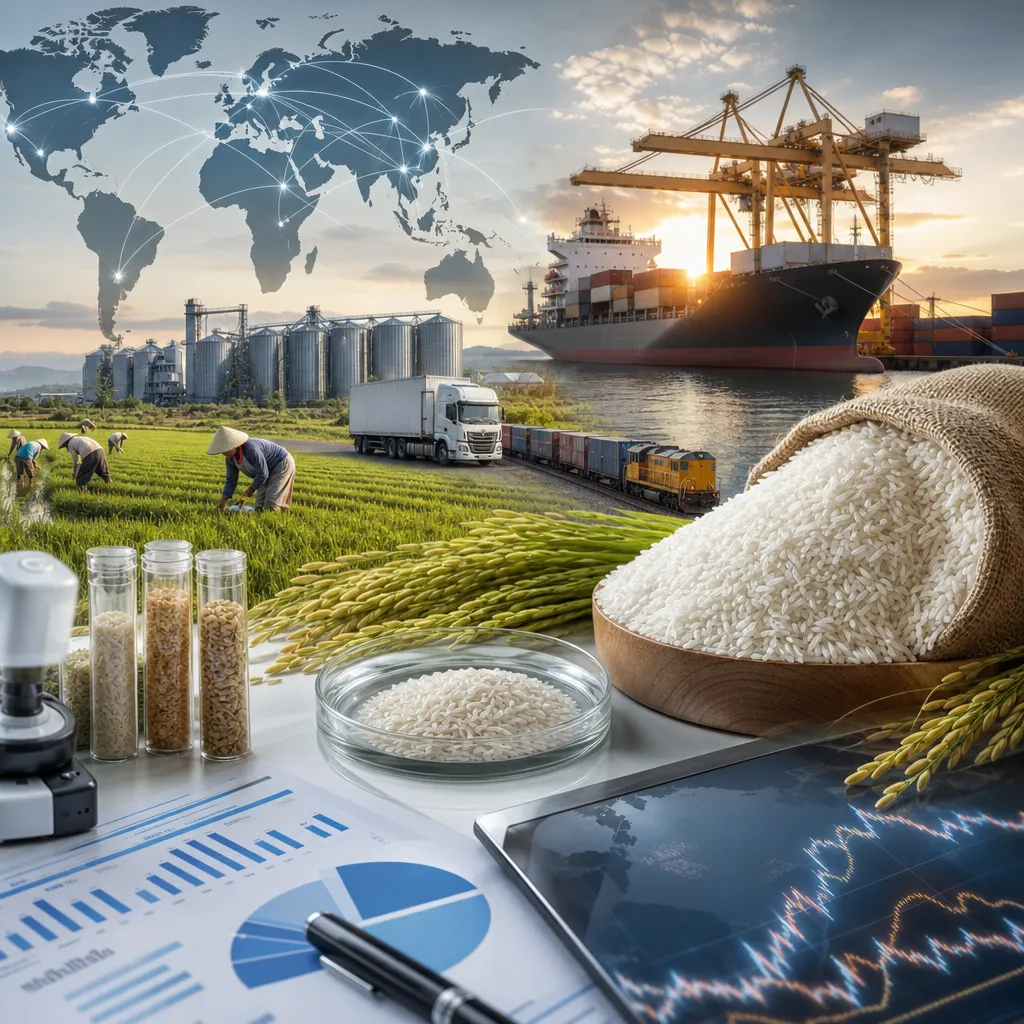
The largest rice exporters are usually a small group of Asian suppliers, led in most years by India, with Thailand, Vietnam, Pakistan, and the United States also playing major roles. Their importance comes not just from production volume, but from how much rice is available for export after domestic consumption, government policy, milling, logistics, and quality sorting. For buyers, traders, and analysts, the export market works through a mix of physical grain trade, government data, port logistics, and international price benchmarks rather than through a single global futures price. In practice, knowing the largest rice exporters matters because it helps explain world rice prices, shipment risk, quality differences, and where importers actually source cargoes.
Rice is traded both as a physical commodity and, in more limited form than wheat or corn, through exchange-linked financial tools in some markets. Most international rice business still happens as negotiated physical trade: exporters, millers, merchants, state buyers, and importers agree on quality, origin, shipment window, Incoterms, and payment terms. That means the largest exporters influence the market not only through crop size, but also through export rules, freight access, currency moves, and reliability of shipment.
Who the largest rice exporters are
The list changes somewhat by season, but the countries most often discussed in the global export market are:
- India — often the dominant exporter by volume, especially in non-basmati and basmati segments.
- Thailand — a major supplier of white rice, parboiled rice, and premium fragrant types.
- Vietnam — a leading exporter known for strong competitiveness in Asian and African destinations.
- Pakistan — important in both basmati and non-basmati export channels.
- United States — smaller in volume than top Asian exporters, but important in specific quality classes and destination markets.
- Myanmar, Cambodia, and sometimes China or Uruguay — meaningful exporters in some years or regional flows, though usually not at the very top of global trade.
These rankings should be checked in current official trade data rather than assumed. Export leadership can shift when a government imposes restrictions, when weather affects yields, or when freight and currency conditions change.
Why some countries export more rice than others
Being a large producer does not automatically make a country a large exporter. Rice is a staple food, so domestic consumption often absorbs most production. A country becomes a major exporter when it has exportable surplus, adequate milling capacity, reliable inland transport, port access, and a trading system that can handle quality segregation and shipment scheduling.
Several practical factors determine export strength:
| Factor | Why it matters | Practical effect on exports |
|---|---|---|
| Production surplus | Exports require supply beyond domestic food needs | Countries with large surpluses can supply tenders and long-term buyers |
| Government policy | Export bans, duties, quotas, and minimum prices can alter trade flows quickly | Importers may shift origin if a major supplier restricts exports |
| Milling and quality control | Rice is traded by grade, broken percentage, moisture, and type | Better quality control improves export competitiveness and claims management |
| Logistics and ports | Rice must move from farm to mill to warehouse to vessel | Bottlenecks can widen offers or delay shipment |
| Currency and finance | Export offers are often compared in U.S. dollars | A weaker local currency can improve export competitiveness |
How the global rice export market works in practice
Unlike highly standardized exchange-traded markets, much of rice trade is done through direct physical negotiation. A buyer may be a state procurement agency, private importer, wholesaler, food company, aid buyer, or distributor. The seller may be an exporter, merchant, miller, cooperative, or integrated trading house.
A typical export transaction often follows this flow:
- A buyer requests offers for a specific origin, quality, shipment month, and quantity.
- Exporters quote based on available stocks, milling yield, inland transport, ocean freight, and current demand.
- The parties negotiate quality terms such as broken percentage, grain length, moisture, crop year, packaging, fumigation, and inspection.
- The contract specifies delivery basis such as FOB or CIF, payment mechanism, vessel timing, and documentation.
- Rice is assembled physically through mills, warehouses, and transport networks before loading at port.
- Inspection and documents are completed, then payment is made according to the agreed term.
This is why export leadership is about much more than field production. Countries with experienced merchants, milling clusters, and established port logistics can dominate trade even when production changes moderately.
Where to check which countries are exporting the most
Readers looking for current rankings should use official and industry data sources rather than headlines alone. Different sources measure different things: some report shipments, some forecast exports for a marketing year, and some show customs records after the fact.
The most useful places to check are:
- USDA WASDE — widely used for global rice production, consumption, stocks, and export forecasts by country.
- USDA Foreign Agricultural Service — useful for country reports, export policy developments, and trade outlook.
- FAO — useful for global food market context and rice trade monitoring.
- National customs or agriculture ministries — useful for country-specific shipment data and export regulations.
- Official tender notices and state buying agencies — useful for tracking near-term demand and origin competition.
For physical traders and import buyers, shipment pace is often checked through exporter contacts, inspection companies, vessel lineups where available, and merchant intelligence. Public reports are important, but real cargo flow can move faster than monthly summaries.
| Source type | What it provides | Who uses it |
|---|---|---|
| USDA WASDE | Global supply, demand, stocks, and export estimates | Analysts, traders, importers, policy observers |
| USDA FAS country reports | Country-level crop, policy, and trade analysis | Exporters, importers, market researchers |
| FAO market information | International food market context and rice updates | Governments, NGOs, analysts, import-dependent users |
| National customs and ministries | Shipment data, export licenses, policy changes | Merchants, local trade participants, compliance teams |
| Commercial trade intelligence | Port activity, offers, bids, tender results | Active physical traders and large buyers |
Largest exporters by market role and rice type
“Largest rice exporters” is not just one market. Rice is segmented by type and quality. An importer buying premium fragrant rice is not shopping the same market as a feed buyer or a government tender for standard white rice. Export leadership therefore varies by segment.
- India is especially influential in global trade because it serves multiple segments, including basmati and non-basmati.
- Thailand remains important in higher-value and differentiated categories, including fragrant rice.
- Vietnam is highly competitive in mainstream export channels and regional destinations.
- Pakistan is a key supplier for basmati and some white rice markets.
- United States is often important where buyers require specific grades, food safety standards, or established origin preferences.
For practical buying and selling, this means the “largest exporter” may not be the cheapest or most suitable supplier for a specific contract. Buyers compare origin not only on price, but also on grain characteristics, milling quality, consistency, phytosanitary compliance, packaging, and shipping reliability.
How rice prices are discovered and where to find them
Rice does not have the same globally dominant futures benchmark structure as corn, soybeans, or wheat. Price discovery in rice relies more heavily on export offers, tender results, government reference data, and private market intelligence. That is important for anyone trying to understand the largest exporters: export share affects prices mainly through physical offers and policy changes, not through one universal screen price.
In practice, prices may be checked in several places:
- Export offer sheets from merchants and brokers for specific origins and grades.
- Tender awards by importing governments or agencies, which show which origin won business.
- USDA and FAO reports for broader market direction rather than live quotes.
- Domestic cash markets through mills, merchants, and local procurement channels in producing countries.
- Exchange data where available in regional markets, though these should not be treated as the same thing as export cash offers.
A reader should distinguish carefully between:
- Physical export price — negotiated for actual rice loading at a port or delivered to a buyer.
- Domestic cash price — paid locally to farmers or primary sellers, often before milling and freight.
- Futures or exchange-linked quote — if available, a financial market reference that may not match a specific export cargo.
A farmer or local merchant should never assume an international export reference is the same as the local bid. Milling losses, quality discounts, transport, storage, basis, and trader margin all matter.
Where buyers and sellers actually transact
Physical rice trade usually happens through established supply-chain participants rather than open retail marketplaces. The location depends on whether the transaction is domestic, cross-border regional, or ocean export.
In the physical market
- Farmers often sell paddy rice to local traders, mills, cooperatives, or procurement agencies.
- Millers convert paddy into milled rice and may sell to wholesalers, exporters, or food companies.
- Exporters and merchants assemble cargoes, manage quality, arrange freight, and contract with overseas buyers.
- Importers may be private distributors, food manufacturers, or state agencies buying by tender.
- Warehouses and port operators handle storage, bagging, fumigation, loading, and documentation.
In financial or risk-management markets
Rice hedging is less standardized globally than wheat or corn hedging. Where a rice futures or futures-related instrument exists, it is accessed through a regulated broker and trading account, not by buying physical bags of rice online. A futures contract is a financial tool with margin and expiry rules; it is not the same as securing exportable stock.
Large merchants may hedge related risks through currencies, freight exposure, or broader grain positions where appropriate. But basis risk can be significant because the exact export specification of rice may not match the financial instrument available.
Main risks when dealing with major rice-exporting origins
The biggest exporters can offer scale and liquidity, but they also bring concentrated risk. If one very large exporter changes policy, global prices and freight flows can move quickly.
- Policy risk — export bans, taxes, minimum export prices, or licensing rules can disrupt trade.
- Quality risk — broken percentage, moisture, foreign matter, or milling quality can differ from expectations.
- Freight and logistics risk — port congestion, inland transport bottlenecks, or container shortages can delay shipments.
- Counterparty risk — buyers and sellers need to assess contract reliability and payment security.
- Currency risk — offers may change quickly when exchange rates move.
- Weather risk — monsoon variation, drought, flooding, and storm damage can reduce supply or quality.
For anyone buying or selling physically, contract details matter: shipment period, inspection standard, tolerated quality variation, discharge terms, insurance, and payment method should all be checked carefully.
How to use exporter rankings in market analysis
Exporter rankings are useful, but only when combined with other fundamentals. A country can be the largest exporter and still lose market share temporarily if domestic prices rise or policy tightens. Analysts usually combine exporter data with crop conditions, stocks, import demand, and trade policy.
A practical workflow is:
- Check global export forecasts in USDA WASDE.
- Read USDA FAS or national reports for policy and crop context.
- Separate rice by type: basmati, white, parboiled, fragrant, or other classes.
- Track tender results and origin switching by importers.
- Compare physical offers with freight and currency conditions.
- Watch whether local farm prices, milling margins, and port values are aligned.
This approach is more useful than looking for one “rice price” or one permanent ranking.
Which country is usually the largest rice exporter?
In many recent years, India has been the largest rice exporter, but that should be verified in current trade data because policy changes and crop conditions can alter rankings.
Where can I check current rice export rankings?
The most reliable public sources are USDA WASDE for global trade estimates, USDA Foreign Agricultural Service for country analysis, and FAO for international market context. National customs and agriculture ministries can add shipment detail.
Are rice exports traded on futures exchanges like wheat or corn?
Most rice export trade is physical and negotiated directly between commercial participants. Some exchange-based tools may exist in certain markets, but they do not replace the need to negotiate origin, quality, shipment, and delivery terms.
Where do importers physically buy rice from major exporters?
Usually through exporters, millers, commodity merchants, or public tenders. Transactions are arranged by contract, often with port shipment terms such as FOB or delivered terms such as CIF.
Why is the largest exporter not always the cheapest supplier?
Because rice is segmented by quality and type. Freight, currency, policy, milling quality, shipment timing, and buyer specifications can make another origin more competitive for a particular deal.
How do local rice prices relate to export prices?
They are connected, but not identical. Local cash prices reflect farmgate conditions, milling yield, storage, freight, and domestic demand, while export prices reflect loaded or delivered cargo value in international trade.
What are the biggest risks in buying rice from large exporting countries?
The main risks are policy changes, shipment delays, quality claims, payment disputes, and freight disruption. Buyers normally manage these through clear contracts, inspection, and careful counterparty checks.
Sources
- USDA World Agricultural Supply and Demand Estimates
- USDA Foreign Agricultural Service
- Food and Agriculture Organization of the United Nations