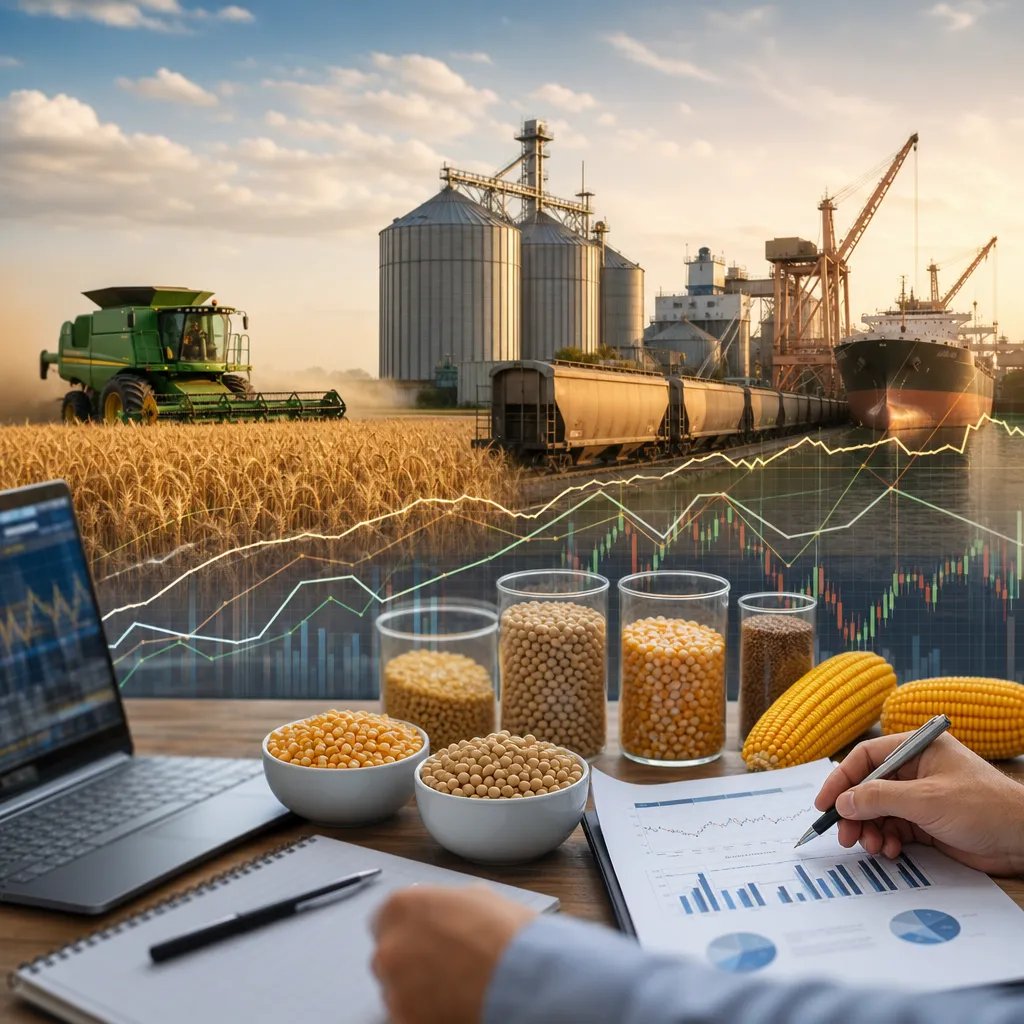




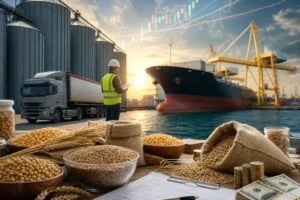
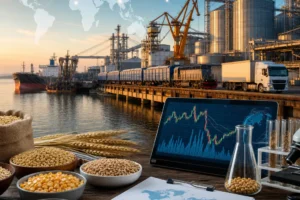

The United States grain market is not one single market but a network of regional cash markets tied to nationwide logistics and global futures benchmarks. Corn, soybeans, wheat, sorghum, barley, oats, rice, and by-products are bought and sold every day through country elevators, cooperatives, processors, feed mills, river terminals, rail loaders, exporters, and futures exchanges. The center of price discovery for many US grains is the futures market, especially contracts traded through CME Group, while the actual physical trade happens in hundreds of local markets across producing and consuming states. For anyone trying to understand US grain trading, the key is to separate benchmark futures from local cash prices, and financial hedging from real delivery of grain.
Geographically, the market spans the Corn Belt, Northern Plains, Southern Plains, Delta, Pacific Northwest, and export corridors linked to the Gulf of Mexico, the Mississippi River system, the Great Lakes, and Atlantic or Pacific outlets. Prices are usually discussed in US dollars, with futures commonly quoted in cents per bushel and export trade often discussed in dollars per metric ton. Local physical transactions can be quoted per bushel, per hundredweight for some crops, or per short ton or metric ton depending on commodity and buyer.
What the US grain market includes
The US is one of the world’s most important grain and oilseed producers, consumers, and exporters. Corn and soybeans dominate acreage and trade value, while wheat remains highly important across several classes and regions. In practice, “grain trading” in the US usually covers both physical grain merchandising and the use of futures and options for pricing and risk management.
The market operates across several layers:
- Farm and local cash market: farmers sell to elevators, cooperatives, feed mills, ethanol plants, crushers, millers, or merchants.
- Interior logistics market: grain moves by truck, rail, or barge to processors, storage points, or export terminals.
- Export market: trading houses and exporters price grain for shipment from major ports or river terminals.
- Futures and options market: commercial firms, farmers, funds, and traders use exchange-traded contracts for hedging and speculation.
The local market a grower sees in Iowa, Kansas, Illinois, North Dakota, Arkansas, or Washington may be very different even when the benchmark futures contract is the same. That is because freight, nearby supply, processing demand, quality, and export access vary sharply by region.
Where the market operates in practice
US grain trading is strongly regional. Corn and soybeans are concentrated in the Midwest and parts of the Plains, while wheat is split across several classes with different production zones, such as hard red winter in the Southern Plains, hard red spring in the Northern Plains, soft red winter in the eastern Midwest and Delta, and soft white or durum in specific western and northern regions. Rice is more concentrated in the Delta, Gulf region, and parts of California.
Major logistics routes matter because grain values are shaped by where it can move efficiently. Interior grain often flows:
- By truck from farm to nearby elevator or processor.
- By rail from Plains and northern states to domestic users or export corridors.
- By barge down the inland river system to export positions tied to the Gulf.
- By vessel from export terminals to international buyers.
The Gulf of Mexico is central for corn, soybean, and some wheat exports. The Pacific Northwest is especially important for some wheat and feed grain flows to Asia. Domestic demand centers such as feed mills, flour mills, ethanol plants, soybean crushers, and livestock regions can also create strong local bids far from export ports.
| Market segment | Where it operates | Main users | Typical purpose |
|---|---|---|---|
| Country cash market | Local elevators, cooperatives, processors, feed mills | Farmers, merchants, end users | Nearby physical buying and selling |
| Terminal and export market | River terminals, rail hubs, Gulf and Pacific export points | Exporters, grain companies, freight participants | Assembling grain for domestic shipment or export |
| Futures and options market | Exchange-traded through CME Group platforms via brokers | Hedgers, traders, funds, commercial firms | Price discovery and risk management |
How US grain prices are formed
US grain pricing begins with benchmark futures, but no local buyer simply pays the screen price. What a producer receives, or what a domestic user must pay, is usually a cash price built from futures plus or minus basis.
Basis is the difference between the local cash price and the relevant futures contract. A strong basis usually means local demand is good or supply is tight relative to logistics capacity. A weak basis often reflects burdensome supplies, expensive freight, quality issues, or limited buyer competition.
Several price layers are common:
- Futures price: the exchange-traded benchmark for a specified contract month.
- Cash bid: what a local elevator, plant, or merchant offers for physical grain at a named location.
- Delivered price: the price paid including transport to a processor, mill, feedlot, or terminal.
- FOB price: export value at the point of loading, often used for vessel trade.
- CIF price: landed or destination-oriented import pricing including freight and insurance under the trade term used.
Price formation reflects more than just the board. Local values can change because of harvest pressure, storage availability, protein or test weight, moisture, damage, river conditions, rail freight, export demand, livestock feeding margins, crush margins, or ethanol economics. The US dollar also matters because grain priced internationally in dollars becomes more or less competitive for foreign buyers as currency conditions change.
| Price type | Where quoted | What it means |
|---|---|---|
| Futures | Exchange screens and broker platforms | Benchmark market price for a contract month, not a farm-gate payment |
| Local cash bid | Elevator, cooperative, processor, merchant bid sheets | Actual physical buying price at a named location and quality standard |
| Delivered bid | Processor or end-user procurement market | Physical price including delivery to the buyer |
| FOB export bid | Export trade and merchant market | Value of grain loaded or ready for loading at export position |
The role of CME Group futures and options
The main US exchange benchmark for grain is CME Group, which includes the long-established Chicago grain complex and other relevant agricultural contracts. These futures and options are used for corn, soybeans, soybean products, wheat contracts, oats, and some other agricultural markets. They are quoted electronically and accessed through futures brokers and trading platforms.
Futures are not the same as buying a truckload of grain. A futures contract gives price exposure to a standardized market and can, in principle, connect to delivery rules, but many participants close or roll positions before delivery. Farmers, elevators, crushers, millers, feed manufacturers, and exporters use futures to hedge price risk. Speculators use the same contracts without owning the physical commodity.
Options add another layer by providing the right, but not the obligation, to buy or sell a futures contract at a chosen strike price. They are often used to create floors, ceilings, or flexible hedge structures. Because futures and options involve margin, leverage, and expiry, they require a brokerage account and disciplined risk management.
The most important practical point is this: a hedger may watch futures online every minute, but the final physical sale still depends on the cash buyer, delivery point, quality, and basis at the local market.
How physical grain is actually bought and sold
Physical grain trading in the US is relationship-based and operationally detailed. Grain is commonly marketed through:
- Country elevators and cooperatives that post daily bids and receive grain locally.
- Processors such as ethanol plants, soybean crushers, flour mills, rice mills, and feed manufacturers.
- Merchants and grain companies that assemble and move grain through regional networks.
- Exporters buying for river, rail, or port positions.
Common contract structures include spot cash sales, forward cash contracts, hedge-to-arrive contracts, basis contracts, and storage arrangements. Terms usually address delivery window, moisture, foreign material, test weight, protein where relevant, discounts, title transfer, and payment timing.
Counterparty quality matters. In practice, sellers need to know who is buying, what quality specifications apply, when grain must be delivered, and how payment will be made. Commercial grain trade also depends on inspection, grading, and weighing systems. In export channels, official inspection and weighing services may be especially important for contract performance.
How exports and imports work in the US grain trade
The US is typically a major exporter of corn, soybeans, wheat, and related products, though trade flows vary by crop year and competitiveness. Export business generally starts with international demand, then works backward through exporters, terminals, freight, and inland origination. Export bids influence interior basis, especially when the river system or port demand is active.
Export pricing often uses FOB terms at major loading positions, while importers may compare CIF landed values against alternative origins such as Brazil, Argentina, the Black Sea region, Canada, Australia, or the European Union depending on commodity. Freight spreads, vessel availability, and destination demand can all influence whether US grain is competitive.
The US also imports some grain or grain products in certain regions or product categories, especially where cross-border trade with Canada or specialty demand makes commercial sense. Even in an exporting country, some local markets can behave like deficit zones and bid aggressively for nearby supply.
Where to check prices and market information online
Anyone looking for US grain prices should check more than one type of source. Futures, local cash bids, and export values are different things. A futures quote from an exchange should never be treated as the exact price at a farm, elevator, or processor.
Useful places to check include:
- CME Group: benchmark futures and options prices, contract information, and market education.
- USDA Agricultural Marketing Service: cash grain reports, terminal market reporting, transportation indicators, and some regional bid information.
- USDA Foreign Agricultural Service: export sales, export inspections context, and global trade intelligence.
- USDA WASDE and related reports: broad supply-demand outlook for major crops.
- Local elevators, cooperatives, processors, and merchants: posted cash bids for actual delivery points.
- Brokerage and market data platforms: intraday futures access, charting, and quote monitoring.
For local decision-making, the most practical price is usually the bid sheet from the buyer a producer can actually deliver to. For broader market direction, traders often combine CME futures, USDA reports, export data, and regional basis information.
Main drivers of US grain market trends
No serious grain trading guide is complete without the main market drivers. US prices move when expected supply, demand, or logistics change. Weather remains one of the most important variables, especially during planting, pollination, grain fill, and harvest. But weather is only one part of the system.
Important drivers include:
- Acreage and planting pace
- Crop conditions and yield prospects
- Harvest progress and farmer selling
- USDA stock and supply-demand reports
- Feed demand, ethanol demand, and soybean crush demand
- Wheat class-specific quality and protein issues
- Export competitiveness versus other origins
- River levels, rail service, and freight costs
- US dollar strength or weakness
- Energy, fertilizer, and biofuel policy impacts
Forward-looking analysis should be handled as scenarios, not certainties. A large crop does not automatically mean low local prices if logistics tighten or a nearby processor bids aggressively. Likewise, a rally in futures does not guarantee a strong farm-gate price if basis weakens during harvest.
Practical trading guide: cash market versus futures market
The safest way to think about US grain trading is to separate physical merchandising from financial risk management.
Physical grain trade usually takes place with an elevator, cooperative, processor, mill, feed company, merchant, or exporter. The seller needs to understand quality specs, delivery terms, discounts, and payment. Ownership of real grain changes hands, and logistics matter.
Futures and options trading takes place through an exchange-connected broker. The trader opens an account, posts margin, and manages market exposure contract by contract. This gives price exposure, not necessarily physical ownership. A speculator may never handle grain, while a commercial hedger may use futures only to offset risk on inventory or forward purchases.
Basis risk is the bridge between the two. A hedge can protect against changes in the benchmark futures market, but local basis can still move. That is why many commercial firms hedge futures separately from basis decisions and freight strategy.
What is the main benchmark for US grain prices?
For many grains, the main benchmark is the futures market operated by CME Group. However, the benchmark contract depends on the commodity and wheat class involved, and local cash prices may differ significantly from futures.
Where can I check US grain cash prices?
The most practical source is the bid posted by a local elevator, cooperative, processor, or merchant for your delivery point. USDA Agricultural Marketing Service reports can also help with regional cash and terminal market context.
Why is my local corn or wheat price different from the futures price?
Because the local cash price includes basis. Basis reflects location, freight, storage, buyer demand, local supply, and quality factors, while futures represent a standardized benchmark market.
How is grain usually sold physically in the US?
Most physical grain is sold through local buyers such as elevators, cooperatives, processors, or merchants using cash contracts, forward contracts, basis contracts, or other commercial arrangements tied to delivery terms and quality specifications.
Can I trade US grain futures online without buying actual grain?
Yes. Futures and options can be traded through a regulated broker and platform without taking physical ownership. But they involve leverage, margin calls, and contract expiry, so they are not the same as a cash grain transaction.
What units are commonly used in the US grain market?
Futures are often quoted in cents per bushel. Physical grain in the domestic market is often discussed in dollars per bushel, while export trade and international comparisons are often made in dollars per metric ton. Some crops may use other units such as hundredweight.
What matters more for exports: futures or FOB values?
For export business, FOB values are often more directly relevant because they represent export position pricing. Futures still matter because they are the benchmark under many pricing structures, but freight, terminal demand, and origin competition strongly affect export values.
Sources
- USDA Agricultural Marketing Service
- USDA World Agricultural Outlook Board
- CME Group