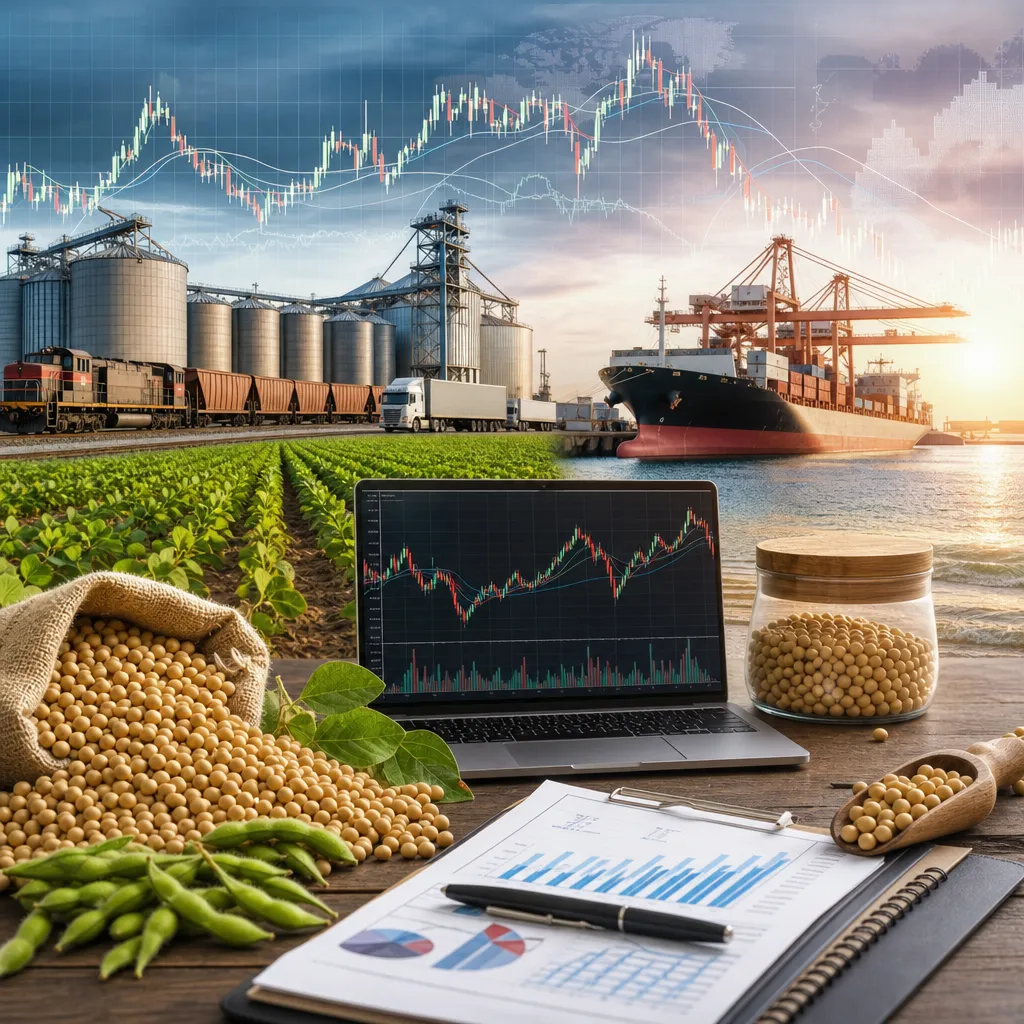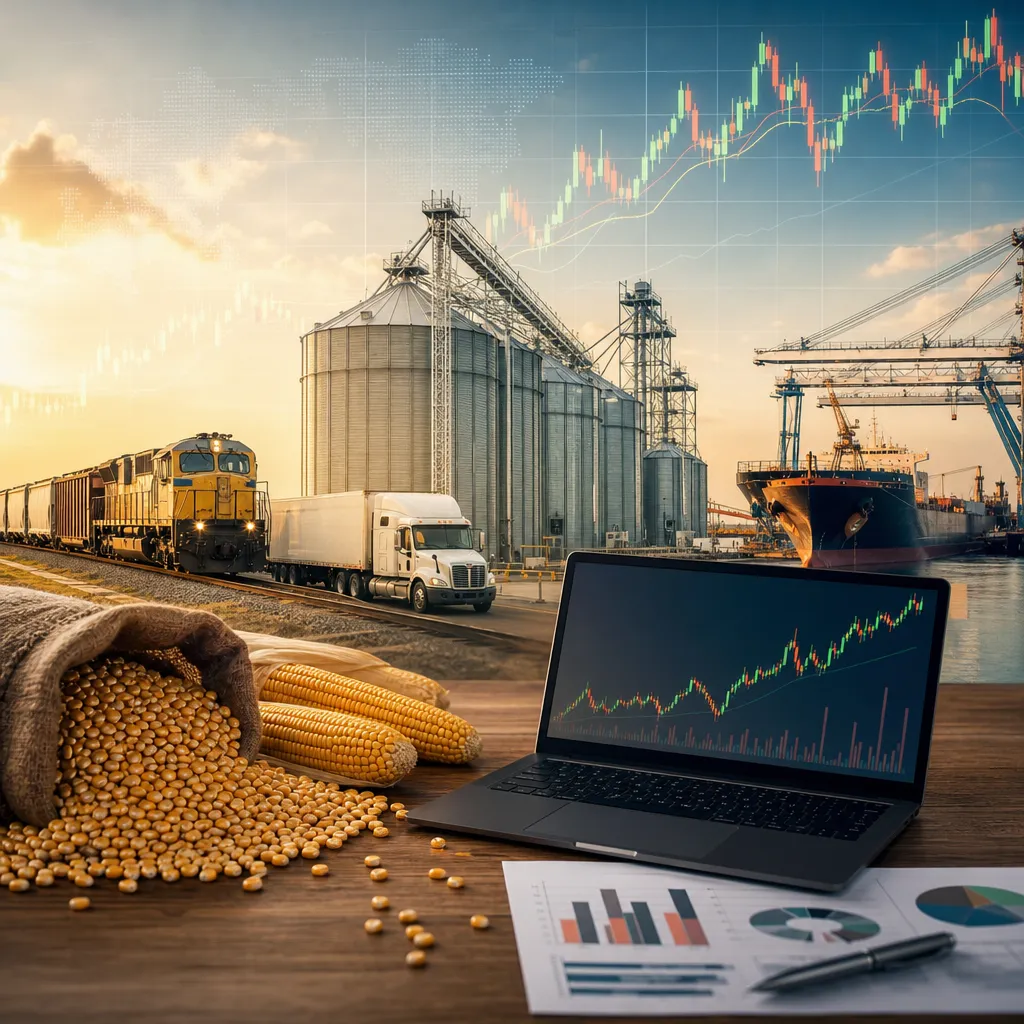


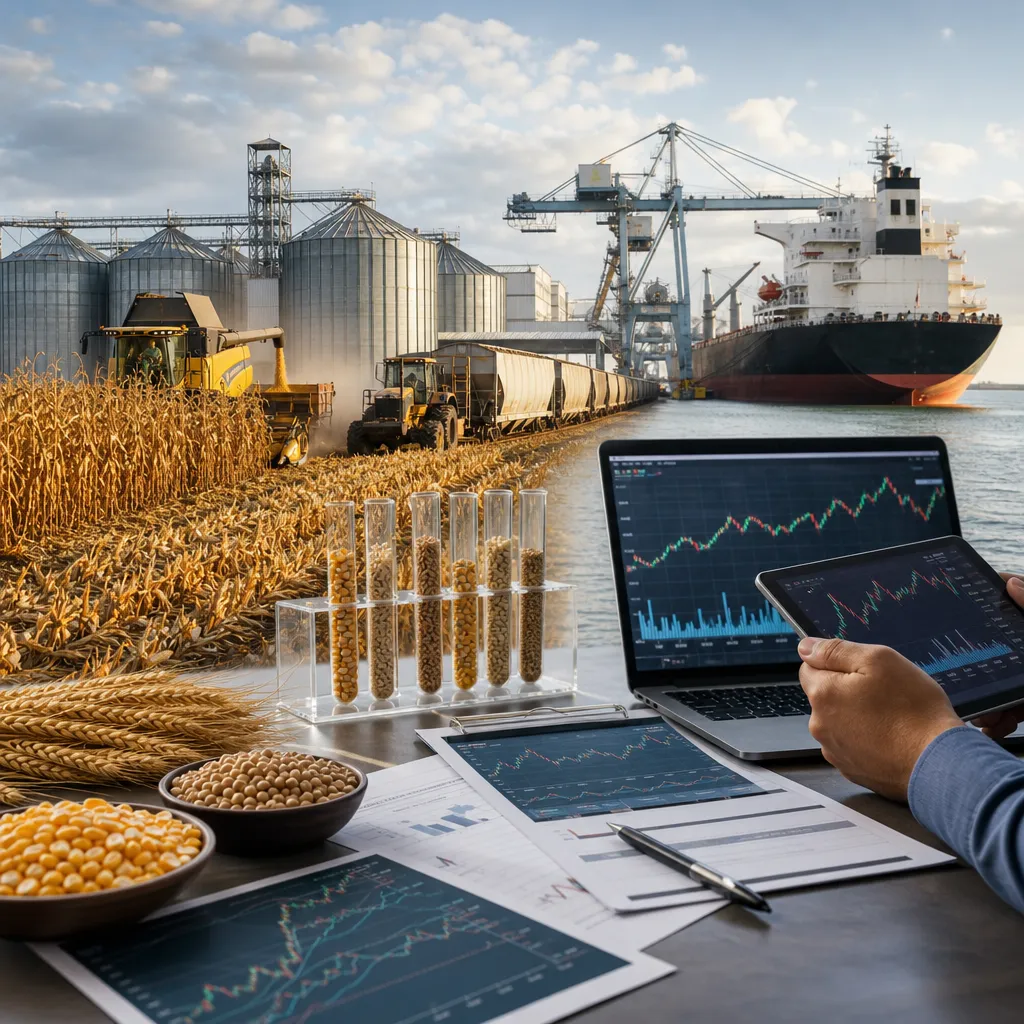
The US grain export market is the network through which American corn, soybeans, wheat, sorghum, barley, and related products move from inland production areas to overseas buyers. It operates across the United States, but its price signals are strongly connected to futures markets in Chicago and to export bids quoted at major Gulf, Pacific Northwest, Great Lakes, and Atlantic shipping points. In practice, this is not a single price or a single marketplace: exporters, elevators, processors, feed users, brokers, shipping companies, and importers all interact through cash bids, basis, futures, and freight. To understand how the market works, readers need to separate exchange-traded benchmarks from physical export values such as FOB offers and inland elevator bids.
The United States is one of the world’s key grain and oilseed suppliers. Corn and soybeans dominate export attention, while wheat remains important through several classes and origins. Prices are usually discussed in US dollars, with futures commonly quoted in cents per bushel on US exchanges and export trade commonly discussed in dollars per metric ton or dollars per bushel depending on the deal. The central benchmark exchange for most users is CME Group’s agricultural futures complex, especially CBOT corn, soybean, and wheat contracts.
What the US grain export market includes
The US grain export market covers physical grain sold from the United States to foreign buyers. That includes outright spot cargoes, forward export sales, container shipments, and bulk vessel business. It also includes the pricing system around those exports: futures, basis, elevation costs, storage, transportation, inspection, quality premiums or discounts, and ocean freight.
The market is broad because crops move through different channels before export:
- Farmers sell to local elevators, cooperatives, processors, or merchants.
- Merchants assemble grain inland and move it by truck, rail, or barge.
- Exporters load grain at terminal facilities for shipment overseas.
- Importers, feed mills, crushers, or state buyers purchase grain under export contracts.
For soybeans and corn, export competition often comes from Brazil, Argentina, and Ukraine when available. For wheat, the US competes with exporters such as Russia, the European Union, Canada, Australia, and Argentina. Because of that, the US export market is global in pricing even though the grain originates in domestic cash markets.
Where the market operates inside the United States
The geography matters. Grain is grown mainly in the Midwest, Great Plains, and parts of the Delta and Northern Plains, but exports are priced around shipping corridors and port positions rather than just farm locations.
The main export gateways are:
- US Gulf — the leading hub for many corn, soybean, and soybean meal exports, supported by the Mississippi River system.
- Pacific Northwest — especially important for shipments to Asia, including wheat, corn, and soybeans depending on market conditions.
- Great Lakes/St. Lawrence route — relevant for some grain flows, especially seasonally.
- Atlantic and other coastal terminals — smaller but still relevant for some cargoes and niche flows.
Inland, grain values depend heavily on access to river elevators, shuttle train loaders, ethanol plants, soybean crushers, feed mills, and flour mills. A producer in Iowa, Kansas, Illinois, or North Dakota does not normally sell directly at the export terminal price; instead, local buyers derive their bids from transportation-adjusted export or domestic values.
| Market area | Main role | Typical commodities | Why it matters |
|---|---|---|---|
| Midwest interior | Production and first-point merchandising | Corn, soybeans, soft red winter wheat in some areas | Local cash bids start here and reflect demand, storage, and logistics |
| Great Plains | Wheat production, feed grains, rail movement | Hard red winter wheat, sorghum, corn | Important for wheat export classes and rail-served trade |
| US Gulf | Bulk export hub | Corn, soybeans, wheat, soybean products | Key FOB pricing point connected to barge logistics |
| Pacific Northwest | Export hub to Asia | Wheat, corn, soybeans | Competitive route for Asian demand and rail-served grain |
How prices are formed
US grain export pricing is layered. The most important mistake to avoid is assuming a CBOT futures quote is the exact cash price received by a farmer or paid by an overseas buyer. It is only one piece of the pricing chain.
A practical way to view price formation is:
- Futures benchmark sets the main reference price for many grain contracts.
- Basis adjusts that benchmark for local supply, demand, freight, storage, and competition among buyers.
- Quality adjustments account for protein, test weight, moisture, damage, falling number, or other export specifications where relevant.
- Logistics costs include truck, rail, barge, elevation, handling, and terminal charges.
- Export terms define whether the price is FOB, CIF, delivered inland, or another basis.
Basis is the difference between the local cash price and the relevant futures contract. A strong basis usually means local demand or logistical access is supportive. A weak basis may reflect harvest pressure, costly freight, slow export demand, or limited nearby buyer interest.
FOB means free on board at the export point, where the seller covers costs up to loading the vessel. CIF includes cost, insurance, and freight to the destination. Delivered price can describe grain delivered to a domestic plant, feed mill, river terminal, or export elevator. These are different markets and should not be treated as interchangeable.
| Price type | Where quoted | What it means |
|---|---|---|
| Futures price | CME Group/CBOT | Exchange-traded benchmark for standardized contracts |
| Local cash bid | Elevator, cooperative, processor, merchant | Physical bid at a local delivery point, often futures plus or minus basis |
| Export bid | Terminal/export market reporting | Value for grain at or into an export channel |
| FOB price | Export trade | Price loaded at port before ocean shipment |
| CIF price | Import/export trade | Price including freight and insurance to destination |
Which benchmarks matter most
For most international participants, the leading financial benchmark is the CBOT complex within CME Group. Corn, soybeans, and wheat futures are used for price discovery, hedging, and spread trading. Kansas City wheat and Minneapolis wheat contracts are also relevant for specific wheat classes, especially when protein and class differences matter.
These futures contracts are not the same as export cargoes. They represent standardized exchange instruments with delivery rules and contract months. Exporters and merchants use them to hedge price exposure, but vessel cargoes are negotiated in the physical market with quality specifications, shipment windows, and freight arrangements.
For wheat in particular, the choice of benchmark may depend on class:
- CBOT wheat is widely watched as a global benchmark.
- Kansas City wheat is important for hard red winter wheat hedging.
- Minneapolis wheat is more relevant for hard red spring wheat exposure.
How grain is actually bought, sold, exported, and hedged
Physical grain trade
Physical grain in the United States is usually sold through commercial channels rather than directly on an exchange. Farmers commonly deliver to local elevators, cooperatives, ethanol plants, crushers, feed mills, or merchants. Contracts may be spot cash, forward cash, basis contracts, hedge-to-arrive contracts, storage arrangements, or minimum price structures depending on the buyer and the producer’s risk preference.
From there, merchants aggregate volume and move grain to domestic users or export terminals. Exporters then sell cargoes to overseas buyers such as importers, feed manufacturers, crushers, millers, or government purchasing agencies. Export deals specify quantity, quality, load port, shipment period, payment terms, and trade rules.
Quality matters. A grain lot may be discounted or rejected if it does not meet moisture, damage, foreign material, protein, or other contractual requirements. Counterparty risk and logistics performance also matter, especially for forward sales.
Futures and options trading
Futures and options are financial tools traded through a broker offering access to CME Group contracts. Traders, merchandisers, processors, and farmers use them mainly to hedge price risk or to take a market view. Buying a futures contract does not usually mean taking physical ownership of grain, and selling futures does not by itself move export cargoes.
Key practical points:
- Futures require a brokerage account and margin.
- Options provide defined-right exposure but still require understanding of premium and expiry.
- Hedgers face basis risk, because local cash prices will not move exactly the same as futures.
- Speculators may never handle physical grain at all.
A common export hedge would involve a merchant buying grain physically and selling futures to protect against a decline in flat price before the cargo is sold or loaded. Later, the hedge may be lifted when the physical sale is finalized.
Where to check prices and market information online
If readers want the current US grain export market, they should check several types of sources because no single screen gives every relevant value. Futures prices, local cash bids, and export indicators are different.
- CME Group — for real-time or delayed futures information on corn, soybeans, and wheat benchmarks.
- USDA Agricultural Marketing Service — for cash grain, transportation, and market reporting, including many regional and export-related reports.
- USDA Foreign Agricultural Service — for weekly US export sales, market development, and trade context.
- USDA WASDE and related USDA reports — for supply, demand, stocks, and trade balance analysis.
- Local elevators, cooperatives, processors, and merchants — for actual nearby cash bids and delivery terms.
- Broker and market data platforms — for futures charts, spreads, options, and sometimes cash indications, depending on subscription access.
For a producer or commercial buyer, elevator and processor bids are often the most actionable for physical grain. For an exporter or merchant, AMS transportation and export market reports help show how basis and logistics are evolving. For a trader, the exchange screen provides benchmark direction, but not the exact local value of grain in Iowa, Kansas, or at the Gulf.
Main drivers of the US export market
The US grain export market moves with both domestic and international forces. Some of the biggest drivers are predictable in framework, even when outcomes are uncertain.
- Weather and yield — US planting, pollination, and harvest conditions shape production potential.
- Stocks and acreage — tighter carryout or lower acreage can support prices; larger supplies can pressure them.
- Competing exporters — crops and export policies in Brazil, Argentina, Russia, the EU, Canada, Australia, and Ukraine influence US competitiveness.
- US dollar movement — a stronger dollar can reduce price competitiveness in international tenders.
- Freight and logistics — river conditions, rail performance, export lineups, and ocean freight affect basis and FOB values.
- Domestic demand — ethanol, feed, crushing, and milling demand can tighten nearby supplies available for export.
- Policy and trade relations — tariffs, sanctions, phytosanitary restrictions, and biofuel policy can change trade flows quickly.
Forecasting this market is therefore best done through scenarios rather than certainty. A large US crop combined with smooth logistics and weak competing-origin supplies can improve export prospects. On the other hand, if South American crops are large and the US dollar is firm, US exports may need lower prices or stronger basis incentives to win demand.
| Factor | Typical market effect | Why it matters |
|---|---|---|
| Large US harvest | Can pressure futures and harvest cash bids | Increases exportable supply if logistics keep up |
| Tight river or rail logistics | Can distort basis and export flow | Transport costs and timing become more important |
| Strong US dollar | Can hurt export competitiveness | Importers compare US prices with rival origins |
| Stronger domestic processing demand | Can support inland basis | Exporters must compete for grain with local users |
Practical differences between online markets and the real export trade
Online, readers may see a corn or soybean futures quote change every second. In the real export market, grain trades through negotiated commercial relationships, quality specifications, freight commitments, and shipping windows. An overseas buyer may use futures as a benchmark but still negotiate origin, protein, load dates, demurrage terms, and insurance separately.
Similarly, a US farmer may watch CBOT online all day but ultimately sell to a nearby cooperative based on that buyer’s cash bid and basis. The screen price alone does not tell the farmer what drying costs, trucking, storage charges, or delivery slot terms will be.
This distinction is essential:
- Online market access is mainly about price discovery and financial risk management.
- Physical market participation is about actual grain ownership, movement, quality, timing, and settlement.
Frequently asked questions
What is the main benchmark for US grain export pricing?
For corn, soybeans, and widely followed wheat pricing, CBOT futures within CME Group are the main benchmark. Export cargoes are then priced by adding or subtracting basis and adjusting for quality, freight, and terms such as FOB or CIF.
Where can I check current US grain prices?
Check CME Group for futures benchmarks, USDA Agricultural Marketing Service for many cash and transportation reports, and local elevators or processors for actual nearby physical bids. Export sales and trade context can be checked through USDA Foreign Agricultural Service.
Why is a local cash bid different from the futures price?
A local cash bid includes basis, which reflects local supply and demand, freight, handling, storage, and buyer competition. It may also include quality adjustments and delivery conditions.
How is grain exported from the United States?
Grain is gathered inland by elevators and merchants, moved by truck, rail, or barge to export terminals, and then loaded onto vessels under commercial export contracts. Major gateways include the US Gulf and the Pacific Northwest.
Can I buy US grain export futures instead of physical grain?
You can trade grain futures and options through a broker, but that gives financial exposure rather than normal physical grain ownership. Physical grain is bought and sold through commercial grain companies, processors, cooperatives, exporters, and importers.
What units are commonly used in the US grain export market?
US futures are commonly quoted in cents per bushel, while international physical trade is often discussed in US dollars per metric ton. Domestic cash markets may use dollars per bushel depending on the commodity and location.
What matters more for export competitiveness: futures or basis?
Both matter. Futures set the broad flat-price environment, while basis reflects local and logistical conditions. A competitive export offer depends on the combined delivered cost to the export point and then to the overseas buyer.
Who uses the US grain export market?
Farmers, elevators, cooperatives, grain merchants, processors, exporters, overseas importers, feed mills, flour mills, crushers, brokers, and hedgers all use it, but not in the same way. Some handle physical grain; others manage price risk through futures and options.
Sources
- USDA Agricultural Marketing Service
- USDA Foreign Agricultural Service
- CME Group