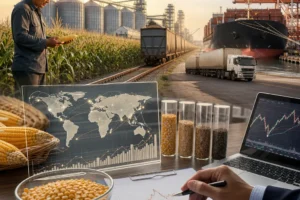
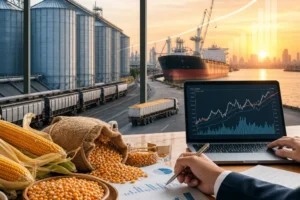
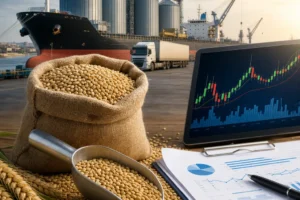
Rice trading for beginners starts with one core distinction: trading rice can mean buying and selling physical grain in the real supply chain, or trading rice futures as a financial contract. These are related markets, but they are not the same thing, and the price on a screen is not automatically the price a farmer, mill, or importer pays locally. To understand rice well, a beginner needs to know where prices are quoted, who the main market participants are, and how quality, freight, storage, and basis affect the final deal. The most practical approach is to learn the cash market first, then see how futures, reports, and data fit around it.
What rice trading actually means
Rice trading usually happens in two different ways.
- Physical rice trade: actual paddy rice, rough rice, milled rice, or broken rice is bought and sold between farmers, mills, merchants, exporters, importers, wholesalers, feed users, or government agencies.
- Financial rice trading: traders use futures or options contracts to speculate on price moves or hedge physical exposure.
In practice, beginners often confuse these markets. A futures contract is a standardized exchange instrument. A physical transaction is a negotiated commercial deal involving quality, delivery point, timing, freight, and payment terms.
Physical rice exists in farms, country elevators, mills, warehouses, inland depots, ports, and import terminals. Financial rice trading exists on regulated exchanges through brokerage accounts and trading platforms.
Where rice prices are found and why they differ
There is no single global rice price that applies everywhere. Rice prices vary by origin, variety, milling quality, broken percentage, moisture, delivery terms, and destination.
Beginners should separate these price references:
- Exchange futures prices: typically quoted for standardized contracts on a futures exchange.
- Local cash prices: prices offered by mills, elevators, cooperatives, merchants, exporters, or government procurement agencies.
- Export quotations: prices for internationally traded rice, often discussed by origin and grade under trade terms such as FOB or CIF.
- Retail prices: consumer prices in supermarkets or wholesale food markets, which are not the same as farmgate or bulk trade prices.
For U.S. rice futures, the main benchmark is the rough rice futures market at CME Group. A quoted futures price is a benchmark for a standardized contract, not a direct cash bid at a local elevator or mill. Local cash prices may be higher or lower depending on basis, freight, quality, supply conditions, and buyer demand.
For physical market information, traders and farmers often check:
- local elevator or mill bids, where available
- merchant or cooperative bid sheets
- government market reporting services
- export market commentary from official agencies or recognized price reporting services
- port quotations and tender results in importing countries
In the United States, USDA reports are widely used to understand production, stocks, exports, and regional cash market context. In international trade, FAO and national agriculture ministries help with broader supply and demand analysis.
| Price type | Where it is found | What it represents | Main limitation |
|---|---|---|---|
| Futures price | Exchange data, broker platform, CME market information | Standardized financial contract value | Not the same as a local physical rice bid |
| Local cash bid | Mill, elevator, cooperative, merchant, buyer | Actual buying price at a location | Depends on quality, delivery point, and timing |
| Export quote | Export market channels, tenders, trade reporting | Price for shipment from an origin or to a destination | May exclude inland logistics or local handling costs |
| Retail or wholesale food price | Shops, food markets, consumer price statistics | Packaged product value in the food chain | Includes processing, branding, packaging, and distribution |
How physical rice trading works
A physical rice trade is usually a commercial negotiation between a seller and a buyer. The seller may be a farmer, cooperative, mill, warehouse owner, or merchant. The buyer may be a mill, trader, exporter, food processor, feed company, government buyer, wholesaler, or importer.
The process usually includes these steps:
- Offer or bid: the buyer posts a bid or the seller requests a quote.
- Specification: both sides define whether the rice is paddy, rough, brown, milled, parboiled, or broken, plus quantity and quality.
- Quality terms: moisture, foreign matter, percentage broken, milling yield, grain length, chalkiness, damaged kernels, and other grade factors are discussed.
- Delivery point: farm pickup, mill gate, warehouse, inland depot, or export port.
- Freight and Incoterms: especially in export trade, the parties clarify who pays inland trucking, port handling, ocean freight, and insurance.
- Inspection and weighing: the parties may rely on internal quality checks or independent inspection, depending on scale and market practice.
- Payment terms: immediate payment, short credit, documentary terms, or other commercial arrangements.
In domestic markets, many farmers sell rough rice to local elevators, cooperatives, merchants, or mills. In export channels, rice often passes through millers and merchants before reaching port. In some countries, state procurement agencies or food security bodies are also important buyers.
Where a beginner can actually buy or sell physical rice depends on scale:
- Farm scale: local elevator, cooperative, nearby rice mill, merchant, or broker
- Commercial scale: grain merchant, processor, wholesaler, or exporter
- International scale: trading house, exporter, importer, tender system, or food procurement buyer
Unlike futures, physical rice cannot be traded effectively just by opening a chart. The buyer must arrange transport, storage, quality control, and contract performance.
How rice futures and options work
Rice futures are standardized contracts traded on a regulated exchange. In the U.S. market, rough rice futures are associated with CME Group. A futures contract allows participants to buy or sell a defined amount of rice for a future month under exchange rules.
To trade futures, a beginner normally needs:
- a futures brokerage account
- access to a trading platform provided by the broker or connected software
- margin money, because futures are leveraged instruments
- basic understanding of contract month, tick size, delivery rules, and risk controls
Important points:
- Leverage means gains and losses are magnified.
- Margin is not the full value of the rice; it is performance collateral.
- Expiry matters. Contracts have delivery months and can move differently across the curve.
- Delivery is possible under exchange rules, but many financial traders close or roll positions before delivery notice periods.
- Basis risk remains for hedgers because the local cash price and futures price do not move in perfect lockstep.
Options on futures, where available through the broker and exchange, give the right but not the obligation to buy or sell a futures contract at a strike price. Farmers and commercial users may prefer options when they want price protection with limited downside on the premium paid, but options still require understanding of time decay, volatility, and expiry.
Futures are most useful for hedging standardized price risk. They are less useful for solving physical issues such as moisture discounts, warehouse losses, or export documentation.
| Market type | Where it operates | Who uses it | Main risk |
|---|---|---|---|
| Physical cash market | Elevators, mills, cooperatives, warehouses, merchants, ports | Farmers, processors, exporters, importers, wholesalers | Quality, logistics, counterparty, freight, storage |
| Futures market | Regulated exchange through brokers | Hedgers, traders, funds, commercial firms | Leverage, margin calls, expiry, basis mismatch |
| OTC forward contract | Private agreement between commercial parties | Farmers, merchants, mills, buyers | Counterparty and contract performance risk |
Who the main participants are
Rice markets are shaped by different users with different goals.
- Farmers produce rough rice and may sell at harvest, store and sell later, or forward contract.
- Elevators and cooperatives collect grain, offer bids, arrange storage, and aggregate supply.
- Rice mills buy rough rice and process it into marketable forms.
- Merchants and trading houses connect supply regions with domestic or export demand.
- Exporters and importers manage international shipments, tenders, currency risk, and documentation.
- Food processors and wholesalers buy rice as a production input or resale product.
- Brokers may facilitate futures trading or, in some physical markets, introduce counterparties.
- Government agencies may publish reports, maintain standards, or influence trade through procurement, tariffs, or import controls.
For a beginner, knowing which participant sets the price in a given deal is essential. A futures broker is not the same as a grain merchant. A local mill is not the same as an exchange. An export tender price is not the same as a farm bid.
What drives rice prices
Rice is strongly influenced by supply and demand, but the mechanics are more localized than in some other grains because rice quality and origin matter greatly.
Important price drivers include:
- Weather: monsoon conditions, drought, flooding, heat stress, and storm damage
- Acreage and yield: planted area and harvested output affect supply
- Stocks: high inventories can cushion poor crops; tight stocks increase sensitivity
- Government policy: export restrictions, procurement programs, import tariffs, food security measures
- Currency moves: exporters become more or less competitive as currencies change
- Freight and logistics: trucking, rail, barge, port congestion, container availability, ocean freight
- Quality spread: premium and discount relationships between grades and origins
- Consumer demand: staple demand is often resilient, but substitution and income trends still matter
Beginners should think in scenarios rather than certainty. A good crop in one major exporter can pressure prices, but a policy change or freight disruption can offset that effect quickly.
Where to get market data, reports, and analysis
Reliable rice trading decisions depend on using official and market-based information together.
Useful sources include:
- USDA: a key source for production, stocks, trade, export data, and periodic global balance sheets. Rice traders often use WASDE for broad supply-demand updates and other USDA publications for more detailed U.S. market information.
- CME Group: reference point for rough rice futures contract specifications, settlement information, and exchange market data.
- CFTC: useful for Commitments of Traders data in futures markets, showing broad positioning categories.
- FAO: global food and agricultural market context, especially for international supply and trade trends.
- National agriculture ministries and statistical agencies: important for local crop estimates, procurement policy, and production zones.
- Customs and trade databases: used by professional analysts to track import and export flows by country.
Where the information exists online depends on the source. Official agencies usually publish reports on their own websites. Exchange data is often available on the exchange site in delayed form, and through brokers or paid market-data services in more detailed form. Paid data platforms may combine charting, futures quotes, options data, and news, but they are not a substitute for checking official reports.
For physical market intelligence, many commercial participants still depend on direct calls with mills, merchants, warehouses, freight providers, and port agents. Real trade flow often moves ahead of what appears in a published report.
Storage, quality, logistics, and basis
Beginners often focus only on headline price and ignore the commercial details that decide actual profit.
Storage matters because rice may be sold at harvest or held for later sale. Storage can improve timing flexibility, but it adds carrying cost, shrink risk, quality deterioration risk, and financing cost.
Quality matters because rice is highly segmented. Moisture, milling yield, grain appearance, impurities, and damage can all create discounts or outright rejection.
Logistics matter because a strong export market at port does not automatically help a seller far inland if truck or rail capacity is tight.
Basis is the difference between local cash price and futures price. A hedger who sells futures still faces basis risk because local conditions may change independently of the exchange market.
Where rice is stored in practice:
- on-farm bins or sheds where suitable
- commercial warehouses
- elevators
- mills with storage capacity
- port warehouses or transit facilities
Before storing rice commercially, check grading standards, handling procedures, insurance responsibility, documentation, and how quality disputes are resolved.
Practical first steps for a beginner
If you are starting from zero, use a staged approach.
- Learn your market definition: are you interested in U.S. rough rice futures, local physical paddy rice, or international milled rice trade?
- Track both cash and futures: compare local buyer bids with exchange benchmarks where relevant.
- Read contract specifications: if trading futures, understand the exchange rules before placing any order.
- Identify buyers and intermediaries: local mills, cooperatives, merchants, brokers, warehouses, exporters.
- Follow core reports: use USDA, CME, and relevant national crop agencies.
- Understand grading and discounts: quality risk can outweigh a small price advantage.
- Start small: whether in physical volume or financial exposure, early mistakes are less costly when size is controlled.
Common mistakes include treating a futures quote as a guaranteed sale price, ignoring freight, not checking moisture or grades carefully, and using leverage without understanding margin risk.
Frequently asked questions
Where can I check rice prices?
Check exchange prices through CME Group or a futures broker platform for standardized rough rice futures. Check local cash bids through mills, elevators, cooperatives, merchants, or government market reporting services where available. For international trade, look at official trade reports, tender results, and origin-based export quotations.
Can I buy physical rice online like a futures contract?
Not in the same way. A futures contract can be traded electronically through a broker account. Physical rice purchases usually require direct dealing with a supplier such as a mill, merchant, wholesaler, or exporter, with agreement on quality, quantity, delivery, and payment terms.
What is the difference between rice futures and cash rice?
Rice futures are standardized exchange contracts used for hedging or speculation. Cash rice is the actual grain bought and sold in the physical market. Cash rice prices depend on local basis, quality, freight, and delivery terms, so they do not exactly match futures prices.
Who normally buys rice from farmers?
That depends on the region, but common buyers include local elevators, cooperatives, mills, merchants, and sometimes government procurement agencies. In some markets, brokers or traders help connect farmers with larger commercial buyers.
Do I need a broker to trade rice futures?
Yes, in normal practice you need a regulated futures broker to access exchange-traded futures. That is different from selling physical rice to a local merchant or mill, which is a commercial transaction rather than an exchange trade.
What reports matter most for beginners?
USDA supply-and-demand reports are widely used, especially WASDE and trade-related releases. CME Group contract information is essential for understanding futures. CFTC positioning data can help show broad market participation in futures, though it should not be used alone.
What are the biggest risks in rice trading?
In physical trading, the main risks are quality disputes, storage losses, freight problems, delayed payment, and counterparty failure. In futures trading, the main risks are leverage, margin calls, volatility, expiry management, and basis mismatch for hedgers.
Is rice trading mainly local or global?
It is both. Rice is a globally traded staple, but many transactions are highly local because quality, milling structure, policy, and transport costs matter a great deal. A trader must understand global supply and demand and also local cash market conditions.
Sources
- USDA Foreign Agricultural Service
- CME Group
- Food and Agriculture Organization of the United Nations (FAO)