
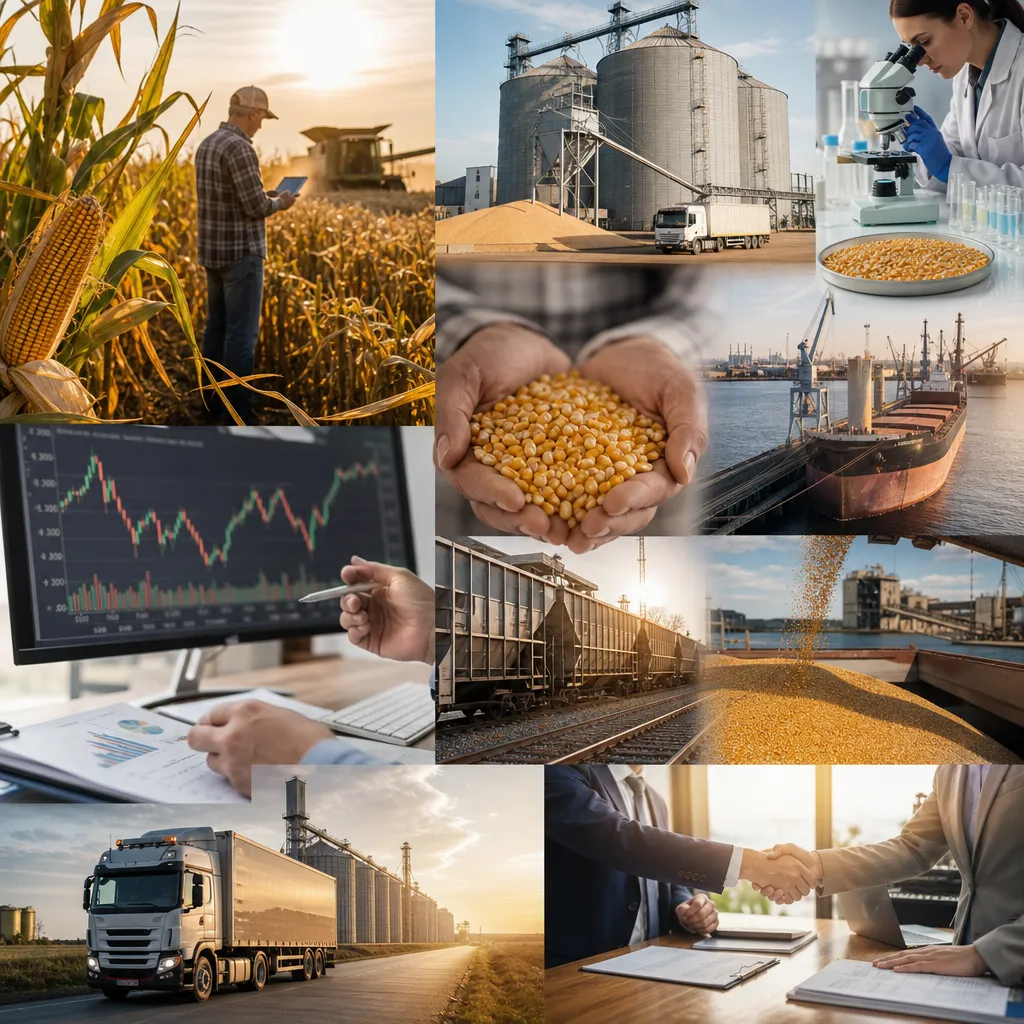
Corn trading begins with one essential distinction: the futures price you see on an exchange is not the same as the cash price paid at a local elevator, ethanol plant, feed mill, or export terminal. Beginners need to understand both markets because corn is traded in two parallel ways: financially through regulated futures and options markets, and physically through grain buyers, cooperatives, merchants, processors, and exporters. In practice, most participants use futures as a price benchmark and the physical market to actually move grain. If you learn where prices are quoted, who the buyers are, and how contracts are structured, corn trading becomes much easier to follow.
What corn trading actually means
Corn trading can refer to several different activities. A farmer may sell harvested corn to a nearby elevator. A feed manufacturer may buy physical corn for animal feed. A trader may speculate on corn futures through a brokerage account. An ethanol plant may hedge future purchases with CME corn futures. All of these are forms of corn trading, but they happen in different places and under different rules.
For beginners, it helps to divide the market into two parts:
- Physical corn market: actual grain is bought, sold, stored, shipped, inspected, and delivered.
- Futures and options market: standardized contracts are traded on an exchange, mainly for hedging or speculation.
The main U.S. benchmark for corn futures is the CME Group corn contract. That exchange price is widely used around the world as a reference, but physical corn is priced locally using a combination of:
- the futures price,
- the local basis,
- quality adjustments,
- freight and delivery costs,
- regional supply and demand.
Where corn prices are found and how to read them
If you want to follow corn trading, the first practical step is learning where prices are quoted.
Futures prices are normally checked through exchange data and broker platforms. CME Group publishes contract information and market data for corn futures and options. Many brokerage platforms, financial terminals, agricultural media services, and market data vendors also show corn futures quotes.
Local cash prices are usually checked through grain elevators, agricultural cooperatives, processors, ethanol plants, feed mills, grain merchants, and local bid sheets. In many grain-producing regions, these bids are published on buyer websites, text services, mobile apps, or farm marketing platforms. In some countries, official market reporting services or agriculture ministries also publish representative cash prices.
A local cash bid is often expressed as:
Cash price = futures price + or – basis
Basis is the difference between the local cash market and the futures benchmark. A strong local demand area, such as a feed-deficit region or processor-heavy zone, may have a firmer basis. Areas with large supplies and weak nearby demand may show a weaker basis.
| Price type | Where to check it | What it means | Who uses it |
|---|---|---|---|
| Futures price | CME Group data, broker platforms, data vendors | Exchange-traded benchmark for standardized corn contracts | Traders, hedgers, analysts, merchants |
| Local cash bid | Elevators, cooperatives, processors, merchant bid sheets | Price paid for physical corn at a specific location | Farmers, local buyers, truckers, merchandisers |
| Export value | Merchants, exporters, port bids, trade data services | Value of corn loaded or delivered into export channels | Exporters, international traders, shippers |
| Farm gate price | Direct contracts, local buyers, official reports in some regions | Net price available to the producer before or after freight depending on terms | Farmers, lenders, farm managers |
A common beginner mistake is assuming a live futures quote is the same as the price received in the countryside. It is not. Delivery point, moisture, test weight, foreign material, drying charges, and freight can all change the final physical price.
How the futures market works
Corn futures are standardized contracts traded on a regulated exchange, primarily CME Group in the United States. A futures contract represents a specific quantity and a specific delivery month, with contract terms defined by the exchange. Most participants do not use futures to take or make physical delivery. Instead, they use the contract to manage price risk or to speculate on price changes.
To trade corn futures, a beginner normally needs:
- a futures brokerage account with an authorized broker,
- risk disclosures and account approval,
- enough capital to meet initial and maintenance margin requirements,
- a trading platform or broker-assisted access.
Futures are leveraged instruments. You do not pay the full value of the corn upfront, but you must post margin. That leverage increases both opportunity and risk. If the market moves against your position, you may have to deposit more funds quickly.
There are two basic futures positions:
- Long: buying futures because you expect prices to rise or because you need to hedge future purchases.
- Short: selling futures because you expect prices to fall or because you need to hedge physical inventory or expected production.
Options on corn futures are also available through the exchange. These give the buyer the right, but not the obligation, to buy or sell a futures contract at a defined strike price before expiration. Farmers and commercial users sometimes prefer options because they can limit downside risk to the premium paid, though options still require careful understanding of time value and volatility.
How physical corn is bought and sold
Physical corn moves through a network of farms, country elevators, cooperatives, processors, feed companies, exporters, rail terminals, barges, warehouses, and ports. Unlike futures, physical transactions are negotiated around actual grain movement.
A typical physical sale by a farmer may work like this:
- The farmer checks bids from local elevators, cooperatives, or processors.
- The buyer quotes a cash price or a basis contract against a futures month.
- The parties agree on quantity, delivery window, quality terms, and payment conditions.
- The grain is delivered by truck or picked up depending on contract terms.
- The buyer grades the grain for moisture, damage, test weight, and other factors.
- Final settlement is made after any discounts, freight, drying, or storage adjustments.
In export and wholesale trade, corn can also be sold through grain merchants and brokers. In those markets, contracts may include detailed quality specifications, shipment terms, origin clauses, tolerance provisions, and Incoterms. Delivery may occur at an inland warehouse, rail destination, river terminal, or port.
Key practical items to check in a physical contract include:
- delivery location,
- who pays freight,
- quality and grade standards,
- moisture limits and drying charges,
- weight determination,
- inspection and rejection rights,
- storage terms if grain is held before sale,
- payment timing,
- counterparty reliability.
Futures trading versus physical corn marketing
These two markets interact constantly, but they are not the same transaction.
| Feature | Futures market | Physical market |
|---|---|---|
| Where it happens | Regulated exchange through a futures broker | Elevators, cooperatives, merchants, processors, exporters, warehouses |
| What is traded | Standardized financial contract | Actual grain with quality and location differences |
| Main purpose | Hedging or speculation | Movement, use, storage, or ownership of corn |
| Price basis | Exchange benchmark | Futures plus or minus basis, quality, freight, and local demand |
| Main risks | Leverage, volatility, margin calls, expiry risk | Quality loss, storage cost, freight, non-payment, basis changes |
A farmer can sell physical corn without ever trading futures personally. Likewise, a speculator can trade corn futures without ever handling physical grain. Commercial firms often do both.
Who uses corn markets and why
Different users approach corn trading for different reasons.
- Farmers: sell production, hedge price risk, manage storage and harvest pressure.
- Elevators and cooperatives: buy from farmers, store grain, manage basis, hedge inventory.
- Feed manufacturers: buy corn as an input and may hedge future needs.
- Ethanol plants and processors: secure supply and manage margins between input cost and product value.
- Exporters and merchants: source grain inland and move it to domestic or global customers.
- Speculators and funds: trade futures and options for financial return.
- Analysts and lenders: monitor price, basis, stocks, and farm economics.
Understanding who is active matters because their behavior affects the market. Harvest selling pressure, processor demand, export buying, and fund positioning can all influence price action and basis structure.
What moves corn prices
Corn prices are driven by both fundamentals and market positioning. Beginners should focus on a small set of recurring variables.
- Weather: planting conditions, drought, heat stress, and harvest delays can shift production expectations quickly.
- Acreage and yield: planted area and realized yield determine crop size.
- Stocks and stocks-to-use: the tighter the balance sheet, the more sensitive price becomes to supply shocks.
- Feed demand: livestock and poultry sectors are major users of corn.
- Ethanol and biofuels: policy, fuel demand, and margins influence industrial use.
- Exports: import demand from major buyers and competition from other origins affect trade flow.
- Currencies: exchange rates can change export competitiveness.
- Freight and logistics: river levels, rail performance, trucking, and port congestion can alter basis and movement.
- Government policy: tariffs, quotas, subsidies, and blending mandates can affect demand and trade.
Forecasting corn is best done in scenarios, not certainties. A weather-driven production shortfall, for example, may support futures, but weak exports or large existing stocks could limit the move. A big crop may pressure futures, but a strong local processor market may still keep cash basis relatively firm in some areas.
Where beginners should get corn market data and reports
Reliable analysis starts with official and exchange-based information. Many beginners read too much commentary and too little primary data.
The most useful public sources include:
- USDA WASDE: global and U.S. balance sheets for production, use, trade, and ending stocks.
- USDA Crop Progress: weekly updates on planting, crop condition, and harvest in the U.S.
- USDA Grain Transportation and local market reports: helpful for basis, movement, and logistics context where available.
- USDA Export Sales: tracks U.S. export commitments and shipments.
- CFTC Commitments of Traders: shows positioning by trader category in futures and options.
- CME Group contract pages: contract specifications, trading months, settlement structure, and official exchange reference information.
- FAO and national agriculture ministries: broader global crop and food market context.
Commercial users may also subscribe to private data terminals, weather services, satellite crop tools, freight analytics, basis platforms, and farm management software. Those tools can be valuable, but a beginner should first understand what official reports measure and when they are released.
| Source | What it provides | How beginners use it |
|---|---|---|
| CME Group | Corn futures and options contract details and market references | Learn contract structure and track benchmark pricing |
| USDA WASDE | Supply and demand balance sheets | Understand production, consumption, exports, and stocks |
| USDA Crop Progress | Weekly crop status and seasonal field progress | Monitor weather impact and crop development |
| CFTC Commitments of Traders | Futures and options positioning by participant group | See whether funds and commercials are heavily long or short |
Practical first steps for a beginner
If you want to start corn trading or corn market analysis, begin with a structured process.
- Decide whether you mean futures trading or physical grain trading. They require different accounts, partners, and skills.
- Learn the pricing chain. Read futures, basis, freight, and quality separately.
- Choose where you will operate. Futures go through a regulated broker; physical grain usually goes through local buyers, merchants, or processors.
- Understand the contract before acting. Delivery month, quantity, margin, settlement, and quality terms all matter.
- Follow a small set of reports consistently. USDA, CME contract information, and CFTC positioning are enough to build a strong foundation.
- Start with risk control. Define position size, delivery obligations, storage exposure, and counterparty limits.
- Keep records. Compare futures movement, local basis, and final cash result over time.
For physical participants, one of the most useful habits is maintaining regular contact with several local buyers, not just one. Local bids can differ meaningfully depending on transportation capacity, processor demand, and inventory needs. For financial traders, one of the most useful habits is understanding margin risk before placing any leveraged order.
Common mistakes beginners make
- Confusing a futures quote with a local cash bid.
- Trading leveraged futures without understanding margin calls.
- Ignoring basis risk when hedging physical grain.
- Focusing only on price direction and ignoring logistics, quality, and storage.
- Using delayed or unofficial market data without checking the original source.
- Entering physical contracts without reviewing delivery and payment terms.
- Relying on a single report instead of combining weather, stocks, exports, and demand indicators.
Where can I check corn prices today?
Check corn futures through CME Group market information or a regulated broker platform. Check local cash bids through grain elevators, cooperatives, ethanol plants, feed mills, processors, and grain merchants in your area. The local cash price can differ materially from the futures benchmark because of basis, freight, and quality adjustments.
Can I buy actual corn online like a futures contract?
Not in the same way. Futures are financial exchange contracts traded online through a broker. Actual physical corn is usually bought through merchants, elevators, cooperatives, processors, or negotiated contracts between commercial parties. Physical grain needs delivery terms, quality specifications, and logistics arrangements.
What is the difference between corn futures and cash corn?
Corn futures are standardized exchange contracts used for hedging or speculation. Cash corn is actual grain sold at a specific place under local market conditions. Cash corn is priced from futures plus or minus basis, with adjustments for quality, freight, and timing.
Do beginners need a broker to trade corn futures?
Yes. Exchange-traded corn futures and options are normally accessed through a licensed futures broker or futures commission merchant, depending on jurisdiction. A brokerage account, margin funding, and risk disclosures are usually required.
Where do farmers usually sell physical corn?
Most farmers sell to local grain elevators, agricultural cooperatives, ethanol plants, feed mills, processors, or grain merchants. In some regions, larger farmers may also contract directly with end users or exporters if logistics and volume support that arrangement.
What reports matter most for corn trading?
For many market participants, the most important regular reports are USDA WASDE, USDA Crop Progress, USDA Export Sales, and CFTC Commitments of Traders. CME Group contract information is also essential for understanding the futures benchmark itself.
Is corn trading mainly about weather?
Weather is critical, especially during planting and pollination, but it is not the only driver. Stocks, export demand, ethanol economics, livestock feeding, currency moves, and freight conditions also affect both futures and local cash markets.
Can a hedge remove all risk?
No. A futures hedge can reduce exposure to broad price moves, but it does not eliminate basis risk, quality risk, logistics problems, storage losses, or counterparty issues in the physical market.
Sources
- USDA World Agricultural Supply and Demand Estimates
- CME Group Corn Futures and Options contract information
- CFTC Commitments of Traders