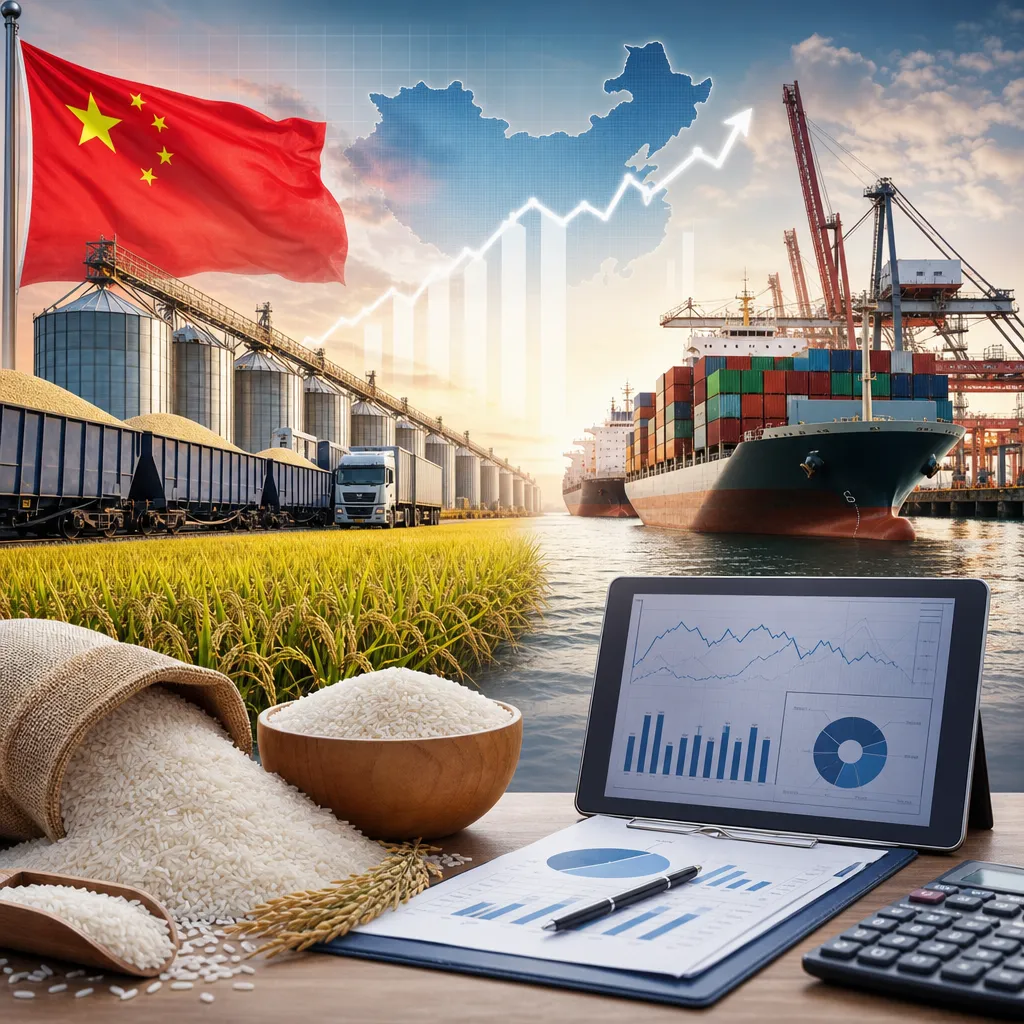








China’s rice market is one of the world’s most important grain markets because China is both a major producer and a major consumer of rice. In practice, “China rice trading” means several connected markets rather than one single price screen: domestic paddy procurement, milling and wholesale trade, food distribution, state reserve activity, and an import market for specific rice qualities and origins. Prices are usually discussed inside China in renminbi, often as yuan per metric ton, while international trade is commonly quoted in U.S. dollars per metric ton on an FOB or CIF basis. Anyone trying to trade, hedge, source, or follow Chinese rice needs to understand the difference between domestic physical prices, exchange-traded futures, and cross-border import or export offers.
Geographically, this is a national market centered in the People’s Republic of China, with major rice production concentrated in provinces such as Heilongjiang, Hunan, Jiangxi, Hubei, Anhui, Jiangsu, Guangxi, and parts of the south and northeast. Consumption is nationwide, but market behavior differs by region because varieties, milling quality, transportation costs, and local demand are not uniform. Southern areas are especially important for indica rice consumption, while the northeast is closely associated with japonica rice. For international traders, the relevant gateways are not just production provinces but also import channels, customs procedures, inland mills, and wholesale food markets.
This guide explains what the China rice market is, where prices come from, how physical and financial trading differ, where to check market information online, and how rice is actually bought, sold, imported, or hedged in relation to China. Because reliable live cash prices change constantly and are not always published in one unified public system, the key is to know which market price you are looking at and what it does, and does not, represent.
What “China rice trading” actually means
Rice trading in China covers several layers of the grain chain. The first layer is paddy rice moving from farms to local collectors, cooperatives, processors, or state-linked procurement channels. The second layer is milling, where rough rice is turned into milled rice for food use. The third layer is wholesale and retail redistribution to food markets, distributors, supermarkets, and food service buyers. A fourth layer is cross-border trade, where imported rice competes with domestic supplies in selected segments.
In Chinese market language, it is also important to distinguish between paddy and milled rice. A quoted price for paddy at farm or procurement level is not the same as a milled rice wholesale price in an urban consumption market. Quality differences matter as well: japonica and indica are not interchangeable in all uses, and broken percentage, moisture, chalkiness, grain length, and freshness can move prices significantly.
China is structurally important because its domestic production and consumption are both very large. That means the internal market often matters more than export trade. Even when international rice prices move sharply, China’s domestic prices may react differently if local stocks, policy, reserve releases, or import management offset outside changes.
Where the market operates inside China
The market operates across producing provinces, large milling centers, and major consumption cities. In the northeast, provinces such as Heilongjiang are especially relevant for japonica rice. In central and southern China, Hunan, Jiangxi, Hubei, Anhui, Jiangsu, Guangxi, and Guangdong all matter for production, trade, or consumption flows. Large urban wholesale markets and distribution hubs influence nearby delivered prices because mills and merchants compete to supply major food-demand centers.
From a trading perspective, the market can be viewed in three geographic layers:
- Production zones: where paddy is harvested and first sold.
- Processing and storage zones: where mills, warehouses, and reserve systems handle grain.
- Consumption and import zones: where rice is delivered for food use and where imported cargoes enter distribution channels.
Imported rice may enter through coastal trade channels and then move inland to wholesalers or processors. But inland transportation cost, handling losses, and customs requirements mean imported offers do not automatically set the national market. China’s rice market remains strongly shaped by domestic supply, policy, and regional preferences.
| Market segment | Where it operates | Typical pricing logic | Main users |
|---|---|---|---|
| Farm and procurement market | Producing provinces and local collection points | Yuan per metric ton for paddy, adjusted for moisture and quality | Farmers, collectors, cooperatives, mills |
| Milling and wholesale market | Processing centers and urban food markets | Delivered or wholesale prices for milled rice by grade and variety | Mills, wholesalers, food distributors, retailers |
| Import market | Port entry channels and customs-cleared inland distribution | CIF import cost plus clearance, inland freight, and local commercial margin | Importers, traders, processors, food buyers |
| Futures-related market reference | Exchange-traded market, not the same as farm cash trade | Standardized contract pricing for hedging and market reference | Commercial hedgers, traders, brokers, investors |
How rice prices are formed in China
China rice prices are formed by a mix of domestic fundamentals, policy, quality, and logistics. The simplest way to think about price formation is to separate the market into physical and benchmark layers.
Physical price is the actual price paid for a specific lot of rice or paddy at a specific location. It depends on variety, moisture, milling yield, broken rate, location, delivery terms, and timing. A mill in one province may pay more than a buyer in another province if freight is tighter or local demand is stronger.
Benchmark or reference price may come from an exchange contract, a wholesale market quote, or an import offer. This is not automatically the same as the local cash price. Traders watch benchmarks because they help anchor expectations, but the lot being traded physically still has to be valued according to local reality.
When relevant, traders should separate the following price types:
- Futures price: exchange-traded, standardized, used for hedging or market reference.
- Cash price: the spot physical price in a local market for actual rice or paddy.
- Delivered price: includes transport to a specified mill, warehouse, or buyer.
- FOB price: export price at the port of shipment before ocean freight.
- CIF price: import cost including goods, insurance, and freight to the arrival point named in the contract.
- Basis: the difference between a local cash price and the relevant futures or benchmark price.
Local Chinese rice prices can diverge from international prices for several reasons: domestic reserve policy, phytosanitary rules, import management, consumer preference for specific varieties, transport costs, and currency effects. Even if world rice prices fall, domestic Chinese prices may hold firmer if local supply is tighter in a given region or if buyers prefer domestic grain.
| Price type | What it means | Why it may differ from another price |
|---|---|---|
| Local cash bid | Price a buyer pays locally for physical paddy or rice | Reflects local quality, freight, urgency, and competition |
| Wholesale rice quote | Price in a distribution or food market for milled rice | Includes milling value, handling, packaging, and location |
| Futures quote | Standardized exchange price for a contract month | Not the same thing as the exact local physical lot |
| Import offer | Quoted cost for rice sourced from abroad | Affected by freight, origin quality, policy, and exchange rate |
Where to check China rice prices and market information online
There is no single perfect public screen for every Chinese rice cash transaction, so users usually combine official, exchange, and trade-reporting sources. Reliable information sources differ depending on whether you want domestic policy context, futures references, or import/export background.
For official domestic market context, readers often start with the National Bureau of Statistics of China for broad production and economic information, and the Ministry of Agriculture and Rural Affairs of the People’s Republic of China for agricultural policy and market-related information. For customs and trade flow context, market participants follow official Chinese customs reporting where available through public releases and secondary institutional reporting.
For global supply, demand, and trade balance context, the USDA is widely used, especially its rice outlook and world agricultural trade reporting. This is useful because China’s domestic market does not operate in isolation, even when internal policy is dominant.
For futures-related pricing, the relevant exchange reference depends on the contract being watched. In China, rice-related futures references have been associated with domestic commodity exchanges rather than overseas grain exchanges, but users must verify whether a given contract is active and relevant at the time they are checking. Futures data should be taken directly from the exchange or from regulated brokerage platforms.
For physical trade, practical price discovery often happens offline or on commercial channels: local mills, grain merchants, wholesale market bulletins, food distributors, and procurement calls. This matters because a publicly visible futures quote will never fully replace a direct delivered-price negotiation for actual rice.
How rice is actually bought and sold in the physical market
Physical rice trade in China is relationship-driven and specification-driven. A buyer does not simply “buy China rice” in a generic way. They buy a named variety, grade, origin, crop season, and quality profile with agreed delivery terms. The trade may begin with a sample, a specification sheet, a procurement inquiry, or a repeat supply relationship.
Common physical market participants include:
- farmers and agricultural cooperatives,
- local grain collectors and merchants,
- rice mills and processors,
- wholesalers and food distributors,
- institutional food buyers,
- importers and cross-border traders.
A standard physical transaction usually involves these steps:
- Price inquiry: buyer and seller discuss quality, variety, volume, delivery point, and timing.
- Quality confirmation: moisture, broken percentage, milling quality, purity, and packaging are checked.
- Contracting: parties agree price basis, quantity, delivery window, payment terms, and risk allocation.
- Delivery: product moves by truck, rail, or through warehouse arrangements depending on location.
- Inspection and settlement: final payment may depend on confirmed weight and quality.
Counterparty risk matters. Traders usually manage it by using established suppliers, documented quality standards, inspection rights, warehouse control, and clear payment terms. In rice, quality disputes can be more commercially important than in more standardized exchange-traded grains because end-use food quality is highly sensitive.
Imports, exports, and China’s role in international rice trade
China’s rice trade role is best understood as selective and policy-shaped. The country is a major domestic producer and consumer, so international trade is important but does not define the whole market. China may import rice to meet quality-specific demand, support regional supply balance, or take advantage of price differences. Imported rice can come from nearby Asian origins or other competitive exporters, depending on policy access and commercial conditions.
For an importer selling into China, the relevant commercial comparison is not just the origin FOB price. The true competitive price is the landed and cleared cost, then the delivered inland cost against domestic alternatives. That means the key comparison is often:
Origin FOB price + ocean freight + insurance + customs and compliance costs + port handling + inland freight + financing + commercial margin
Exports from China are generally less central to the overall rice balance than domestic circulation, but particular qualities or neighboring trade channels may still matter. International traders must pay close attention to licensing, sanitary and phytosanitary controls, quality standards, and customs documentation. Rice is a food staple, so compliance requirements are commercially critical.
How hedging and futures fit into China rice trading
Futures and options are financial tools, not the same thing as physical ownership of rice. A mill, merchant, or importer may use futures to manage price risk, while still buying or selling physical cargoes through normal commercial contracts. A speculator may trade a rice-related contract through a broker without ever handling a bag of rice.
The practical distinction is simple:
- Physical trade transfers actual grain.
- Futures trade transfers price exposure through standardized contracts.
Commercial users hedge because they fear adverse price movement between purchase and resale, or between procurement and final product sales. For example, a processor that expects to buy paddy later may use futures to reduce exposure if prices rise before procurement is completed. An importer may also watch futures or other benchmark markets while managing basis and currency risk separately.
Hedging is never perfect. Basis risk remains because the local cash market in a Chinese province may not move in exactly the same way as a standardized exchange contract. Quality mismatches, timing mismatches, and policy intervention can widen the difference between futures and local physical values.
Anyone accessing futures needs a licensed broker, an approved account, and a clear understanding of margin, contract expiry, liquidity, and delivery rules. That is a financial market activity, separate from negotiating rice quality and truck delivery in the physical market.
Main price drivers and practical market scenarios
China rice prices are especially sensitive to domestic supply conditions, policy, and quality spread between varieties. A useful market view comes from tracking scenarios rather than pretending there is one fixed forecast.
| Driver | What to watch | Possible market implication |
|---|---|---|
| Weather and yield | Flooding, drought, planting progress, harvest quality | Can tighten or loosen regional supplies |
| State policy and reserves | Procurement guidance, reserve releases, policy support | May stabilize prices or alter regional availability |
| Import economics | World rice prices, freight, exchange rate, import terms | Changes competitiveness of imported rice versus domestic supply |
| Consumer preference | Demand by variety and eating quality | Can widen premium for preferred origins or grades |
| Logistics | Truck availability, rail movement, inland freight, port congestion | Can move delivered prices even if farm values are unchanged |
A bullish scenario for domestic prices would usually involve weather-related production stress, firm food demand, costly imports, and limited commercial stocks in key consuming regions. A softer scenario would more likely involve comfortable harvest conditions, smoother logistics, manageable reserve supplies, and weaker import parity.
Practical trading checklist for market participants
For anyone entering the China rice market, the main discipline is to define the trade correctly before looking at price. The wrong benchmark is one of the most common trading mistakes.
- Define the product: paddy or milled rice, japonica or indica, grade and quality.
- Define the location: farm gate, warehouse, mill-delivered, wholesale market, or port.
- Define the unit: usually yuan per metric ton domestically, often U.S. dollars per metric ton in trade offers.
- Define the timing: spot, prompt shipment, or future delivery window.
- Define the benchmark: local cash, wholesale quote, import parity, or futures reference.
- Define the payment and quality process: inspection, tolerance, and settlement terms.
For hedging, add another checklist: which contract, which expiry month, what basis risk, what margin exposure, and whether the hedge is offsetting a real physical risk or simply adding speculative exposure.
Where can I check China rice prices today?
For live and current prices, start with official Chinese agricultural market information where available, exchange data for any relevant futures reference, and direct quotes from mills, merchants, importers, or wholesale markets. A single “China rice price” is rarely enough because the market depends on variety, quality, and location.
Are Chinese rice prices quoted in yuan or U.S. dollars?
Domestic physical prices are commonly discussed in renminbi, usually yuan per metric ton. International import or export offers are often quoted in U.S. dollars per metric ton, especially on FOB or CIF terms.
What is the difference between a China rice futures price and a local cash price?
A futures price is a standardized exchange-traded contract price. A local cash price is the actual physical price for rice or paddy in a specific place and quality. They are connected, but not identical.
How is rice physically bought in China?
Rice is typically bought through mills, merchants, cooperatives, wholesalers, or import channels using negotiated contracts that specify quality, quantity, delivery point, and payment terms. Sampling and quality inspection are central to the transaction.
Does China import rice even though it produces a lot domestically?
Yes. China may import rice for quality-specific demand, regional supply balance, or price competitiveness. Imported rice must still compete with domestic alternatives after freight, customs, and inland logistics are added.
What benchmark should international traders watch?
International traders usually watch a combination of Chinese domestic policy signals, local cash indications, and global rice market reports such as USDA trade and balance-sheet analysis. Import parity is often more useful than a generic world price.
Can a trader hedge China rice exposure online?
Yes, if there is a relevant futures or derivatives market accessible through a licensed broker. But that hedges price exposure only. It does not replace the need to source physical rice, manage quality, or arrange delivery.
Sources
- Ministry of Agriculture and Rural Affairs of the People’s Republic of China
- National Bureau of Statistics of China
- USDA Foreign Agricultural Service