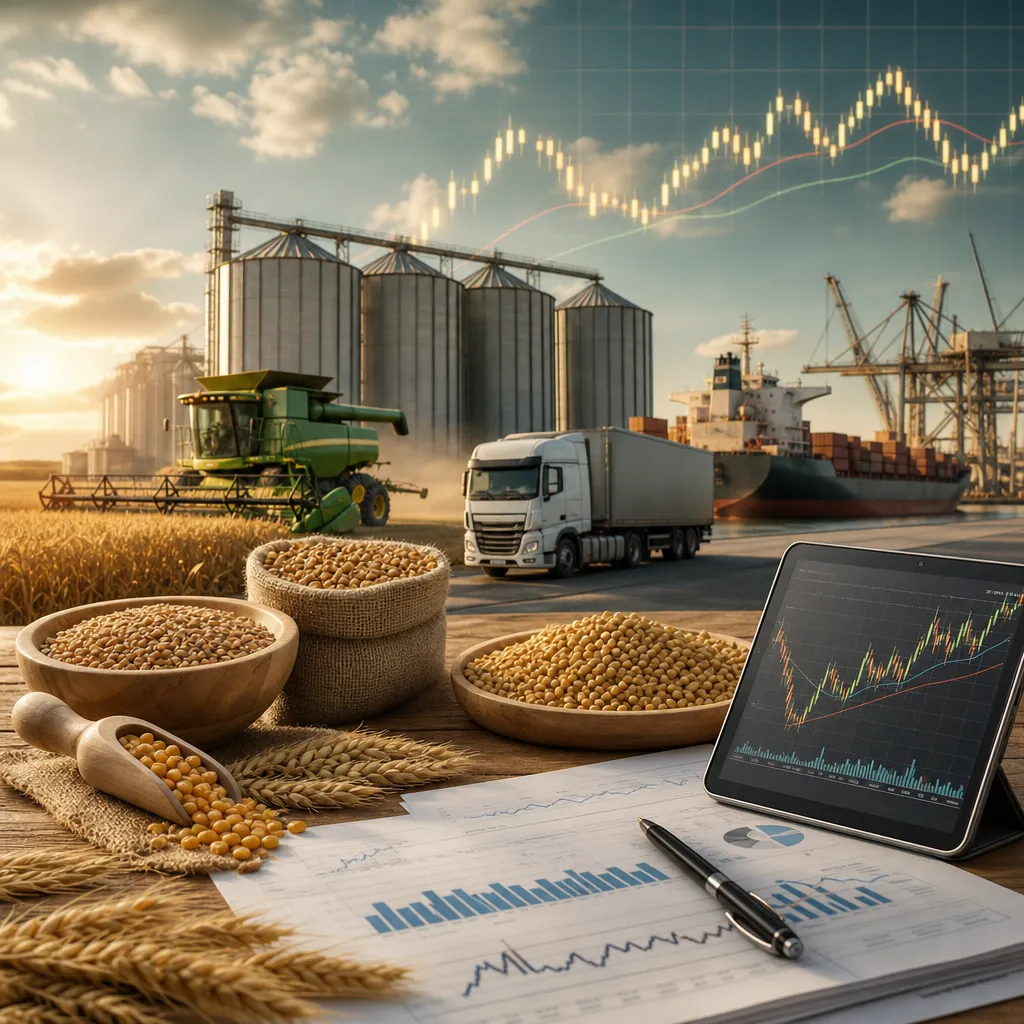









The Black Sea grain market is not a single exchange or a single country. It is a regional export market centered on major wheat, corn, barley, and oilseed flows from Black Sea countries, especially Russia, Ukraine, and Romania, with Bulgaria also relevant and Turkey important as both an importer and a transit point. In practice, “Black Sea grain price trends” usually refers to how export prices from ports in this region move relative to global benchmarks such as Chicago wheat or Euronext wheat. These trends matter because the Black Sea is one of the world’s most influential grain export zones, and price moves there can affect importers across the Middle East, North Africa, Asia, and beyond.
Unlike a single domestic cash market, the Black Sea market is a network of farm-gate bids, inland elevator prices, river and rail values, port delivered prices, and export offers quoted in different currencies and on different terms. Export business is commonly discussed in U.S. dollars per metric ton, while domestic transactions can also be quoted in local currencies. To understand price trends correctly, readers need to separate futures benchmarks from physical export values and understand how freight, quality, basis, currency, and logistics shape the final price.
What the Black Sea Grain Market Covers
Geographically, the Black Sea grain market mainly refers to grain moving through ports on the Black Sea and nearby connected routes. Russia is a major wheat exporter from Black Sea ports. Ukraine remains a major grain and oilseed supplier when logistics permit, with exports influenced by war-related risks and route availability. Romania is a major European Union grain exporter and an important gateway, including for some regional transit flows. Bulgaria also participates in regional grain export trade, while Turkey plays a major importing, milling, and shipping role.
The core commodities are:
- Wheat, especially milling wheat for export tenders and private trade
- Corn, used for feed and export
- Barley, including feed barley
- Sunflower products, although these are outside pure grain, they often matter in regional oilseed trade analysis
For export comparisons, the most common unit is U.S. dollars per metric ton. In domestic trade, local currencies are also used, depending on the country. Price reporting often uses trade terms such as FOB and CIF, which are essential for understanding Black Sea trade.
Why the Black Sea Matters for Global Price Trends
The Black Sea matters because it is one of the lowest-cost grain export origins in many marketing years. Importers often compare Black Sea wheat and corn with supplies from the European Union, the United States, Argentina, Australia, and sometimes Brazil. When Black Sea export offers are competitive, they can pressure global prices. When Black Sea supply is disrupted by weather, policy changes, logistics problems, or conflict, world prices can rise quickly.
This region is especially influential in wheat. Large importers in North Africa and the Middle East frequently monitor Black Sea offers when issuing tenders. If Russian export prices decline, for example, other exporters may need to lower offers to remain competitive. If Romanian or Ukrainian corn becomes hard to ship, nearby importers may shift demand to other origins.
That is why “Black Sea grain price trends” should be read not only as local market information but also as a signal for world grain trade.
How Black Sea Grain Prices Are Formed
Black Sea grain prices are formed through the interaction of global benchmarks, local supply and demand, export competition, and logistics. There is no single official spot price for the entire region. Instead, market participants piece prices together from several layers.
| Price type | Where quoted | What it means |
|---|---|---|
| Futures price | Exchange such as CME Group or Euronext | A standardized contract price used for price discovery and hedging, not the exact port or farm price |
| Local cash bid | Farmer, silo, elevator, or processor market | The spot or nearby physical buying price in a local area, often in local currency |
| Delivered port price | Inland-to-port physical market | Price for grain delivered to a port terminal, reflecting transport and handling |
| FOB price | Export market | Free on Board value at the port, excluding ocean freight after loading |
| CIF price | Import market or tender market | Cost, insurance, and freight to the destination buyer |
| Basis | Cash versus futures relationship | The difference between local physical price and benchmark futures, influenced by logistics, quality, and local market conditions |
For example, a Black Sea export wheat offer may move because Chicago or Euronext futures rise, but it may also move because port congestion eases, exporters become more aggressive, or inland farmers hold back sales. Quality matters greatly in wheat: protein content, test weight, moisture, and other specifications affect export value. Corn values may react strongly to harvest pressure, feed demand, and shipping availability.
Currency is also important. Even when export prices are quoted in U.S. dollars, domestic grain is produced, handled, and often financed in local currency. Exchange rate moves can therefore change local selling incentives and alter export competitiveness.
Benchmarks and Exchanges That Influence the Region
The Black Sea grain trade is heavily influenced by futures markets even though much physical trade happens privately. The most relevant international benchmarks are usually:
- CME Group wheat futures, especially Chicago wheat and sometimes Kansas City wheat
- Euronext milling wheat futures, widely followed for European and nearby export competition
- CME Group corn futures for corn price direction
These exchange prices are not the same as Black Sea port prices. They are benchmark reference points. Traders, exporters, mills, and risk managers use them to hedge or estimate market direction. A physical exporter might buy grain inland, sell FOB cargoes, and hedge part of the price exposure using futures through a broker. A farmer or local merchant may watch futures online but still negotiate the actual physical sale separately.
Because the Black Sea is deeply connected to both European and global trade, Euronext often matters for wheat moving from Romania and Bulgaria, while Chicago futures can still influence sentiment and inter-origin comparisons. The relationship is practical rather than perfect: the hedge reduces general price risk, but basis risk remains because local Black Sea prices can diverge from the futures benchmark.
Where to Check Black Sea Grain Prices and Market Information Online
If a reader wants a current Black Sea grain price, the first step is to define the exact market: wheat or corn, which origin country, what quality, what shipment period, and whether the quote is local cash, port delivered, FOB, or CIF. Without that context, “the Black Sea price” is too broad.
Reliable places to check market information include official and institutional sources, exchange sites for benchmark futures, and recognized reporting channels used by the trade.
| Source type | What you can check | How it helps |
|---|---|---|
| CME Group | Wheat and corn futures benchmarks | Shows global price direction and hedging references |
| Euronext | European milling wheat futures | Useful for EU and nearby Black Sea export comparisons |
| USDA | World supply, demand, export outlook, and country analysis | Useful for trend context rather than local cash bids |
| European Commission | EU market information and trade data | Important for Romania and Bulgaria within the EU framework |
| National agriculture and statistics bodies | Crop progress, production, trade, and domestic market updates | Helps explain local supply pressure and shipment capacity |
| Merchants, exporters, brokers, elevators, cooperatives | Actual bids, offers, quality spreads, and nearby delivery terms | Most relevant for real physical buying and selling |
For physical trade, many current bids are not fully public. Traders often gather the market through direct contact with exporters, local merchants, cooperatives, port buyers, and brokers. That is why a futures quote seen online should never be treated as the exact farm-gate or port cash price.
How Grain Is Actually Bought and Sold in the Black Sea Region
Physical grain trade in the Black Sea region happens through a chain of farmers, collectors, inland elevators, processors, exporters, and port terminals. A producer usually does not “sell on an exchange” in the same way as a futures trader. Instead, grain is sold under a commercial contract with a buyer.
Typical physical trade channels include:
- Farm to local elevator or merchant, often for immediate delivery or short-term storage
- Farm or collector to processor, such as a flour mill or feed mill
- Inland merchant to exporter, with grain assembled to meet vessel-size demand
- Exporter to overseas buyer, often on FOB terms, sometimes tied to tenders or destination demand
The contract normally specifies commodity, quality, quantity, delivery period, delivery point, payment terms, and dispute standards. Quality is especially important in wheat export business. A cargo sale can be priced against the current cash market, against a formula linked to a futures benchmark, or through negotiated flat price terms.
Importantly, physical trading and hedging are different activities. A merchant may own physical grain and hedge price risk separately in futures. A speculator may trade futures without owning any grain at all.
Export Routes, Logistics, and Why Port Values Differ from Inland Prices
Black Sea price trends are strongly shaped by logistics. Inland grain values do not automatically equal port values because transport costs and bottlenecks can be significant. Rail capacity, truck availability, river logistics, storage conditions, and port handling all influence what an exporter can pay inland.
Russia’s export market depends heavily on Black Sea port loading capacity and inland rail and truck movement from producing regions. Romania’s role includes its own crop exports and its access to Black Sea shipping through its ports, integrated with EU transport networks. Ukraine’s export pathways have been unusually sensitive in recent years to security conditions, available corridors, river movements, border transshipment, and neighboring-country routing.
When port demand is strong and logistics run smoothly, basis may strengthen and inland prices can rise relative to futures. When transport is disrupted or ports are congested, inland prices can weaken even if global futures are stable or higher. This is why regional grain market analysis must always include logistics, not just crop size.
Main Drivers of Black Sea Grain Price Trends
Black Sea grain prices can trend up or down for several reasons at once. A practical way to analyze the market is to track a short list of recurring drivers.
| Driver | Likely market effect | Why it matters |
|---|---|---|
| Weather and yields | Can sharply tighten or loosen exportable supply | The region’s wheat and corn output is highly weather-sensitive |
| Harvest pace | Often pressures prices during heavy movement | Large seasonal deliveries can weaken nearby cash bids |
| Export policy and regulation | Can alter competitiveness and trade flow | Taxes, quotas, or administrative changes affect seller behavior |
| Currency moves | Can support or limit farmer selling and export margins | Exports are internationally priced but local costs are not |
| Freight and logistics | Changes basis and port competitiveness | Transport constraints can disconnect inland and export prices |
| Importer demand | Supports FOB offers when tenders are active | North African and Middle Eastern buying is especially influential |
| Competing exporters | Can cap Black Sea rallies or force discounts | The region competes directly with EU, U.S., Australian, and South American origins |
How Market Participants Hedge Black Sea Grain Exposure
Hedging is common, but it is usually done through international futures markets rather than through a single dedicated Black Sea exchange contract used by all participants. Exporters, merchants, processors, and sometimes large producers may hedge price exposure with wheat or corn futures and sometimes options.
In practical terms:
- A merchant buys physical grain from a farmer or collector.
- The merchant plans to resell domestically or export through a port.
- To manage the risk of a market drop before resale or shipment, the merchant may sell futures through a broker.
- When the physical sale is completed, the hedge is adjusted or closed.
This process does not eliminate all risk. The largest remaining exposure is often basis risk: the local Black Sea cash market may strengthen or weaken relative to the hedge benchmark. There can also be quality risk, logistics risk, counterparty risk, and financing risk.
Anyone seeking only financial price exposure normally accesses futures through a regulated broker and posts margin. That is different from buying or selling physical grain cargoes, which requires commercial counterparties, logistics capability, and contract management.
Outlook: How to Read Future Black Sea Grain Trends
A sound forecast for Black Sea grain prices should be scenario-based rather than certain. The region can shift quickly because weather, policy, and logistics all matter.
Bullish scenario: prices can rise if production disappoints, adverse weather reduces yield or quality, export flows are disrupted, or import demand becomes aggressive while competing exporters are tight.
Bearish scenario: prices can weaken if crops are large, harvest movement is heavy, export systems function smoothly, and importers have many alternative origins to choose from.
Mixed scenario: futures may fall while local cash stays firm if nearby export demand is strong, or futures may rise while inland prices lag if transport bottlenecks widen basis. That is why trend analysis must track both benchmark futures and local physical market signals.
For readers following this market closely, the most practical routine is to monitor benchmark futures, official crop and trade reports, tender results from major importers, and direct indications from merchants or port buyers. No single number captures the whole Black Sea market.
What does “Black Sea grain price” usually mean?
It usually refers to export-oriented grain prices from Black Sea origins such as Russia, Ukraine, Romania, or Bulgaria, often quoted in U.S. dollars per metric ton on FOB or delivered-port terms.
Where can I check Black Sea grain prices online?
You can check benchmark futures on CME Group and Euronext, broader market outlook from USDA, and EU market information from the European Commission. For actual physical bids and offers, traders often rely on merchants, exporters, brokers, and local buyers.
Are Black Sea grain prices the same as Chicago or Euronext futures?
No. Futures are benchmark contracts used for price discovery and hedging. Black Sea physical prices also reflect basis, quality, location, transport, storage, currency, and nearby buyer demand.
In what currency and unit are Black Sea grain prices quoted?
Export trade is commonly discussed in U.S. dollars per metric ton. Domestic transactions may also be quoted in local currencies, depending on the country and the buyer.
How is grain physically sold in the Black Sea region?
Grain is usually sold through contracts between farmers, merchants, processors, exporters, and overseas buyers. The contract defines quality, quantity, delivery point, timing, and payment terms.
Can a trader hedge Black Sea grain without owning physical grain?
Yes. A trader can use wheat or corn futures and options through a broker to gain or hedge price exposure. That is financial trading, not the same as owning, storing, or shipping grain.
Why do inland prices differ from port export prices?
Because inland prices must account for transport, handling, storage, and local buyer competition. If logistics are difficult, port values may not fully pass back to farms and inland elevators.
What are the biggest drivers of Black Sea grain trends?
The main drivers are weather, crop size, harvest pace, export policy, logistics, currency moves, importer demand, and competition from other exporting regions.
Sources
- USDA Foreign Agricultural Service
- CME Group
- European Commission