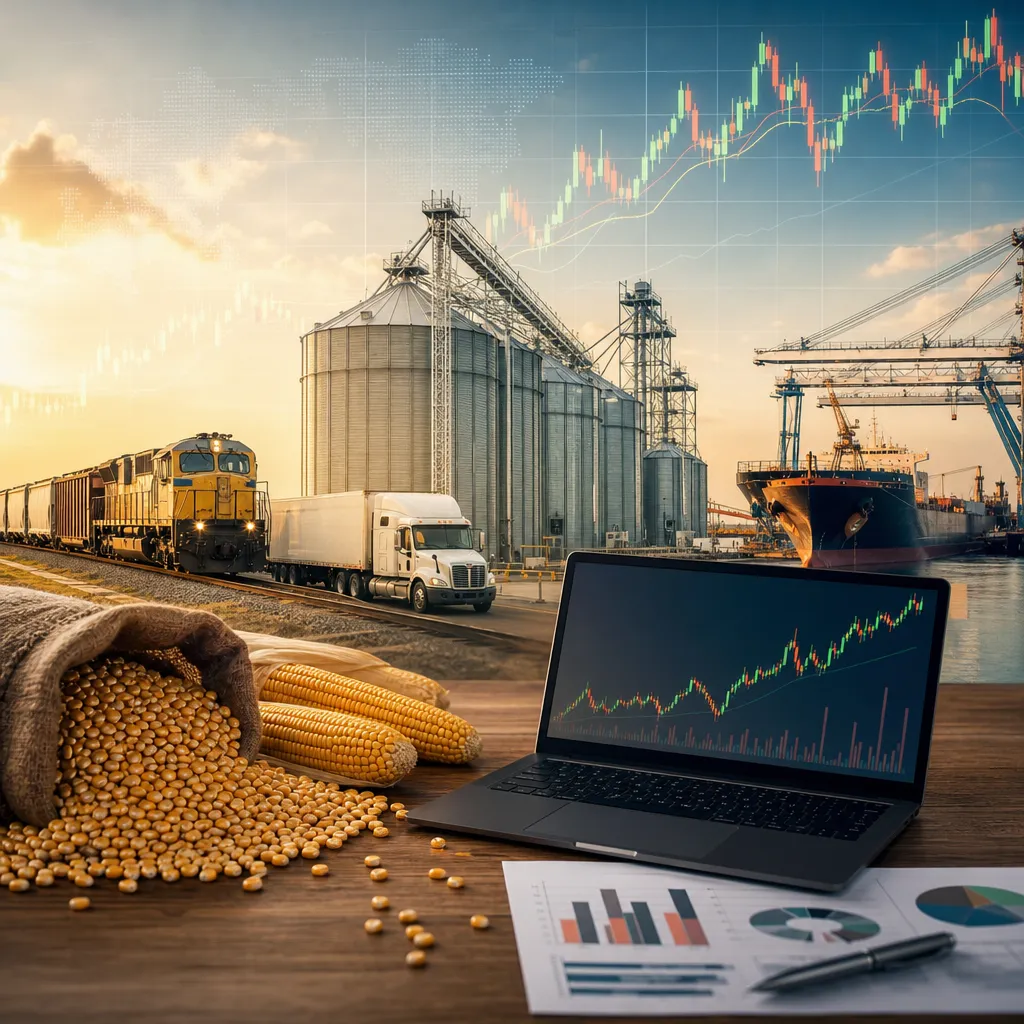



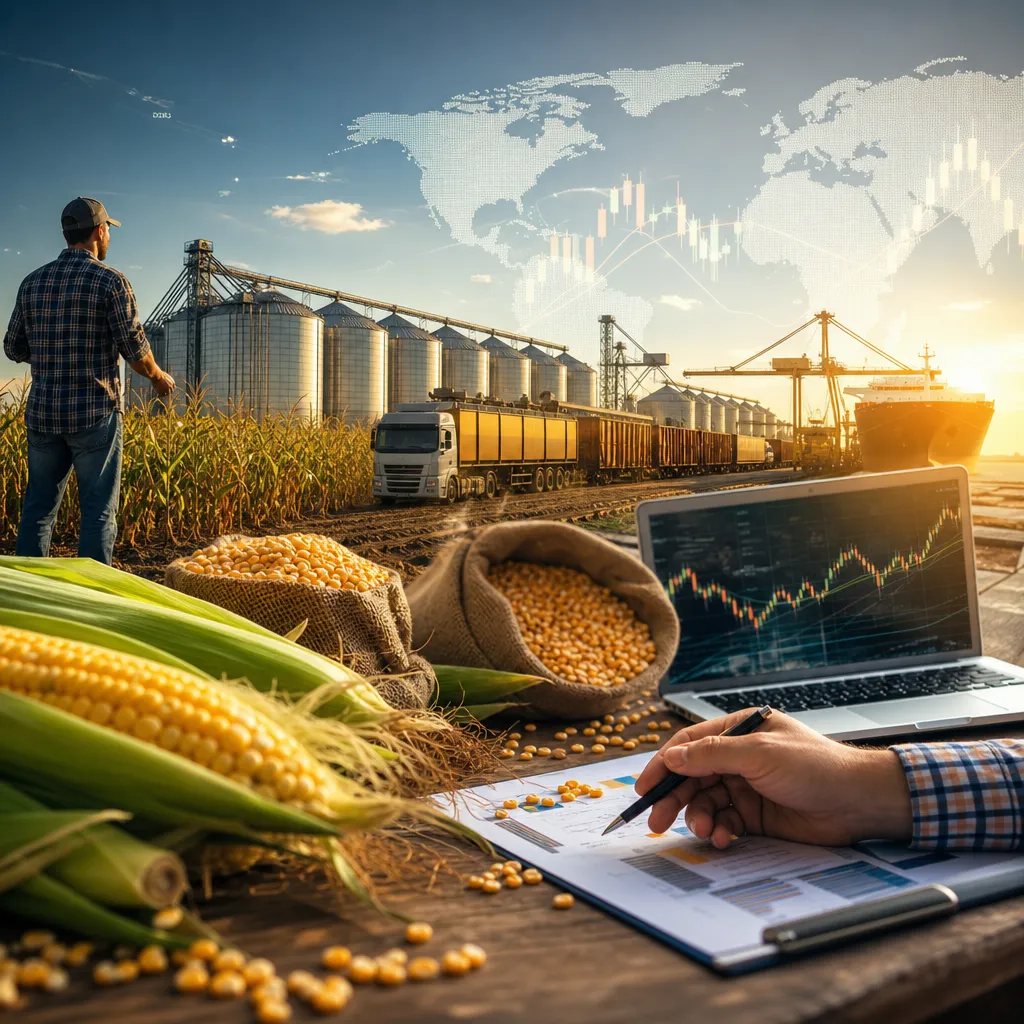
A corn price forecast is best understood as a range of plausible market outcomes, not a single number. Corn prices move through the interaction of weather, acreage, yield, stocks, exports, feed demand, ethanol demand, currency moves, and freight, while the price a farmer or buyer sees locally also depends on basis and logistics. In practice, most market participants track two parallel markets: exchange-traded corn futures for the benchmark price, and local cash bids at elevators, cooperatives, processors, or export points for the actual physical trade price. A useful forecast therefore asks two questions at once: where benchmark futures may go, and how local cash basis may strengthen or weaken around that benchmark.
For most international market participants, the main benchmark is Chicago corn futures traded at CME Group. That benchmark is widely used by farmers, merchandisers, feed buyers, ethanol plants, exporters, importers, and speculators, but it is not the same as a local farmgate price. If you need a practical forecast, start with the futures outlook, then compare it with local bids, freight, quality adjustments, and storage economics in your own region.
How a corn price forecast works in practice
A corn price forecast combines fundamental analysis with market structure. Fundamental analysis looks at supply and demand: planted area, crop condition, yield potential, old-crop stocks, new-crop production, exports, imports, feed use, industrial use, and policy effects such as biofuel mandates. Market structure looks at futures spreads, basis, storage incentives, and the relationship between nearby and deferred contracts.
In the online market, futures prices are visible almost continuously through exchange data vendors, broker platforms, and market information services. In the physical market, prices are negotiated or posted by grain elevators, cooperatives, merchants, feed mills, processors, or exporters for a specific location and delivery period. A forecast becomes more useful when it connects both worlds.
| Market layer | What it shows | Where to check it | Who uses it |
|---|---|---|---|
| Futures market | Benchmark exchange price for standardized corn contracts | CME Group data, futures brokers, market data platforms | Traders, hedgers, analysts, merchants |
| Cash market | Actual local bid or offer for physical corn | Elevators, cooperatives, processors, exporters, local market reports | Farmers, feed mills, buyers, merchants |
| Basis market | Difference between local cash price and futures price | Local bids, merchandiser quotes, farm marketing software | Farm marketers, grain merchandisers, processors |
| Export market | Port values influenced by global demand, freight, and currency | Exporter indications, trade reporting, government export data | Exporters, importers, trading houses |
Main drivers of the corn price forecast
The most important variable is yield. Corn has a large weather premium because yield can change materially with heat and dryness during pollination and grain fill. Acreage matters too, but once planting is complete, weather and crop condition updates often dominate near-term price direction.
Stocks are the second major driver. A market with comfortable ending stocks can absorb production problems more easily than a market with tight stocks-to-use. That is why the same weather event may produce a mild reaction in one year and a sharp rally in another.
Demand is equally important. Corn demand comes from livestock feed, ethanol and other industrial uses, and exports. If feed margins weaken, ethanol margins shrink, or a major importer switches origin, prices may soften even without a large crop. Currency moves also matter because they change export competitiveness. A stronger dollar can make U.S. corn less competitive, while a weaker dollar can support exports.
| Driver | Typical effect on prices | How to monitor it |
|---|---|---|
| Acreage | More area can increase supply potential; less area can tighten outlook | USDA acreage reports, national farm surveys |
| Weather and yield | Adverse weather often supports prices; favorable weather can pressure them | Weather maps, crop condition reports, satellite and field data |
| Ending stocks | Tighter stocks usually increase sensitivity to supply shocks | USDA WASDE, balance sheets, national statistics |
| Exports | Stronger export demand can support basis and futures | USDA Export Sales, customs and trade data |
| Energy and ethanol | Better ethanol economics can improve corn demand | Energy market data, processor margins, industry reports |
| Freight and logistics | Higher transport cost can weaken local bids away from destination markets | River, rail, truck, and port logistics updates |
Forecast scenarios: bullish, neutral, and bearish
A practical corn forecast should be scenario-based.
Bullish scenario: weather stress reduces yield potential, crop ratings deteriorate, old-crop stocks are already tight, and export or ethanol demand stays firm. In that setting, futures may rise and basis may also strengthen if local users need coverage and logistics are constrained.
Neutral scenario: acreage is near expectations, weather is mixed but not destructive, and demand remains steady. In this case the market often trades within a broad range, reacting to each official report and short-term weather update without establishing a lasting trend.
Bearish scenario: favorable weather lifts yield expectations, planted area is ample, stocks rebuild, and exports face stronger competition from other origins. Futures can weaken in that environment, while harvest pressure may also push basis lower where storage is limited.
These scenarios matter because local cash outcomes can diverge from futures. A farmer in a deficit feed region may still see relatively strong bids in a weak futures market. Conversely, a large crop in a transport-constrained area can produce depressed local bids even if futures hold up reasonably well.
Where to check corn prices and forecast inputs
For benchmark prices, CME Group is the relevant exchange for U.S. corn futures. Many brokers and market-data vendors distribute delayed or real-time futures data, depending on the service. Traders use these quotes to track the board price, spreads between contract months, and option premiums.
For public fundamental data, USDA is the most important source for the global corn market. The WASDE report provides supply and demand tables, including production, exports, and ending stocks. Crop Progress provides weekly condition and planting or harvest updates in season. Export Sales helps monitor forward demand and shipment pace.
For positioning data, the U.S. Commodity Futures Trading Commission publishes Commitments of Traders. This shows broad categories of futures and options holdings and is often used to judge whether speculative length or short covering may amplify price moves.
For local physical prices, farmers and buyers usually check elevator bid sheets, cooperative websites, grain merchant offers, processor bids, ethanol plant bids where relevant, or official state and regional market reporting systems. In some countries, ministries of agriculture, marketing boards, or commodity exchanges publish reference cash prices, but actual physical deals still depend on quality, delivery point, timing, and freight.
Futures prices versus local cash corn prices
This is the most important distinction in any corn price forecast. Futures are standardized exchange contracts. Cash prices are the real physical prices paid for corn at a specific place for a specific delivery period and quality. The difference between the two is called basis.
If December corn futures rise but local elevators are overloaded at harvest, the local cash bid may not rise by the same amount because basis can weaken. If a processor needs immediate grain and local supply is tight, basis can strengthen sharply even if futures are flat.
Physical transactions usually move through one of several channels: a farmer sells to a local elevator or cooperative; a merchant buys and resells to a processor, feed mill, or exporter; or a buyer contracts directly with a producer or a broker. The contract may be spot, forward cash, basis-only, futures-fixed, or hedge-to-arrive, depending on local market practice. The final value depends on grade, moisture, test weight, discounts, drying charges, freight, unloading terms, and payment timing.
How farmers, buyers, and traders use the forecast
Farmers use a forecast to decide whether to make cash sales, store grain, use a forward contract, or hedge with futures or options. Storage only makes sense if the expected carry, basis improvement, or seasonal rally is enough to offset storage cost, shrink, interest, quality risk, and logistics risk.
Feed mills, livestock producers, and processors use the forecast to schedule coverage. They may buy physical corn forward from merchants or elevators, or hedge anticipated needs in the futures market through a broker. Importers often monitor both origin prices and ocean or inland freight because a lower grain price can be offset by higher transport cost.
Speculators and financial traders use the forecast differently. They trade futures or options through a regulated broker account, post margin, and manage leverage. This is financial trading, not the same as buying truckloads or railcars of corn. Futures contracts can lead to delivery obligations if held into the delivery process, although many speculators close or roll positions before that stage.
How to build a practical corn price forecast step by step
- Start with the benchmark. Identify the relevant futures contract month, such as nearby or new-crop corn.
- Check the balance sheet. Review production, use, exports, and ending stocks from USDA or the relevant national agency.
- Follow weather and crop condition. During the growing season, this is often the main short-term driver.
- Review demand indicators. Watch export sales, feed demand conditions, and ethanol or industrial demand where relevant.
- Measure basis locally. Compare nearby bids from elevators, cooperatives, processors, or merchants in your delivery area.
- Include logistics. Assess truck availability, rail service, river conditions, port congestion, and storage capacity.
- Build scenarios. Estimate what changes if yield is better, worse, or near trend and whether basis likely strengthens or weakens.
- Match the forecast to a decision. Selling physical grain, hedging futures, buying feed, or storing inventory each requires a different focus.
A common mistake is relying on the board alone. Another is treating an annual forecast as fixed when corn prices often reprices quickly after weather shifts or major reports. For physical participants, a forecast without basis, freight, and quality assumptions is incomplete.
Key risks and limitations in any corn forecast
Forecasts fail most often because weather changes faster than assumptions, official estimates are revised, or demand weakens unexpectedly. Policy can also matter: import restrictions, biofuel policy changes, export competition, or currency shocks can alter trade flows quickly.
There is also a timing risk. A forecast may be directionally right but commercially unhelpful if the market moves before or after a participant needs to act. A farmer with full bins and a nearby cash flow need faces a different decision from an end user buying six months forward.
For hedgers, basis risk remains even if futures are used correctly. A short futures hedge can protect against a drop in the benchmark price, but it does not guarantee the local basis. For buyers, long futures can offset a rise in benchmark values but not every change in freight or quality premium.
FAQ
Where can I check corn prices today?
Check benchmark futures through CME Group data or a futures broker platform, and check actual physical cash bids through local elevators, cooperatives, processors, grain merchants, or official regional market reports. The local cash price may differ materially from futures because of basis, freight, and quality adjustments.
What is the difference between corn futures and cash corn prices?
Futures are exchange-traded standardized contracts used for price discovery and hedging. Cash prices are what a buyer pays for physical corn at a specific location and time. Cash price equals the futures reference plus or minus basis, then possibly further adjusted for quality and handling.
Where does physical corn buying and selling usually happen?
Most physical trade happens through grain elevators, cooperatives, merchants, processors such as feed manufacturers or ethanol plants, exporters, and sometimes direct farm-to-buyer contracts. The transaction is tied to a delivery point, quality specification, and payment term.
How do I use a corn price forecast if I am a farmer?
Use it to compare selling now versus later, storing corn versus moving it at harvest, and cash marketing versus hedging. Combine the forecast with your local basis, storage cost, moisture and quality outlook, and cash flow needs.
Which reports matter most for corn forecasts?
USDA WASDE is central for supply and demand. USDA Crop Progress matters during planting and growing season. USDA Export Sales helps track demand. CFTC Commitments of Traders can help interpret speculative positioning in futures and options.
Can I trade corn prices online without handling physical grain?
Yes. That is done through futures and options accounts with regulated brokers offering exchange access. This is financial trading and involves margin, leverage, and market risk. It is not the same as purchasing physical corn from an elevator or merchant.
Why can my local corn bid fall even if futures are stable?
Because basis can weaken. Common reasons include large local supplies, limited storage space, transport bottlenecks, weak processor demand, or higher freight from your area to the end market.
Is storing corn always the best response to low harvest prices?
No. Storage only pays if later basis improvement or futures carry is enough to cover storage cost, interest, shrink, drying, spoilage risk, and operational constraints. In some years the market pays poorly for storage.
Sources
- USDA World Agricultural Supply and Demand Estimates
- CME Group Corn Futures and Options Contract Information
- U.S. Commodity Futures Trading Commission Commitments of Traders