

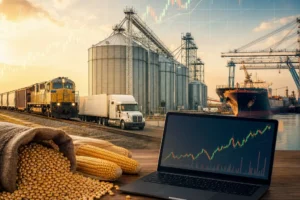








Argentina corn prices today usually refers to the price of maize in the Argentine physical grain market, especially in the country’s main producing provinces and export corridors linked to the Paraná River port system. Argentina is one of the world’s major corn exporters, so local prices are shaped by both domestic conditions and international benchmarks. In practice, there is no single national “today price”: farmers, exporters, feed users, and traders watch a combination of exchange references, export parity, cash bids, currency moves, and logistics costs. To understand Argentine corn prices properly, readers need to separate futures values from local cash offers and export bids.
The core geography is Argentina, with the most influential commercial flow running from the central agricultural belt toward Up-River export terminals near Rosario in Santa Fe. Corn is produced widely, especially in the Pampas region, and traded in both domestic and export channels. Prices are commonly discussed in Argentine pesos per metric ton in local cash trade, while export and international comparisons often use U.S. dollars per metric ton. The global benchmark most market participants monitor is Chicago corn futures, but the local physical price in Argentina can trade above or below that benchmark once basis, freight, quality, and currency are taken into account.
What “Argentina corn prices today” means in practice
When market participants ask for Argentina corn prices today, they may mean several different things:
- Local cash bid: what a buyer such as an exporter, processor, feed mill, or merchant is willing to pay for physical corn in a specific location.
- Delivered price: the price for corn delivered to a named destination, such as a plant, warehouse, or port-area facility.
- Export bid: what exporters can pay inland based on expected export sales and port economics.
- Futures reference: a price from a derivatives market used as a benchmark, not the same as a farm-gate price.
- FOB indication: the export value of corn loaded on board a vessel at an Argentine port, before ocean freight.
Because these are different markets, two people in Argentina can both quote “today’s corn price” and still be talking about different numbers. A farmer in Córdoba may look at a local truck-delivered bid in pesos, while an exporter may assess a dollar-denominated port value linked to international demand.
Where the Argentine corn market operates
Argentina’s corn market operates across production zones, inland collection points, commercial grain networks, and export hubs. The country’s central grain economy is heavily connected to Santa Fe, Córdoba, Buenos Aires, Entre Ríos, and surrounding provinces.
The most important reference area for export trade is the Up-River zone on the Paraná River, especially around Rosario. This area matters because a large share of Argentina’s grain export logistics is organized through river terminals and associated crushing, storage, and shipping infrastructure. Inland corn values often move in relation to what buyers can pay into these export channels after deducting freight and handling costs.
Domestic consumption also matters. Corn is used inside Argentina for feed, livestock, poultry, dairy, and industrial processing including ethanol. That means the local market is not purely an export market; buyers compete for grain depending on season, regional supply, and end-user demand.
| Market segment | Where it operates | What the price means |
|---|---|---|
| Farm-gate or local cash market | Producing regions and local buyers | Price paid for physical grain at or near origin, often adjusted for delivery terms and quality |
| Delivered inland market | Processors, feed users, warehouses, regional merchants | Price for grain delivered to a specific inland destination |
| Port/export market | Rosario/Up-River and other export-linked zones | Export-oriented buying value influenced by FOB demand and logistics |
| Futures/derivatives reference | Exchange-traded market | Benchmark used for price discovery and hedging, not identical to a spot cash transaction |
How corn prices are formed in Argentina
Argentine corn prices are formed from a mix of global and local factors. The starting point for many export-oriented calculations is often the international corn market, particularly Chicago futures. But that is only a benchmark. The actual Argentine cash price depends on what is known as basis, meaning the difference between the benchmark futures value and the local physical market value.
Basis in Argentina can strengthen or weaken because of:
- distance to export terminals or domestic consumers,
- truck or rail freight costs,
- port demand and vessel lineup,
- harvest pressure or tight nearby supply,
- quality specifications and moisture,
- storage availability,
- competition among exporters and domestic users,
- movements in the Argentine peso against the U.S. dollar,
- government policy and export market conditions.
Currency is especially important. Corn is globally traded in dollars, but many local transactions and producer decisions are influenced by pesos. A shift in the exchange environment can materially affect the local price a seller sees, even when the international corn market is quiet.
It is also important to distinguish price types:
- Futures price: exchange-traded reference for a standardized contract month.
- Cash bid: buyer’s actual offer for physical corn at a place and time.
- Delivered price: price including movement to the specified destination.
- FOB price: export value at the port, loaded on board, before ocean freight.
- CIF price: import-oriented concept including cost, insurance, and freight to destination; useful more for destination markets than for Argentine domestic cash trade.
Where to check Argentina corn prices online
For reliable daily market information, readers should use recognized market institutions and official reporting bodies rather than social media screenshots or unverified messaging groups.
Useful places to check include:
- Bolsa de Comercio de Rosario (BCR): one of the main references for Argentina’s grain market, with market commentary and cash-market information relevant to the Rosario and export corridor.
- Matba Rofex: the principal Argentine futures and derivatives exchange relevant to agricultural hedging and price referencing.
- Bolsa de Cereales: widely followed for crop, market, and agricultural information in Argentina.
- Secretaría de Agricultura, Ganadería y Pesca: official Argentine agriculture authority for market and sector information.
- USDA reports: useful for global balance sheets, Argentina production context, and export competition, though not a substitute for a local cash bid.
- Local cooperatives, acopios, exporters, and grain merchants: often the most practical source for a real executable bid in a producer’s area.
If someone needs the actual price they can sell at today, the most relevant number is usually a bid from a local buyer or broker for a defined quality, delivery point, and payment term. Exchange screens and international futures show market direction, but the physical transaction still depends on basis and logistics.
| Source type | What it provides | Best use |
|---|---|---|
| Argentine exchange/market institutions | Market references, futures data, commentary, sometimes spot indications | Price discovery and market context |
| Government agriculture sources | Sector data, official market context, policy information | Understanding regulation and domestic fundamentals |
| USDA and international reports | Global supply/demand, export competition, crop outlook | Benchmarking Argentina within world markets |
| Local buyers and brokers | Executable bids for specific locations and delivery windows | Actual selling and procurement decisions |
Physical grain trade: how corn is actually bought and sold
Most Argentine corn is not sold by retail investors clicking a futures screen. It is traded physically through the commercial grain chain. Sellers include farmers and, at times, holders of stored grain. Buyers may include exporters, feed manufacturers, poultry and livestock operators, ethanol plants, starch users, merchants, and cooperatives.
A physical grain transaction usually involves these steps:
- Price inquiry for spot or forward delivery.
- Agreement on location, quality, quantity, and delivery window.
- Definition of payment terms and commercial conditions.
- Delivery by truck or through a storage/commercial facility.
- Quality verification and settlement.
Inland buyers may quote a delivered price to their plant, while exporters often bid based on what they can pay for grain that will move into port logistics. In harvest periods, local prices can come under pressure if transport and storage systems are crowded. In tighter supply periods, basis may improve if exporters or domestic users compete more aggressively for nearby grain.
Counterparty quality matters. In physical trade, sellers care about payment reliability, weights, grading, moisture treatment, and contractual clarity. The highest quoted price is not always the best price if deductions, timing, or credit risk are unfavorable.
Futures and hedging in Argentina
Argentine corn market participants also use futures and other derivatives for risk management. This normally takes place through Matba Rofex or, for international benchmarking, indirectly through markets such as CME Group’s Chicago corn futures via appropriately structured brokerage access.
The key point is that futures trading is different from physical grain ownership:
- Physical grain sale: transfers ownership of real corn.
- Futures hedge: manages price risk without necessarily moving physical grain at that moment.
- Speculation: takes a market view without an offsetting physical exposure.
A farmer may sell physical grain to a local buyer and use futures or forward tools to manage price exposure before sale. An exporter may buy grain in the cash market and hedge sales risk through futures. A trader may never touch physical corn at all, using derivatives only for financial exposure.
Anyone using futures needs a broker, a trading account, and sufficient understanding of margin, leverage, contract expiry, and basis risk. Even a perfect futures hedge does not eliminate the difference between exchange prices and the local Argentine cash market.
What drives Argentina corn price trends
Argentine corn price direction is shaped by both domestic crop conditions and the broader world grain balance. Forecasting should be treated as scenario analysis rather than certainty.
Main drivers include:
- Weather: planting conditions, rainfall, heat, and yield risk can alter production expectations.
- Harvest pace: rapid harvest generally increases spot supply pressure; delays can tighten nearby availability.
- Export demand: stronger international buying can support port bids and inland values.
- Competition from other exporters: U.S., Brazil, and Black Sea supply conditions matter to Argentina’s export pricing.
- Currency movement: local price behavior can diverge from global futures because of peso dynamics.
- Freight and logistics: transport constraints can widen discounts in interior regions.
- Domestic feed and industrial demand: stronger local use can support prices independently of export flow.
- Policy environment: trade rules and market regulation can influence selling pace and export economics.
In a bullish scenario, weather issues, slower farmer selling, solid export demand, or stronger domestic buyer competition can support basis and cash prices. In a bearish scenario, a large crop, smooth logistics, weak export interest, or heavy harvest selling may pressure local bids.
Why local cash prices differ from Chicago futures
Many readers expect Argentine corn prices to move one-for-one with Chicago. They do not. Chicago corn futures reflect a U.S.-based benchmark contract, while Argentine cash markets reflect local business conditions.
Local prices may differ because:
- Argentina’s harvest timing differs from the U.S. seasonal cycle,
- exporters price against their own shipment programs and destination demand,
- interior freight can materially reduce the farm-gate value,
- quality or moisture issues affect merchant bids,
- currency shifts change local purchasing power and selling behavior,
- domestic policy and local financing conditions influence grain marketing.
For this reason, a futures rally does not guarantee a proportionate rise in a producer’s local bid, and a futures drop does not always mean the local price falls equally. Basis can offset or amplify benchmark moves.
FAQ
Where can I check Argentina corn prices today?
Start with the Bolsa de Comercio de Rosario and Matba Rofex for market references, then confirm real executable bids with local cooperatives, acopios, exporters, or grain brokers in your area.
Are Argentina corn prices quoted in pesos or dollars?
Both can be relevant. Local physical transactions are often discussed in Argentine pesos per metric ton, while export values and international comparisons are commonly assessed in U.S. dollars per metric ton.
Is Chicago corn futures the same as the Argentina cash price?
No. Chicago is a global benchmark futures market. Argentine cash prices are local physical bids adjusted for basis, freight, quality, location, currency, and buyer competition.
What is the main export-linked corn market in Argentina?
The Rosario or Up-River corridor on the Paraná River is the main export-linked pricing center because it concentrates a large share of grain logistics and terminal activity.
How do farmers actually sell corn in Argentina?
Usually through physical contracts with cooperatives, merchants, acopios, processors, or exporters. The sale specifies quality, quantity, delivery point, timing, and payment conditions.
Can a trader gain exposure to Argentina corn prices online without buying physical grain?
Yes. That is normally done through futures or other derivatives via a broker. However, this gives financial exposure, not ownership of physical corn, and it involves margin and basis risk.
Why do corn prices differ between provinces or buyers?
Because transport costs, local supply, buyer demand, quality needs, and delivery terms vary. A port-area exporter and an inland feed user may value the same corn differently.
What are the main factors to watch for near-term Argentina corn price direction?
Weather, planting and harvest progress, export demand, competition from Brazil and the U.S., peso movement, logistics, and domestic consumption trends are the main practical drivers.
Sources
- Bolsa de Comercio de Rosario
- Matba Rofex
- USDA Foreign Agricultural Service