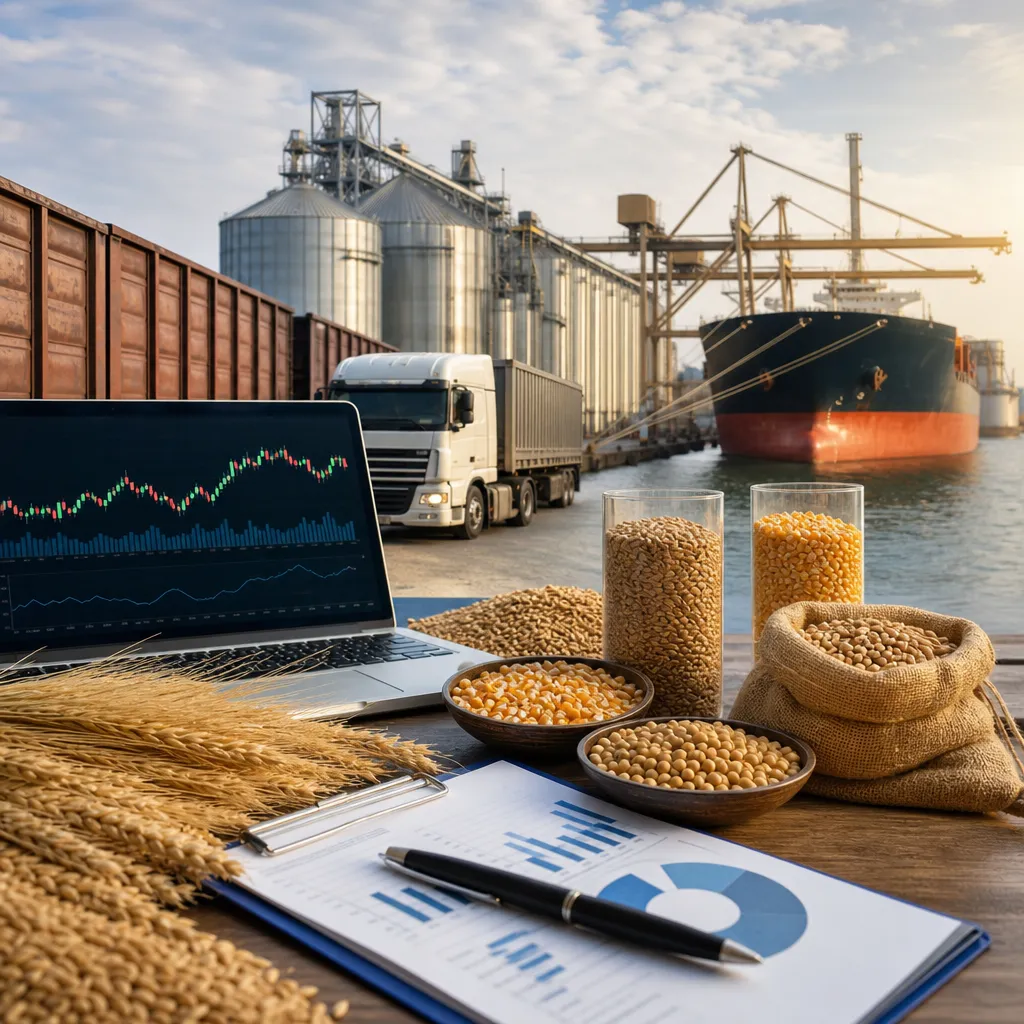








The Black Sea corn market refers to the export and physical grain trade centered on the Black Sea region, especially Ukraine, Romania, Bulgaria, and, to a lesser extent in corn, southern Russia. It is one of the world’s most closely watched origins because Black Sea corn competes directly with shipments from the United States, Brazil, and Argentina into Mediterranean, Middle Eastern, North African, and European destinations. When people ask for “Black Sea corn prices today,” they usually mean export-market indications at ports or FOB values rather than a single exchange-traded local cash price. There is no one official “Black Sea corn price” screen, so readers need to distinguish between futures benchmarks, port bids, export offers, and inland cash prices.
Geographically, the market operates across several countries with different currencies, logistics systems, and risk profiles. Romania and Bulgaria are European Union producers and exporters, typically pricing physical export grain in euros or U.S. dollars per metric tonne, depending on the trade. Ukraine is a major corn origin as well, with domestic prices often discussed in hryvnia per tonne inland, while export trade is commonly assessed in U.S. dollars per metric tonne. Because seaborne grain trade is international, FOB Black Sea offers are usually compared against global benchmarks such as CBOT corn futures and, for Europe-linked trade, Euronext grain markets.
What “Black Sea corn prices today” actually means
In practice, “today’s Black Sea corn price” can mean several different things, and each one reflects a different stage of the market.
- FOB port price: the value of corn loaded on a vessel at a Black Sea port, quoted in U.S. dollars per metric tonne.
- Port delivered price: the price paid for corn delivered to an export terminal or port location.
- Inland cash price: the local bid at farm, elevator, warehouse, or inland collection point, usually in local currency per tonne.
- CIF import price: the price including cost, insurance, and freight into the destination country.
- Futures benchmark: a financial market reference, such as CBOT corn futures, used to help structure hedges and price relationships.
Those are not interchangeable. A trader may watch CBOT futures online, negotiate a FOB price in dollars, and buy the physical corn inland in local currency. A farmer or local merchant may never trade futures directly but still receive a cash bid that is influenced by those benchmarks.
Where the Black Sea corn market operates
The term Black Sea in grain trade usually points first to the export corridor from the western and northern Black Sea region. For corn, the most relevant origins are:
- Ukraine: a major historical exporter of corn, with prices shaped by domestic crop size, logistics conditions, export access, and currency.
- Romania: an important EU corn producer and Black Sea exporter, especially through the port system linked to Constanța.
- Bulgaria: a smaller but relevant regional exporter when production allows.
- Russia: better known globally for wheat exports, though some corn also enters regional trade depending on production and internal economics.
These origins compete in overlapping demand zones. Buyers in Spain, Italy, the eastern Mediterranean, North Africa, and the Middle East may compare Black Sea origin against other suppliers based on landed cost, quality, timing, vessel size, and political or logistics risk.
| Market element | Where it operates | Typical unit/currency | Why it matters |
|---|---|---|---|
| Inland cash market | Farm, elevator, warehouse, processor, rail or truck loading point | Usually local currency per metric tonne | Reflects what the seller can actually receive locally |
| Port delivered market | Export terminals and port areas in Black Sea countries | Often U.S. dollars or euros per metric tonne | Connects inland grain to export business |
| FOB export market | Seaborne cargo trade from Black Sea ports | Usually U.S. dollars per metric tonne | Main international reference for Black Sea export competitiveness |
| Futures benchmark | CBOT and, indirectly for Europe-linked trade, Euronext | Exchange quotation by contract month | Used for hedging and price discovery, not exact local cash settlement |
How Black Sea corn prices are formed
Black Sea corn prices are formed through a chain of commercial relationships rather than one single public auction. Exporters, international trading houses, local merchants, feed manufacturers, warehouses, truckers, rail operators, barge operators where applicable, and port terminals all influence the net price.
The starting point is often a global benchmark. Corn values worldwide are heavily influenced by CBOT corn futures, because they provide a transparent international reference for nearby and forward months. In Europe-linked trade, Euronext grain markets can also matter indirectly, especially when buyers are comparing Black Sea corn with EU internal prices and feed grain alternatives.
From that benchmark, the market adds or subtracts a basis. Basis is the difference between the benchmark futures value and the local cash or export price. That basis reflects:
- distance to port or end user,
- regional supply and demand,
- quality specifications such as moisture, test weight, damage, or mycotoxin risk,
- available storage, drying, and handling capacity,
- currency movement,
- freight and insurance costs,
- political and logistics risk,
- buyer competition at a given moment.
For example, a strong export program and tight nearby supplies can lift port bids relative to futures. On the other hand, harvest pressure, transport bottlenecks, weak vessel demand, or a stronger local currency can weigh on inland values.
Why local cash prices differ from futures
This is one of the most important points for readers following “today’s” market. A futures price is a standardized financial contract. A Black Sea cash price is a negotiated physical grain value for a specific quality, place, and delivery period.
| Price type | What it represents | Common use | Key limitation |
|---|---|---|---|
| CBOT futures | Exchange-traded benchmark contract | Price discovery, hedging, speculation | Not a direct quote for Black Sea farm-gate corn |
| Port bid | Buyer bid at export terminal or nearby delivered point | Merchant and exporter procurement | Still excludes many farm-level costs |
| FOB offer | Value for cargo loaded on vessel | International export trade | Not equal to what inland sellers receive |
| Farm or elevator cash bid | Actual local purchase price for physical grain | Producer selling decisions | Can vary sharply by village, buyer, and quality |
A Black Sea exporter might hedge with futures, but the company still earns or loses money based on the local basis, execution, vessel timing, and freight. That is why readers should never assume that a futures chart equals the local physical market.
Where to check Black Sea corn prices online
There is no single universal government screen showing one official live Black Sea corn price. The most practical approach is to combine benchmark, official, and commercial sources.
Exchange benchmarks
- CME Group: for CBOT corn futures, which are widely used as the global benchmark for corn pricing and hedging.
- Euronext: useful for European grain market context and relative feed grain values, especially for Romania and Bulgaria within the EU environment.
Official supply and trade information
- USDA: World Agricultural Supply and Demand Estimates, Production reports, Grain reports, and FAS market information are widely used for global corn balance-sheet context.
- European Commission: useful for EU crop, trade, and market monitoring relevant to Romania and Bulgaria.
- National statistical and agricultural authorities: country-level production, trade, and crop updates when available.
Physical market and export indications
- Local elevators, merchants, cooperatives, and processors: these are often the most relevant sources for actual inland cash bids.
- Exporters and brokers: provide port-delivered and FOB market indications, usually to trade participants rather than the general public.
- Commodity news and market reporting services: widely used by traders for daily assessments, though access may be subscription-based.
For a producer or buyer in the region, the best “today” price is usually obtained by comparing several current bids from local buyers and then checking whether benchmark futures and currency markets are moving in the same direction.
How corn is actually bought and sold in the Black Sea region
The physical market is built around contracts and logistics, not around clicking a futures chart. Corn is commonly sold through merchants, grain collectors, cooperatives where relevant, processors, feed mills, or exporters.
Physical grain transactions
- A seller offers corn from farm storage, warehouse stock, or harvested flow.
- The buyer specifies quality terms, delivery location, delivery window, and payment terms.
- The parties agree whether the grain is sold ex-farm, delivered to warehouse, delivered to port, or against another named location.
- The grain is sampled and checked for contract quality.
- Logistics are arranged by truck, rail, or other available route.
- Payment takes place according to contract terms, often after final weights and quality confirmation.
For export cargoes, merchants aggregate corn from many inland origins, move it into terminal storage, and then execute sales to foreign buyers on an FOB basis. Importers compare this against other origins on a CIF basis at destination.
Counterparty risk matters. In practical terms, sellers should pay attention to contract wording, quality claims, delivery tolerances, payment timing, and who bears transport risk at each point.
How hedging and futures relate to Black Sea corn trade
Futures and options are mainly financial risk-management tools. They do not automatically mean the user will take delivery of physical grain.
A Black Sea exporter may buy corn physically inland, sell it for export, and use CBOT corn futures to reduce exposure to falling world corn prices while assembling the cargo. If futures fall, the hedge may offset some of the loss in cash value. If local basis moves unexpectedly, however, the hedge will not fully protect the trader. That is called basis risk.
Access to futures markets normally happens through a regulated broker and brokerage account. Traders post margin, manage leverage, and roll or close positions before expiry if they do not intend to make or take delivery. This is very different from owning physical grain in a Black Sea warehouse or loading cargo at port.
For farmers and smaller commercial firms, a more common route is indirect hedging through contracts with merchants rather than trading exchange futures personally. The merchant then manages the hedge at company level.
Main factors driving Black Sea corn prices now and in the near term
Forecasting this market requires scenarios rather than certainty. A few variables matter more than most:
- Weather and yield: production potential in Ukraine, Romania, Bulgaria, and competing exporters can quickly alter exportable surplus.
- Harvest timing: harvest pressure often weakens nearby cash markets if logistics cannot absorb supply fast enough.
- Export access and logistics: port operations, inland transport availability, border flows, and freight conditions strongly affect basis.
- Currency movement: local currencies versus the U.S. dollar or euro can change grower selling incentives and export competitiveness.
- Import demand: feed demand in the EU, Mediterranean, North Africa, and Middle East can shift export bids.
- Competing origins: U.S., Brazilian, and Argentine crop prospects influence global values and Black Sea competitiveness.
- Policy and geopolitical risk: trade restrictions, corridor access, sanctions environment, or insurance risk can materially affect offers and execution.
A bullish scenario would usually involve weather-related crop stress, firm import demand, and smooth export execution from competing origins being limited. A bearish scenario would normally involve a larger crop, aggressive harvest selling, cheaper competing origins, or weaker feed demand. In between, the market often trades as a spread between global futures and changing local basis.
Practical reading of the market for buyers, sellers, and importers
If you are tracking Black Sea corn prices for action rather than headlines, use a layered approach.
- Producers: compare live local bids from several buyers, then check whether futures, export values, and currency are supporting or pressuring those bids.
- Domestic feed users: focus on delivered cost, quality consistency, and replacement value versus imported or alternative feed grains.
- Exporters: watch inland procurement, terminal elevation costs, vessel timing, and basis risk relative to hedges.
- Importers: compare FOB Black Sea offers with freight-adjusted alternatives from other origins on a landed basis.
The most important practical rule is simple: know which market you are looking at. A headline about corn futures, a port offer, and an inland bid may all move differently on the same day.
FAQ
Where can I check Black Sea corn prices today?
Check CBOT corn futures on CME Group for the global benchmark, then compare that with information from local merchants, exporters, port market participants, and official crop and trade reports. There is no single public screen for one universal Black Sea cash price.
Is there a Black Sea corn futures contract?
In practical market use, Black Sea corn is more commonly priced off international benchmarks and physical export negotiations than through one dominant exchange contract representing the entire region. Traders often rely on CBOT as the main global reference.
What unit are Black Sea corn prices usually quoted in?
Export trade is typically quoted in U.S. dollars per metric tonne. Inland domestic prices are often quoted in local currency per tonne.
Why is my local corn bid lower than the export price I read about?
Because the export price usually reflects corn at port or FOB vessel position, while your local bid must deduct transport, handling, storage, quality adjustments, trader margin, and other execution costs from that export value.
How do Black Sea corn prices relate to CBOT corn futures?
CBOT provides a benchmark for world corn values. Black Sea cash and export prices then trade at a premium or discount to that benchmark depending on basis, freight, quality, logistics, and regional supply-demand conditions.
Can a farmer in the region hedge corn price risk online?
Possibly, through a broker with access to futures and options, but that is a financial transaction requiring margin and risk management. Many farmers instead use physical contracts with merchants, who may hedge at the company level.
Are Black Sea corn prices more influenced by Europe or by the global market?
Both. The market is globally linked through seaborne trade and CBOT, but European demand, Euronext-linked feed grain competition, and EU trade flows are especially important for Romania and Bulgaria.
What matters more: futures or basis?
For local physical selling, both matter. Futures show the world market direction, but basis often determines the actual price change a seller receives at farm or elevator level.
Sources
- USDA Foreign Agricultural Service
- CME Group
- European Commission