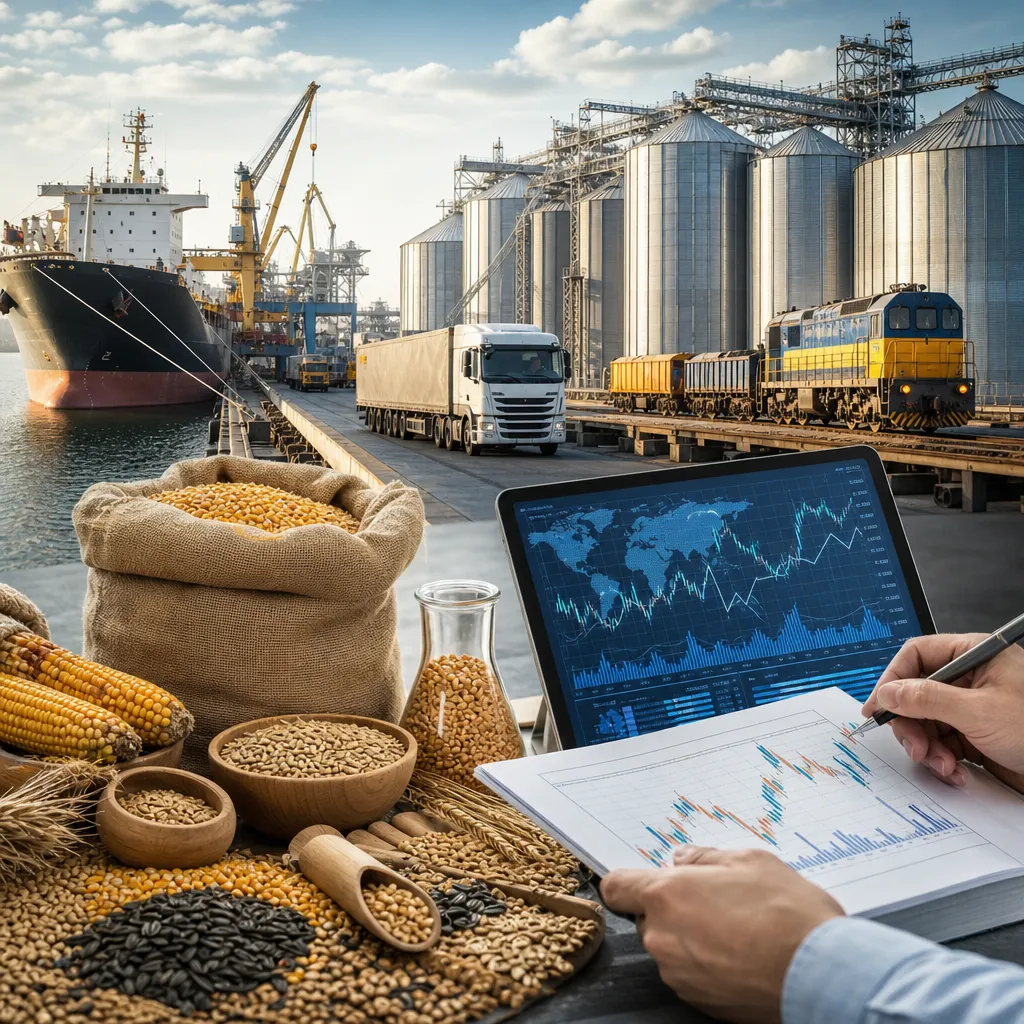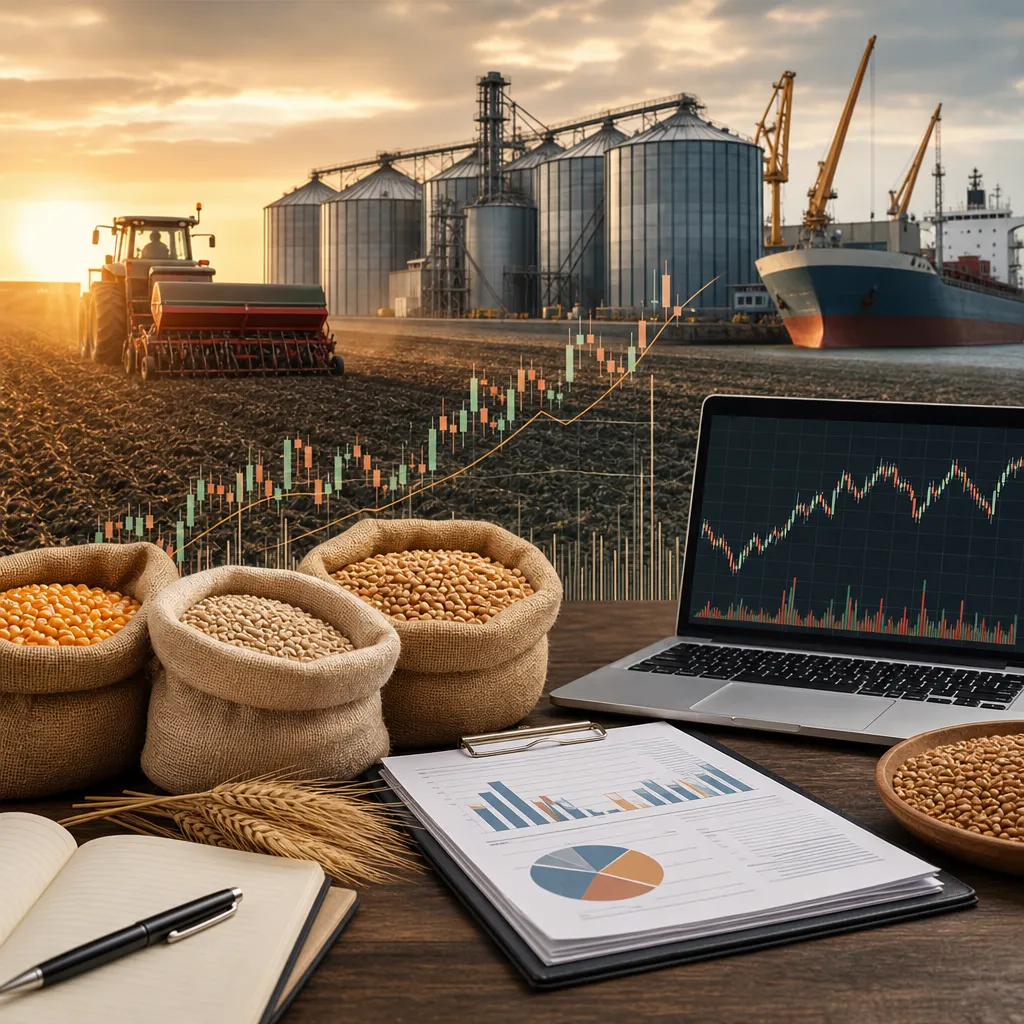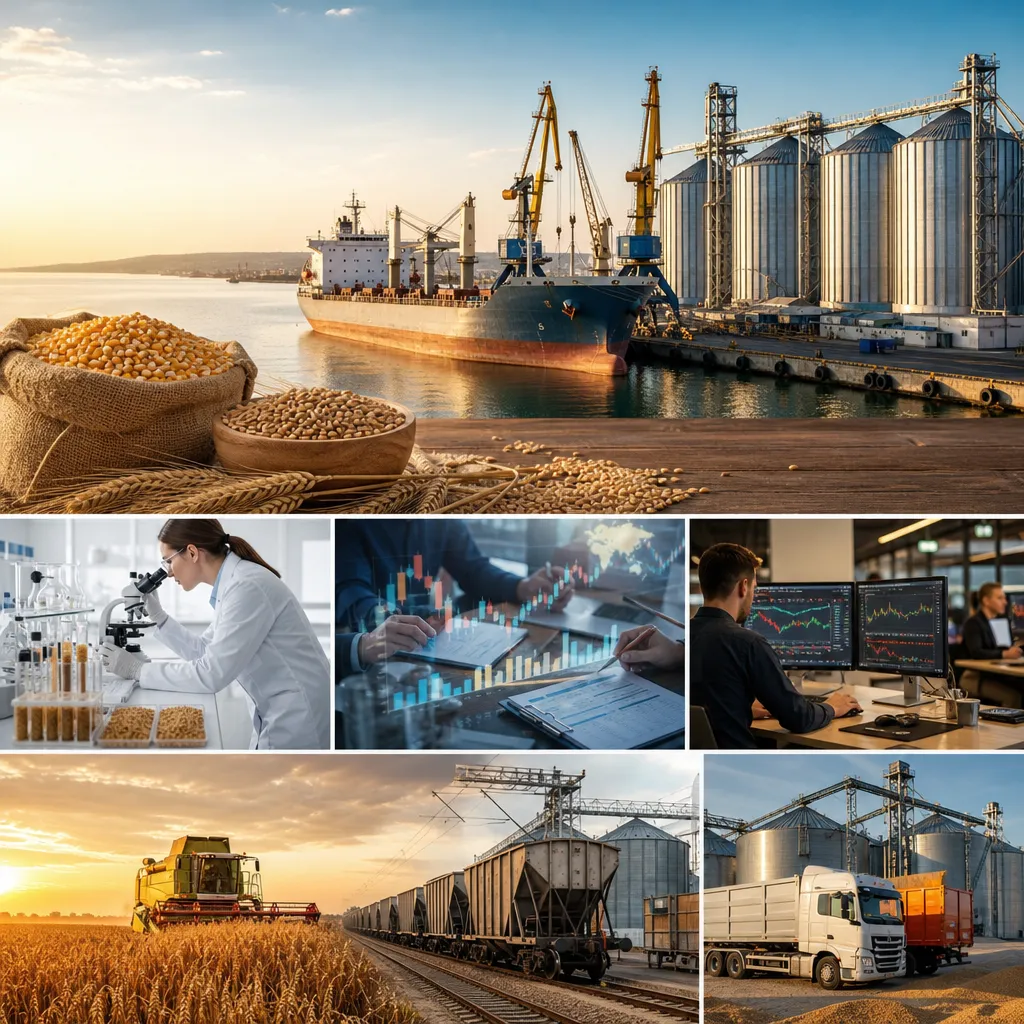

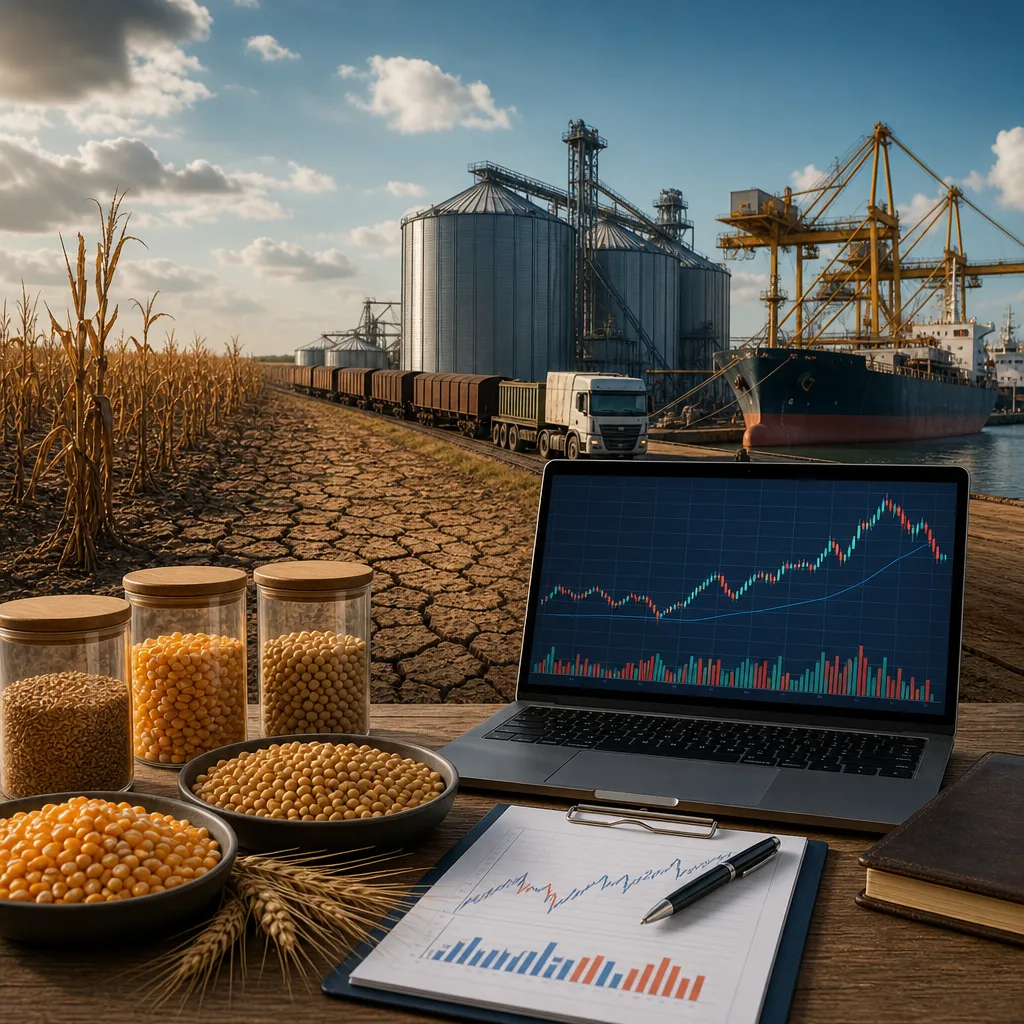
Drought usually pushes grain prices higher, but not all prices move the same way and not at the same time. The first thing to separate is exchange futures prices from local cash grain prices: futures reflect a broad benchmark market, while cash prices are what a farmer, merchant, mill, or feed buyer can actually buy or sell at a specific location and quality. During drought, both can rise, but basis, freight, quality damage, and local shortages can make nearby cash markets move much more sharply than headline futures quotes. That is why anyone following drought-driven grain markets should watch weather, crop reports, futures, local bids, and logistics together.
How drought affects grain prices
Drought changes grain prices by threatening yield, reducing harvested area, hurting quality, and shifting trade flows. The market reacts first to expectations, then to actual production losses, and finally to downstream problems such as storage, transport, and rationing of demand.
For major crops such as wheat, corn, soybeans, barley, sorghum, canola, rice, and sunflower seed, the price impact depends on where the drought occurs. A drought in a major exporter tends to affect world benchmark prices more than a drought in a smaller domestic market. A drought in an importing country may lift local prices even if world prices move less.
Price reactions are often strongest when drought hits at critical crop stages, such as pollination in corn or grain fill in wheat. Markets also price in drought differently depending on starting stocks. If inventories are already tight, prices can react aggressively. If stocks are comfortable, the move may be smaller or shorter.
| Drought factor | Typical price effect | Why it matters |
|---|---|---|
| Lower yield potential | Bullish | Less grain available for feed, food, crushing, or export. |
| Smaller harvested area | Bullish | Fields may be abandoned or cut for forage instead of grain. |
| Quality deterioration | Mixed | Premium quality can become scarce even if lower-grade grain is still available. |
| Higher feed substitution | Mixed | Buyers may switch between corn, wheat, barley, sorghum, or oats. |
| Export restrictions or reduced surplus | Bullish | Importers compete for fewer exportable supplies. |
| Demand destruction | Bearish after the initial rally | High prices can reduce feed use, crush, or discretionary buying. |
Where grain prices are quoted during drought
The most visible grain prices are usually futures prices quoted on regulated exchanges. For globally watched contracts, this often means benchmarks such as corn, wheat, and soybean futures on CME Group. These are financial and delivery-linked benchmarks, not the same as a local physical offer in a country elevator, inland terminal, mill, or port.
Local physical prices are normally quoted as cash bids, often expressed as futures plus or minus a basis. Basis reflects local supply and demand, freight, quality, storage pressure, nearby shortages, and buyer competition. During drought, basis can strengthen sharply in deficit areas because users need grain immediately.
Where people usually check prices in practice:
- Exchange websites for futures benchmarks and contract specifications.
- Local elevators and cooperatives for actual spot and forward cash bids.
- Merchants, processors, mills, crushers, and feed companies for delivered bids tied to quality and freight.
- Government market reporting services where available, for regional cash market summaries.
- Broker and market-data platforms for futures, options, spreads, delayed or real-time quotes, and historical charts.
A farmer should not assume that a rally in exchange wheat or corn futures means the same increase in the local bid. If drought reduces local production, the basis may improve. If logistics are congested or a region is isolated from export channels, futures can rise while local prices lag, or local prices can spike even more than futures.
Futures versus local cash grain during drought
Understanding the difference between these markets is essential. Futures are standardized contracts traded through a futures broker on a regulated exchange. Physical grain is traded through elevators, cooperatives, merchants, processors, exporters, importers, mills, and feed users under local commercial terms.
| Market type | What is traded | Where it is used | Main drought issue |
|---|---|---|---|
| Futures | Standardized exchange contract | Broker platform linked to a regulated exchange | Fast repricing of production risk and speculative flows |
| Options | Right to buy or sell a futures contract | Broker platform on listed derivatives markets | Used to manage upside or downside risk with known premium cost |
| Cash grain | Physical grain at a specific location and grade | Elevator, cooperative, merchant, mill, crusher, feed buyer, exporter | Basis, freight, quality loss, and delivery timing can dominate |
| Forward physical contract | Private agreement for future delivery | Directly with a commercial buyer or through a merchant | Production shortfall can create delivery risk for the seller |
In a drought year, the gap between futures and local cash prices can become more unpredictable because basis becomes more volatile. A region with severe crop losses may see strong local bidding from feeders or mills, while another region with better crops may become the source of replacement grain.
How farmers, buyers, and traders use drought markets
Farmers and elevators
Farmers usually monitor local bids at nearby elevators, cooperatives, ethanol plants, flour mills, crushers, or feed mills. In drought, they may face a hard tradeoff: prices are attractive, but production is uncertain. Selling too much grain forward can create a delivery problem if the crop fails. As a result, some use futures or options to hedge price risk while keeping flexibility on physical volume.
Elevators and cooperatives manage their own risk by adjusting bids, basis, storage terms, and hedge positions. In short crop situations, they may bid aggressively for nearby grain but limit forward commitments.
Processors and feed buyers
Feed manufacturers, millers, crushers, and livestock operators often buy cash grain or use futures and options to protect input costs. During drought, they may widen the area from which they source grain, switch ingredients, or buy coverage earlier than usual to secure supply.
Traders and merchants
Commercial traders watch spreads, basis, freight routes, port values, and crop conditions. A drought does not only create a directional price trade; it can also create opportunities in inter-regional arbitrage, quality premiums, and export-import substitution. These are usually handled by merchants, brokers, and logistics teams rather than by retail investors.
Where to check reliable drought and grain market data
Good drought analysis starts with official and exchange data, then adds local commercial intelligence. Useful sources differ depending on whether you need weather, crop condition, trade, positioning, or benchmark prices.
- USDA WASDE: broad supply-and-demand balances for major crops. Used to judge whether drought losses materially tighten stocks.
- USDA Crop Progress: weekly crop condition and development updates in the United States. Important when U.S. production affects global pricing.
- USDA Export Sales: shows demand pace for U.S. exportable grain and oilseeds.
- CME Group: futures prices, contract specs, listed options, expiry calendars, and delivery framework.
- CFTC Commitments of Traders: reveals how different trader categories are positioned in futures and options markets.
- FAO and national agriculture ministries or statistical agencies: useful for international crop and food market context.
- Local market reporting services: cash bids, basis levels, and physical trade indicators where public reporting exists.
Weather data matters most when it is crop-stage specific. A drought map alone is not enough. Analysts compare rainfall deficits, temperature stress, soil moisture, and crop development timing. The market often reacts not to drought headlines alone, but to whether damage is likely to be reversible.
| Source | What it provides | How it is used in drought markets |
|---|---|---|
| USDA WASDE | Global and U.S. balance sheets | Tests whether drought damage changes ending stocks and trade flows |
| USDA Crop Progress | Weekly crop conditions and development | Tracks deterioration or stabilization in crop ratings |
| CME Group | Futures and options prices, contract rules | Shows benchmark market reaction and hedge instruments |
| CFTC Commitments of Traders | Trader positioning data | Helps assess whether a rally is heavily fund-driven |
| Local bids and market reports | Cash prices and basis by location | Shows what physical grain is actually worth nearby |
How drought changes physical grain trade
In the physical market, drought can turn a routine transaction into a logistics and quality problem. The buyer is not only asking, “What is the futures market doing?” but also “Can this seller deliver the contracted tonnage, at the right moisture, protein, test weight, and location?”
A standard physical transaction usually involves:
- A seller such as a farmer, elevator, or merchant.
- A buyer such as a mill, feed company, crusher, exporter, or importer.
- Agreed quantity, quality, delivery point, and timing.
- A pricing formula, often flat price or futures plus basis.
- Freight allocation and payment terms.
During drought, several parts of that chain become more fragile:
- Quality: protein may improve in some wheat crops while yield falls, but test weight or kernel size can suffer. In corn and sorghum, shriveled grain or mycotoxin risks may become more important.
- Freight: grain may need to move longer distances into deficit regions.
- Storage: thin crops can reduce elevator throughput, but stressed grain may need closer quality monitoring.
- Counterparty performance: sellers with production losses may struggle to fulfill forward contracts.
This is why drought markets often reward buyers and sellers who know their local delivery network. The physical price is heavily shaped by where grain can actually move: farm to elevator, elevator to processor, inland terminal to port, or across borders under import and phytosanitary rules.
Hedging and risk management in a drought year
Drought markets are volatile, so risk management matters more than prediction. The right tool depends on whether the user is exposed to price, supply, basis, or quality risk.
Futures hedging is usually used by farmers, elevators, merchants, processors, and large buyers that have access to a futures broker and understand margin requirements. A short hedge can protect a seller against falling futures, while a long hedge can protect a buyer against rising futures. But futures do not remove local basis risk.
Options can be useful when production is uncertain. A farmer worried about drought may hesitate to forward sell physical grain that may not be harvested. Buying a put option can set a floor under futures exposure without creating the same physical delivery obligation as a cash contract. A buyer can use call options to protect against a price spike while keeping some flexibility if prices fall. The tradeoff is the option premium.
Physical contract management is just as important. Before signing a forward contract in a drought-prone season, parties should check quantity commitments, tolerance clauses, quality terms, force majeure treatment where applicable, delivery windows, and the consequences of non-performance. These details depend on jurisdiction and contract form.
None of these tools makes drought risk disappear. Futures involve margin calls. Options can expire worthless. Forward contracts can become painful if production fails or basis moves sharply.
Storage, basis, and logistics under drought stress
Storage decisions during drought are more complex than “hold grain because prices are rising.” If a drought has created a local shortage, nearby basis may already be strong, which means immediate sale could outperform storage. On the other hand, if harvest pressure briefly weakens basis but later users scramble for supply, storing grain can be valuable.
What should be checked before storing drought-affected grain:
- Moisture and condition: stressed grain may store less safely and require aeration or faster movement.
- Quality discounts: verify dockage, low test weight, damaged kernels, or toxin limits before deciding to hold.
- Carrying cost: include interest, shrink, handling, and commercial storage charges if applicable.
- Basis outlook: ask whether local deficit conditions are likely to strengthen bids later or whether imports will cap the market.
- Logistics: road, rail, barge, and port availability can sharply affect regional values.
Commercial storage may take place at farm bins, elevators, warehouses, inland terminals, and port facilities. Each has different operating costs and quality-control capabilities. In practice, the best location is often the one closest to the highest-value exit point, not simply the one with available space.
What readers should do in practice when drought hits the grain market
Start with the crop and region that matter to you, then connect benchmark prices to your actual market. A farmer should pull local elevator and processor bids, compare basis, and assess production risk before making forward commitments. A commercial buyer should confirm replacement cost, freight, and quality availability, not just screen prices. A trader or analyst should pair weather and crop reports with futures structure, export demand, and local cash signals.
A practical workflow is:
- Check benchmark futures for the relevant crop and nearby contract month.
- Check local cash bids from elevators, cooperatives, processors, or merchants.
- Review official crop and supply reports such as USDA WASDE and Crop Progress where relevant.
- Monitor weather and crop-stage sensitivity, not just generalized drought headlines.
- Recalculate basis, freight, and storage economics.
- If hedging, confirm margin capacity, option premium cost, and contract expiry.
- If trading physical grain, confirm grade, delivery point, and counterparty performance risk.
Drought does not create one uniform “grain price.” It creates a chain reaction across futures, basis, quality, logistics, and trade flows. The people who navigate it best are usually the ones who know exactly which market they are pricing and where the grain can physically move.
Where can I check grain prices during a drought?
Use exchange data for futures benchmarks and local elevator, cooperative, processor, or merchant bids for actual cash values. Government market reports may also provide regional cash summaries where available.
Why can local grain prices rise more than futures in a drought?
Because local buyers may face immediate supply shortages. Basis can strengthen sharply when mills, feeders, or exporters compete for limited nearby grain.
Can I trade drought-driven grain prices online?
Yes, but only through a regulated futures or options broker if you are trading exchange-listed derivatives. That is different from buying or selling physical grain, which is usually done through commercial grain channels.
What is the main risk of forward selling grain in a drought year?
The biggest risk is production shortfall. If the crop underperforms, the seller may not have enough grain to deliver under the contract.
Are futures prices the same as the price a farmer receives?
No. The farmer receives a local cash price, which is usually the futures reference adjusted by basis, quality, freight, and delivery terms.
Which official reports matter most in drought-driven grain markets?
USDA WASDE, USDA Crop Progress, USDA Export Sales, exchange contract data from CME Group, and positioning data from the CFTC are among the most widely used sources.
Does drought always make grain prices go up?
No. Drought is generally bullish, but price moves depend on where it occurs, global stocks, demand destruction, substitution between crops, and whether the market has already priced in the risk.
Should grain be stored during a drought rally?
Only if the expected gain from later sale exceeds storage, quality, interest, and logistics costs. In some drought years, the strongest pricing opportunity is immediate nearby delivery rather than storage.
Sources
- USDA World Agricultural Supply and Demand Estimates
- CME Group agricultural futures and options contract information
- CFTC Commitments of Traders