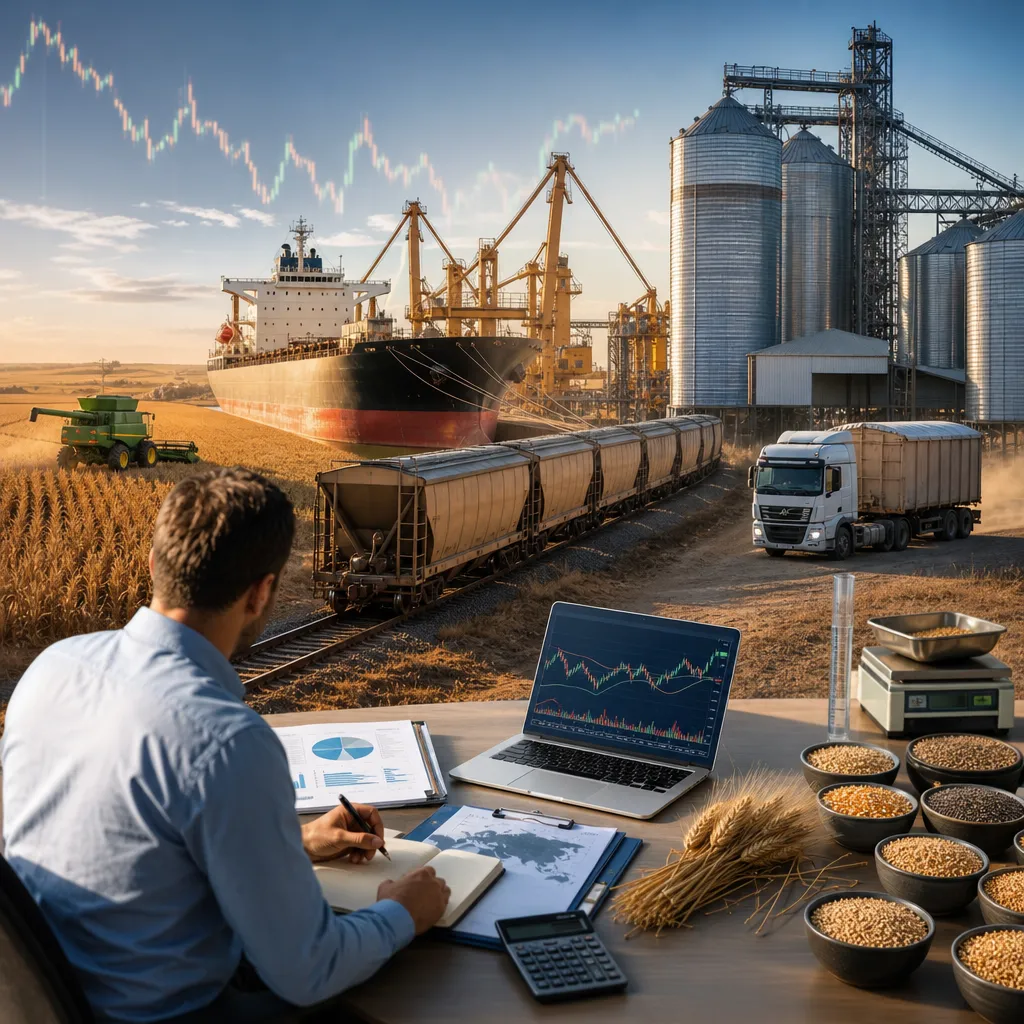

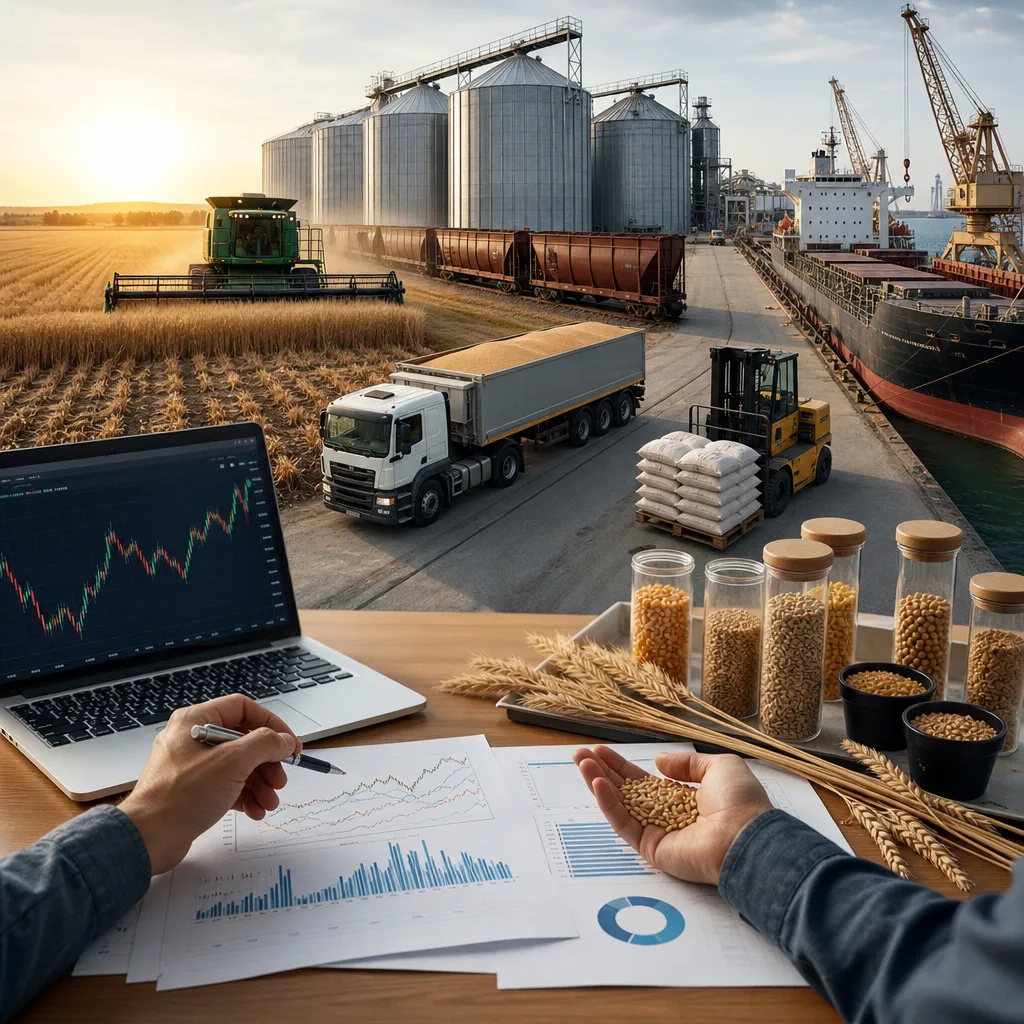
Harvest season is one of the most important periods for grain prices because it is when large volumes of new crop enter the market at the same time. In most regions, harvest pressure tends to weaken local cash bids in the short term, especially when storage is limited, transport is congested, or quality is uneven. But harvest does not affect every grain, location, or contract in the same way: futures prices reflect broader regional or global expectations, while the cash price a farmer receives depends on local basis, logistics, quality, and buyer demand. Understanding that difference is the key to using harvest-season price moves well, whether you are selling physical grain, hedging with futures, or analyzing the market.
Why harvest season matters for grain prices
During harvest, supply becomes physically available. Elevators, cooperatives, crushers, feed mills, ethanol plants, flour mills, exporters, and merchants can finally buy actual grain instead of only estimating crop potential. This often creates a temporary imbalance: many sellers want to move grain immediately, but handling capacity is finite.
That is why local prices often weaken at harvest even when national or world prices are not collapsing. The main reasons are practical:
- Elevator space fills up, so buyers lower bids or widen discounts.
- Freight becomes tight, especially truck availability during peak movement.
- Drying and conditioning costs rise if grain comes in with high moisture.
- Quality differences become visible, leading to discounts for low test weight, damage, protein shortfall, vomitoxin, oil content issues, or foreign material.
- Basis often weakens because local supply is abundant relative to immediate demand.
At the same time, harvest results can also support prices if yields disappoint, quality is poor, exports stay strong, or another major producing region has weather trouble. So harvest season is not automatically bearish. It is a period when the market discovers the size, quality, and location of supply.
Futures prices versus cash grain prices
A common mistake is to treat an exchange futures quote as the same thing as the local grain price. It is not. Futures are standardized contracts traded on regulated exchanges. A local cash bid is the actual price offered by a physical buyer at a named delivery point, adjusted for basis, freight, and quality.
For example, wheat, corn, soybean, canola, and other grain benchmarks may trade on organized exchanges such as CME Group or ICE Futures. Those prices are visible online and update throughout the trading session. But a farmer usually sells to a nearby elevator, cooperative, processor, or merchant at a cash bid, which is usually calculated as:
Cash price = futures reference price + or – local basis
Basis reflects local conditions. It can strengthen when buyers need grain urgently, and weaken when harvest deliveries overwhelm storage or transport.
| Market type | What price shows | Where it is found | Who uses it |
|---|---|---|---|
| Futures market | Standardized benchmark for a delivery month and contract specification | Commodity exchange data, broker platforms, financial market terminals | Traders, hedgers, analysts, merchants, processors |
| Local cash market | Actual bid at a delivery point, adjusted for basis and quality | Elevator bid sheets, cooperative apps, merchant quotes, processor purchasing desks | Farmers, local buyers, feed mills, elevators |
| Forward cash contract | Agreed future delivery price or basis with physical terms | Direct contract with elevator, processor, merchant, exporter | Farmers, commercial grain sellers and buyers |
| OTC risk contract | Privately negotiated price risk tool outside exchange trading | Banks, merchants, commercial counterparties | Larger commercial hedgers |
Where to check harvest-season grain prices
If you need benchmark futures prices, the normal sources are exchange websites, broker trading platforms, and professional market-data vendors. CME Group is widely used for major U.S. corn, wheat, and soybean futures. ICE is relevant for several agricultural contracts including canola in some markets. These sources show contract month, unit, and currency, which matter because not all contracts are quoted the same way.
If you need the actual nearby cash price, the best source is usually the physical buyer in your area. That may be:
- a grain elevator,
- an agricultural cooperative,
- a feed mill,
- a flour mill,
- an oilseed crusher,
- an ethanol plant,
- a grain merchant,
- an exporter or port buyer.
Many of these buyers publish daily bids on their websites, mobile apps, recorded phone lines, or customer portals. In some countries, government or exchange-linked market reporting systems also publish regional cash indications, but those may lag real-time bids.
For broader market information during harvest, the most useful public sources usually include:
- USDA Crop Progress for harvest pace and crop condition in the United States.
- USDA WASDE for supply, demand, stocks, imports, and exports.
- USDA Export Sales for international demand signals.
- CFTC Commitments of Traders for positioning in U.S. futures markets.
- FAO for global food and agricultural market context.
- National agriculture ministries and statistical agencies for local production and trade data.
How harvest pressure works in the physical grain market
The physical grain market is not a single screen. It is a network of local and export channels. Grain moves from farms into on-farm bins, country elevators, cooperative storage, commercial warehouses, processors, feed users, domestic mills, rail terminals, river terminals, and export ports.
At harvest, the practical flow often looks like this:
- The farmer delivers grain directly from field to farm storage or to a buyer.
- The buyer samples and grades the grain for moisture, damage, test weight, protein, oil content, or other quality factors depending on the crop.
- The buyer applies drying, shrink, dockage, or quality discounts where relevant.
- The final bid reflects local basis, delivery period, and freight economics.
- The grain is stored, processed, fed, exported, or resold further down the chain.
Where harvest prices end up depends heavily on location. A farm near a crusher, ethanol plant, or export line may see stronger bids than a farm in an oversupplied area with limited transport. This is why two farms in the same country can face very different harvest cash prices even when they are watching the same futures market.
Important physical-market terms include:
- Delivery point: where title and movement obligations change.
- Basis: local premium or discount versus futures.
- Grade or specification: quality standard in the contract.
- Freight: trucking, rail, barge, or vessel cost.
- Payment terms: when and how the seller gets paid.
- Storage terms: whether grain is sold immediately, stored commercially, or held on farm.
Storage, basis, and post-harvest selling decisions
Storage can reduce harvest-time selling pressure, but only if the economics justify it. Keeping grain after harvest is not automatically profitable. The seller must compare the current cash bid with the expected later price, minus storage cost, interest on inventory, shrink, aeration, drying, quality risk, and basis uncertainty.
On-farm storage gives flexibility. Farmers can avoid forced harvest delivery, wait for basis improvement, and sell into later demand windows. But on-farm storage also requires bins, monitoring, aeration, labor, and spoilage control.
Commercial storage through an elevator or warehouse can be useful when farm capacity is full, but the operator’s charges and terms matter. Some buyers offer delayed pricing, minimum-price contracts, hedge-to-arrive contracts, or basis contracts. These can be useful tools, but the producer needs to understand exactly which risk is fixed and which risk remains open.
| Option | How it works | Main advantage | Main limitation |
|---|---|---|---|
| Sell at harvest | Deliver grain and accept current cash bid | Immediate cash flow and no storage risk | Often exposed to weak harvest basis |
| Store on farm | Hold physical grain in farm bins for later sale | Marketing flexibility and potential basis improvement | Quality, monitoring, and financing risk |
| Commercial storage | Store at elevator or warehouse under operator terms | Useful when on-farm capacity is limited | Storage and handling charges reduce net return |
| Basis or forward contract | Fix one part of the price structure before delivery | Improves price planning | May leave futures or basis risk still open |
How futures and options are used during harvest
Harvest is one of the busiest periods for hedging because producers, merchants, processors, and exporters all need to manage price risk while physical grain is changing hands. Futures and options are usually accessed through a regulated futures broker. That requires a brokerage account and acceptance of exchange and margin rules.
Futures are standardized exchange contracts. They are financial tools first, even though some contracts permit delivery under strict exchange rules. Most market participants do not use futures to move farm grain directly to an exchange warehouse. Instead, they use futures to hedge price exposure while handling physical grain separately in the cash market.
Options on futures can be used to set a floor or manage upside and downside risk, but they involve premiums and time decay. They are not risk-free alternatives.
Examples of harvest-season use:
- A farmer stores corn and sells futures to protect against a post-harvest price drop.
- An exporter buys physical wheat and sells futures to hedge inventory until shipment.
- A feed mill buys call options to protect against rising grain costs while waiting to purchase physical supply.
- A crusher hedges soybeans and soybean products separately to manage processing margin risk.
Key risks remain even with hedging:
- Basis risk: futures may move as expected while local basis does not.
- Margin calls: hedgers using futures may need to post cash even if the physical side gains value.
- Contract mismatch: the futures contract may not perfectly match local grain quality or location.
- Timing risk: harvest delays can shift delivery windows and change basis sharply.
What drives prices during and after harvest
Harvest itself is only one variable. Grain prices during this period usually respond to a combination of physical and financial signals.
- Yield reality: final production often differs from pre-harvest expectations.
- Quality results: poor milling quality, low protein, mycotoxins, or moisture damage can tighten usable supply even in a large crop.
- Export demand: port programs and importer buying can absorb harvest pressure quickly.
- Domestic processing demand: crush, feed, ethanol, starch, and milling demand affect local bids.
- Currency moves: export competitiveness often changes with exchange rates.
- Freight and energy costs: trucking, rail, barge, fuel, and drying costs affect net farm prices.
- Government policy: trade restrictions, biofuel rules, quality regulations, or intervention buying can alter seasonal patterns.
- Weather after harvest starts: rain, frost, wind, or delays can reduce quality and slow movement.
This is why forecasting harvest-season prices should be framed as scenarios, not certainty. A large crop with weak export demand usually pressures prices, but a large crop with strong export logistics and aggressive processor demand may stabilize faster than expected.
Practical ways to analyze harvest-season grain prices
For farmers, traders, and buyers, the most useful approach is to combine exchange data with local commercial information.
A practical workflow is:
- Check the relevant futures contract month for your crop.
- Collect local bids from multiple elevators, cooperatives, or processors.
- Compare basis levels across locations and delivery periods.
- Review harvest pace and crop condition reports.
- Watch export sales, port lineups, and processor demand where relevant.
- Calculate storage economics rather than assuming later prices will be better.
- If hedging, match the futures month and quantity carefully to your physical exposure.
Commercial users often rely on a mix of public reports, exchange data, broker platforms, bid aggregation tools, merchant intelligence, and internal logistics information. Farm management and grain marketing software can help organize contracts, inventory, target prices, and hedge records, but those tools do not replace local basis knowledge or contract reading.
The most common harvest-season mistakes are selling purely off the futures screen, ignoring quality discounts, underestimating freight bottlenecks, storing poor-quality grain too long, and using futures without understanding margin exposure.
FAQ
Where can I check grain prices during harvest?
Use two sources. For benchmark prices, check the relevant exchange or a licensed market-data platform. For the actual price available to sell physical grain, check local elevator, cooperative, processor, or merchant bids. The local cash bid is the operational price that matters for farm sales.
Why are local harvest bids often lower than futures prices?
Because futures are benchmark contracts, while local bids include basis, freight, storage pressure, and quality adjustments. At harvest, basis often weakens as many sellers deliver grain at once.
Can I sell grain online the same way I trade futures?
Usually not in the same way. Futures are traded through a regulated broker and exchange account. Physical grain is normally sold through an elevator, cooperative, merchant, processor, or direct commercial contract with delivery and quality terms.
Does harvest always make grain prices fall?
No. Harvest often pressures local cash prices, but prices can hold or rise if yields disappoint, quality is poor, exports are strong, or global supply concerns offset local harvest pressure.
What is the best report to follow during harvest?
There is no single best report for every market. In the United States, USDA Crop Progress is central for harvest pace, while WASDE is key for broader supply and demand. Export Sales, CFTC positioning data, and national market reports also help depending on the crop and region.
Should I store grain after harvest?
Only if the expected improvement in price or basis is likely to exceed storage, interest, shrink, and quality risk. Storage is a commercial decision, not just a space decision.
How do futures help during harvest if I am selling physical grain locally?
Futures can hedge broad market price risk. They do not replace the physical sale. You still need a local buyer and must manage basis, quality, and delivery terms separately.
Who usually buys grain during harvest?
Typical buyers include grain elevators, cooperatives, feed manufacturers, flour mills, oilseed crushers, ethanol plants, merchants, exporters, and warehouses acting on behalf of commercial grain handlers.
Sources
- USDA World Agricultural Supply and Demand Estimates
- USDA National Agricultural Statistics Service Crop Progress
- CME Group Agricultural Products