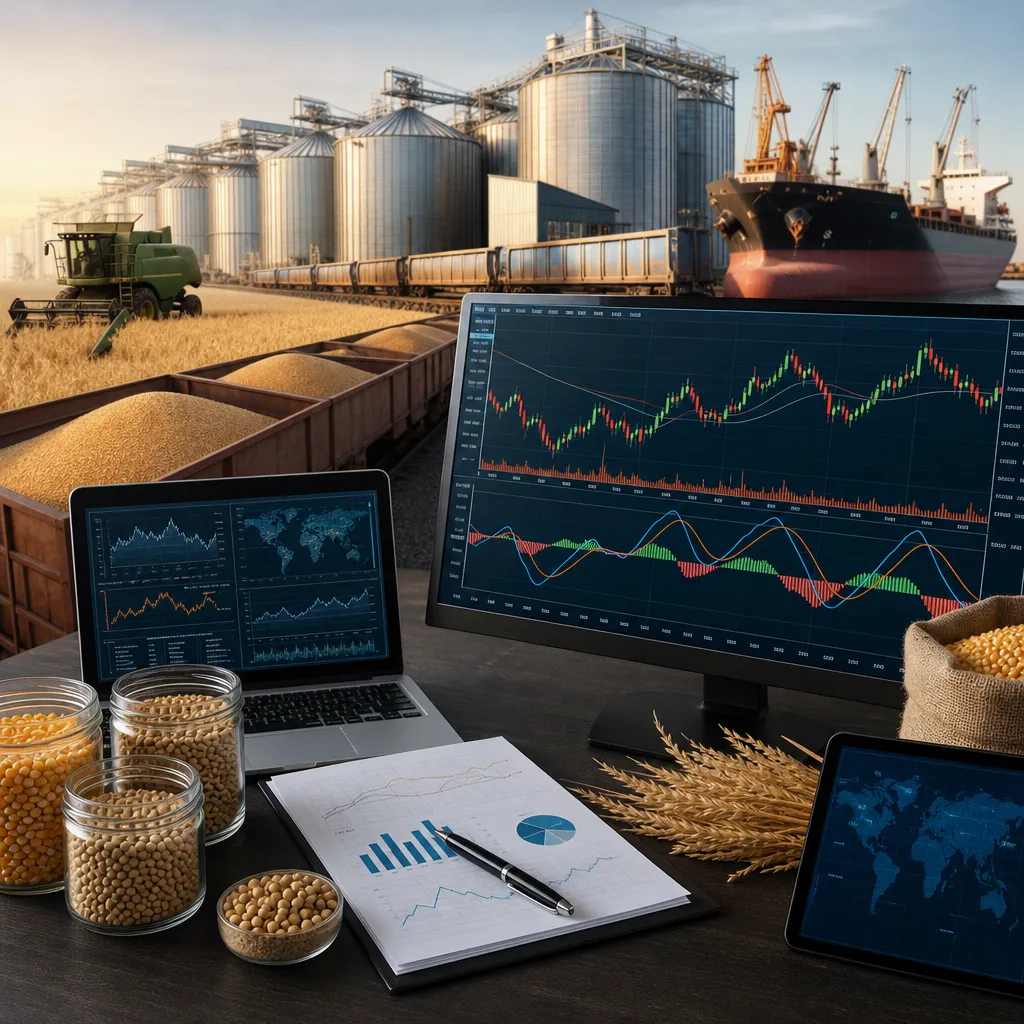




Grain breakout trading is a strategy that tries to capture large price moves when grain markets push above resistance or below support. In practice, traders apply it most often to futures such as corn, soybeans, wheat, canola, or rapeseed-linked contracts, but the same logic is also used in local cash markets when basis or bids break out from a long-held range. The method is simple in concept and difficult in execution: identify a well-defined range, wait for price to leave it with conviction, and control risk because false breakouts are common. To use it properly, a trader also needs to know where grain prices are formed, which reports move them, and how exchange futures differ from physical grain bids at elevators, crushers, mills, and export terminals.
In grain markets, breakouts are rarely random. They are often triggered by weather shocks, USDA reports, export demand, acreage changes, logistics issues, currency moves, or fund positioning. That means breakout trading is not just chart reading; it sits at the intersection of technical levels, agricultural fundamentals, and market structure.
What grain breakout trading means
A breakout occurs when price moves beyond an important trading range, chart pattern, or previous high or low. In grain futures, this usually means a contract month on a regulated exchange moves through a level where buying or selling had repeatedly stalled before.
Common breakout setups include:
- Price moving above a recent swing high
- Price moving below a recent swing low
- A move out of a sideways consolidation range
- A break from technical formations such as triangles, flags, or channels
- A breakout after a major report changes the supply-demand outlook
For example, corn futures may trade in a narrow band before a USDA report. If the report materially changes yield expectations and the market trades strongly above the top of that band, breakout traders may treat that as a signal that a new price discovery phase has started.
This can be done in two very different markets:
- Futures market: financial trading on an exchange such as CME Group, usually through a futures broker
- Physical grain market: actual grain buying and selling through elevators, cooperatives, merchants, processors, mills, feed buyers, or exporters
Those two markets are connected, but they are not the same thing.
Where breakout trading happens in grain markets
Most formal breakout trading takes place in grain futures and options markets. For US grain benchmarks, the main venue is CME Group, where traders access corn, soybean, soybean meal, soybean oil, wheat, oats, rough rice, and other agricultural contracts through licensed futures brokers and approved trading platforms.
Outside the US, traders may use other regulated exchanges for region-specific grain and oilseed exposure, including contracts linked to European wheat or rapeseed markets where available on major exchange venues. The actual broker and platform depend on the trader’s jurisdiction and the exchange being used.
Physical market participants also watch breakouts, but they usually act through:
- Local grain elevators
- Agricultural cooperatives
- Country merchants
- Feed mills
- Flour mills
- Crushers and processors
- Export houses and terminal markets
A farmer does not normally “trade a breakout” in the same way as a speculator clicking a futures order. Instead, the farmer may respond to a futures breakout by selling cash grain, booking a forward contract, placing a hedge, or reworking storage and basis plans.
| Market type | Where it exists | How it is used | Main users |
|---|---|---|---|
| Futures | Regulated exchanges such as CME Group, accessed through a futures broker | Speculation, hedging, spread trading, price discovery | Traders, funds, merchandisers, farmers, processors |
| Options on futures | Same exchange ecosystem, via broker platform | Defined-risk directional views, hedging around reports, volatility strategies | Hedgers, commercial firms, experienced traders |
| Cash grain | Elevators, cooperatives, merchants, processors, exporters | Physical grain buying and selling with delivery and quality terms | Farmers, feed buyers, mills, crushers, exporters |
| OTC contracts | Direct commercial agreements between counterparties | Customized physical or risk-management terms | Merchants, processors, large commercial users |
How a breakout setup is identified
Breakout traders generally start by defining a price area that matters. In grain markets, the most useful levels are often obvious on a daily or weekly chart: prior highs, prior lows, report-day extremes, seasonal turning points, or a range that has held for several weeks.
Typical process:
- Choose the market and contract month. In grain futures, liquidity matters. Traders usually focus on the most active contract month rather than an illiquid deferred contract.
- Mark support and resistance. These are levels where price has failed multiple times.
- Watch for a trigger. The trigger may be a close above resistance, a move through intraday highs, or a breakout accompanied by higher volume or strong follow-through.
- Align with market context. Grain breakouts have a better chance of continuing when a real catalyst exists, such as adverse weather, a surprise stocks figure, or major export sales.
- Define invalidation. Before entering, the trader decides where the breakout has failed.
Some traders require a daily close above resistance to reduce noise. Others enter intraday but only when a scheduled event or weather development explains the move. In grains, the catalyst matters because report-driven price spikes can reverse quickly.
What confirms a breakout in grain markets
Not every move above a line on a chart deserves to be traded. Grain markets are heavily influenced by algorithmic trading, macro flows, and rapid interpretation of reports, so false breaks are common.
Useful confirmation factors include:
- Volume: heavier activity suggests broader participation
- Closing strength: a strong settlement near the day’s high can be more meaningful than a brief intraday push
- Fresh information: USDA data, export announcements, weather map changes, or crop stress reports can support continuation
- Cross-market support: soybean meal leading soybeans, or corn strength confirmed by ethanol or export demand, may improve conviction
- Basis response: in some cases, stronger local bids or firmer basis at processors and export channels can show that the physical market supports the futures move
Basis is the difference between local cash price and futures price. A futures breakout without any support from the cash market may still work, but commercial confirmation often matters, especially for moves expected to last beyond a short-term headline reaction.
| Confirmation factor | Why it matters | Where to check |
|---|---|---|
| Exchange volume | Shows whether the move has broad participation | Broker platform, exchange market data, commercial data terminals |
| Settlement above resistance | Reduces risk of chasing a temporary spike | Exchange settlement data, broker charts |
| USDA report surprise | Adds a fundamental reason for repricing | USDA reports such as WASDE, Crop Production, Grain Stocks, Export Sales |
| Weather shift | Can alter yield expectations quickly | Official weather agencies, private weather services, broker research |
| Basis strength | Shows physical demand may support futures | Local elevator bids, processor bids, merchant quotes, regional market reporting services |
Where to check grain prices, charts, reports, and cash bids
For breakout trading, price source quality matters. A delayed quote on a news page is not the same as executable market data on a broker platform.
Futures prices
Futures prices are normally checked through:
- Futures broker platforms
- Exchange data distributed by CME Group and market-data vendors
- Professional terminals and agricultural data services
- Financial charting software that carries exchange futures
These quotes refer to a specific contract month, unit, and currency. For example, a grain futures quote is not a general “grain price.” It is a standard exchange contract with defined delivery terms.
Cash prices
Local cash grain bids are usually checked through:
- Elevator bid sheets
- Cooperative websites or mobile tools
- Processor bid pages
- Direct merchant quotes
- Regional agricultural market reporting services
Cash prices differ from futures because they include basis, quality adjustments, freight, location, and timing. A strong futures breakout may not fully translate into local cash bids if basis weakens, freight rises, or nearby storage fills.
Reports and position data
Important public sources include:
- USDA: WASDE, Crop Progress, Grain Stocks, Acreage, Crop Production, Export Sales, and related reports
- CFTC: Commitments of Traders, used to track managed money and commercial positioning
- CME Group: contract specifications, settlements, market education, and exchange reference data
- FAO and national agricultural agencies: broader international context for supply, consumption, and trade
These sources help traders decide whether a breakout is likely to be sustained by fundamentals or whether it may fade once initial order flow passes.
How traders actually execute a grain breakout trade
To trade grain futures, a person or business normally needs a futures brokerage account approved for exchange-traded commodity products. The order is then placed on the broker’s platform in the relevant contract month. This is online financial trading, not the purchase of a truckload or railcar of grain.
A practical futures workflow is:
- Select the crop and contract month
- Check contract size, tick value, trading hours, and notice or expiration dates
- Identify the breakout level
- Choose entry method, such as a stop order above resistance or below support
- Define risk with a stop-loss or options structure
- Monitor margin requirements and liquidity
- Track report dates and delivery-related deadlines
Commercial users may trade the breakout differently. A merchandiser, processor, or farmer might use futures to hedge inventory, forward purchases, or expected production. In that case, the breakout is not only a trading signal; it is also a pricing opportunity or a warning that unhedged exposure is becoming more dangerous.
In the physical market, execution happens through contracts, not chart clicks. A farmer reacting to a bullish soybean breakout might:
- Call or message multiple elevators for current bids
- Compare basis by delivery point and month
- Sell cash grain out of storage
- Book a forward contract for future delivery
- Use a hedge-to-arrive or basis contract if offered and understood
- Retain upside with options instead of staying fully unpriced
The exact contract types vary by region and buyer, so the seller should check quality rules, drying terms, discount schedules, freight responsibility, and payment timing.
Risks, costs, and limitations of breakout trading
The biggest practical risk is the false breakout. Grain markets often move sharply after a report and then reverse once traders digest details, weather models change, or commercial hedging appears.
Main risks include:
- Leverage risk: futures are margined instruments, so losses can exceed initial cash committed to the trade
- Gap risk: markets can move suddenly on USDA releases or weather developments
- Liquidity differences: nearby contracts are often more liquid than deferred months
- Basis risk: hedgers may gain on futures but lose locally if basis weakens
- Delivery risk: holding futures too close to delivery periods without understanding contract mechanics can create avoidable problems
- Headline risk: export policy, geopolitics, biofuel changes, and logistics disruptions can reverse trends rapidly
Costs normally include brokerage commissions, exchange and data fees, bid-ask spread, financing or margin impact, storage costs for physical grain, and freight or handling charges in the cash market. Exact costs vary by provider and region, so they should be verified directly before trading or contracting.
How farmers, merchandisers, and analysts use breakouts differently
Speculators usually want directional exposure and may hold a position from hours to several weeks.
Farmers use breakouts as pricing signals. A bullish corn breakout may trigger incremental sales targets, reownership via call options, or a hedge review rather than pure speculation.
Merchandisers watch whether futures breakouts are matched by basis changes, export demand, and interior movement. Their edge often comes from logistics and basis, not from outright price direction alone.
Processors and feed buyers may use bearish breakouts to extend coverage or bullish breakouts to protect input costs.
Analysts combine chart action with acreage, crop condition, stocks-to-use, export pace, and currency trends to judge whether the move is technically real and fundamentally durable.
Common mistakes in grain breakout trading
- Trading a breakout without knowing whether a major USDA report is due within hours
- Using a thin contract month where price can be erratic
- Assuming futures price equals local cash value
- Ignoring basis, freight, and grade differences in physical sales decisions
- Entering after an exhausted spike rather than at a defined trigger point
- Holding futures into delivery periods without understanding contract rules
- Using leverage too aggressively in volatile weather markets
- Relying on charts alone without checking export, crop, or weather context
Where can I check grain futures prices for breakout trading?
The most reliable sources are futures broker platforms and exchange-distributed market data. CME Group is the key reference point for major US grain futures contract information, while brokers and commercial data vendors provide live or delayed charts depending on the service level.
Where do I find local cash grain bids?
Local bids are usually posted by grain elevators, cooperatives, processors, and merchants. These may appear on company websites, mobile tools, bid sheets, or direct communications from buyers. Local cash bids are not the same as futures quotes because basis and freight matter.
Is breakout trading the same as buying physical grain?
No. Breakout trading usually refers to financial trading in futures or options through a regulated broker and exchange. Buying physical grain involves negotiating delivery, quality, quantity, payment terms, and logistics with a commercial counterparty such as an elevator, processor, or merchant.
Which reports matter most for grain breakouts?
USDA reports are central, especially WASDE, Crop Production, Acreage, Grain Stocks, Crop Progress, and Export Sales. Traders also monitor CFTC Commitments of Traders to understand fund positioning and the risk of crowded moves.
Can farmers use breakout signals without speculating heavily?
Yes. Many farmers use breakouts as a marketing signal rather than a pure trade. They may sell part of stored grain, set target orders with an elevator, hedge expected production, or use options to manage upside and downside exposure.
What is the biggest mistake when applying breakout trading to grain marketing?
The biggest mistake is treating a futures breakout as if it automatically guarantees a better local cash price. Basis can weaken, elevators can change bids, and quality or freight issues can reduce the actual sale price.
Do I need a broker to trade grain breakouts?
For exchange-traded futures or options, yes, a regulated futures broker is normally required. For physical grain, sales are made through commercial buyers such as elevators, cooperatives, processors, merchants, or exporters rather than through a retail futures broker.
How do I know whether a breakout is real or false?
No method is certain, but traders usually look for strong closes, volume, follow-through after the trigger, and a clear fundamental reason such as weather stress or a supply-demand surprise. A move that quickly falls back into the old range is a warning sign of failure.
Sources
- USDA Foreign Agricultural Service and USDA World Agricultural Outlook Board
- CME Group
- U.S. Commodity Futures Trading Commission